As with any policy reform, there are potential benefits and drawbacks to introducing a certification framework. Certification frameworks improve and recognise the levels of skills and competences of public procurement officials. Thus, they may greatly contribute to recognising public procurement as a professional task and increasing the sense of professionalism and motivation. A certification framework can be also used for the purpose of recruitment and promotion. However, it implies administrative costs and may have an impact on the job market for certain roles, for instance by increasing barriers to entry. Likewise, introducing a certification may imply additional or unnecessary burden for professionals already in the job. If the certification does not bring about advantages for procurement professionals, it may be perceived as burdensome.
Professionalising public procurement through certification


Source: Author’s own elaboration
Certification frameworks are well-established and widely used tools to increase professionalisation, and may serve a variety of purposes, most notably in regulated or high-stakes sectors, where professionalism is of utmost importance. Namely, certification frameworks support the standardisation of competences by defining clear standards of knowledge and skills expected of a certified professional. When designing a public procurement certification framework, the skills and competences that are relevant for conducting public purchasing, from conducting a preliminary market consultation, through drafting technical specifications, evaluating tenders, negotiating with economic operators to managing the contract are clearly defined. This mapping of the necessary competences enables public procurement policymakers to design a training programme that helps participants acquire those competences.
In a similar vein, certification frameworks support quality assurance and play a role in enhancing the professional legitimacy and trust by signalling to relevant stakeholders, e.g. future employers or the wider public, that certified individuals are competent and reliable. Ensuring value for money and meeting citizens’ demands for accountability in the use of public funds is supported by well-established professional standards.
The implementation of a certification framework could also foster a “learning culture”. In a learning culture learning is seen as part of the job; expected, continuous throughout the career, viewed positively, and modelled by leadership. Whether a public service has a learning culture can be a significant factor in the workforce’s overall skill and competency development (OECD, 2023[8]).
Creating a certification framework could also contribute to setting public procurement apart from other jobs in the civil service job family, potentially leading to its recognition as a standalone job. Recognising public purchasing as a standalone job could allow policymakers to focus efforts to professionalise and motivate officials through a clear career progression pathway, performance management systems, professional networks and excellence award systems. This could in turn improve the standing of public procurement as a competitive and attractive career choice and help attract and retain talented and motivated professionals (OECD, 2025[2]).
These aspects are highly relevant in the public procurement context. Historically, public procurement has received little consideration as a standalone profession and has often been treated as an administrative function carried out by non-specialised staff. Such an approach, however, can prove costly. In fact, research suggests that so-called “passive” waste in public procurement, defined as a combination of lack of skill and administrative burden, plays an overwhelming role in total waste in government procurement, i.e. government overpaying for goods, services and works (Bandiera, Prat and Valletti, 2009[9]). Similarly, limited administrative capacity may also result in greater irregular expenditure, which also poses a cost to the administration. These issues will be further discussed later in this chapter.
Although there are limited systematic reviews of professionalisation initiatives and related public procurement outcomes (Fazekas and Blum, 2021[10]), investment in a skilled public procurement workforce is being increasingly pursued by OECD and non-OECD countries. The share of OECD countries that have introduced a certification framework increased from 25% in 2020 to 31% in 2024 (OECD, 2025[1]). At EU level, the European Commission issued a 2017 Recommendation on the professionalisation of public procurement, motivated by the need to effectively implement its strategic agenda through a competent procurement workforce. In fact, the potential economic gains from solving problems due to public procurement professionalisation were estimated at more than EUR 80 billion (European Commission, n.d.[11]).
Certification frameworks are recognised by the European Commission as a key enabler of public procurement professionalisation strategies. By formally acknowledging the diverse skill set required of procurement practitioners, including legal, managerial, and leadership competencies, certifications help ensure that only qualified professionals are entrusted with procurement procedures (Vara, 2021[12]).
Certification frameworks can be valuable tools for broader capacity building and institutional strengthening, particularly at a large scale. This has been the rationale for introducing a certification framework in Croatia, as the country needed a wide-ranging public procurement capacity-building effort to comply with EU accession requirements (see Box 3).
As part of its EU accession process, Croatia identified a significant need to strengthen public procurement capacities, given that most public administration staff lacked sufficient knowledge of procurement laws. Additionally, the country’s dispersed geography made it difficult to deliver centralised training effectively.
To overcome these issues, the Ministry of the Economy, Entrepreneurship and Crafts introduced a nationwide certification programme for procurement professionals. The goal was to build a substantial pool of individuals well-versed in procurement regulations and rules for implementing EU funds. Croatian law mandates that any public procurement exceeding EUR 26,000 for goods and services or EUR 66,000 for construction works must involve a Public Procurement Committee, which must include at least one certified procurement practitioner.
To earn certification, civil servants must complete a 50-hour training course covering key aspects of procurement law and practice, followed by an exam. The certification is valid for three years and can be renewed by completing an additional 32-hour course. Around 75% of candidates pass the exam. The initial certification costs EUR 500. There is no fixed renewal cost for certification: candidates have to attend a 32-hour training programme provided by a professional training provider. Candidates can choose between public and private training providers, however, if they choose to attend training offered by private providers, there may be associated costs.
Certified practitioners are responsible for overseeing all aspects of procurement procedures and ensuring compliance. Although they are not personally liable, they may face reputational consequences if legal action is taken against the contracting authority for a procedure they were involved in. Authorities are not required to employ certified practitioners full-time but may engage them as needed.
The Ministry also certifies trainers, who may come from either the public or private sector, and ensures that certified practitioners are involved in procurement processes through regular inspections. Non-compliance results in fines for the contracting authority.
Source: (OECD, 2022[13])
A certification framework is expected to bring various benefits to the performance of the public procurement system. As mentioned, however, there are no empirical studies that have measured the impact of a certification framework, and no countries surveyed have carried out these kinds of quantitative impact studies. Indeed, it is difficult to measure the impact of a certification framework. For example, when some key performance indicators, such as increased uptake of green public procurement, increased use of the quality criteria, decreased number in single bid procedures, or decreased number in mistakes, improve, it is difficult to quantify how much the certification framework contributed to this improved situation as there are many other factors which might have affected it even by interacting with each other.
To fill this information gap and provide some empirical evidence on the question, the OECD conducted a short survey of countries that have introduced a certification framework on the perception on the various impacts of a certification framework. It is important to note, however, that the limitation of a perception-based survey is that policy makers may not be neutral when assessing the impact of their own policies. More concrete and quantifiable impacts, such as increased job satisfaction or better outcomes in terms of savings generated could help paint a more nuanced picture of the impact of a certification framework but such impact assessments have not been conducted in most countries to date.
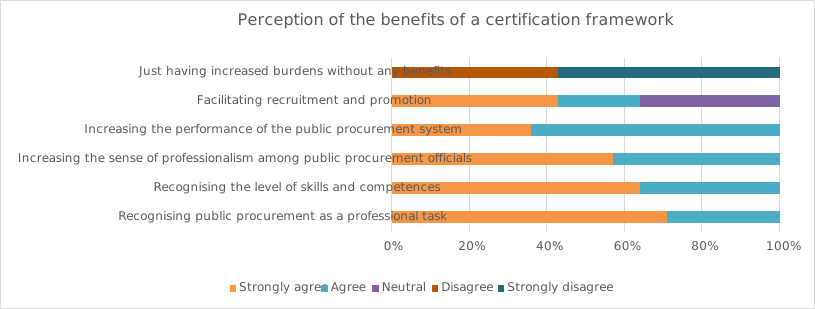
Note: Based on the answers from 15 countries excluding Brazil
Source: Based on the responses to the survey on good practices of certification framework for public procurement (2025)
Overall, countries that introduced a certification framework expressed positive views on the impact of a certification framework. All responding countries recognise the positive impacts that stem from “Recognising public procurement as a professional task”, “Recognising the levels of skills and competences”, “Increasing the sense of professionalism among public procurement officials”. Survey respondents are also in agreement on the positive impacts related to “Increasing the performance of the public procurement system”, underscoring the links between a professional workforce and certification frameworks.
The certification framework can facilitate recruitment and promotion when used as a standard requirement for carrying out certain types of procurement procedures, or as an indicator of advanced capabilities. In this regard, the responding countries viewed the certification framework as slightly less impactful than in the above-mentioned categories, as 36% (5 out of 14 countries) stated that they had a neutral perception of this impact.
Importantly, countries did not view the administration of the certification framework as an added burden without benefits. All countries surveyed found that the certification framework benefitted their public procurement system in one of the above-mentioned ways.
In addition, a certification framework can increase the reputational standing of the public procurement authority and the broader public procurement community. For example, France and Peru recognise it as a a model to be followed in other areas of cross-functional professional activities within the government (Box 4). In Norway, the certification framework received positive coverage in online newspapers about public procurement accompanied by interviews of successful candidates. In the United Kingdom, the certificate is seen as a ‘common currency’ for recruitment in public sector bodies. Having everyone accredited to the same standards allows for agile movement of resources when required. The Cabinet Office also notes improved customer and supplier relationship management.
France
The DAE (Direction des Achats de l'État, the Procurement and Purchasing Department) in France has been considered as a leader in the field of a certification framework in France. The DAE reported significant benefits from introducing the certification framework, providing recognition to public buyers by peers and other management functions. The evolution has impacted certified agents in a positive way, allowing them to negotiate better compensation terms, gain mobility, or seize new career opportunities.
Other French interministerial departments were inspired by the DAE’s certification framework when developing their own certifications.
Peru
In Peru, other public administration systems such as budgeting, accounting and public investment expressed to the OECE (public procurement authority of Peru) the interest to apply similar certification processes for the field of public financial management.
Source: Survey on good practices of certification framework for public procurement (2025)
Although surveyed countries do not view certification frameworks as adding extra burdens without providing beneficial impacts, it is advised to look at costs and benefits holistically, particularly for countries wishing to establish a certification framework for the first time. In fact, establishing a certification framework that is effective and sustainable entails securing a budget to finance tasks related to the design and set-up of the framework and its maintenance throughout time. An investment is needed in the initial phases of the set-up. Here countries need to lay the groundwork for introducing a certification framework. This may entail taking stock of current competency levels, establishing an underlying public procurement competency model (if not already available), designing the certification, and testing its feasibility.
At the same time, recurring administrative costs need to be considered for the implementation and running of a certification framework. As the survey results show, these costs include, but are not limited to, (i) administrative tasks (registration, issuance of a certificate, answering questions etc.), (ii) provision of training (in particular, in case training is a mandatory requirement to obtain a certificate), (iii) preparation of exam questions, (iv) scoring and evaluation of the exam submitted by candidates, (v) administration of digital platforms and (vi) keeping the certification framework up to date with continuous monitoring, improvements and updates. A certification framework can only reach its aims if it is accompanied by enough training and development to ensure adequate supply of skilled workers. Falling short of this, the certification framework risks becoming a box-ticking exercise that does not meaningfully contribute to the upskilling of the public procurement workforce. In addition, countries need to consider the burden that a certification may place on an individual. Depending on the type of certification, procurement practitioners may be required to pass an examination or attend a certain training to carry out their current functions. Hence, practical aspects need to be considered, such as how often examinations or trainings are offered, and how convenient these are to complete for public buyers with a full-time job. Failing to address these questions might generate reluctance among some procurement officials due to the burden and time to obtain a certificate. In the most extreme case this could reduce the attractiveness of procurement as a profession and lead to a shortage of skilled professionals.
Given the above, it is important that any framework introduced is supported by adequate resources to ensure its effective implementation and sustainability. Establishing a framework without the necessary financial, human, and institutional capacity can lead to inefficiencies, undermine credibility, and result in wasted investments. Therefore, countries should gather a comprehensive picture of expected administrative costs prior to initiating such reforms. A clear understanding of the full cost implications not only facilitates informed decision-making but also strengthens stakeholder engagement and buy-in from the outset.
At the same time, upcoming administrative and operational costs need to be viewed in the broader context. For instance, countries could compare the potential economic losses from a major infrastructure project failure due to public procurement errors with the total investment in certification at national level. If certification helps ensure that large-scale projects are delivered efficiently and successfully, the resulting value and cost savings could justify establishing and maintaining a certification framework.