In 2025, India removed the remaining foreign equity limits in the insurance sector, allowing foreign investors to own up to 100% of insurance companies (up from 74%). The rule requiring most board members in foreign-invested insurance firms to be resident Indian citizens was also abolished.
As a result, India’s STRI for insurance fell by 0.10, from 0.55 to 0.45, between 2024 and 2025. Lower STRI scores matter because reducing policy barriers to services trade directly lowers trade costs. This is significant since services trade faces higher costs than agriculture or manufacturing, especially in emerging economies (WTO, 2019[6]).
Using the Benz and Jaax (2020[7]) methodology, the estimated trade cost reduction of the 2025 reform for India’s insurance sector is about 25%. However, cutting services trade costs has broad benefits beyond services themselves. Services, such as telecommunications, transport, and financial services, are key inputs for manufacturing. Therefore, reducing services trade barriers helps manufacturers access global markets and obtain these inputs more efficiently, with potential gains in economic performance.
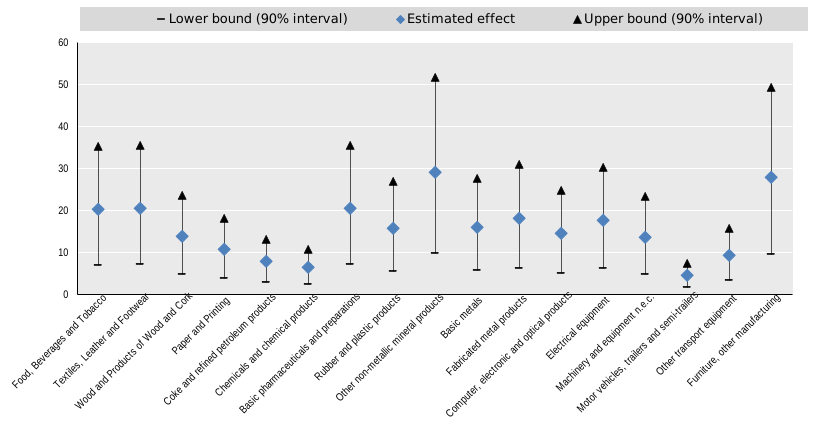
India’s reform in insurance can significantly enhance productivity in its downstream manufacturing sectors. Based on Benz et al. (2023[8]), it is estimated that reducing barriers to financial services trade is associated with an average 16% increase in labour productivity across manufacturing industries (Figure 9). Expected gains vary by sector, ranging from +4.5% in Motor vehicles, trailers and semi-trailers to +27.8% and +28.9% in Furniture and other manufacturing and Other non-metallic mineral products, respectively. Notably, productivity improvements are estimated at around +20% for Food and Beverages as well as Textiles, Leather, and Footwear.