This chapter covers the Competition Authority of Kenya’s market study function. It includes a description and analysis of the authority’s legal powers, the process the authority follows, and the outcomes of past market studies.
OECD Peer Reviews of Competition Law and Policy: Kenya

Abstract
7.1.1. Legislative powers to conduct market studies
The Competition Act enables the CAK to “carry out inquiries, studies and research into matters relating to competition and the protection of the interests of consumers”.1 The legislation does not explain the difference between inquiries, studies and research. The CAK understands and uses the law to enable three activities:
Research: informal desktop research on a market or sector involving no information gathering powers.
Inquiry: a preliminary research activity where there may currently be limited available information, an emerging sector of the economy, or where there is interest from other government agencies who want to know more about the sector.
Study: a formal market study process for an entire sector, including use of evidence gathering powers, engagement with external stakeholders and concluding with formal recommendations made.
Inquiries or market studies can be carried out by the CAK ex officio, or upon direction of the Cabinet Secretary for the National Treasury and Economic Planning.2 The Cabinet Secretary’s direction to commence an inquiry or market study may set a timeframe and may request advice on potential policy or legislative reforms.3
Notices of commencing an inquiry or market study must be published in the Kenyan Gazette and a national newspaper, with the notice covering the subject, inviting submissions from the public, and any terms of reference if the Cabinet Secretary has directed the CAK.4 The CAK must also send written notice to undertakings likely to be affected by the outcome of the study, all relevant industry and consumer organisations, and the Cabinet Secretary.5
When conducting an inquiry or market study, the CAK has compulsory information gathering powers.6 Failure to comply with an information is an offence under the Competition Act.7 However, as noted in Chapter 3, this is not enforced in practice.
7.1.2. The CAK market study process
Since the CAK’s founding, the authority has viewed market studies as a vital tool to address sectors with entrenched competition concerns, large incumbent firms and often government policies that facilitated the conduct. Particularly in its earlier years of operation, the CAK’s corporate strategy was to prioritise market studies as a way of addressing long-standing market structures and anticompetitive conduct.
During OECD fact-finding, the CAK reported that almost all their market studies and inquiries have been commenced ex officio. Sectors are selected on the basis of the CAK’s internal prioritisation guidelines and on complaints received by the CAK’s enforcement teams.
Prioritisation is also guided by sectors of interest based on the Kenyan Government’s current national priorities. The CAK noted their latest inquiry on animal feed was an example of this alignment with the national priorities, as food security and nutrition are a key aspect of the government’s agricultural transformation and inclusive growth priorities.
Inquiries and market studies are conducted by the CAK’s Planning, Policy and Research Department. The department is made up of 8 staff, including a manager, 4 analysts (3 trained as economists and 1 with a government procurement background), and 3 other staff. In addition to market study activities, the same department is also responsible for advocacy opinions, event organisation, international co‑operation activities, knowledge management for the CAK, and producing annual reports.
The CAK noted they may also retain external consultants to assist in conducting inquiries and studies, such as those with greater relevant industry expertise.
The CAK estimates its inquiries and market studies run for an average of 18 months. Figure 7.1 below outlines the CAK’s internal process for conducting a study.
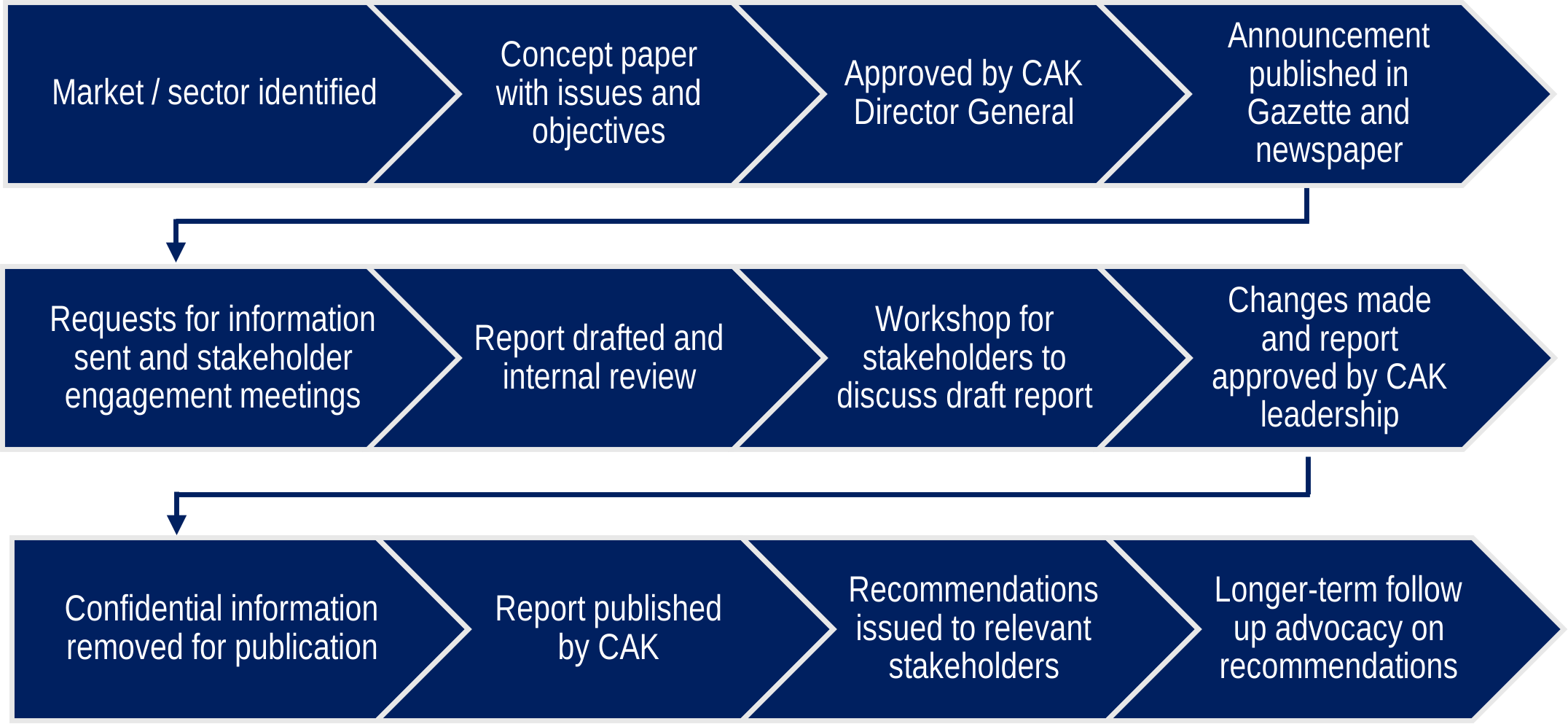
Source: OECD, based on material from the CAK questionnaire.
Over the past five years, the CAK has undertaken six market studies. Table 7.1 below surveys the markets in focus. This represents an average of 1.2 market studies per year, lower than the average of three market studies carried out yearly by OECD jurisdictions in the latest Competition Trends report (OECD, 2024[1]).
Source: CAK.
A highlight from earlier in the CAK’s operations was the market study into Unstructured Supplementary Service Data (USSD), highlighted below in Box 7.1. In this case the CAK found that Safaricom the major telecommunications firm and market leader in mobile money services was imposing high and discriminatory fees on USSD.
USSD is one of the key technologies that underpins mobile money services, which are widely used in Kenya. The CAK launched the market study to examine whether the pricing and access conditions were restricting competition.
The CAK found that Safaricom, the dominant telecommunications firm in Kenya charged high and discriminatory USSD fees, imposing a margin squeeze and creating barriers for competitors to Safaricom’s preferred mobile money service. The market was also found to include network effects such as interoperability challenges, as well as opaque pricing information and a lack of consumer awareness of USSD charges.
Through the market study recommendations, the CAK was able to negotiate a commitment with Safaricom to cut USSD fees by 90% on competitors (in lieu of an investigation), and impose a consistent price for all market players. Firms also committed to publishing the standard prices for USSD services, and informing customers of any prices charged for processing mobile money transfers.
More broadly, there were helpful regulatory spillover effects, as the market study recommendations included greater collaboration between the CAK, the Central Bank of Kenya and the Communications Authority. This longer-term collaboration informed broader policy reforms, including digital credit regulations and advocacy for fair pricing in telecommunication services.
Source: CAK decision CAK/PR/03/10/A.
The CAK report that their ongoing efforts to improve co‑operation and engage in advocacy activities have been helpful in getting better engagement from public sector stakeholders during market study processes.
However, private sector stakeholders remain a challenge, with the CAK reporting a general perception that firms are unwilling to engage with the CAK out of concern they will incriminate themselves and come under scrutiny of the CAK’s enforcement activity. There is no specific requirement in the Competition Act for information gathered in a market study not to be used for other enforcement purposes.
The CAK report that the potential outcomes for market studies they consider are as follows:
Referral to CAK enforcement staff for investigation.
Seeking administrative settlements with sector stakeholders suspected of violating the Competition Act.
Advocacy targeting relevant stakeholders, including creating consumer awareness and collaborating with sector regulators.
Recommendations to develop policy or legislation if there is no current framework for the sector.
Recommendations to amend relevant legislation and regulations.
In terms of recommendations for reforms coming out of a market study, the CAK estimates that approximately 50% of their recommendations have led to successful changes in law or policy. The CAK noted that they made recommendations in 2016 about bringing digital lenders into the regulatory remit of the Central Bank of Kenya, which were then followed five years later in 2021.
Market studies are made available to the public on the CAK website.
Broadly, stakeholders were complimentary that the CAK’s long-term project to build awareness of the authority and its mandate meant that it had generally good buy from the public sector when conducting market studies.
Nonetheless, challenges remain in relation to private sector stakeholders in the context of market studies. As discussed in Chapter 3 in greater detail, the CAK’s lack of enforcement in relation to compulsory information gathering powers means that market studies often cannot adequately measure factors such as market concentration and must rely on general sector data gathered by the government. Enhancing information gathering is vital to conduct robust competition analysis. External stakeholders noted this lack of detailed evidence from the sectors under review meant that there was insufficient analysis to justify any policy recommendations made.
Another concern raised was about the selection of topics for market studies. OECD good practices suggest that defining market selection criteria allows competition authorities to identify markets with potential competition problems or regulatory inefficiencies, or that have a greater importance for the economy (OECD, 2018[2]). The 2024 market study into online food and grocery delivery was criticised by stakeholders as the CAK focussing on a relatively niche topic that impacts only wealthy consumers in the capital of Nairobi. Additionally, evidence from the African Competition Forum’s Digital Platforms Landscape Study shows that there has been low adoption of online delivery services in Kenya, in both absolute terms and relative to other African countries in the landscape study (African Competition Forum, 2024[3]).8
The evidence provided by the CAK to the African Competition Forum was that they had only received a single complaint in the online delivery services sector, related to excessive pricing and alleged collusion on commission prices charged by the apps (African Competition Forum, 2024[3]). In the circumstances, an initial investigation for potential enforcement action may have been more appropriate rather than launching a market study. Given the CAK’s limited resources and current challenges relating to information gathering powers, the authority should always focus its market study work on high profile markets with immediate impact on large parts of the economy, not those perceived as being in vogue for competition authorities globally.
References
[3] African Competition Forum (2024), ACF Digital Platforms Landscape Study, http://compcom.co.za/wp-content/uploads/2025/06/ACF-Digital-Platform-Study.pdf (accessed on 12 November 2025).
[1] OECD (2024), OECD Competition Trends 2024, OECD Publishing, Paris, https://doi.org/10.1787/e69018f9-en.
[2] OECD (2018), Market Studies Guide for Competition Authorities, OECD Publishing, Paris, https://doi.org/10.1787/7381b582-en.
← 1. Competition Act s 9(1)(g).
← 2. Competition Act s 18(1).
← 3. Competition Act s 18(2)-(3).
← 4. Competition Act s 18(5)(a).
← 5. Competition Act s 18(5)(b).
← 6. Competition Act s 18(6).
← 7. Competition Act s 89.
← 8. The study found that Kenya has a low adoption of online food delivery services. Only three African Competition Forum jurisdictions were noted to have medium adoption (The Gambia, Namibia and Zambia), with only South Africa having high adoption. See (African Competition Forum, 2024[3]).