This chapter covers the mandate, structure and resources of the Competition Authority of Kenya.
OECD Peer Reviews of Competition Law and Policy: Kenya

Abstract
The Competition Authority of Kenya is the competition authority in Kenya, as well as the consumer protection regulator. It was created in 2011, replacing the former Monopolies and Prices Department of the Treasury, which was responsible for enforcing the 1989 Act. The CAK was established as an independent statutory body, with its own budget and organisational autonomy.1 The CAK reports to the National Treasury and is accountable to the Office of the Auditor-General, which audits the CAK’s accounts annually,2 and to the National Assembly, through the submission of annual reports.3
These reports must contain information on the CAK’s annual activities and plans, including details of its performance against key performance indicators, such as the number and nature of complaints decided or under consideration, investigations completed or ongoing, and significant market studies and inquiries conducted or planned.4
The CAK is empowered to enforce competition law (i.e. to review and authorise mergers, as well as investigate and sanction anti-competitive agreements, abuse of dominance and violations of merger review rules), carry out market studies and conduct competition advocacy activities. In addition, the CAK is mandated to enforce consumer protection and abuse of buyer power provisions, which fall outside the scope of this Peer Review.
As will be further discussed in Chapters 3, 4 and 5 of this Peer Review, enforcement of competition is still developing in Kenya, according to the information obtained by the OECD. During the OECD fact-finding exercise, the CAK provided several different sets of statistics regarding its enforcement practices. While the CAK contends this is largely driven by the need to convert from the CAK’s financial year reporting (July to June) to calendar year reporting, the figures are nonetheless inconsistent with those previously reported by the CAK to the OECD’s annual Competition Trends project, which utilises calendar years. In combination with the fact that the CAK does not publish all of its enforcement decisions (as further discussed below), it was not possible to report with certainty on the enforcement figures in Kenya and to assess in detail how competition law has been interpreted and applied in practice.
2.1.1. CAK internal structure
The CAK is composed of a Board of Directors (“the Board”) and a Director-General, supported by various units, as described below.
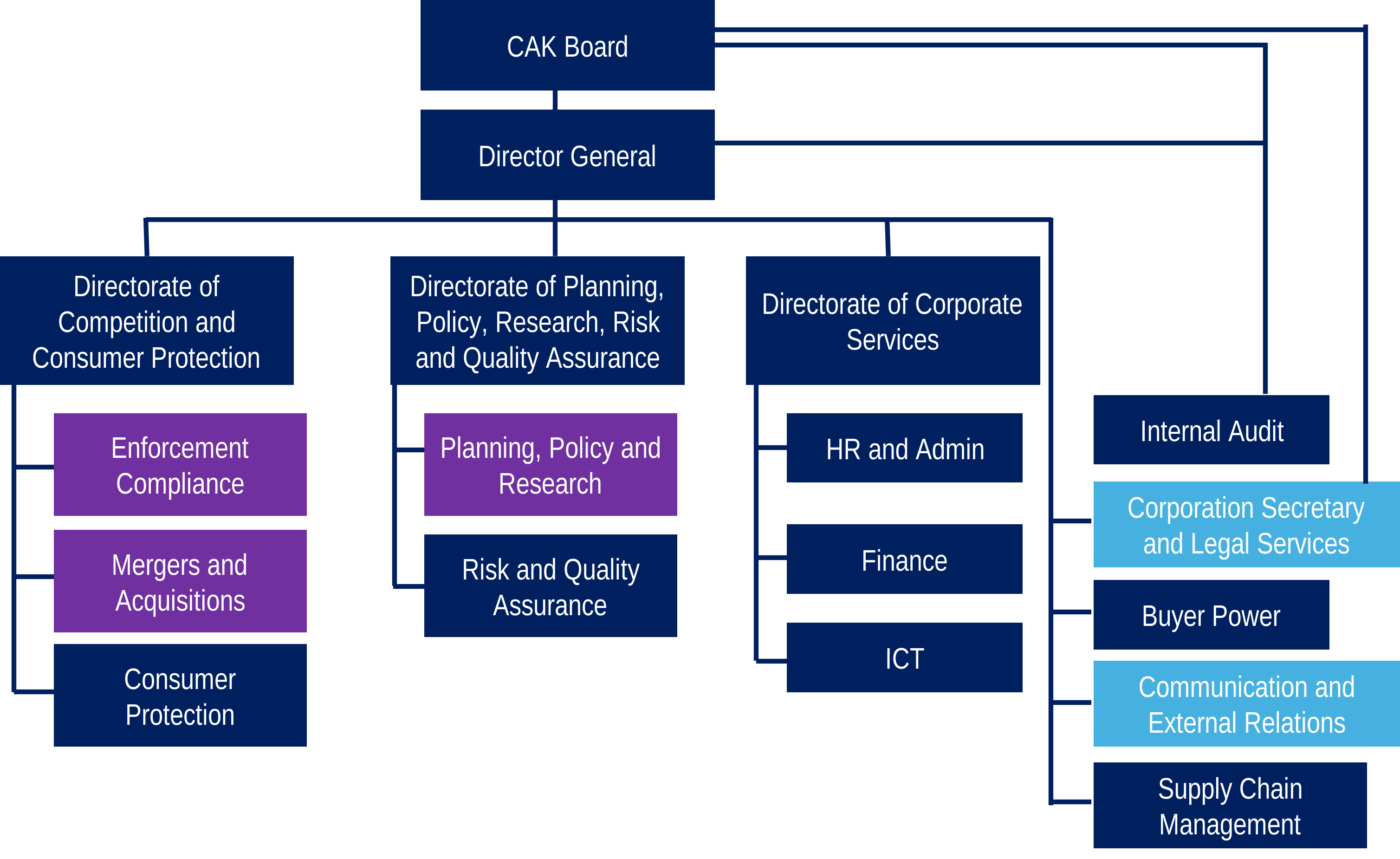
Note: The units marked with a purple square are involved exclusively in competition-related activities, while those marked with a light blue square are partially involved in competition-related activities. The other units are either dedicated to administrative tasks or to other substantive activities (consumer protection or abuse of buyer power).
Source: OECD, based on CAK (2024[1]), Strategic Plan (2023-2027) – Promoting and Sustaining Enforcement for Enhanced Consumer Welfare, https://cak.go.ke/sites/default/files/downloads/2025-06/COMPETITION-AUTHORITY-STRATEGIC-PLAN-2023-2027.pdf.
The Board consists of nine members: (i) the Chairperson; (ii) the Principal Secretary for the National Treasury or their representative; (iii) the Principal Secretary for the Ministry of Investment, Trade and Industry or their representative; (iv) the Attorney-General or their representative; and (v) five independent, non-executive members. In addition, the Director-General is an ex officio member of the Board of Directors but does not have voting rights.5
The Board serves as the CAK’s main decision making body, including the imposition of administrative sanctions in cases of anti-competitive practices, abuse of buyer power and consumer protection violations, as well as merger control. The Board provides overall strategic direction to the agency.
The Board has four committees, each composed of two to four Board members. Before the Board takes a decision, the matter must be first assessed and approved by the relevant committee:
1. Technical and Strategy Committee, mandated to advise on strategic planning and the implementation of the Competition Act, including enforcement decisions
2. Finance Committee, responsible for recommending financial policies, goals and budgets to support the operation of the authority
3. Human Resources Committee, in charge of implementing human resource policies and
4. Audit Committee, tasked with ensuring ethics and integrity
The Board of Directors is supported by the Corporation Secretary and Legal Services Department, which advises the Board, organises its meetings, drafts its decisions and communicates them once adopted. This department also provides legal advice to the various CAK operational units and represents the agency before the courts.
The Director-General is the CAK’s chief executive officer and is responsible for managing the agency’s day-to-day activities, including both administrative and substantive tasks (e.g. investigations into anti-competitive practices, abuse of buyer power and consumer protection infringements, as well as merger review).6 The Director-General has the power to assign tasks to the various CAK’s units, take procedural decisions during investigations and approve final investigation reports before submitting them with a proposed decision for consideration by the Board of Directors.
The departments responsible for competition-related activities are: the Enforcement and Compliance Department and the Mergers and Acquisitions Department (both under the Directorate of Competition and Consumer Protection), which are in charge of investigating anti-competitive practices and reviewing mergers, respectively; and the Planning, Policy and Research Department (under the Directorate of Planning, Policy, Research, Risk and Quality Assurance), which conducts market studies and competition advocacy efforts (the latter in collaboration with the Communication and External Relations Department). Additionally, as noted above, the Corporation Secretary and Legal Services Department – formally reporting to the Board of Directors – is also directly involved in competition-related activities (alongside the other substantive areas).
The CAK has neither a dedicated Chief Economist position nor a separate economics unit to provide economic analysis in support of its enforcement and advocacy teams.
2.1.2. Leadership, appointments and dismissals
As reported above, the CAK Board of Directors is composed of nine members.7 They are appointed for a three‑year term, which may be renewed once.8
The Chair of the Board of Directors is appointed by the President of the Republic and is not subject to parliamentary vetting. The government representatives (i.e. from the National Treasury; the Ministry of Investments, Trade and Industry; and the Attorney-General) are also not vetted by Parliament.9 The Competition Act does not specify any eligibility criteria for their selection.
The five independent, non-executive members are appointed by the Cabinet Secretary for the National Treasury and are vetted by Parliament. They must be “experienced in competition and consumer welfare matters”, and at least one must “be experienced in consumer welfare matters”.10
Neither the Competition Act nor secondary regulations provide for rules on the selection process, such as timeframes, procedures or eligibility conditions. There are also no provisions regarding staggered appointments of Board members.
The Board of Directors operates as an independent body, and its members can only be removed from office under the conditions set out in the Competition Act, namely if they: (i) resign during their term; (ii) are declared bankrupt or insolvent; (iii) are convicted of a criminal offence; (iv) have a conflict of interest likely to significantly interfere with the proper and effective performance of their functions; (v) are incapacitated (mentally or physically) and unable to perform their duties; (vi) fail to attend at least two‑thirds of Board meetings without the Board’s permission within any period of 12 consecutive months; (vii) commit a material breach of the CAK code of conduct.11 The Cabinet Secretary for the National Treasury has the power to make any removal and must inform the relevant member in writing in advance, stating the grounds for removal.12
All Board members (except the Director-General) are part-time and receive an allowance based on the number of meetings they attend. The Board of Directors must meet at least four times each financial year, with each meeting held no later than four months after the previous one.13 Each year, the National Treasury approves the number of meetings to be held, and any changes (e.g. if there is a need for additional meetings) must receive its prior approval. The Board held 15 meetings in the 2023-2024 financial year and 12 meetings in the 2022-2023 financial year.14
The Board’s quorum is four members, and decisions are taken by majority vote. In the event of a tie in the votes, the presiding member (either the Chairperson, when present, or another member designated by the Board in the Chairperson’s absence) has a deliberative and casting vote.15
At the time of writing, only four Board members were in office: the Chairperson and the representatives from the National Treasury, the Ministry of Investments, Trade and Industry and the Attorney-General (in addition to the Director-General). No non-executive Board members were in office.
The Director-General is appointed by the Board of Directors and approved by Parliament for a five‑year term, which may be renewed once. The Director-General must have knowledge and experience in competition matters.16 Neither the Competition Act nor secondary regulations provide additional eligibility criteria or rules on the selection process. There are also no specific provisions for dismissal of the Director-General, and the Competition Act explicitly establishes that the rules on Board members dismissals do not apply to the Director-General.17
The technical personnel at second and third management levels are appointed through a competitive process by the Board of Directors. All other staff members are competitively selected through a panel appointed by the Director General, through delegated authority by the Board.18 Staff may be dismissed in case of gross misconduct, including desertion, insubordination, poor performance and intoxication during working hours.19
Board members, the Director-General and CAK staff are subject to rules on conflicts of interest. In particular, they are required to use their best efforts to avoid any situation that could create a conflict of interest. If this is not possible, the conflicted person must disclose the conflict as soon as it arises and refrain from participating in any related matter. Conflicts of interest include any financial or other personal interests that could interfere with the proper performance of official duties.20 Board members, the Director-General and CAK staff are also subject to professional secrecy obligations, as further discussed in Chapter 3.
2.1.3. Resources
Budget
The CAK’s budget has two main sources:21 approximately 70% comes from the state budget (through exchequer transfers), while the remaining 30% derives from the fees and fines the agency collects, including imposed fines and merger filing fees (both local and from the COMESA regime). This means that the CAK retains the funds it collects from fees and fines and uses them to finance its own activities.
The CAK’s budget is co‑ordinated by the Finance Department, under the Directorate of Corporate Services. Every financial year, with inputs from the different CAK units, the Finance Department drafts the budget – including both sources of funding – which is then approved by management and the Board of Directors. The draft budget is subsequently submitted to the National Treasury, which integrates it into the state budget for parliamentary approval.22 Both the National Treasury and Parliament may adjust the draft budget in line with overall available resources and the national policy prioritisation process that guides allocation across government entities.
The share of budget financed by CAK’s fees and fines is estimated on the basis of past trends in fine collection as well as merger activity in the region. If changes occur during the financial year, particularly with respect to the realisation of projected fines and fees, the budget must be revised, subject to approvals by the Board of Directors, the National Treasury and Parliament. This is the case also if the resources collected by the CAK exceed the initial projections.
In addition to the annual budget, the CAK prepares a three‑year budget plan to enhance predictability and support longer-term planning of its activities. However, this plan is not binding on the government.
In 2024, the CAK’s budget was KES 578 181 004 (equivalent to EUR 3.8 million), of which KES 195 439 032 (equivalent to EUR 707 000) was allocated to competition activities (the “competition budget”), according to data provided by the CAK. Figure 2.2 presents the CAK’s total and competition budgets between 2020 and 2024.

Source: Nominal data provided by the CAK.
It shows that both the total budget and the share dedicated to competition activities have increased over the years, the peak competition budget accounted for around one‑third of the total budget in 2024.
According to the CAK, the recent budget increases reflect the agency’s success in convincing the National Treasury and Parliament of the importance of its mandate, as well as the conclusion of several high-profile cases.
Once approved by Parliament and allocated to the CAK, the budget is managed and spent under the authority of the Director-General.23 Expenses with human resources generally account for more than 50% of the budget. Other expenditures include office space, goods and services, training and travel, as well as costs to the agency’s substantive activities.
Human resources
In 2025, the CAK had 84 staff members, of whom 35 (41.7%) worked – at least partially – on competition-related activities (i.e. competition enforcement and advocacy). Table 2.1 below shows the evolution of total and competition staff between 2020 and 2025.
Note: Competition staff includes members from: the Directorate of Competition and Consumer Protection (which includes the Enforcement and Compliance Department and the Mergers and Acquisition Department); the Directorate of Planning, Policy, Research, Risk and Quality Assurance (namely the Planning, Policy and Research Department); the Corporation Secretary and Legal Services Department; and the Communication and External Relations Department.
Source: Data provided by the CAK.
Of the roughly 30 staff currently working on competition-related activities, there are 10 lawyers and 16 economists.
The CAK conducts staff selection and promotion through a competitive process,24 without the involvement of other government departments. However, the creation of new positions requires approval from the National Treasury. Salary structures and staff benefits are set by the Public Service Commission, which is responsible for setting pay scales, allowances and other entitlements for public employees across the government.
According to the CAK, salaries are competitive compared to other government agencies. Nevertheless, the private sector and regional economic communities (especially COMESA and the EAC) often provide more attractive opportunities. While staff turnover is not high (e.g. five departures in 2024 and four in 2023), it imposes additional costs on the agency to recruit and train replacements. Recruiting new staff is particularly challenging given the highly technical and specialised nature of competition law and economics. In practice, new recruits require intensive training once hired.
To improve retention, the CAK has developed a programme that includes training opportunities (including postgraduate studies), recognition of outstanding performance, prioritisation of internal promotion over external recruitment, and the provision of mortgages and car loans at concessionary rates.
2.2.1. CAK internal structure
All decisions of the Board of Directors must first be reviewed and approved by one of the four Board committees. This introduces an additional layer that may slow down the decision making process, which might be unnecessary especially given the current number of Board members.
As mentioned above, the CAK lacks a dedicated Chief Economist and/or a separate economics unit to support its enforcement and advocacy teams with economic analysis. This could help the CAK improve the use of economic analysis in investigations and decisions, particularly in abuse of dominance and merger cases.
Today, economic analysis plays a crucial role in competition enforcement (OECD, 2021[2]; 2021[3]). For instance, 90% of OECD competition authorities have created the position of a Chief Economist and/or have established a separate economics unit (OECD, 2023[4]).
2.2.2. Leadership, appointments and dismissals
Three out of nine Board members are direct representatives of the government. Although conflict-of-interest rules exist, this governance structure may expose the CAK’s decision making to political influence. Additionally, potential conflict of interests is not considered as an eligibility criterion prior to appointing Board members, but rather as a basis for their removal.25 This risk is heightened by the absence of eligibility requirements ensuring that these four Board members have expertise and experience in competition matters.
While the Competition Act stipulates that independent, non-executive members must have experience in competition and consumer protection matters, this requirement is too general and may not guarantee sufficient expertise in competition law.
More broadly, there are no clear rules governing the selection process for Board members, thereby leaving room for political influence in their appointment.
Several stakeholders interviewed by the OECD raised serious concerns about the selection process of Board members, including the non-executive ones. They noted that although many qualified professionals exist in Kenya, in practice appointments are not necessarily made on the basis of merit or technical expertise. According to them, past boards included more qualified members, who played a more active role in decision making. Stakeholders also criticised the overall lack of transparency in the selection process.
This departs from the OECD Recommendation on Transparency and Procedural Fairness in Competition Law Enforcement [OECD/LEGAL/0465], which calls for jurisdictions to:
ensure that competition law enforcement is independent, impartial and professional, by (…) guaranteeing that competition law enforcement is conducted by accountable public bodies that enjoy independence, i.e. are free from political interference or pressure, and that interpret, apply and enforce competition law on the basis of relevant legal and economic arguments grounded in sound competition policy principles.
Furthermore, the absence of rules on staggered appointments of Board members hinders partial renewals and continuity of the Board, creating a risk of lack of quorum that could paralyse the CAK. In practice, the appointment of non-executive Board members often takes too long, which is likely to further undermine the agency’s independence, as the Board can continue to operate even without any of the non-executive members. In fact, at the time of writing, all non-executive positions were vacant. The short terms of Board members (i.e. three years) exacerbate these challenges and create additional cost related to training, since most appointees do not have extensive competition expertise.
Similar concerns regarding transparency, political influence and eligibility criteria were also raised in relation to the selection of the Director-General, which may undermine the agency’s effective functioning and independence. Moreover, the absence of timelines for the appointment process can result in prolonged periods under acting Director-Generals, which significantly affects the authority’s operations.
In addition, the lack of clear rules ensuring that the Director-General may only be dismissed under clearly defined and specific conditions may also weaken the independence of his/her functions. Indeed, the possibility of arbitrary dismissals may undermine the ability of top-level officials to act independently.
2.2.3. Resources
Budget
Despite the progressive increases in recent years, the CAK’s budget remains considerably low for international and regional standards. Figure 2.3 below compares the average competition budget with certain groups of jurisdictions that provided data to the OECD CompStats Database,26 in particular with (i) OECD jurisdictions; (ii) non-OECD jurisdictions; (iii) jurisdictions in the Middle East and Africa (MEA) region; (iv) jurisdictions that also have had a competition authority for a similar length of time (10‑20 years). The CAK’s budget appears well below when compared to any of the indicated groups.

Note: GDP is expressed in PPP (Purchasing Power Parity). Given the current make up of jurisdictions that provide data for the OECD CompStats database, comparing Kenya to its GDP or population peers is not a useful comparison given the different World Bank Group income classifications that the peer jurisdictions belong to. The CompStats database lacks data from enough jurisdictions with sufficiently similar GDP per capita for this to be useful comparison. As such, comparing Kenya to jurisdictions that have had similar lengths of time to develop their competition authorities was assessed as being the best feasible comparison given the limitations in the data. The peer group of jurisdictions with a competition authority that has been active for 10‑20 years and consists of: COMESA, Dominican Republic, Ecuador, El Salvador, Hong Kong (China), Mauritius, Spain, Panama and Paraguay.
Source: OECD CompStats, World Bank and CAK.
During the OECD fact-finding mission, stakeholders raised concerns about the low level of the CAK’s budget, which could limit the agency’s effectiveness. Moreover, some questioned whether the current allocation of resources is the most efficient, suggesting that improvements could be made, particularly by prioritising core enforcement activities over training or certain administrative expenses.
Concerns were also expressed about the lack of predictability in the CAK’s budget, which hampers longer‑term planning of its activities. First, the budget is approved annually, and abrupt cuts are possible, although in recent years the agency has successfully managed to secure progressive increases, as noted above. Second, the share of the budget financed through merger filing fees and fines is difficult to forecast and remain uncertain in practice. Deviations from projected figures – which are only noticeable during the course of the financial year – can significantly affect the agency’s operations.
Stakeholders interviewed by the OECD highlighted that the government’s broader policy trend is toward making independent agencies increasingly self-funded, with progressively reduced reliance on state resources. The (OECD, 2016[5]) has previously noted self-funding can create risks to a competition authority’s legitimacy, as reliance on fines can create perverse incentives for an authority to unduly impose more fines or only focus on cases with better prospects of high fines, and reliance on merger fees can create shortfalls during periods of where the country’s economic performance is weaker.
However, as discussed in Chapters 3 and 4 of this report, the current trend in Kenya is that the number of CAK decisions is low and that the size of fines is low, suggesting a need to increase the agency’s focus on enforcement activities and a need to increase the size of fines. Given these conflicting concerns, it is preferable for the CAK to maintain a consistent level of funding from the government whilst the CAK works to enhance its enforcement practices.
Human resources
The number of staff allocated to competition-related activities at the CAK is significantly lower than in other comparable jurisdictions. Figure 2.4 below compares the number of competition staff per million inhabitants in Kenya with (i) OECD jurisdictions; (ii) non-OECD jurisdictions; (iii) jurisdictions in the Middle East and Africa (MEA) region; and (iv) jurisdictions that also have had a competition authority for a similar length of time (10‑20 years).

Note: Age of authority peer group refer to the same group as in Figure 2.3.
Source: OECD CompStats and CAK.
Although the CAK’s budget has progressively increased in recent years, staff levels have remained stable. This reinforces the view that the additional resources have not been allocated efficiently, suggesting room for improvements in this regard, as discussed above.
During the OECD fact-finding mission, CAK staff reported being generally satisfied with their working conditions, including material conditions, and highlighted the agency’s good reputation. This positive perception was also confirmed in an anonymous online survey conducted by the OECD among CAK staff.27 The main concern identified relates to career prospects and opportunities for advancement at the CAK. In fact, many officials feel stuck at certain stages of their careers, as promotions are limited. The CAK is currently reviewing its HR regulations with the aim of addressing this issue.
Private stakeholders interviewed by the OECD raised concerns about staff turnover, particularly at senior management level. They noted that several highly qualified staff have left in recent years and were not necessarily replaced by professionals with equivalent expertise. According to those stakeholders, this has negatively affected the CAK’s operations, especially in relation to competition enforcement.
References
[1] CAK (2024), Strategic Plan (2023-2027) - Promoting and Sustaining Enforcement for Enhanced Consumer Welfare, https://cak.go.ke/sites/default/files/downloads/2025-06/COMPETITION-AUTHORITY-STRATEGIC-PLAN-2023-2027.pdf.
[6] OECD (2024), OECD Competition Trends 2024, OECD Publishing, Paris, https://doi.org/10.1787/e69018f9-en.
[4] OECD (2023), “The Optimal Design, Organisation and Powers of Competition Authorities”, OECD Roundtables on Competition Policy Papers, No. 304, OECD Publishing, Paris, https://doi.org/10.1787/dea26a24-en.
[3] OECD (2021), “Economic Analysis and Evidence in Abuse Cases”, OECD Roundtables on Competition Policy Papers, No. 269, OECD Publishing, Paris, https://doi.org/10.1787/63e6d5f0-en.
[2] OECD (2021), “Economic Analysis in Merger Investigations”, OECD Roundtables on Competition Policy Papers, No. 261, OECD Publishing, Paris, https://doi.org/10.1787/f9cc5dc4-en.
[5] OECD (2016), “Independence of Competition Authorities - From Design to Practice”, OECD Roundtables on Competition Policy Papers, No. 195, OECD Publishing, Paris, https://doi.org/10.1787/ea9749e1-en.
← 1. Competition Act, s 7.
← 2. Competition Act, s 81.
← 3. Competition Act, s 83.
← 4. Competition Act, s 83(2). The past annual reports are available at https://cak.go.ke/planning/annual-reports.
← 5. Competition Act, s 12(3).
← 6. Competition Act, ss 12, 19.
← 7. In addition, the Director-General is also an ex officio member of the Board of Directors.
← 8. Competition Act, Schedule Provisions as to the Authority, s 1.
← 9. Competition Act, s 10(1).
← 10. Competition Act, s 10(1)(f), (2).
← 11. Competition Act, Schedule Provisions as to the Authority, s 2(1).
← 12. Competition Act, Schedule Provisions as to the Authority, s 2(2).
← 13. Competition Act, Schedule Provisions as to the Authority, s 3(1). For instance, the Board of Directors held 15 meetings in the 2023/24 financial year. See CAK (2024), “Strategic Plan (2023-2027) - Promoting and Sustaining Enforcement for Enhanced Consumer Welfare”.
← 14. CAK (2024), Annual Report & Financial Statements – FY 2023/24; CAK (2023), Annual Report & Financial Statements – FY 2022/23, https://cak.go.ke/planning/annual-reports.
← 15. Competition Act, Schedule Provisions as to the Authority, s 3(4), (5), (6).
← 16. Competition Act, s 12(1), (2).
← 17. Competition Act, Schedule Provisions as to the Authority, s 2(1).
← 18. Competition Act, ss 13(3), 19.
← 19. Employment Act, 2007, ss 41 ff.
← 20. Competition Act, ss 13(4), 85(1), Competition Act, Schedule Provisions as to the Authority, s 4, and Public Officer Ethics Act, rev. 2016, s 12.
← 21. Competition Act, s 78.
← 22. Competition Act, s 80.
← 23. Competition Act, s 80(4).
← 24. Competition Act, s 13(3).
← 25. Competition Act, Schedule Provisions as to the Authority, s 2(1)(b)(iii).
← 26. The OECD CompStats Database compiles general statistics related to 69 OECD and non-OECD jurisdictions. Information of CompStats Database is compiled in the publication OECD Competition Trends (OECD, 2024[6]).
← 27. To complement the information gathered through the Peer Review questionnaire and the interviews held during the fact-finding mission, the OECD carried out an online survey among CAK staff between March and April 2025. The survey aimed at collecting information on working conditions, including career plans, training, team specialisation, interaction with other government bodies and public perception of the CAK’s work. It consisted of eight questions, with satisfaction levels rated on a scale from 1 to 5. A total of 80 CAK staff members responded.