This chapter reviews the structural conditions shaping the development of Viet Nam’s capital markets. It examines the country’s growth model, the three-pillar structure and the financing mix of the economy, before assessing the use of market-based financing across public equity, corporate bonds, and private equity and venture capital. The chapter also provides an overview of recent reforms to Viet Nam’s capital market framework.
OECD Capital Market Review of Viet Nam 2026

Abstract
The Vietnamese government’s target of reaching high-income status by 2045 will require rapid and sustained growth. Well-functioning capital markets will be central in Viet Nam’s transition towards a growth model with a stronger focus on efficient resource allocation and continuous productivity increases. This chapter provides an overview of Viet Nam’s growth model to date, the structure of the economy, the corporate financing landscape and recent capital market developments.
Viet Nam’s economy rests on three pillars comprising state-owned enterprises, foreign-invested firms and the domestic private sector, while its financial system remains heavily centred around banks. Each of these three pillars interacts with the bank-based financial system under different conditions. State-owned enterprises have historically had access to favourable borrowing conditions; foreign-invested firms rely largely on external funding sources; and the domestic private sector, despite accounting for more than half of formal employment, remains disproportionately dependent on domestic bank financing while continuing to face persistent funding constraints (see Section 1.3).
Importantly, Viet Nam’s transition from extensive, capital-driven growth to intensive, productivity-led growth will depend heavily on the ability of domestic private firms to scale, upgrade and integrate into higher value-added activities in trade-related sectors. State-owned enterprises remain concentrated in domestically oriented industries, while foreign-invested firms account for a significant share of exports but have relatively limited linkages with the domestic economy. Around half of the value embedded in Vietnamese exports originates from foreign sources, and 85% of export-related jobs are concentrated in production activities. Capital accumulation has been the principal driver of rapid GDP growth, while the contribution of total factor productivity (TFP) growth has remained comparatively limited. Firm-level evidence suggests that addressing within-industry distortions could be associated with aggregate TFP gains of more than 50% (IMF, 2025[1]). This highlights the importance of efficient capital allocation, whether through bank credit or capital markets.
Diversified sources of finance can support the transition towards productivity-led growth. Total outstanding credit to the economy stood at around 145% of GDP at the end of 2025, underscoring the important role of bank credit in Viet Nam’s financial system. Further expansion is increasingly constrained by rising loan-to-deposit ratios, comparatively low capital adequacy ratios and the prospective implementation of Basel III standards by 2030 (see Section 1.4). Beyond these constraints, the structure of bank-led intermediation itself also faces limitations in providing long-term financing. Reflecting bank risk management requirements, lending tends to be concentrated among established, lower-risk borrowers. Deeper capital markets could complement bank lending by broadening access to long-term and risk-bearing finance, particularly for firms whose needs are not well served by conventional bank loans.
Capital markets can support Viet Nam’s transition towards productivity-led growth by providing long-term and risk-tolerant capital. They can improve capital allocation through market price signals (Wurgler, 2000[2]), strengthen corporate discipline through disclosure, investor scrutiny and corporate governance requirements (Jensen and Meckling, 1976[3]; OECD, 2023[4]), and provide firms with long-term financing while preserving liquidity for investors. This is particularly important for firms investing in higher-risk, intangible-intensive and higher value-added activities.
Capital markets can also strengthen financial resilience by providing financing during periods of stress, as seen following the 2008 global financial crisis and during the pandemic-related crisis in 2020 (OECD, 2021[5]). The absence of such a countercyclical financing channel can prolong recessions and amplify pro-cyclical credit dynamics, as illustrated by Viet Nam’s banking stress episode of 2011-2012. However, Viet Nam’s 2022 corporate bond market developments illustrate that these benefits depend on well-functioning and well-supervised markets supported by a diversified investor base.
Viet Nam’s capital markets remain modest in depth relative to regional peers and to the country’s own development targets. Its equity market capitalisation stood at around 76% of GDP and the corporate bond market at only 10% of GDP in 2025 (Figure 1.1, Panels A and B). Both remain well below the targets set in the Strategy for Stock Market Development to 2030 of 120% of GDP for equity market capitalisation and 25% of GDP for corporate bonds.
Capital markets also reflect the underlying economic structures. Viet Nam’s equity market remains heavily concentrated in financials and real estate, which together account for around 60% of market capitalisation on the public equity market (Figure 1.1, Panel C). Similarly, in the corporate bond market, issuance is dominated by financial and real estate companies with limited participation from the manufacturing, technology and consumer industries that are central to the productivity transition. Importantly, corporate bonds issued by banks constitute over half of total issuances during 2021-2025 (see Section 1.5). The dominance of financials also reflects the central role of this sector in intermediating credit, as banks and financial firms raise capital on equity and bond markets to fund their own lending activities.

Note: Viet Nam’s equity market analysis (Panel A and C) includes the Unlisted Public Company Market (UPCoM) alongside the two main exchanges.
Source: Vietnam Bond Market Association; OECD Capital Market Series dataset, LSEG, Bloomberg, see Annex for details.
Since the Doi Moi reforms of the late 1980s, and the transition to a “socialist market economy”, Viet Nam has experienced strong growth rates (Figure 1.2, Panel A). The successful growth model has relied on a rapidly expanding export sector, especially following the important trade agreement with the United States in 2000 and Viet Nam’s accession to the World Trade Organization in 2007. The main driver of growth has been the transfer of labour from agriculture to more productive manufacturing. Large increases in capital have supported the industrial expansion and rapid catch-up growth, as Viet Nam’s export basket has evolved from agricultural products, first to apparel, and then to electronics and machinery today (World Bank, 2024[6]).
This export-oriented growth model has made Viet Nam one of the most trade-dependent countries in the world. With exports representing close to 90% of GDP, it far surpasses most peer countries, including highly open economies such as Malaysia and Thailand (Panel B). Foreign direct investment (FDI) has flowed in following the trade agreements, and FDI as a share of GDP has on average consistently exceeded that of most peer countries by several percentage points (Panel C). These inflows have been driven by Viet Nam’s favourable geographic location, stability and low labour costs (OECD, 2025[7]). In recent years, as production costs in the People’s Republic of China (hereafter ‘China’) have risen, manufacturing activities have increasingly relocated to Viet Nam, further establishing its position as a key assembly hub within global value chains (Pincus, 2016[8]).
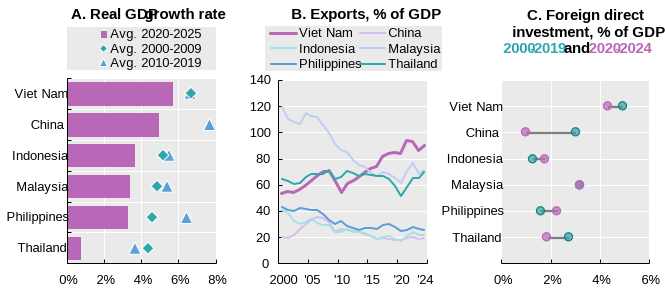
Note: Real GDP growth in China averaged 10.4% during 2000-2009.
Source: World Bank, (2026[9]), Open Data, https://data.worldbank.org/.
While the current trade and geopolitical tensions increase uncertainty, Viet Nam may still benefit from some of the rerouting and diversification of supply chains (OECD, 2026[10]). Wage levels remain competitive and a substantial share of agricultural workers could still transfer into more productive industries. However, this growth model, largely driven by capital accumulation and labour expansion, is facing increasing challenges (OECD, 2025[7]).
Capital accumulation has been the primary driver of rapid GDP growth, while the contribution of TFP improvements has remained limited (Figure 1.3, Panel A). A low TFP contribution suggests that the economy has yet to fully harness efficiency gains from better resource allocation, technological upgrading, and the diffusion of knowledge across firms. Consequently, Viet Nam’s growth remains more reliant on capital accumulation than that of peer economies, with capital increases contributing nearly three-quarters of economic growth (Panel B). This pattern is also reflected in Viet Nam’s high incremental capital-output ratio (ICOR) of eight (Panel C), placing Viet Nam, along with China, well above the three to four range typically associated with efficient capital use, suggesting scope to improve investment efficiency (IMF, 2025[11]).
While this model has supported rapid economic convergence, sustaining growth over the longer term may require a greater contribution from productivity gains. Transitioning from extensive to intensive growth, and thereby avoiding the middle-income trap, will require a stronger emphasis on productivity gains, higher value-added inputs from domestic labour and technological upgrading. Firm-level analysis suggests that eliminating within-industry distortions to reach an efficiency frontier could increase aggregate TFP by over 50% (IMF, 2025[1]). This would imply significant economic gains due to reductions in resource misallocation. Realising such gains requires a decisive shift in how capital is allocated, from low-productivity uses towards the sectors best placed to drive productivity. Well-functioning capital markets can play a critical role in channelling capital towards its most productive use.

Note: In Panel A, each bar reflects the average of a six-year period, except the last which represents a nine-year period. In Panel C, the incremental capital-output ratio is here defined as the total investment divided by the increase in GDP that year.
Source: Asian Productivity Organization (2025[12]), APO Productivity Databook 2025, https://www.apo-tokyo.org/wp-content/uploads/2025/10/APO-Productivity-Databook-2025_PUB.pdf; National Statistics Office of Vietnam, (2026[13]), https://www.nso.gov.vn/en/px-web/?pxid=E0402&theme=Investment; IMF, (2025[14]), World Economic Outlook Database, https://www.imf.org/en/publications/weo/weo-database/2025/april.
Viet Nam’s economy rests on three distinct pillars: state-owned enterprises (SOEs) or the state sector, foreign-invested firms and domestic private firms. Each pillar has played a distinct role in the economy, shaping the country’s capital allocation dynamics as well as the current state and potential of corporate financing and capital market development. SOEs dominate key industries and continue to benefit from substantial advantages conferred by the state. Foreign-invested firms have been the primary driver of export growth and a major source of higher-income employment, but they operate with limited links to domestic suppliers. Meanwhile, the domestic private sector remains the largest, but opportunities remain to strengthen its capacity to scale up and compete internationally.
These three sectors contribute unevenly to output, investment and employment, and their relative importance has shifted only modestly despite a decade of reforms (Figure 1.4). The state sector accounted for 29% of GDP in 2024, down by only 3 percentage points since 2016. Meanwhile, the share of the foreign-invested sector has risen by a corresponding amount. In 2024, it accounted for 20% of GDP, 34% of formal jobs and 17% of investment. The domestic private sector remains the main employer, accounting for 59% of formal jobs and its share of investment has increased to 56%. Meanwhile, its share of output has remained constant since 2016, pointing to the relatively lower value added in the domestic private sector.

Note: In Panel C, latest employment numbers refer to 2022.
Source: National Statistics Office of Vietnam (2026[13]), Statistical data, https://www.nso.gov.vn/en/data-and-statistics/; Nhân Dân (2022[15]), Numbers of firms, employees in FDI, non-state sectors soar: census, https://en.nhandan.vn/numbers-of-firms-employees-in-fdi-non-state-sectors-soar-census-post116354.html; Chủ (2022[16]), Analysis of Some Key Indicators of Active Enterprises Which Have Business Operations in 2022, https://ntpartnerlawfirm.com/analysis-indicators-vietnamses-enterprises-22/.
The state sector remains dominant across a range of domestically oriented industries. Despite successive reform efforts since the Doi Moi reforms, many companies in the “commanding heights of the economy” remained state-owned, including natural resources, commodity trading, retail and distribution, transport, finance, construction, telecommunications and manufacturing for the domestic market (Pincus, 2016[8]). SOEs in Viet Nam may benefit from specific forms of state support, including access to government procurement contracts, subsidies, favourable financing conditions and state-backed guarantees, as well as through financing arrangements that have provided greater flexibility and reduced their exposure to competitive pressures and insolvency proceedings (OECD, 2025[7]).
The government has sought to address inefficiencies in the SOE sector through both equitisation and the consolidation of local and regional firms to create national champions. However, progress has been slow. Between 2016 and 2020, only 39 of the targeted 128 firms were equitised, followed by only 5 during 2021-2022, and none since then (VietNamNet, 2022[17]; Viet Nam News, 2024[18]). The government has recently set a new target to equitise 20 large SOEs (Government of Viet Nam, 2026[19]). Thus far, divestment progress has been influenced by challenges related to the valuation of land-use rights, slow planning processes and the complexity of aligning the incentives of the different stakeholders involved. These challenges may also highlight opportunities to strengthen accountability mechanisms for SOE executives in relation to the timely implementation of divestment plans. SOE status may provide continued access to certain advantages related to land, financing and local administrative support. Local administrations may also have an interest in maintaining the revenues or budget allocations associated with SOEs (Knutsen and Khanh, 2020[20]). Similarly, consolidation efforts have so far resulted in relatively few SOEs operating in export-oriented sectors or integrated into global value chains.
Foreign-invested firms have played a crucial role in Viet Nam’s economic growth over the last decade, accounting for around three-quarters of exports and one-third of formal employment (Figure 1.4, Panel C). These firms are more productive than domestic private firms and pay a wage premium to their employees. In 2022, their share of labour income (measured by firms’ wage bills) surpassed 50%. However, their links with domestic private firms remain relatively limited. Foreign-invested firms source most of their production inputs from foreign suppliers. These firms consequently accounted for almost 70% of imports in 2025. Moreover, around half of the value added embodied in Viet Nam’s exports originates from foreign sources, considerably higher than most peer countries, and has been on an upward trend for the last decade (Figure 1.5, Panel A). Meanwhile, spillovers from foreign-invested firms to the domestic private sector through increased demand or direct access to technology are modest (IMF, 2025[1]; OECD, 2025[7]; NSO, 2026[21]).
The relatively isolated character of foreign investment activity is consistent with the employment structure of Viet Nam’s export workforce. It is more heavily concentrated in production roles than in peer economies at comparable income levels, reflecting the importance of assembly operations in FDI-driven exports and opportunities to strengthen domestic integration into global value chains (Panel B). In 2018, 85% of jobs in export activities were in production roles, which are typically associated with lower value-added activities, and this share has hardly changed since 2000. This pattern is also evident in more technologically advanced sectors, such as the production of electrical and optical equipment, where Vietnamese inputs are still largely focussed on production, reflecting the focus on lower value-adding assembly (World Bank, 2024[6]).

Source: OECD (2025[22]), Trade in Value Added 2025 edition,
https://data-explorer.oecd.org/?pg=0&bp=true&tm=%22%28TIVA%29%202025%20edition%22&snb=5&isAvailabilityDisabled=false; World Bank, (2026[9]), Open Data, https://data.worldbank.org/; World Bank (2024[6]), Viet Nam 2045 - Trading Up in a Changing World, https://documents1.worldbank.org/curated/en/099111424204523679/pdf/P178784-e07719d0-909c-43d9-9b24-81b4dcb14765.pdf.
The participation of domestic private firms remains limited in more advanced sectors. Many domestic firms are either too small or lack the capabilities required to serve export markets or act as suppliers to foreign-invested firms. The share of domestic firms that have linkages to global value chains has decreased from 35% in 2009 to 18% in 2023, while exports have grown dramatically as a share of GDP over the same period. Firms engaged in trade are on average 70% more productive than domestic firms not engaged in imports or exports (World Bank, 2024[6]).
This three-pillar structure has direct implications for companies’ access to financing. Evidence suggests that SOEs have historically enjoyed lower borrowing costs than those of domestic private firms, which partly reflects SOEs’ scale, longer track record and implicit state backing. This may allow some relatively less productive enterprises to retain resources and market share, hindering the reallocation of capital towards more productive firms (IMF, 2025[1]; Le, 2022[23]). Similarly, foreign-invested firms have accessed finance at a lower cost, largely through their parent company or external funding channels, which puts further competitive pressure on domestic private firms. Consequently, domestic private firms, particularly SMEs, face significantly higher borrowing costs, while access to finance consistently ranks as the second-largest obstacle to business activity in Viet Nam (see Section 1.4).
Against this background, the government has taken several measures to support the domestic private sector. Decree No. 205/2025/ND-CP actively seeks to support links between local suppliers and foreign-invested firms through financial support for investment, training and quality assurance (Government of Viet Nam, 2025[24]). The Politburo’s Resolution 68-NQ/TW marks a clear shift by acknowledging the central role of the private sector in economic development. The resolution aims to create a more favourable regulatory environment, reduce administrative burdens, enhance connections between domestic private firms, SOEs and foreign-invested firms, and increase access to public contracts. It also includes a target to integrate 20 large private firms into global value chains by 2030.
Resolution No. 79-NQ/TW issued in January 2026 reaffirms the strategic role of SOEs, emphasising the need for enhanced oversight and accountability, adherence to the OECD Guidelines for Corporate Governance of State-Owned Enterprises, and clearer operational boundaries to minimise overlap with the private sector. Whether these commitments can produce a more level playing field in practice, and whether the domestic private sector can scale up and become competitive in global value chains, depend crucially on access to finance. In April 2026, the Central Committee of the Communist Party released Conclusion No. 18-KL/TW, which gives priority to developing the domestic capital market (Central Committee of the Communist Party of Viet Nam, 2026[25]).
Viet Nam has historically maintained high rates of domestic savings, providing a substantial pool of resources for investment. Over the past decade, gross domestic savings averaged 34% of GDP, well above the world average of around 27%, as well as that of other ASEAN countries such as Malaysia (30%) and Thailand (31%) (World Bank, 2026[9]). Despite having one of the highest domestic savings rates in the region, Viet Nam faces the structural challenge of effectively mobilising and transforming these savings into productive investment. This reflects the limited depth of capital markets and the concentration of financial intermediation within the banking sector.
Viet Nam’s financial system is predominantly bank-based, reflecting the still limited depth of its capital market. By the end of 2025, total outstanding credit to the economy reached approximately USD 740 billion, equivalent to 145% of GDP, one of the highest ratios among peer economies. Credit growth has remained consistently high. The first decade of the 2000s saw an average growth rate of over 30%. Credit growth has since moderated, ranging from approximately 12% in 2020 to over 19% in 2025.

Note: For Viet Nam, the series refers to credit to the economy as reported by the State Bank of Vietnam. This corresponds to the series reported by the World Bank under the indicator “Domestic credit to private sector (% of GDP)” for the overlapping years. The World Bank notes that, for some countries, this indicator may include credit to public enterprises.
Source: World Bank (2026[9]), Open Data, https://data.worldbank.org/; National Statistics Office of Vietnam (2026[13]), Statistical data, https://www.nso.gov.vn/en/data-and-statistics/; IMF (2026[26]), World Economic Outlook (April 2026), https://www.imf.org/external/datamapper/datasets/WEO; VnEconomy (2026[27]), Vietnam’s 2026 credit expansion projected at USD106 billion, https://en.vneconomy.vn/vietnams-2026-credit-expansion-projected-at-106-bln-down-7-bln-yoy.htm.
The current pace of credit expansion is becoming increasingly difficult to sustain. The ratio of bank loans to customer deposits has risen rapidly from 81% in 2016 to 105% in Q1 2025 (Figure 1.7, Panel A), indicating a reduction in the sector’s liquidity buffer. This measure differs from the regulatory loan-to-deposit ratio defined under Circular No. 22/2019/TT-NHNN, whose denominator includes a broader range of funding sources. On that basis, the system-wide ratio stood at 76% at end-2025, below the regulatory limit of 85%, according to the SBV. Capital adequacy ratios (CARs) remain below those of peer countries (Panel B), constraining banks’ capacity to support continued rapid credit expansion. These pressures are compounded by the requirement to implement Basel III standards by 2030, which will require banks to hold greater volumes of higher-quality capital and subject a broader range of assets to more stringent risk weightings (VIR, 2025[28]). The aggregate CAR figure also masks heterogeneity within the sector. According to the SBV, although all state-owned commercial banks met the regulatory minimum, their average CAR of 10.1% remained materially lower than that of privately owned banks.

Source: IMF, (2025[29]), Financial Soundness Indicators database, https://data.imf.org/en/datasets/IMF.STA:FSIC.
Heavy reliance on bank credit can also produce pro-cyclical financial dynamics, as illustrated by the 2011-2012 banking episode, which followed several years of credit growth in excess of 30% per annum and was accompanied by a marked deterioration in asset quality (Do, Nguyen and Le, 2017[30]). To manage these systemic risks, the State Bank of Vietnam (SBV) has long relied on administrative credit growth caps allocated to individual commercial banks on the basis of supervisory ratings and capital adequacy assessments (State Bank of Viet Nam, 2018[31]). The initial system-wide credit growth target for 2025 was set at 16%, but was subsequently raised in response to lending demand, with actual growth reaching over 19% (State Bank of Vietnam, 2026[32]). In 2026, the system-level guideline was set at around 15% with closer monitoring of higher-risk sectors such as real estate. The SBV has signalled its intention to phase out credit growth ceilings over time (State Bank of Vietnam, 2026[33]).
Beyond these prudential considerations, the bank-led model also has implications for the allocation and maturity of financing. Administrative credit growth caps, while supporting macroprudential objectives, may also shape lending patterns, as banks operating within these limits may favour established, lower-risk borrowers with sufficient collateral. To avoid credit rationing for SMEs and start-ups, and to support their expansion, the government has implemented different measures, such as Resolution No. 198/2025/QH15 which provides for interest rate support for certain projects and corporate income tax exemptions (National Assembly of Viet Nam, 2025[34]). In June 2026, the government approved Decision No. 982/QĐ-TTg which envisages measures to support digital technology enterprises expanding globally (Prime Minister of Viet Nam, 2026[35]).
The reliance on bank credit has certain costs, in particular by delaying capital market development (OECD, 2025[7]). Capital market instruments compete with bank deposits for household savings. Since most companies are neither listed nor active bond issuers and therefore rely heavily on bank finance, strong demand for credit sustains high lending rates and, in turn, high deposit rates as banks compete for funding. In 2026, 6- to 12-month deposits offered interest rates of 5.3% to 7.3%, providing households with a relatively attractive and low-risk alternative. Equities, corporate bonds and investment funds must therefore offer sufficiently attractive risk-adjusted returns to attract household savings (World Bank, 2023[36]; VinaCapital, 2026[37]; DTI News, 2026[38]).
The largest listed companies in Viet Nam have a much higher reliance on short-term debt relative to those in peer countries (Figure 1.8). This dependence has also increased since 2018. At the system level, the maturity structure of bank credit is broadly balanced. Short-term loans accounted for 52.4% of outstanding credit at end-2025, while the ratio of short-term funding used for medium- and long-term lending stood at 28.6%, below the regulatory limit, according to the SBV. Nevertheless, dependence on short-term debt and its elevated cost negatively affect the corporate sector’s ability to commit to long-term, productivity-enhancing projects, the very investments Viet Nam would benefit the most from (FiinRatings, 2025[39]). This underlines the need to develop capital markets as a means of reducing reliance on bank credit and supporting a more balanced maturity structure of corporate liabilities.
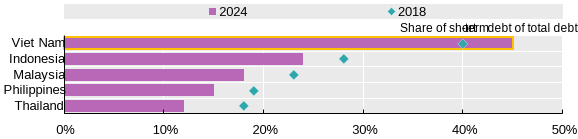
Note: Average share of debt due within 12 months for the top 50 listed companies by assets in each jurisdiction.
Source: S&P Capital IQ and S&P Global Ratings as cited in FiinRatings (2026[40]), Strengthening Trust, Transparency, and Market Infrastructure for Sustainable Growth, https://fiinratings.vn/Data/pdf/FR/Event/Event-Presentations-Vietnam-C-Bond-Forum-2026.pdf.
Access to finance was the second most frequently cited business constraint, identified by 21% of firms, after the effects of informality (22%). This suggests that access to finance is perceived as a more significant barrier in Viet Nam than in most other ASEAN economies (Figure 1.9, Panel A). The cost of corporate borrowing also compares unfavourably with that in peer countries. The premium over the risk-free sovereign rate increased considerably during the 2018-2022 period, reaching approximately 450 basis points, the highest among ASEAN peers (Panel B).

Note: In Panel B, the corporate borrowing cost premium refers to the average spread over the sovereign risk-free rate.
Source: World Bank, (2023[41]), Enterprise Surveys Indicators Data, www.enterprisesurveys.org; IMF, (2025[1]), Vietnam: 2025 Article IV Consultation, https://www.imf.org/-/media/files/publications/cr/2025/english/1vnmea2025001-source-pdf.pdf.
At the end of 2025, outstanding corporate equity and debt amounted to around USD 480 billion, equivalent to approximately 97% of GDP, below bank credit which stood at 145% of GDP (see Section 1.4). Within market-based financing, equity is by far the largest. Listed public equity on Ho Chi Minh Stock Exchange (HOSE) and Hanoi Stock Exchange (HNX) accounts for around USD 331 billion, with an additional USD 44 billion registered on the Unlisted Public Company Market (UPCoM), and approximately USD 17 billion in private equity (PE) and venture capital (VC). Combined, public and private equity markets totalled around USD 392 billion in 2025. Market-based debt financing is considerably smaller, at around USD 88 billion, concentrated primarily in corporate bonds (USD 50 billion) and syndicated loans (USD 38 billion). Overall, this shows that, while Vietnamese firms have access to market-based finance, mainly through public equity, they continue to rely predominantly on bank lending.

Note: For PE and VC, outstanding capital is proxied by cumulative investment deployed in Viet Nam over 2020–2024, as no official stock measure is available.
Source: OECD Capital Market Series dataset, LSEG, Bloomberg, see Annex for details.
1.5.1. Equity markets
Viet Nam’s public equity market has grown rapidly since its establishment in 2000. As of end 2025, it comprised three trading venues, with a market capitalisation of around USD 375 billion, equivalent to 76% of GDP, and 1 554 public companies1 (defined as listed or registered companies for trading). Viet Nam thus occupies a mid-tier position among ASEAN peers. Its market capitalisation-to-GDP ratio remains below those of Malaysia, Singapore and Thailand. Another distinguishing feature is the comparatively small size of public firms. At a median of around USD 11 million, Vietnamese companies traded on public markets are among the smallest in the region, partly reflecting the inclusion of companies registered on the Unlisted Public Company Market (UPCoM).

Note: For Viet Nam, the universe of public companies includes companies listed on HOSE and HNX, as well as public companies registered for trading on UPCoM.
Source: OECD Capital Market Series dataset, LSEG, Bloomberg, see Annex for details.
HOSE and HNX operate as subsidiaries of the Vietnam Exchange (VNX), a wholly state-owned holding company established in 2020 and operational from August 2021, which unified the two exchanges under a single institutional structure while preserving their separate legal status. Both exchanges currently operate equity boards, while HNX also organises the bond, derivatives and UPCoM markets. Under the market restructuring roadmap, equity trading is to be consolidated on HOSE, which has been receiving all new listing applications since 1 July 2025. UPCoM has accounted for a growing share of total public companies over the past decade (Figure 1.12, Panels A and B). The substantial increase in the number of companies on the UPCoM is primarily driven by the obligation for all public companies, including equitised SOEs, to register their shares for trading on the UPCoM (see more in Box 1.1).
Equity prices have broadly advanced alongside this deepening of the market: the VN Index, the benchmark price index for HOSE, reached successive highs since 2000, albeit with sharp episodes of volatility, including during the global financial crisis and the COVID-19 pandemic. Meanwhile, the HNX Index exhibits a similar trajectory, albeit more muted (Figure 1.12, Panel C).

Source: OECD Capital Market Series dataset, LSEG, Bloomberg, see Annex for details.
The three venues differ markedly in scale and structure. HOSE, the main exchange, hosts 401 companies with a combined market capitalisation of USD 315 billion and a median company size of USD 60 million (Figure 1.13, Panel A). HNX lists 302 companies with a significantly smaller median size of USD 9 million and a total market capitalisation of USD 16 billion. UPCoM is the most populous venue with 851 entities, but has the smallest typical firm size, with a median capitalisation of USD 5 million. This picture is reinforced by the size distribution: while HOSE hosts a substantial proportion of companies valued above USD 100 million, HNX and especially UPCoM are heavily skewed towards smaller firms, with a large proportion falling below USD 20 million (Figure 1.13, Panel B).

Note: HOSE and HNX are regulated stock exchanges, while the Unlisted Public Company Market (UPCoM) is a trading platform for public companies. Panel B shows the distribution of companies on each trading venue by market capitalisation at end-2025, expressed as a share of the number of companies.
Established in 2009 by the Ministry of Finance (MOF), the State Securities Commission (SSC) and the HNX, UPCoM is a regulated trading platform for equities and convertible bonds of public companies that do not yet meet the listing requirements of the main exchanges. It was designed to bring discipline and investor protection to the previously fragmented over-the-counter trading of unlisted public company shares (OECD, 2019[42]).
A defining feature of UPCoM is the regulatory status of its participants. UPCoM companies are classified as “public companies” rather than “listed companies” and accordingly face lighter compliance obligations than their HOSE or HNX counterparts, such as fewer governance requirements and less frequent reporting obligations if they fall below the ‘large-scale’ VND 120 billion equity-threshold (Ministry of Finance of Viet Nam, 2020[43]). The requirements on the number of independent directors are also less stringent. The daily price band is also wider on UPCoM (±15%) than on HOSE (±7%) or HNX (±10%), and UPCoM stocks are ineligible for margin trading.
A key driver of UPCoM’s growth has been its mandatory link to the equitisation of SOEs. Under Decree No. 155/2020/ND-CP, companies must register for UPCoM trading within 30 days of receiving confirmation of public company status, a deadline that has progressively tightened from an initial six months (under Decision 108/2008/QD-BTC) to three months and then to the current 30-day window. This requirement has channelled a large number of equitised SOEs onto UPCoM, contributing to a rapid expansion of registered companies.
Currently, three categories of entities are subject to mandatory registration on UPCoM under Article 133 of Decree No. 155/2020/ND-CP: (1) unlisted public companies that are not registered on HOSE or HNX; (2) companies that are subject to mandatory or voluntary delisting from HOSE or HNX and continue to satisfy the criteria for public company status; (3) enterprises that underwent equitisation, including state-owned enterprises, one-member limited liability companies wholly owned by the state and public service units transitioning into joint-stock companies.
UPCoM is designed as a transitional platform, with companies expected to progress to HOSE or HNX once they satisfy the relevant thresholds (OECD, 2022[44]). In practice, migration has been relatively limited, with only a small share of UPCoM companies graduating to the main boards each year (see section 2.2). Several factors contribute to this pattern. The lighter governance and disclosure obligations applied to UPCoM companies reduce the incentive to migrate, particularly for smaller issuers and family-controlled firms for which the compliance costs of a full listing may outweigh the benefits of enhanced visibility and access to capital. UPCoM also receives a steady inflow of companies moving in the opposite direction, as firms that no longer meet HOSE or HNX listing requirements are transferred to UPCoM rather than being removed from the regulated market entirely. As a result, UPCoM functions less as a stepping stone to the main boards than as a long-term home for a broad range of public companies.
Source: OECD Capital Market Series dataset, LSEG, Bloomberg, see Annex for details.
The Vietnamese equity market is heavily concentrated in the financial and real estate industries. As of end 2025, on the largest stock exchange HOSE these two industries together accounted for around 66% of the market capitalisation, financials for 38% and real estate for 28%. Meanwhile, consumer non-cyclicals and consumer cyclicals each represented around 7-8%. HNX shows a broadly similar distribution, with financials and real estate accounting for almost half of the market capitalisation, though relatively greater weight in basic materials (13%) and industrials (9%). UPCoM exhibits a different structure, with industrials accounting for 30% and technology 24%, alongside a more balanced spread across other industries. The dominance of financial and real estate industries on the main exchanges highlights the underrepresentation of technology and industrial companies in Viet Nam’s public equity market.

Source: OECD Capital Market Series dataset, LSEG, Bloomberg, see Annex for details.
Viet Nam’s public equity market has undergone two distinct phases. The first, from around 2000 to 2010, was characterised by high IPO volume, with non-financial companies completing 353 IPOs and raising a combined total of USD 25 billion (Figure 1.15, Panel A). Market activity was amplified during this period by several factors. On the supply side, the equitisation of SOEs generated a large pipeline of new issuers. By the end of 2007, over 3 300 SOEs had been equitised, with around 200 subsequently listed (OECD, 2009[45]). In parallel, the legal framework also strengthened during this period, with the Securities Law taking effect in 2007, strengthening rules for public offerings and market supervision. On the demand side, accession to the World Trade Organization and resulting capital inflows fuelled an equity boom. The VN Index reached a high point in 2007. This supported higher IPO volumes and larger deal sizes.
The second phase, from 2011 to 2025, saw activity moderate considerably, with around 200 non-financial IPOs raising approximately USD 7.7 billion. This slowdown reflects weaker equity market conditions and the stalling of the SOE privatisation programme, as well as structural issues in the listing process, which have discouraged issuers.
Overall, Viet Nam raised approximately USD 32 billion from 557 non-financial IPOs between 2000 and 2025, representing 0.7% of GDP, the highest in ASEAN (Figure 1.15, Panel B). The typical deal remained small with a median size of USD 10 million. Importantly, non-financial issuers accounted for 77% of total IPO proceeds, the lowest share among ASEAN peers, reflecting a comparatively large contribution from financial sector IPOs.

Note: In Panel B, capital raised is expressed in 2025 USD billions. The column “Share of non-financial IPOs” shows the share of IPO proceeds by non-financial companies.
Source: OECD Capital Market Series dataset, LSEG, Bloomberg, see Annex for details.
Viet Nam’s secondary equity offering (SEO) market has been more modest in scale. From 2000 to 2025, non-financial companies completed 1 008 SEOs, raising a combined total of USD 18 billion, equivalent to 0.2% of GDP, which is the lowest figure among ASEAN peers (Figure 1.16, Panel B). The median offering size was USD 6 million, which was well below the ASEAN median of USD 9 million, reflecting the prevalence of small transactions. Secondary equity offerings by non-financial companies accounted for 58% of total proceeds, the lowest share in the region, resembling the IPO activity.

Note: In Panel B, capital raised is expressed in 2025 USD billions. The column “Share of non-financial SEOs” shows the share of SEO proceeds by non-financial companies.
Source: OECD Capital Market Series dataset, LSEG, Bloomberg, see Annex for details.
Viet Nam’s equity issuance stands out in ASEAN for the prominent role of the real estate sector. The sector accounts for 17% of IPO proceeds and 22% of SEO proceeds, reflecting the importance of equity markets as a funding source for property development alongside corporate bonds (Figure 1.17).

Source: OECD Capital Market Series dataset, LSEG, Bloomberg, see Annex for details.
1.5.2. Corporate bonds
Viet Nam’s corporate bond market has emerged over the past decade as one of the fastest-growing segments of the capital market. From a very low base of around USD 5 billion at the end of 2012, outstanding amounts reached approximately USD 50 billion by the end of 2025, equivalent to 10% of GDP (Figure 1.18, Panel A). The market expanded rapidly between 2018 and 2021, almost tripling in size in real terms, before contracting during 2022-2024. The contraction observed reflected the combined effects of major fraud cases, together with a broad tightening of the regulatory framework governing issuance conditions, investor eligibility and disclosure requirements. The market remains limited in depth by regional standards at 10% of GDP (Figure 1.18, Panel B).

Source: Vietnam Bond Market Association; OECD Capital Market Series dataset, LSEG, Bloomberg, see Annex for details.
The development of Viet Nam’s corporate bond market was slow throughout the beginning of the 2010s. Annual issuance remained modest, ranging around USD 2 billion over 2012-2015, before accelerating moderately to USD 5.7 billion in 2016 and USD 6.7 billion in 2017 (Figure 1.19, Panel A). Cumulative issuances totalled only 359 transactions over the entire 2011-2016 period, and the market was dominated by state-owned enterprises and large commercial banks (VietnamCredit, 2020[46]).
The introduction of Decree No. 163/2018/ND-CP, which entered into force in February 2019, contributed to a rapid expansion. The decree removed key constraints on corporate bond issuance, including the profitability requirement for issuers while allowing broad investor participation in private placements. Issuance subsequently rose from USD 13 billion in 2018 to nearly USD 37 billion in 2021 (Figure 1.19, Panel A), driven largely by private placements by real estate developers, often without independent credit ratings (FiinRatings, 2023[47]; VietnamCredit, 2022[48]).
Corporate bond activity slowed sharply from 2022, following the fraud investigations and the subsequent regulatory tightening. New issuance fell from USD 37 billion in 2021 to USD 13 billion in 2022, while the number of transactions dropped to less than 500 and has fluctuated around that level since. Issuance values have partially recovered, reaching approximately USD 24 billion in 2025. Average issue size rose from approximately USD 10 million per transaction in 2020 to nearly USD 45 million in 2025, reflecting the exit of smaller and riskier issuers after the 2022 reforms. Indeed, there has been a growing dominance of commercial banks, which alone accounted for over half of new issuances in 2024 and 2025. The credit composition of new issuance has improved in parallel as the share of issuers with weak credit profiles declined from 34% in 2023 to 25% in 2024, and this trend of improved credit profile further continued in 2025 (VIS Rating, 2025[49]; VIS Rating, 2026[50]).

Note: Panel A presents annual gross corporate bond issuance, with bars stacked by issuance channel (private placement and public offering) for the years for which the channel breakdown is available (2018-2025); for the period 2012-2017, only aggregate issuance is reported (shown as “Total”). Panel B reports the annual number of issuance transactions, available from 2018 onwards.
Source: Vietnam Bond Market Association.
A defining characteristic of Viet Nam’s corporate bond market is its strong reliance on private placements. Privately placed bonds have accounted for the large majority of total issuance in every year since 2018, and for more than 90% in most years, both by issuance amount and number. Public offerings have remained marginal, accounting for a small share of issuance in any year and were largely inexistent between 2018 and 2020.
Viet Nam’s corporate bond issuance is highly concentrated in two sectors. Commercial banks accounted for 53% of total issuance value and 46% of the number of transactions, while real estate companies contributed a further 28% of issuance value and 23% of transactions (Figure 1.20). The remaining sectors each accounted for 5% or less of the total issuance amount. Although non-bank financial companies represented 11% of transactions, they accounted for only 5% of issuance amount, indicating relatively smaller average deal sizes within this segment.

Source: Vietnam Bond Market Association.
1.5.3. Private equity and venture capital
Viet Nam’s private equity and venture capital industry expanded rapidly over the past decade, supported by strong global growth in the asset class and improvements in the domestic legal framework. Over the 2016-2025 period, total investment reached over USD 34 billion across 1 374 completed deals. Activity accelerated markedly up to 2021, with annual deal value increasing from around USD 1 billion in 2016 to an average of USD 4.7 billion during 2019-2021 (Figure 1.21, Panel A), while the number of transactions rose from 71 in 2016 to more than 200 in 2021 (Panel B). This expansion was supported by strong macroeconomic growth, a rising middle class and a strong start-up scene, despite the backdrop of increasing trade tensions over the period (FT, 2019[51]). Meanwhile, the Law on Support for Small and Medium-sized Enterprises and its implementing Decree No. 38/2018/ND-CP established a dedicated legal framework for innovative start-up investment funds, separate from the securities-fund regime under the Law on Securities (National Assembly of Viet Nam, 2017[52]; Government of Viet Nam, 2018[53]).
The total invested amount fell by 18% between 2021 and 2025, and transaction volumes by roughly a quarter, from 202 deals in 2021 to 149 in 2025. Private equity deal value and number of transactions were on a downward trajectory until 2024, with 2025 marking a rebound. This mirrors experiences in other Asian private capital markets amid tighter global financial conditions and weaker investor appetite for higher-risk assets (OECD, 2025[54]). Relative to the size of its economy, Viet Nam continues to compare favourably with regional peers reflecting the positive growth momentum in the economy. It should be noted, however, that private equity and venture capital markets across most peer countries, with the exception of Singapore, remain at an early stage of development (Panel C).

Note: Invested amount is the total amount from private equity and venture capital deals where deal size data have been reported. The number of deals includes deals where there is no reported deal size. Peer countries in Panel C have been calculated using estimations based on Pitchbook data.
Source: NIC (2026[55]), Vietnam Innovation and Private Capital Report 2026, https://cdn.prod.website-files.com/66de662c48797295a3a99478/6a177bf971435c1aee5de137_Vietnam%20Innovation%20%26%20Private%20Capital%20Report%202026.pdf; Pitchbook (2026[56]); Southeast Asia Private Capital Breakdown 2026, https://pitchbook.brightspotcdn.com/6e/08/cbc3c0fd4f73bae2379b524344d8/2026-southeast-asia-private-capital-breakdown.pdf; IMF (2026[26]), World Economic Outlook (April 2026), https://www.imf.org/external/datamapper/datasets/WEO; OECD calculations.
Limited exit opportunities remain a key constraint for the PE and VC industry. Fund managers have faced increasing difficulties in securing reliable exit channels to realise returns and distribute proceeds to investors. Annual exits fell from an average of almost nine before 2020 to only three in both 2024 and 2025, reflecting both the global slowdown in exit activity and subdued public equity activity in Viet Nam.
Although the domestic investor base has gradually deepened, the market remains heavily dependent on foreign investors. Over the 2016-2025 period, the large majority of private equity and venture capital deal value in Viet Nam involved foreign investor participation, broadly in line with peer countries (Figure 1.22). The more distinctive feature is the limited participation of domestic investors. Deal value with domestic investor participation reached only 10% in private equity and 21% in venture capital, among the lowest shares among the peer countries.

Note: The figure shows the share of deal value over 2016-2025 involving at least one domestic/foreign investor. As categories are not mutually exclusive, the shares do not sum to 100%.
Source: OECD Capital Market Series dataset; see Annex for details.
The period 2020-2026 has been one of the densest phases of capital market reform in Viet Nam since the establishment of the SSC in 1996 and the opening of the HOSE in 2000. Over this period, the authorities have modernised the securities law framework, consolidated exchange and post-trade infrastructure, launched the KRX trading system, secured FTSE Russell’s reclassification of Viet Nam from Frontier to Secondary Emerging Market status, and established the legal framework for an international financial centre in Ho Chi Minh City and Da Nang. This section reviews the main reforms across four areas: the strategic and legal framework; market infrastructure; foreign access and international classification; and the international financial centre.

Source: Based on official government and regulatory sources.
1.6.1. Strategic and legal framework
Viet Nam’s recent capital market reforms rest on a substantially renewed securities law framework. The Law on Securities 2019, effective from 1 January 2021, redefined the typology of public offerings, raised the minimum paid-up charter capital threshold for public companies to VND 30 billion (from VND 10 billion), established the obligation for public companies to comply with corporate governance requirements, strengthened SSC supervisory and enforcement powers, and directly mandated the establishment of the Vietnam Securities Depository and Clearing Corporation (VSDC) as the centralised post-trade infrastructure (National Assembly of Viet Nam, 2019[57]). The quantitative conditions for public offerings and the substantive corporate governance rulebook were delegated to implementing instruments, which took effect on the same date and consolidated operative rules on public offerings, listing conditions, tender offers, foreign ownership limits, public company governance, and securities depository arrangements (Government of Viet Nam, 2020[58]).
The medium-term policy direction was subsequently set by the Strategy for Stock Market Development to 2030, approved in December 2023 (Ministry of Finance of Viet Nam, 2023[59]). The Strategy establishes targets for market capitalisation, institutional investor participation, product diversification, derivatives-market development and international market classification. Headline targets include equity market capitalisation reaching 100% of GDP by 2025 and 120% of GDP by 2030, and outstanding bonds totalling at least 47% of GDP by 2025 and 58% of GDP by 2030, with corporate bonds accounting for at least 25% of GDP by 2030. It also identifies emerging market upgrade, central counterparty (CCP) clearing and disclosure modernisation as key milestones (Ministry of Finance of Viet Nam, 2023[59]).
The 2024-2025 amendment cycle addressed several residual gaps in the securities framework. The 2024 amendment to the Law on Securities, effective January 2025, introduced an express statutory definition and prohibition of market manipulation, refined the framework for professional securities investors, and provided a clearer statutory basis for the non-prefunding model and for central counterparty clearing through a VSDC subsidiary (National Assembly of Viet Nam, 2024[60]). Subsequent decrees introduced foreign ownership transparency, a shorter IPO-to-listing process, electronic securities trading code confirmations, omnibus account arrangements for foreign fund management companies and the implementation rules of CCP clearing (Government of Viet Nam, 2020[58]; Government of Viet Nam, 2025[61]). Together, these reforms closed gaps identified by domestic stakeholders and international benchmark providers and set a statutory outer deadline of December 2027 for full CCP-based clearing.
1.6.2. Market infrastructure
The institutional architecture of Viet Nam’s securities market was reorganised in parallel with the legal framework reforms. The 2019 Law on Securities provided for the creation of a single national exchange, implemented in December 2020 through the establishment of the Vietnam Exchange (VNX) as a State-owned holding company with HOSE and HNX as its subsidiaries. The VNX started operations in August 2021. The consolidation pursued two objectives: to align regulatory and operational oversight under a single state-holding structure, and to clarify the division of responsibilities between the two trading venues, with cash equities concentrated on HOSE and government bonds, derivatives and the UPCoM segment on HNX.
Post-trade infrastructure was strengthened through the conversion of the former Vietnam Securities Depository into the VSDC (Government of Viet Nam, 2022[62]). The VSDC’s mandate covers securities registration, depository, clearing, settlement and the supervision of clearing and settlement activities. Its corporatisation was an important precondition for the future CCP model, since only a corporatised entity with its own capital, independent governance and an explicit statutory mandate can stand as principal to both sides of cleared transactions.
The launch of the KRX trading system in May 2025 was another milestone of the reform cycle. The system was developed under a contract concluded with the Korea Exchange in 2012 to replace the legacy HOSE matching engine, a system in service since the early 2000s and that had reached its capacity limits (The Investor, 2024[63]). The new system substantially expands order-throughput capacity, supports a wider range of order types and provides the technical capacity for a shorter and more standardised settlement cycle (Banking Times, 2025[64]).
Beyond operational improvements, the KRX system provides the infrastructure for intraday trading, short selling, options on individual equities and CCP-cleared cash market transactions (The Investor, 2025[65]). Their introduction will depend on the supporting regulatory and operational framework.
The main infrastructure milestone currently being implemented is the launch of CCP clearing for the cash equity market. With the legal framework largely in place (Law No. 56/2024/QH15, Decree No. 155/2020/ND-CP as amended and supplemented by Decree No. 245/2025/ND-CP and Circular No. 145/2026/TT-BTC), the SSC targets the first quarter of 2027 for implementation. CCP clearing is important for both domestic risk management and international market accessibility (Ministry of Finance of Viet Nam, 2026[66]).
1.6.3. Foreign access and international classification
Foreign access reforms have been central to Viet Nam’s internationalisation agenda. The most important reform removed the requirement for foreign institutional investors to pre-fund 100% of equity purchases before order placement (Ministry of Finance of Viet Nam, 2024[67]). Under the new framework, the executing securities companies assess settlement risk and assume residual obligations through their proprietary account if the foreign institutional investor fails to pay. The same reform also introduced phased English-language disclosure requirements for listed and large public companies.
The foreign access framework was further refined in 2025-2026. SBV simplified procedures for opening and operating indirect investment capital accounts and payment accounts for non-resident foreign investors, including SWIFT-based authorisation and processing (State Bank of Viet Nam, 2024[68]). Subsequent reform supported greater transparency and flexibility in foreign ownership arrangements and trading code administration, while a further measure established the Global Broker Model, setting the conditions under which a foreign global broker may act as counterparty for a foreign institutional investor’s transactions on the Vietnamese market and refining the non-prefunding framework (Government of Viet Nam, 2025[61]). Together, these measures complemented the non-prefunding reform and addressed practical frictions in foreign institutional participation.
FTSE Russell announced in October 2025 that Viet Nam would be reclassified from Frontier to Secondary Emerging Market status and implementation took place in September 2026. The establishment of the Global Broker Model (Circular No. 08/2026/TT-BTC) and refinements to the non-prefunding framework cleared the remaining requirements for FTSE Russell reclassification, confirmed in April 2026 (LSEG, 2026[69]). The upgrade reflects progress on non-prefunding, failed-trade handling, settlement arrangements and broader accessibility. It is, however, a step in the reform process rather than its endpoint. MSCI Emerging Market classification remains outstanding, with the MSCI 2026 Global Market Accessibility Review retaining Viet Nam in the Frontier bucket and flagging continuing weaknesses including foreign ownership and information flows (MSCI, 2026[70]).
1.6.4. The International Financial Centre
The establishment of the Viet Nam International Financial Centre (VIFC) is one of the most significant recent developments in Viet Nam’s capital market landscape. The initiative endorsed the construction of a regional and international financial centre in Viet Nam, and identified Ho Chi Minh City and Da Nang as the two host cities (Communist Party of Viet Nam, 2024[71]). The corresponding Action Plan was issued in December 2024, distributing implementation tasks across the relevant ministries and localities (Government of Viet Nam, 2024[72]).
The legal framework was established through a National Assembly Resolution and eight Government decrees in 2025. In June 2025, the National Assembly passed Resolution No. 222/2025/QH15, which provided the VIFC with a foundational legal framework. In December 2025, the government of Viet Nam issued eight implementing decrees, covering establishment, financial policies, taxation and other issues, thus translating the resolution into a coherent and operational legal regime (Tilleke & Gibbins, 2025[73]). Critically, the framework confirms that, in the event of inconsistencies between the VIFC regime and other laws (excluding the Constitution), the VIFC rules prevail (Government of Viet Nam, 2025[74]). This precedence clause underlines the exceptional nature of the framework within the broader legal order.
The VIFC is structured as a unified legal entity operating across two strategic locations, each with a distinct developmental focus. VIFC-HCMC is oriented towards developing a comprehensive and diverse financial ecosystem, combining traditional financial products, fintech and green finance (Vietnam Briefing, 2025[75]). VIFC-Da Nang, by contrast, is positioned as a regulatory sandbox for newer categories of financial services, including digital assets and lending by institutions that do not take deposits from the public.
The VIFC has the potential to transform Viet Nam into a regional financial hub in several dimensions. It is intended to provide a transparent, internationally benchmarked regulatory setting for financial activity, which is of great importance for international financial institutions, fintech firms and digital asset developers (Baker McKenzie, 2026[76]). Moreover, the framework provides for the construction and operation of multi-asset depository, clearing and settlement centres, bringing post-trade infrastructure closer to international standards.
The practical success of the VIFC will, however, depend on the quality and consistency of its implementation. The success of establishing a separate legal system within the VIFC will ultimately depend on how it interacts with local law (VIFC Insight, 2026[77]). Attracting a critical mass of international participants will also require that the regulatory advantages offered within the VIFC are well aligned with the broader domestic financial framework. Competing with established regional financial centres requires not only initial capital commitments, but also consistent institutions, strong governance standards, transparency and the continuous development of competitive financial products.
References
[12] Asian Productivity Organization (2025), 2025 APO Productivity Databook, Asian Productivity Organization, https://doi.org/10.61145/GENB1427 (accessed on 17 April 2026).
[76] Baker McKenzie (2026), Vietnam: International Financial Center Opens, Baker McKenzie, https://www.bakermckenzie.com/-/media/files/insight/publications/2026/01/vietnam-international-financial-center-opens.pdf?sc_lang=en&rev=35fbf7a9a9224cf5ba16f6889719a65a&hash=0FC0D74420282ACB825488402EBE0638.
[64] Banking Times (2025), The KRX system goes live successfully: A new driver for investors and for market reclassification, Banking Times, https://thoibaonganhang.vn/he-thong-krx-van-hanh-thanh-cong-dong-luc-moi-cho-nha-dau-tu-va-nang-hang-thi-truong-163716.html (accessed on 10 November 2026).
[25] Central Committee of the Communist Party of Viet Nam (2026), Conclusion No. 18-KL/TW on the Socio-Economic Development Plan, National Financial Plan, Public Borrowing and Debt Repayment, and Medium-Term Public Investment Plan for 2026–2030, https://dangcongsan.org.vn/van-ban-cua-dang/ket-luan-so-18-kl-tw-ngay-02-4-2026-hoi-nghi-lan-thu-hai-ban-chap-hanh-trung-uong-dang-khoa-xiv-ve-ke-hoach-phat-trien-k.html?categoryId=1902447.
[16] Chủ, T. (2022), Analysis of Some Key Indicators of Active Enterprises Which Have Business Operations in 2022, NT International Law Firm, https://ntpartnerlawfirm.com/analysis-indicators-vietnamses-enterprises-22/ (accessed on 17 April 2026).
[71] Communist Party of Viet Nam (2024), Politburo Notice No. 47-TB/TW, https://chinhphu.vn/?classid=509&docid=212255&pageid=27160.
[30] Do, H., N. Nguyen and T. Le (2017), “Effects of the Credit Boom on the Soundness of Vietnamese Commercial Banks”, International Journal of Financial Research, Vol. 8/3, pp. 57-73, https://doi.org/10.5430/IJFR.V8N3P57.
[38] DTI News (2026), Deposit rates fall as 30 banks cut interest rates, Dantri International, https://dtinews.dantri.com.vn/vietnam-today/deposit-rates-fall-as-30-banks-cut-interest-rates-20260420110651663.htm (accessed on 3 May 2026).
[40] FiinRatings (2026), Strengthening Trust, Transparency, and Market Infrastructure for Sustainable Growth, FiinRatings, https://fiinratings.vn/Data/pdf/FR/Event/Event-Presentations-Vietnam-C-Bond-Forum-2026.pdf.
[39] FiinRatings (2025), Vietnam Debt Capital Market Forum 2025: Vietnam’s Growth Ambition Confronts a Capital Market Bottleneck, Panelists Say, FiinRatings, https://cdn.fiingroup.vn/medialib/261746/F/2025/09/03/15163219007210700_mentary_Vietnam-Debt-Capital-Market-Forum-2025.pdf (accessed on 21 April 2026).
[47] FiinRatings (2023), A study on corporate bonds default in Vietnam, FiinRatings, https://fiinratings.vn/upload/docs/market-commentaries-4-study-on-corporate-bonds-default-in-vietnam.pdf.
[51] FT (2019), “Venture capital piles into Vietnamese technology companies”, Financial Times, https://www.ft.com/content/cbe426bc-adc4-11e9-8030-530adfa879c2?syn-25a6b1a6=1 (accessed on 9 November 2026).
[19] Government of Viet Nam (2026), Decree No. 57/2026/ND-CP on Restructuring State Capital in Enterprises, https://congbao.chinhphu.vn/van-ban/nghi-dinh-so-57-2026-nd-cp-468963/62835.htm.
[24] Government of Viet Nam (2025), Decree No. 205/2025/ND-CP Amending and Supplementing a Number of Articles of Decree No. 111/2015/NĐ-CP on the Development of Supporting Industries, https://congbao.chinhphu.vn/van-ban/nghi-dinh-so-205-2025-nd-cp-45657.htm.
[61] Government of Viet Nam (2025), Decree No. 245/2025/ND-CP amends and supplements a number of articles of Decree No. 155/2020/ND-CP, https://congbao.chinhphu.vn/van-ban/nghi-dinh-so-245-2025-nd-cp-46247.htm.
[74] Government of Viet Nam (2025), Decree No. 323/2025/ND-CP on the Establishment of the International Financial Centre in Viet Nam, https://congbao.chinhphu.vn/van-ban/nghi-dinh-so-323-2025-nd-cp-46859.htm.
[72] Government of Viet Nam (2024), Government Resolution No. 259/NQ-CP Promulgating the Action Plan for Implementing Notice No. 47-TB/TW of the Politburo on the Development of Regional and International Financial Centres in Viet Nam, https://vanban.chinhphu.vn/?pageid=27160&docid=212255.
[62] Government of Viet Nam (2022), Decision No. 26/2022/QD-TTg on the Establishment, Organisation and Operation of the Viet Nam Securities Depository and Clearing Corporation, https://congbao.chinhphu.vn/van-ban/quyet-dinh-so-26-2022-qd-ttg-38361.htm.
[58] Government of Viet Nam (2020), Decree No. 155/2020/ND-CP On Detailing and Guiding the Implementation of a Number of Articles of the Law on Securities, https://congbao.chinhphu.vn/van-ban/nghi-dinh-so-155-2020-nd-cp-32880.htm.
[53] Government of Viet Nam (2018), Decree No. 38/2018/ND-CP on Investment in Innovative Small and Medium-Sized Start-ups, https://congbao.chinhphu.vn/van-ban/nghi-dinh-so-38-2018-nd-cp-26149/21824.htm.
[26] IMF (2026), World Economic Outlook database (April 2026), International Monetary Fund, https://www.imf.org/external/datamapper/datasets/WEO (accessed on 19 May 2026).
[29] IMF (2025), Financial Soundness Indicators database, https://data.imf.org/en/datasets/IMF.STA:FSIC (accessed on 11 September 2026).
[11] IMF (2025), Regional Economic Outlook: Asia and Pacific, October 2025 -- Navigating Trade Headwinds and Rebalancing Growth, International Monetary Fund, https://doi.org/10.5089/9798229025881.086.
[1] IMF (2025), Vietnam: Selected Issues, International Monetary Fund, https://doi.org/10.5089/9798229027038.002.
[14] IMF (2025), World Economic Outlook Database (April 2025), https://www.imf.org/en/Publications/WEO/weo-database/2025/april (accessed on 24 October 2025).
[3] Jensen, M. and W. Meckling (1976), “Theory of the firm: Managerial behavior, agency costs and ownership structure”, Journal of Financial Economics, Vol. 3/4, pp. 305-360, https://doi.org/10.1016/0304-405X(76)90026-X.
[20] Knutsen, H. and D. Khanh (2020), “Reforming State-Owned Enterprises in a Global Economy: The Case of Vietnam”, The Socialist Market Economy in Asia: Development in China, Vietnam and Laos, pp. 141-166, https://doi.org/10.1007/978-981-15-6248-8_5.
[23] Le, P. (2022), “Capital Misallocation and State Ownership Policy in Vietnam*”, Economic Record, Vol. 98/S1, pp. 52-64, https://doi.org/10.1111/1475-4932.12666.
[69] LSEG (2026), Reclassification of Vietnam from Frontier to Secondary Emerging Market Status, London Stock Exchange Group, https://www.lseg.com/content/dam/ftse-russell/en_us/documents/policy-documents/ftse-faq-document-vietnam-reclassification.pdf.
[66] Ministry of Finance of Viet Nam (2026), Circular No. 145/2026/TT-BTC on Securities Registration, Depository, Clearing and Settlement Activities, https://vanban.chinhphu.vn/?classid=1&docid=219758&pageid=27160&typegroupid=6.
[67] Ministry of Finance of Viet Nam (2024), Circular No. 68/2024/TT-BTC Amending and Supplementing a Number of Articles of Circulars Regulating Securities Transactions, Clearing and Settlement, Securities Company Operations and Information Disclosure on the Securities Market, https://chinhphu.vn/?classid=1&docid=211243&orggroupid=4&pageid=27160.
[59] Ministry of Finance of Viet Nam (2023), Decision No. 1726/QD-TTg Approving the Stock Market Development Strategy to 2030, https://congbao.chinhphu.vn/van-ban/quyet-dinh-so-1726-qd-ttg-40845.htm.
[43] Ministry of Finance of Viet Nam (2020), Circular No. 96/2020/TT-BTC Guiding the Disclosure of Information on the Securities Market, https://congbao.chinhphu.vn/van-ban/thong-tu-so-96-2020-tt-btc-32793.htm.
[70] MSCI (2026), MSCI Global Market Accessibility Review, MSCI Inc., https://www.msci.com/downloads/web/msci-com/indexes/index-resources/market-classification/MSCI%202026%20GLOBAL%20MARKET%20ACCESSIBILITY%20REVIEW%20REPORT.pdf (accessed on 11 September 2026).
[34] National Assembly of Viet Nam (2025), Resolution No. 198/2025/QH15 on Special Mechanisms and Policies for Private-Sector Development, Government of Vietnam, https://congbao.chinhphu.vn/van-ban/nghi-quyet-so-198-2025-qh15-44898.htm.
[60] National Assembly of Viet Nam (2024), Law No. 56/2024/QH15 Amending and Supplementing a Number of Articles of the Law on Securities, https://congbao.chinhphu.vn/van-ban/luat-so-56-2024-qh15-43561.htm.
[57] National Assembly of Viet Nam (2019), Law No. 54/2019/QH14 on Securities, https://congbao.chinhphu.vn/tai-ve-van-ban-so-54-2019-qh14-30258-29119?format=pdf.
[52] National Assembly of Viet Nam (2017), Law No. 04/2017/QH14 on Provision of Assistance for Small and Medium-sized Enterprises, https://congbao.chinhphu.vn/van-ban/luat-so-04-2017-qh14-24225/18418.htm.
[13] National Statistics Office of Vietnam (2026), Data and statistics archive, National Statistics Office of Vietnam, https://www.nso.gov.vn/en/data-and-statistics/ (accessed on 11 July 2026).
[15] Nhân Dân (2022), Numbers of firms, employees in FDI, non-state sectors soar: census, Nhân Dân Newspaper, https://en.nhandan.vn/numbers-of-firms-employees-in-fdi-non-state-sectors-soar-census-post116354.html (accessed on 17 April 2026).
[55] NIC (2026), Vietnam Innovation and Private Capital Report 2026, National Innovation Center and Vietnam Private Capital Association, https://cdn.prod.website-files.com/66de662c48797295a3a99478/6a177bf971435c1aee5de137_Vietnam%20Innovation%20%26%20Private%20Capital%20Report%202026.pdf.
[21] NSO (2026), Socio-economic situation in the fourth quarter and 2025, National Statistics Office, https://www.nso.gov.vn/en/data-and-statistics/2026/01/socio-economic-situation-in-the-fourth-quarter-and-2025 (accessed on 21 September 2026).
[10] OECD (2026), Asia Capital Markets Report 2026, OECD Capital Market Series, OECD Publishing, Paris, https://doi.org/10.1787/08f87bed-en.
[54] OECD (2025), Asia Capital Markets Report 2025, OECD Publishing, Paris, https://doi.org/10.1787/02172cdc-en.
[7] OECD (2025), OECD Economic Surveys: Viet Nam 2025, OECD Publishing, Paris, https://doi.org/10.1787/fb37254b-en.
[22] OECD (2025), Trade in Value Added (TiVA) 2025 Edition (database), https://data-explorer.oecd.org/?pg=0&bp=true&tm=%22%28TIVA%29%202025%20edition%22&snb=5&isAvailabilityDisabled=false (accessed on 17 April 2026).
[4] OECD (2023), G20/OECD Principles of Corporate Governance 2023, OECD Publishing, Paris, https://doi.org/10.1787/ed750b30-en.
[44] OECD (2022), OECD Review of the Corporate Governance of State-Owned Enterprises in Viet Nam, Corporate Governance, OECD Publishing, Paris, https://doi.org/10.1787/a22345d0-en.
[5] OECD (2021), The Future of Corporate Governance in Capital Markets Following the COVID-19 Crisis, Corporate Governance, OECD Publishing, Paris, https://doi.org/10.1787/efb2013c-en.
[42] OECD (2019), Corporate Governance Frameworks in Cambodia, Lao PDR, Myanmar and Viet Nam, OECD Publishing, Paris, https://www.oecd.org/content/dam/oecd/en/publications/reports/2019/04/corporate-governance-frameworks-in-cambodia-lao-pdr-myanmar-and-viet-nam_06175eaf/e76f5790-en.pdf.
[45] OECD (2009), OECD Investment Policy Reviews Viet Nam, OECD Publishing, Paris, https://www.oecd.org/content/dam/oecd/en/publications/reports/2009/12/oecd-investment-policy-reviews-viet-nam-2009_g1ghb3cf/9789264050921-en.pdf.
[8] Pincus, J. (2016), “Vietnam: In Search of a New Growth Model”, Southeast Asian Affairs, pp. 379-397, https://doi.org/10.1355/9789814695671-026.
[56] Pitchbook (2026), Southeast Asia Private Capital Breakdown 2026, Pitchbook, https://pitchbook.brightspotcdn.com/6e/08/cbc3c0fd4f73bae2379b524344d8/2026-southeast-asia-private-capital-breakdown.pdf (accessed on 19 May 2026).
[35] Prime Minister of Viet Nam (2026), Decision No. 982/QĐ-TTg Approving the Scheme on Supporting and Developing Digital Technology Enterprises to Go Global by 2030, with a Vision to 2045, Government of Viet Nam, https://chinhphu.vn/?classid=2&docid=218350&pageid=27160.
[68] State Bank of Viet Nam (2024), Circular No. 25/2025/TT-NHNN Amending and Supplementing Certain Articles of Circular No. 17/2024/TT-NHNN on the Opening and Use of Payment Accounts at Payment Service Providers, https://congbao.chinhphu.vn/van-ban/thong-tu-so-25-2025-tt-nhnn-46158.htm.
[31] State Bank of Viet Nam (2018), Circular No. 52/2018/TT-NHNN on the Rating of Credit Institutions and Foreign Bank Branches, https://congbao.chinhphu.vn/van-ban/thong-tu-so-52-2018-tt-nhnn-28354/25678.htm.
[33] State Bank of Vietnam (2026), Document on principles for assigning credit growth targets for 2026 to credit institutions, 31 December 2025, State Bank of Vietnam, https://thoibaonganhang.vn/nhnn-dinh-huong-tang-truong-tin-dung-khoang-15-nam-2026-yeu-cau-kiem-soat-chat-vao-linh-vuc-rui-ro-176415.html.
[32] State Bank of Vietnam (2026), Fiscal and monetary policies driving economic growth in 2025: Highlights and orientations for 2026, https://tapchinganhang.gov.vn/chinh-sach-tai-khoa-tien-te-thuc-day-tang-truong-kinh-te-nam-2025-nhung-diem-sang-va-dinh-huong-nam-2026-17003.html.
[65] The Investor (2025), “Vietnam’s new stock trading system KRX to go live on May 5”, The Investor, https://theinvestor.vn/vietnams-new-stock-trading-system-krx-to-go-live-on-may-5-d15128.html (accessed on 9 November 2026).
[63] The Investor (2024), “New stock trading system KRX must come on stream in 2025: regulator”, The Investor, https://theinvestor.vn/new-stock-trading-system-krx-must-come-on-stream-in-2025-regulator-d13809.html (accessed on 9 November 2026).
[73] Tilleke & Gibbins (2025), Eight New Decrees Shaping the Architecture of Vietnam’s International Financial Centers, Tilleke & Gibbins, https://www.tilleke.com/insights/eight-new-decrees-shaping-the-architecture-of-vietnams-international-financial-centers/ (accessed on 9 November 2026).
[18] Viet Nam News (2024), “Equitisation faces major challenges to meet target”, Viet Nam News, https://vietnamnews.vn/economy/1716529/equitisation-faces-major-challenges-to-meet-target.html (accessed on 17 April 2026).
[75] Vietnam Briefing (2025), Vietnam International Financial Center Part 1: Regulatory Framework, Vietnam Briefing, https://www.vietnam-briefing.com/news/exploring-the-vietnam-international-financial-center-part-1-scope-administration-and-regulatory-framework.html/ (accessed on 9 November 2026).
[48] VietnamCredit (2022), Vietnam’s corporate bond market: individual investors facing numerous risks, Vietnam Credit Group, https://vietnamcredit.com.vn/news/vietnams-corporate-bond-market-individual-investors-facing-numerous-risks_14683 (accessed on 9 November 2026).
[46] VietnamCredit (2020), Vietnam’s corporate bond market poses high risks, Vietnam Credit Group, https://vietnamcredit.com.vn/news/vietnams-corporate-bond-market-poses-high-risks_14065 (accessed on 10 November 2026).
[17] VietNamNet (2022), Equitization of State-owned enterprises still going slowly, VietnamNet Global, https://vietnamnet.vn/en/equitization-of-state-owned-enterprises-still-going-slowly-2028085.html (accessed on 17 April 2026).
[77] VIFC Insight (2026), VIFC FAQ: Common Questions About Vietnam’s International Financial Centre, VIFC Insight, https://vifcinsight.com/vifc/common-questions (accessed on 9 November 2026).
[37] VinaCapital (2026), Looking Ahead at 2026, VinaCapital, https://vinacapital.com/wp-content/uploads/2026/01/20260119_VinaCapital-Insights_Looking-Ahead-at-2026.pdf (accessed on 21 April 2026).
[28] VIR (2025), “Banks accelerate capital hikes amid Basel III push”, Vietnam Investment Review, https://vir.com.vn/banks-accelerate-capital-hikes-amid-basel-iii-push-135128.html (accessed on 9 November 2026).
[50] VIS Rating (2026), Corporate Bond Market Review: 2025 Annual Report, VIS Rating, https://visrating.com/research/corporate-bond-market-review-2025-annual-report.334.html.
[49] VIS Rating (2025), Corporate Bond Market Review: 2024 Annual Report, VIS Rating, https://visrating.com/research/view/corporate-bond-market-review-2024-annual-report.272.
[27] VnEconomy (2026), “Vietnam’s 2026 credit expansion projected at $106 bln, down $7 bln YoY”, VnEconomy, https://en.vneconomy.vn/vietnams-2026-credit-expansion-projected-at-106-bln-down-7-bln-yoy.htm (accessed on 9 November 2026).
[9] World Bank (2026), World Bank Open Data, World Bank Group, https://data.worldbank.org/ (accessed on 20 April 2025).
[6] World Bank (2024), Viet Nam 2045 Trading Up in a Changing World, World Bank Group, https://www.worldbank.org/en/country/vietnam/publication/viet-nam-2045-trading-up-in-a-changing-world (accessed on 12 March 2026).
[41] World Bank (2023), Enterprise Survey Indicators database, World Bank Group, http://www.enterprisesurveys.org (accessed on 10 November 2026).
[36] World Bank (2023), Unlocking the Potential of Viet Nam’s Capital Markets, World Bank Group, https://documents1.worldbank.org/curated/en/099022224202031302/pdf/P176855186fbdd0e8180c114c148e02dc6c.pdf (accessed on 21 April 2026).
[2] Wurgler, J. (2000), “Financial markets and the allocation of capital”, Journal of Financial Economics, Vol. 58/1-2, pp. 187-214, https://doi.org/10.1016/S0304-405X(00)00070-2.
← 1. In Viet Nam, a public company (công ty đại chúng) is a legal category under the Securities Law. Under Article 32 of the Securities Law 2019, as amended by Law No. 56/2024/QH15, a joint-stock company qualifies either by having paid-up charter capital of at least VND 30 billion, shareholders’ equity of at least VND 30 billion (a condition effective from 1 January 2026), and at least 10% of voting shares held by a minimum of 100 investors who are not major shareholders, or by completing an initial public offering registered with the State Securities Commission. Public companies comprise both companies listed on HOSE and HNX and unlisted public companies registered for trading on UPCoM.