This chapter provides a comprehensive assessment of five key areas of Viet Nam’s capital market with a view to: building trust in capital markets, facilitating companies’ access to equity financing, expanding access to long-term financing via corporate bonds, strengthening the investor base, and internationalising capital markets. Each assessment is followed by recommendations aimed at improving the functioning of the capital market.
OECD Capital Market Review of Viet Nam 2026

Abstract
This chapter provides assessments and policy recommendations across five mutually reinforcing areas: building trust in capital markets, facilitating companies’ access to equity financing, expanding access to long-term financing via corporate bonds, strengthening the investor base, and increasing the internationalisation of the capital market. These recommendations are interconnected as the success of each depends on the implementation of the others, and the cumulative effect on Viet Nam’s economy will depend on the coherence of the package as a whole and the final interaction between the Viet Nam International Financial Centre and the domestic financial system.
Complementing bank-based financing with capital market funding requires trust among investors, issuers and other market participants, which has been bolstered by recent reforms in Viet Nam. The country’s progress has been recognised in FTSE Russell’s reclassification to Secondary Emerging Market status. The gradual adoption of the International Financial Reporting Standards (IFRS), together with the move towards English-language disclosure, represent two further developments in Viet Nam’s capital market framework.
Despite strong underlying fundamentals and recent reforms, several longstanding structural issues continue to affect market confidence. In recent years, cases involving irregularities in stock trading, corporate disclosures and board oversight, as well as alleged misuse or transfer of corporate resources to the detriment of companies or minority shareholders, have highlighted areas for further strengthening corporate governance and market integrity (VNExpress, 2024[1]; FT, 2024[2]). Recent reforms have strengthened the regulatory framework, including the 2024 amendment to the Law on Securities and the 2026 revision of the Corporate Governance Code, which is more closely aligned with the G20/OECD Principles of Corporate Governance. Effective surveillance, enforcement and corporate governance remain key for strengthening market trust.
Viet Nam’s concentrated ownership landscape may also affect foreign investor confidence, highlighting the importance of provisions to address associated risks. Corporations and the public sector account for 30% and 18% of ownership, respectively, while institutional investors hold only 5%. Corporate and public-sector ownership exceed the corresponding Asian averages (19% and 17%) and global averages (10% and 9%).
State-owned enterprises (SOEs) continue to play an important role in the Vietnamese equity market. The public sector owns a substantial proportion of market capitalisation in almost all industries, particularly in financials, consumer cyclicals, technology, energy and utilities (Figure 2.1). Of the 100 largest public companies by market capitalisation, 43 are SOEs (defined as companies in which the public sector owns 25% or more of the outstanding shares), and the public sector controls the majority of companies in most industries. Real estate is the only industry in which the public sector has a limited presence.
Concentrated ownership can raise corporate governance considerations for minority shareholders, particularly regarding access to information, management influence and the use of corporate assets by controlling shareholders. Acting as both executive and owner gives rise to potential conflicts of interest that may weaken accountability and transparency, affecting investor confidence and the cost of capital (SSC, 2025[3]).
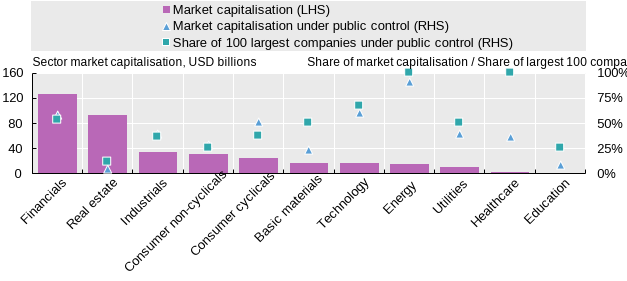
Note: Public sector control is defined as companies where the public sector owns 25% or more of outstanding shares. Largest 100 companies in terms of market capitalisation. The analysis includes UPCoM.
Source: OECD Capital Market Series dataset.
2.1.1. Corporate governance framework and company practices
As in most jurisdictions, the corporate governance framework in Viet Nam rests on a combination of laws, regulations, guidelines and institutions. The Law on Enterprises 2020 and Law on Securities 2019 (amended in 2025 and 2024, respectively) contain the core provisions regarding corporate governance. These are further elaborated in Decree No. 155/2020/ND-CP, as amended by Decree No. 245/2025/ND-CP. In 2025, the Prime Minister’s Decision No. 2014/QD-TTg on the Approval of the Scheme for Upgrading Securities Market clarified the expected adherence to international best practices on corporate governance, including OECD standards. Companies operating in certain sectors are subject to additional requirements, such as those under the Law on Credit Institutions in the case of the banking sector (Government of Viet Nam, 2020[4]; Prime Minister of Viet Nam, 2025[5]).
Additional requirements and recommendations are set out in the stock exchange listing rules, the recently updated Viet Nam Corporate Governance Code 2026 (hereafter the “Code”) and the Viet Nam Corporate Governance Manual 2025. The revised Code aims to align more closely with the G20/OECD Principles and the code recommends a “comply or explain” approach, but listed companies are not yet required to report against it on that basis. As of mid-2026, the SSC is assessing the differences between the practices recommended in the Code and the existing legal framework, with a view to incorporating suitable practices into regulation where appropriate. Meanwhile, the Corporate Governance Manual provides detailed guidance on core concepts to facilitate application of the Code (SSC, 2025[3]; SSC, 2026[6]).
The stock exchanges and market participants also annually organise the Vietnam Listed Company Awards (VLCA) and produce an aggregate report on the state of corporate governance. The Vietnam Institute of Directors has also introduced the VNCG50 initiative, which recognises pioneering companies committed to applying corporate governance best practices, with the intent of developing an index based on companies with strong corporate governance practices (SSC, 2025[7]; VIOD, 2025[8]).
The effectiveness of the corporate governance framework in shaping company practices appears to be lagging behind that of peer countries, although significant parts have recently been updated. Viet Nam scored a total of 60.2 points out of 130 in the 2024 ASEAN Corporate Governance Scorecard, below regional peers (Figure 2.2). While such numerical evaluations have their limitations in a “comply or explain” framework, these results highlight certain weaknesses.
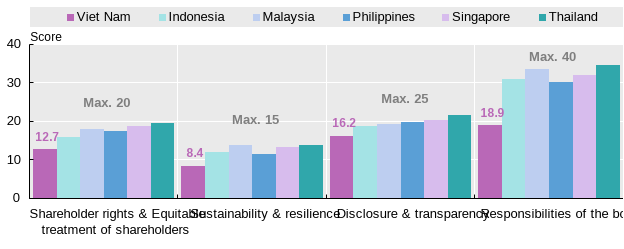
Note: Parts A and B in the ASEAN Corporate Governance Scorecard have been combined in the Shareholder rights & Equitable treatment of shareholders category. On top of the scores of each of the areas of assessment, jurisdictions are also given a maximum of 30 extra points from bonuses and penalties based on corporate governance practices not captured in the areas above.
Source: ACMF (2026[9]), 2024 ACGS Country Report and Assessments, https://acmfcms.assistasia.org/uploads/2024_ACGS_Country_Reports_and_Assessments_84d6089d23.pdf
Digital tools are also facilitating shareholder engagement. The 2020 Law on Enterprises recognises participation and voting through online meetings and electronic voting, while VSDC provides an electronic voting platform (V-Vote). Listed companies have also begun to adopt online and hybrid annual general meetings, facilitating shareholder participation. These arrangements can make participation easier, particularly for minority shareholders and foreign investors.
Taken together, the current legal and regulatory framework for corporate governance in Viet Nam has improved significantly. The key challenge relates to the actual implementation of practices, as the development of a fiduciary culture is still in progress (Quinn, 2020[10]).
Functioning of the board of directors
The predominant governance model in Viet Nam is a two-tier board, comprising a board of directors and a supervisory board. The board of directors in Viet Nam must consist of 3 to 11 members, with the term of each not exceeding five years. Independent directors can be appointed for at most two consecutive terms. The supervisory board has three to five members chosen by the annual general meeting. The Law on Enterprises 2020 also provides for an alternative governance model, first introduced by the 2014 law, comprising a single board of directors with an audit committee.
Independent directors
One major reason for the low score on the “Responsibilities of the Board” category of the ASEAN Corporate Governance Scorecard is the persistent challenge of board independence (Figure 2.2). Independent directors are widely seen as one of the most important features to protect minority shareholders (OECD, 2023[11]). For listed companies, a minimum number of independent directors applies depending on board size (one member for boards of three to five members, two for six to eight members, three for nine to eleven members), meaning that as few as 20% of directors need to be independent (one member on a five-member board). This threshold is lower than in all peer countries except the Philippines (Table 2.1) (Government of Viet Nam, 2020[4]). This requirement applies to the board of directors of both companies with one- and two-tier boards. The new Code recommends that at least one-third of directors should be independent, along with forming audit, nomination and remuneration committees with independent chairs, a majority of independent directors and only non-executive members. These recommendations are not binding and go beyond the statutory minimums, which correspond to one-third of the board only for certain board sizes.
Note: [ ] indicates a requirement by the listing rule or regulation; ( ) indicates a recommendation by codes or principles. For Indonesia, the 30% refers to the supervisory board (Board of Commissioners). For Viet Nam, regulation provides the provisions within brackets while the corporate governance code recommends that the board should be comprised of at least one-third of independent directors.
Source: PSE (2026[12]), Main Board - IPO Listing Requirements, https://www.pse.com.ph/ipo-listing-requirements/#listing1; IDX (2026[13]), Stocks, https://www.idx.co.id/en/products/stocks/; SGX (2026[14]), Board Matters, https://rulebook.sgx.com/rulebook/board-matters-1; Bursa Malaysia (2026[15]), Listing Criteria, https://www.bursamalaysia.com/listing/get_listed/listing_criteria; SET (2022[16]), Independent Director and Audit Committee Rules Summary, https://media.set.or.th/set/Documents/2022/Jul/Independent_Director_and_Audit_Committee.pdf; Government of Vietnam (2020[4]), Decree No. 155/2020/ND-CP, https://congbao.chinhphu.vn/van-ban/nghi-dinh-so-155-2020-nd-cp-32880.htm; SSC (2026[6]), Corporate Governance Code of Viet Nam 2026, https://ssc.gov.vn/cs/idcplg?IdcService=GET_FILE&allowInterrupt=1&dID=172904&dDocName=APPSSCGOVVN1620164551&filename=CG%20code_full_02022026.pdf.
In Viet Nam, the two-tier governance model is used by 79% of listed companies. Members of the supervisory board must not be company managers, their terms must not exceed 5 years, and they may be re-elected for an unlimited number of terms. Members should have relevant financial or business administration education, should not be related to the directors on the board of directors or executives, and need not be shareholders or employees of the company, unless the company charter provides otherwise. The responsibilities of the supervisory board include oversight of the board of directors, CEO, financial statements, internal control, audit risk management, carrying out inspections at the request of shareholders and proposing improvements to the company’s organisational structure. Further requirements stipulate that the head of the supervisory board must have relevant educational qualifications, and that board members may not work in the company’s accounting or finance department nor be members or employees of the audit firm that has audited the company’s financial statements in the preceding three years (Government of Viet Nam, 2020[4]; National Assembly of Viet Nam, 2024[17]; VLCA, 2025[18]).
Two-tiered board structures are commonly associated with stakeholder-oriented corporate governance systems (Germany) or jurisdictions with concentrated ownership and a strong presence of controlling shareholders (Continental Europe, Indonesia, Viet Nam). While a well-functioning two-tier model effectively addresses the ownership-management agency problem, it generally puts less emphasis on controlling the influence of majority shareholders over minority shareholders. In Viet Nam, minimum independence requirements for the board of directors can partly mitigate this issue. However, because the supervisory board, tasked with most key oversight functions, is not subject to comparable independence requirements, the potential benefits of independent directors could be undermined.
Board independence in Viet Nam is set by both a mandatory minimum requirement and a more ambitious voluntary recommendation. Listed companies in Viet Nam have on average 1.4 independent directors, lower than in peer countries (Figure 2.3, Panel A). Compliance with the statutory minimum is high. According to the SSC, only around 6% of listed companies do not meet it. However, only 38% of listed companies have at least one-third of independent directors (Panel B) and only 2% have an independent chairperson (Panel C).
In several peer countries, the corporate governance framework seeks to reinforce independence at the level of the chairperson. In Malaysia and Singapore, the corporate governance code recommends that the chair be independent, and if the chair is not, the board should have a majority of independent directors (Malaysia) or appoint a lead independent director (Singapore). In Thailand, the corporate governance code focuses on the independence vis-à-vis management. In Viet Nam, the revised Code recommends that the chairperson should be independent, or if they are not, that a lead director be appointed. However, the code is not yet applied on a “comply or explain” basis for listed companies.
Only 2% of assessed companies hold at least one annual meeting of non-executive board members without executives present, as recommended by the Code (VLCA, 2025[18]).

Note: In panels A and B, the data for Viet Nam is based on analysis of the board of directors of a 481-company sample from the Corporate Governance Assessment Report 2025 and consultations with VIOD. For the peer countries, the OECD Capital Market Series dataset has been used for both panels A and B. Panel C is based on the same sample of 481 companies.
Source: OECD Capital Market Series dataset; VLCA (2025[18]), Corporate Governance Assessment Report Vietnam Listed Companies 2025, staticfile.hsx.vn/Uploads/UploadDocuments/2421948/VLCA 2025 - Corporate Governance Assessment Report Vietnam Listed Companies 2025 - EN.pdf; VNIDA (2023[19]), Report on Independent Directors Survey in Public Companies in Vietnam, https://www.vnida.vn/wp-content/uploads/2019/09/Report-on-Independent-Directors-Survey-in-Public-Companies-in-Vietnam.pdf.
During OECD consultations, market participants highlighted opportunities to further strengthen the independence of directors in practice. The application of rules is perceived as legalistic, with the rules being followed to the letter rather than in substance. This results in independence on paper, but not necessarily in effect. For example, the independence test in the Law on Enterprises captures a director’s spouse, parents, children and siblings, but does not extend to relationships by marriage (in-laws) or to more distant relations that could nonetheless compromise independence in substance (National Assembly of Viet Nam, 2020[20]). The G20/OECD Principles suggest that such “negative” presumptions, which define independence through enumerated disqualifying relationships, can usefully be complemented by “positive” criteria, including a requirement for the board to make an affirmative finding that a director has no material relationship that could interfere with the exercise of independent judgement. This affirmative-finding approach is followed in a number of jurisdictions (OECD, 2023[11]; National Assembly of Viet Nam, 2020[20]).
Committees, internal control and the corporate secretary
As most listed companies have opted for the supervisory board model, the use of audit committees remains limited. However, the revised Code is expected to encourage their wider adoption. Around 21% of companies have such committees (Figure 2.24, Panel A) (VLCA, 2025[18]). Of the companies with an audit committee, 96% comply with the legal requirement of having an independent chairperson (Government of Viet Nam, 2020[4]). The Code further recommends that a majority of committee members are independent, that it meets at least four times a year, instead of the legally mandated two, and that companies with a two-tier structure also set up an audit committee (SSC, 2026[6]).
Nomination and remuneration committees also remain uncommon. Only 13% of companies in Viet Nam have established these committees, and of those that do, only 3% have independent chairpersons (Panel B) (VLCA, 2025[18]). While the new Code includes recommendations on nomination, remuneration and risk management committees, and emphasises their independence, it has yet to be widely adopted. In Singapore and Malaysia, nomination committees are mandatory, while in Thailand they are recommended by the corporate governance code with approximately half of listed firms complying, in which nearly 80% of such committees are composed of a majority of independent directors (OECD, 2025[21]).

Note: Based on a sample of 481 companies. In Panels A and B, the share of companies with an independent committee chairperson is calculated as a percentage of companies that have established an audit committee or a nomination/remuneration committee. Panel C is based on the ASEAN Corporate Governance Scorecard 2024 and a sample of 69 companies.
Source: VLCA, (2025[18]), Vietnam Listed Company CG Assessment Report 2025, https://staticfile.hsx.vn/Uploads/UploadDocuments/2421948/VLCA%202025%20-%20Corporate%20Governance%20Assessment%20Report%20Vietnam%20Listed%20Companies%202025%20-%20EN.pdf.
Reflecting the limited use of audit committees, the internal audit and internal control systems in Vietnamese listed companies show significant room for improvement. Only 12% of listed companies perform a full assessment of their internal control systems (Panel C). The G20/OECD Principles (see sub-Principles V.D.2-3 and V.D.7-8) emphasise the importance of strong internal audit and control systems in supporting effective audit committee oversight. Ultimately, safeguarding corporate assets is paramount for building investor trust in emerging markets, where ex-post redress might be perceived as challenging. Market participants noted that companies outside the VN30 index may have more limited resources and capacity to ensure comprehensive compliance.
Viet Nam established a unified internal audit regime in 2019, mandatorily applied to listed companies, state-owned parent companies and certain public sector bodies, while reporting lines were left flexible. The Code emphasises the responsibility of the board for oversight of internal control and risk management through committees and it requires internal audit to report directly to the audit committee (Government of Viet Nam, 2019[22]; SSC, 2026[6]). However, in-house control systems remain relatively underdeveloped. An analysis of 210 firms between 2018 and 2023 found that outsourcing the internal audit unit, compared to developing it in-house, has a significant positive effect on return on equity (Nga, Binh and Loan, 2025[23]). This highlights the potential gains from strengthening governance, while also pointing to clear differences in the quality of in-house and outsourced internal audit systems.
In Viet Nam, the corporate secretary holds an important role in the corporate governance framework, but their actual professional expertise is limited. While the regulation focuses on the administrative side of the role, the Code highlights the corporate secretary’s function in (1) advising on governance matters, (2) acting as a bridge between the board and management and (3) inducting new directors (Government of Viet Nam, 2020[4]; SSC, 2026[6]). In peer countries such as Malaysia, Thailand and the Philippines, the corporate secretary plays an important supportive role in ensuring good corporate governance, according to the ASEAN Corporate Governance Scorecard. However, relatively few corporate secretaries in Viet Nam have the required legal, accounting or business administration training (SSC, 2025[3]; ACMF, 2026[9]).
Minority shareholder protection
A central tenet of the G20/OECD Principles and the new Vietnamese Code is that the corporate governance framework should protect and facilitate the exercise of shareholder rights and ensure the equitable treatment of all shareholders. These rights centre on essential protections such as transparent and timely disclosure, effective participation in shareholder meetings, approval of extraordinary transactions and effective redress for the violation of shareholder rights, all of which can improve asset utilisation and reduce agency costs (Nguyen and Pham, 2021[24]).
Disclosures
The Vietnamese disclosure regime has significantly improved in recent years and the framework is broadly comparable with that of regional peers. The Law on Securities, Circular No. 96/2020/TT-BTC and Circular No. 95/2020/TT-BTC amended by Circular No. 138/2025/TT-BTC set out the core disclosure requirements, including those related to extraordinary events, timeliness and format (Ministry of Finance of Viet Nam, 2020[25]). Further regulation in 2020 introduced a roadmap for the adoption of IFRS by all SOEs, listed companies and large unlisted public companies, with a voluntary phase from 2022 to 2025 and a mandatory phase envisaged thereafter (with its scope and timing to be determined by the Ministry) (Ministry of Finance of Viet Nam, 2020[26]). Supporting this development, regulation issued in 2025 provides updated guidance on the application of the Vietnamese Accounting Standards, effective from the start of 2026. Along with the amended Law on Accounting 2024, this brings Vietnamese accounting practices closer to IFRS principles, notably through the shift to a principles-based approach, broader fair value measurement and revenue recognition guidance aligned with IFRS 15 (KPMG, 2025[27]; Ministry of Finance of Viet Nam, 2020[26]; Ministry of Finance of Viet Nam, 2025[28]).
Disclosure administration was further streamlined in 2024, allowing companies to report key disclosure information to their respective stock exchange, which then uploads it to the SSC’s Information Disclosure System (SSC, 2024[29]). More recently, the SSC, the stock exchanges and the International Finance Corporation have initiated early-stage discussions on the use of artificial intelligence tools to assess the quality and completeness of company disclosures. Despite progress towards centralising information on the back end, the interface is not comparable to investor-facing platforms such as the SEC’s EDGAR in the United States, which offers structured search, reliable historical disclosure, standardised filings, APIs and bulk access. The Information Disclosure System could be further enhanced to facilitate investor access, as corporate information remains distributed across stock exchange platforms, a separate corporate bond portal and company websites. The revised Code also makes significant strides in pushing for stronger disclosures. It updates recommendations to enhance disclosure on material information on related party transactions, capital structure, group structure and indirect ownership, sustainability and resilience, foreseeable material risks, remuneration policies and linking them to long-term value creation.
Importantly, the Code also recommends a “comply or explain” approach to its application as a whole, which would markedly improve disclosures for companies under such a mandate. However, current practice nonetheless remains weak. Only 30% of companies have a policy prohibiting loans to board members and only 7% have a policy requiring a committee or independent director to oversee related party transactions (Figure 2.5). Only 6% of companies report that these transactions are conducted on an arm’s length basis. For material transactions where related shareholders are involved, only 16% of companies require that related shareholders abstain from voting on such transactions.
Voluntary shareholder engagement and disclosure also remain limited. Only 22% of companies have established an investor relations function and 6% disclose their application of the corporate governance code. While the upgrade to emerging market status will likely increase investor interest, it will also increase expectations on listed companies to engage with investors.

Note: RPTs stands for related party transactions. Based on a sample of 69 companies assessed in the ASEAN Corporate Governance Scorecard 2024.
Source: VLCA, (2025[18]), Vietnam Listed Company CG Assessment Report 2025, https://staticfile.hsx.vn/Uploads/UploadDocuments/2421948/VLCA%202025%20-%20Corporate%20Governance%20Assessment%20Report%20Vietnam%20Listed%20Companies%202025%20-%20EN.pdf.
Another central transparency issue is beneficial ownership, for which a comprehensive framework entered into force on 1 July 2025. The amendments to the Law on Enterprises introduced an operational definition and require companies to collect, update and retain information on their beneficial owners, and provide it to the authorities upon request. Supporting regulation sets an ownership threshold of 25%, applying to both direct and indirect ownership and is complemented by provisions on other scenarios where control is achieved. As only 66% of companies currently disclose direct ownership of major shareholders, robust enforcement of this new framework could significantly improve transparency on ownership (National Assembly of Viet Nam, 2025[30]; VLCA, 2025[18]; Government of Viet Nam, 2025[31]).
While increased transparency on beneficial owners improves transparency in company groups, important issues at the group level remain. The Law on Enterprises allows horizontal cross-shareholdings across companies without a clear parent but restricts subsidiaries owning shares of their parent company and the cross-shareholdings of companies within the same group. However, market practices suggest that these restrictions may sometimes be addressed through the use of intermediary entities (Dat, 2025[32]).
Viet Nam has also strengthened its legal framework for personal data protection through the adoption of Law No. 91/2025/QH15 on Personal Data Protection, which entered into force on 1 January 2026. The law establishes requirements for the collection, processing, sharing and protection of personal data, including investor information. Its implementation is relevant for information-sharing arrangements among the State Securities Commission (SSC), stock exchanges and Viet Nam Securities Depository and Clearing Corporation (VSDC), as well as for the processing of investor account data through foreign platforms. These developments provide an opportunity to strengthen data governance and investor protection while facilitating the secure exchange of information across capital market institutions.
Related party transactions
In Viet Nam, transactions between a public company and shareholders holding more than 10% of the ordinary shares, members of the board of directors, members of the supervisory board, the CEO and other executives, their related persons, as well as companies in which those persons or their related persons have specified ownership interests, must be approved by the board of directors or the general meeting of shareholders, as applicable, and be publicly disclosed. The framework was recently strengthened with the tightening of beneficial ownership disclosure requirements. Members of the board of directors and shareholders with interests related to the parties in a transaction must not vote on transactions in which they or their related persons have an interest (National Assembly of Viet Nam, 2025[30]; Government of Viet Nam, 2020[4]).
These requirements establish a broad ex-ante approval and disclosure framework. However, the calibration of certain safeguards is less stringent than in several peer countries. The general threshold for when transactions require shareholder approval is higher than in peer countries (Table 2.2). The general meeting of shareholders must approve: (1) related party transactions with an individual value of at least 35% of total assets, or those that bring the aggregate value of such transactions over a 12-month period to that threshold; and (2) related party transactions over 10% of the total assets and conducted between the company and a shareholder holding at least 51% of voting shares, or a related person of that shareholder. Shareholders related to the counterparty must not vote. Depending on whether the one- or two-tier governance model is used, either the audit committee or the supervisory board should review transactions and offer recommendations. However, unlike peer countries, Viet Nam does not require an external opinion on material transactions, and the applicable thresholds may be relatively high compared with peers.
Note: Net tangible assets are total assets minus liabilities and goodwill and other intangibles.
Source: OECD (2025[33]), SET (2003[34]), OJK (2020[35]), SEC Philippines (2019[36]), Congress of the Philippines (2018[37]), Hiswara Bunjamin and Tandjung (2020[38]), Government of Vietnam (2020[4]).
In OECD consultations, some market participants raised concerns about whether related-party transactions are consistently supported by sufficiently detailed disclosure and demonstrable arm’s-length terms. Regulations require that fundamental information on assessed transactions is disclosed and that public companies should disclose information on transactions approved by the annual general meeting or board, but they do not elaborate on what information should be included. The Code recommends that companies issue a written policy on related party transactions, including disclosure requirements, and the Corporate Governance Manual 2025 suggests some basic content that could be included. Combined with the limited independence of directors, this might foster an environment where insiders are given substantial discretion and information asymmetry between them and minority shareholders (Cao, 2022[39]; Ministry of Finance of Viet Nam, 2020[25]).
While transactions and contracts can be invalidated by a court decision, recourse through legal remedies is relatively uncommon in Viet Nam. As oversight remains primarily procedural, there is scope to strengthen substantive reviews, particularly in light of recent cases that have highlighted the importance of effective monitoring and enforcement (Dat, 2025[32]).
2.1.2. Recommendations
To strengthen corporate governance, the Vietnamese authorities could consider:
Requiring listed companies to report against the 2026 Corporate Governance Code on a “comply or explain” basis, phased in over time.
Facilitating monitoring through an efficient single access point for corporate information.
Refining the definition and criteria of independent directors and phasing in the Code’s one-third independence threshold as a mandatory requirement for listed companies, and supporting the development of a diverse pool of capable independent directors.
Increasing the share of listed companies with audit committees, encouraging companies to strengthen internal control functions, and ensuring audit committee oversight.
Promoting the use of nomination and remuneration committees, the formalisation of director nomination and selection process, and the implementation of regular board evaluations.
Improving corporate governance capabilities and knowledge among directors, executives and corporate secretaries, including through continuing professional education requirements.
Tightening rules for related party transactions, including by lowering thresholds for shareholder approval, requiring external opinions, ensuring review by the internal audit and audit committee, and considering a “majority of the minority” approval requirement for transactions subject to shareholder approval.
Strengthening corporate governance is important for the continued development of Viet Nam’s capital markets. Effective governance can enhance investor confidence, strengthen corporate accountability and facilitate companies’ access to market-based financing. It can also support more efficient capital allocation and the sustainable growth of the corporate sector. While various regulatory reforms have been implemented in recent years, key challenges persist and warrant further measures.
Reporting against the revised Code on a “comply or explain” basis could be gradually made mandatory for listed companies, starting with the VN30 companies, while stronger incentives (e.g. index inclusion) could encourage adherence. Monitoring could be enhanced through a centralised information portal and more detailed assessments of companies’ application of the Code. Stock exchanges could also further develop the annual Corporate Governance Assessment Report of the Vietnam Listed Companies Awards into a more comprehensive source on how companies apply the Code.
Given the limited tradition of fiduciary practice, expanding the use of independent directors is central to improving the quality of governance in Viet Nam. Ensuring genuine independence is critical. Authorities could tighten definitions and require boards to affirm that directors have no material relationships impairing independent judgement. The minimum mandatory proportion of independent directors could also be gradually increased to one-third for all listed companies, in line with the Code. The SSC could work with VIOD and VNIDA to expand the pool of candidates through training and certification, including continuing professional education for directors, alongside networking and mentorship programmes to attract diverse talent. Increasing the participation of international candidates could broaden the pool of qualified directors, strengthen independence and support the internationalisation ambitions of domestic private companies. A phased rollout of enforcing minimum independence requirements across all companies listed could be adopted.
Addressing the limited use of audit committees is another priority. More than a decade after the one-tier model’s introduction, only 21% of companies have one. Given concerns around related party transactions and recent court cases, authorities could encourage broader adoption of audit committees while ensuring their independence. Wider adherence to the Code’s audit committee provisions could also strengthen internal control systems. Currently, only 12% of companies conduct full assessments, and perceived effectiveness remains low. Authorities and exchanges should signal that strong internal audit and control functions are expected and could consider making elements of Section 2 (Control Environment) from the Code mandatory, supported by guidance in the Corporate Governance Manual.
Greater adoption of the Code would likely also encourage nomination and remuneration committees and a higher presence of independent chairs of these committees. Stock exchanges could require or incentivise their establishment and work with VIOD and VNIDA on capacity-building. Formalising nomination and selection processes, including through external recruitment services, would strengthen integrity, independence and board competence. Requiring or recommending a written nomination procedure, developed by the board, approved by shareholders and overseen by the nomination committee, would further reinforce governance. Regular board evaluations could also be promoted. Corporate governance capabilities and knowledge among directors, executives and corporate secretaries could be strengthened, including through continuing professional education requirements.
Stricter thresholds for related party transactions would bring Viet Nam closer to ASEAN peers and provide stronger safeguards. Measures could include lowering thresholds for shareholder approval, requiring external opinions, and ensuring internal audit and audit committee review. Requiring companies to adopt accessible policies on related party transactions, using suggested guidance in the Corporate Governance Manual as a template, would further strengthen oversight. For transactions subject to shareholder approval, introducing a “majority of the minority” requirement should be considered. The SSC could also strengthen monitoring capacity and support whistleblowing and auditor flagging. Ultimately, effective oversight will depend on strong audit committees and internal control systems.
A well-functioning equity market complements bank-based financing by channelling long-term patient capital to companies and offering investors an efficient way to share in their returns. In Viet Nam, both the public and private segments of this market have considerable scope for further development relative to the size of the economy. The listed segment has experienced limited new issuance in recent years. Meanwhile, the private equity and venture capital market is still at an early stage and is heavily dependent on offshore capital. This section examines these two segments, identifying the structural features that shape companies’ access to equity financing and suggests reforms that could improve it.
2.2.1. Public equity markets
Viet Nam’s primary equity market has seen fewer new listings and increased delistings in recent years. Between 2020 and 2025, the number of companies listed on HOSE and HNX fell from 745 to 703. Over the same period, 102 companies were admitted to exchanges while more than 140 either transferred to UPCoM or exited the market entirely, resulting in a net decline in the number of listed companies since 2022 (Figure 2.6, Panel A). The decline was most pronounced in 2023, when delistings and transfers to UPCoM together exceeded 30 companies, leading to a net loss of over 20 listed companies from stock exchanges in a single year. Although 2025 brought a partial improvement, net listings remained negative. Other ASEAN markets, taken together, recorded positive net listings over the period (Panel B).

Source: OECD Capital Market Series dataset, LSEG, Bloomberg, see Annex for details.
IPO activity has been weak in recent years. Indeed, only a small number of companies were listed in 2021 and 2022 through IPOs, and IPO activity slowed further in 2023, amid a global downturn in IPO activity (Figure 2.7, Panel A). The partial recovery recorded in 2025 with five IPOs was concentrated in the financial sector. Issuance proceeds were also weak between 2020 and 2024, reflecting both a small number of transactions and modest deal sizes (Panel B). The increase recorded in 2025 is almost entirely attributable to two large securities-firm IPOs.

Note: Panel A reports listings by year of listing on HOSE or HNX. Panel B reports IPOs by year of IPO. The two panels therefore do not reconcile when an IPO and its subsequent listing fall in different years. In Panel A, “JSC direct listing” refers to a joint-stock company (JSC) listing its shares directly on HOSE or HNX without first registering for trading on UPCoM. Under the listing rules in force since 2021, this route is no longer available. Companies that have traded on UPCoM for two years may be eligible for transferring to HNX or HOSE, denoted by the “Transfer from UPCoM” category, with exemptions applying to companies that have conducted a public offering or that has been privatised.
Source: OECD Capital Market Series dataset, LSEG, Bloomberg, see Annex for details.
The main channel for new listings over this period has been the migration of companies from UPCoM to the two main exchanges. These firms transferred once they had fulfilled the two-year trading history requirement and the other listing criteria set out in Decree No. 155/2020/ND-CP. UPCoM transfers accounted for around half of new listings during this period, highlighting the importance of this pathway. In contrast, SOE equitisation, which historically brought a large number of SOEs to the market, has effectively stalled since 2022. Meanwhile, the direct listing route for joint-stock companies (JSC) was discontinued as a standalone pathway, since listing rules now require at least two years of UPCoM trading history before a HOSE or HNX listing, unless the company has conducted a public offering or been equitised (Government of Viet Nam, 2020[4]).
Listing process and criteria
Viet Nam relies on a single admissions template centred on recent profitability (Government of Viet Nam, 2020[4]; Government of Viet Nam, 2025[40]). Applicants must demonstrate profitability for each of the two consecutive years preceding the year of the listing application, achieve a return on equity (ROE) of at least 5% in the preceding year and have no accumulated losses at the time of application (Table 2.3).
Unlike peer jurisdictions, the Vietnamese rulebook does not provide an alternative entry route based on market capitalisation, revenue or other measures. By contrast, peer jurisdictions including Indonesia, Malaysia and Singapore combine the profitability test with one or more alternative tracks. For example, Singapore offers three mainboard routes: a profit route; a route based on a profitable latest year paired with a market capitalisation of SGD 150 million (~ USD 117 million); and an operating revenue route paired with a market capitalisation of SGD 300 million (~ USD 234 million). Thailand and the Philippines also provide a profit route, but instead of requiring profitability in every individual year, they rely on cumulative net income tests, and neither imposes an explicit ROE hurdle.
Viet Nam’s listing framework is primarily geared towards established, profitable companies, with more limited provisions for younger, innovative firms with high growth potential. As the 5% threshold is a ratio rather than an absolute figure, a profitable company that raises equity to fund expansion may fail the test, even when its earnings are growing, since the equity base grows faster than net income during the investment phase. Rapidly expanding firms often reinvest heavily, tolerate temporarily compressed margins or raise equity to support growth, all of which suppress ROE. In peer countries, a company can still qualify for a listing by demonstrating scale, revenue generation, cash-flow capacity or cumulative profitability over a multi-year window.
1. At least 15% of voting shares must be held by at least 100 shareholders who are not major shareholders, or 10% where the charter capital is VND 1 trillion or more.
Source: PSE (2026[12]), IPO Listing Requirements - Main Board, https://www.pse.com.ph/ipo-listing-requirements/#listing1; IDX (2026[41]), Stocks, https://www.idx.co.id/en/products/stocks/; SGX (2025[42]), Mainboard, https://www.sgx.com/securities/mainboard; Bursa Malaysia (2026[15]), Listing Criteria, https://www.bursamalaysia.com/listing/get_listed/listing_criteria; SET (2022[43]), Common Shares Listing Admission, https://media.set.or.th/set/Documents/2022/Jul/Common_Shares_Listing_Admission.pdf; Government of Vietnam (2020[4]), Decree No. 155/2020/ND-CP, https://thuvienphapluat.vn/van-ban/EN/Chung-khoan/Decree-155-2020-ND-CP-elaboration-of-some-Articles-of-the-Law-on-Securities/484721/tieng-anh.aspx#tab2.
The composition of listed companies reflects the listing framework. By the end of 2025, only 17 out of over 700 listed companies were in the technology sector, and no Vietnamese technology firm had conducted an IPO in the preceding decade. This does not reflect the high dynamism of the economy. Viet Nam hosts more than 4 000 innovative start-ups and ranks among the fastest-growing digital economies in Southeast Asia, with a gross merchandise value of USD 43 billion in 2025 (equivalent to 8% of GDP) (Vietnam.vn, 2025[44]).
The 2025 Law on Science, Technology and Innovation provides the legal basis for the Vietnam Exchange and its subsidiaries to establish a dedicated listing segment for innovative start-up enterprises. The segment is intended to offer an alternative listing venue for technology and high-growth companies whose financial profiles do not meet the current admission criteria. Access is limited to professional and institutional investors and officially recognised individual investors (National Assembly of Viet Nam, 2025[45]).
IPO process and pricing mechanism
Recent regulatory reform has substantially shortened Viet Nam’s IPO-to-trading process by introducing a parallel review mechanism and tightening the post-approval admission deadline. Under the pre-reform framework, listing could only be sought after the IPO had been completed. The stock exchange then had 30 days from receipt of a complete and valid listing application to decide on the application, and issuers were required to begin trading within 90 days of listing approval (Government of Viet Nam, 2020[4]). This could create a prolonged gap between IPO and trading, leaving newly issued shares illiquid for a period and increasing market-window risk. Companies may now file the listing dossier with the stock exchange concurrently with the IPO registration dossier filed with the SSC, allowing both reviews to proceed in parallel (Government of Viet Nam, 2025[40]). Trading must now begin within 30 days of listing approval, down from 90 days. Official commentary has indicated that the overall reform may shorten the IPO process by approximately three to six months (SSC, 2025[46]).

Source: OECD elaboration.
Early implementation evidence shows a shorter IPO-to-trading interval following the reform, although the Vietnamese timeline remains longer than in peer ASEAN markets. The median period between the completion of the IPO process and the first day of trading has fallen from 156 days under the pre-reform framework to 32 days since the new framework took effect (Figure 2.9, Panel A). Even after this reduction, the Vietnamese median is still above that observed in regional peers, where the equivalent period ranges from 17 days in the Philippines and 14 days in Malaysia at the upper end, to 7 days in Thailand, 4 days in Indonesia and 2 days in Singapore (Panel B).

Note: The figure shows the median number of days between the completion of the IPO and the first day of trading. The data cover IPOs between 2022-2025, including 10 IPOs for Viet Nam and 497 IPOs for peer countries.
Source: Publicly available sources; OECD Capital Market Series dataset, see Annex for details.
The pricing methodology used in Vietnamese IPOs also differs from that used among regional peers. The Vietnamese framework relies primarily on fixed-price public offerings, under which the issuer sets the offer price before the full level of investor demand is known. This contrasts with common practice in several ASEAN peers, where bookbuilding is more widely used, particularly for larger transactions. Bookbuilding allows the IPO price to be determined through investor demand, with investors submitting indications of interest within an indicative price range before the final offer price and allocations are set.
The legal status of bookbuilding varies across ASEAN peers, ranging from de facto integration into the standard IPO workflow to coexistence with fixed-price methods. In Indonesia, bookbuilding is incorporated as a standard preliminary stage within the electronic public-offering workflow, ahead of the offering, allotment and settlement stages (GLI, 2025[47]). While in Singapore there is no single pricing mechanism mandated by the SGX, bookbuilding is among the methods commonly used by companies (Mandalore Partners, 2025[48]). In Malaysia, fixed-price offerings are more common, but bookbuilding is often associated with larger and more mature firms (Ong, Mohd-Rashid and Taufil-Mohd, 2020[49]). Indeed, the listing process for companies in Malaysia includes a roadshow and bookbuilding stage for companies listing in the Main Market and ACE Market, whereas in the LEAP market, which is targeted at small and medium-sized enterprises, there is no bookbuilding step (Bursa Malaysia, 2026[50]).
In Viet Nam, the main constraint on bookbuilding lies in the rules governing share allocation rather than in the absence of a legal framework. Under the Securities Law, when a public offering is oversubscribed, the issuer or underwriter must allocate securities to investors in proportion to the amounts subscribed (pro-rata rule). Underwriters therefore cannot exercise the discretion over allocation that is normally central to bookbuilding, which allows them to reward investors who reveal information on demand and valuation. The pro-rata rule may consequently weaken underwriters’ incentives to use bookbuilding, despite its potential contribution to price discovery.
As a result, fixed-price offerings have dominated Vietnamese private sector equity issuance in recent years. Between 2022 and 2025, fixed-price offerings accounted for four out of nine private sector transactions and raised over USD 900 million, equivalent to 43% of total capital raised. (Figure 2.10). Auctions were the second most used method of offering with three IPOs in total but accounted for a relatively smaller share (22%) of the total capital raised. Bookbuilding was used in only one transaction over the same period, raising USD 37 million and accounting for less than 2% of capital raised.

Note: The figure shows the types of initial equity offerings in Viet Nam by their share in total capital raised (USD 2 billion), covering 9 private company offerings between 2022-2025.
Source: Publicly available sources; OECD Capital Market Series dataset, see Annex for details.
Delisting regime
The delisting regime in Viet Nam prescribes fifteen distinct grounds for compulsory delisting across four broad categories: failure to maintain quantitative listing requirements; financial distress, notably consecutive years of after-tax losses or accumulated losses exceeding charter capital; corporate events such as bankruptcy or revocation of the business registration certificate; and breaches of disclosure and governance obligations (Government of Viet Nam, 2020[4]). Before any delistings are enforced, there are intermediate steps such as warnings, control measures, trading restrictions and suspensions (Vietnam Stock Exchange, 2025[51]). Companies delisted from HOSE or HNX that continue to satisfy conditions for public company status are required to register for trading on UPCoM, which is also operated by HNX but with thinner liquidity. Relisting on HOSE or HNX requires at least two years on UPCoM, plus full compliance with original listing standards. Transferring to UPCoM can have significant consequences as liquidity is usually lower. Bid-ask spreads widen, institutional coverage decreases, and companies may be subject to additional supervisory restrictions. Few companies that have transferred to UPCoM have subsequently returned to exchanges.
Analysis of individual delisting notices across HOSE and HNX between 2020 and 2025 indicates that most exits were driven by two factors: disclosure and reporting failures, and financial distress, which together accounted for around three-quarters of all delistings during this period (Figure 2.11). Disclosure and reporting failures were the single largest category, responsible for 46% of delistings. This reflects non-compliance with ongoing obligations such as the timely publication of audited financial statements or the submission of periodic reports, as well as unfavoured opinions from auditors. Financial distress accounted for a further 29% of delistings.

Source: Based on company disclosures, exchange announcements and public delisting notices.
Among delistings due to financial distress, the most frequently cited trigger was the rule requiring compulsory delisting after three consecutive years of after-tax losses, which was particularly evident in 2023. The concentration of such cases reflects an inherent structural feature of the rule. As it operates on a three-year rolling window of audited results, macroeconomic shocks tend to generate a delayed and concentrated wave of delistings several years after the initial disruption. In Viet Nam, pandemic-related losses of 2020 and the challenges experienced in the domestic real estate and corporate bond markets in 2022 contributed to an increase in delistings in 2023, when the market recorded its largest annual decline in listed companies. More than 30 companies were removed from the main boards that year, with the three-consecutive-year loss criterion accounting for around one-third of those delistings. The framework therefore tends to be procyclical as delisting requirements bind most tightly during periods of macroeconomic stress, contributing to the contraction in the listed segment.
Viet Nam’s delisting framework is relatively strict compared to peers. Three consecutive years of losses trigger automatic delisting, regardless of other listing indicators, with limited scope for regulatory discretion. Unlike some peer frameworks, this limits consideration of temporary shocks or firm-specific circumstances and may amplify delistings during economic downturns. This contrasts with some other frameworks such as Korea’s KOSDAQ Improvement Period mechanism and Australia’s ASX query-letter approach that are designed to accommodate these circumstances. These features may support market discipline in normal conditions, but they can also amplify cyclical downturns during periods of broad-based economic stress.
2.2.2. Private equity and venture capital markets
Viet Nam’s private equity and venture capital markets remain relatively limited, with a small onshore fund and domestic investor base, as well as limited links between private and public markets. The onshore fund base is small with only around 24 PE and VC funds established in Viet Nam since 2016, against 56 in Malaysia, 58 in Indonesia and 584 in Singapore (Figure 2.12, Panel A). The domestic investor base is also small, with Vietnamese investors participating in only around 14% of deal values between 2016 and 2025, the lowest share among ASEAN-6 peers (Panel B). A market largely reliant on offshore capital is more exposed to external funding cycles and tends to accumulate limited local investment expertise. Moreover, the connection with the public market has weakened over the same period. The combined share of initial public offerings and private placements has fallen from around 49% to only 4% of exits. Meanwhile, trade sales have risen from 30% to 61% (Panel C). This narrows the pipeline through which private equity feeds into public capital markets and reduces the public market exit route on which the asset class partly depends to realise returns.

Note: Panel A reports funds domiciled in each country. Panel B shows the share of total deal value in deals with participation of at least one domestic investor. Panel C shows the distribution of exits by number of transactions.
Source: OECD Capital Market Series dataset; see Annex for details.
Fundraising and fund formation
Deeper PE and VC markets depend on the availability of fund vehicles that can attract institutional investment. Currently, Viet Nam’s existing framework legal offers fewer options for PE and VC investment vehicles suited to institutional investors than those available in other countries, while its domestic investor base remains relatively small. The primary domestic vehicle is the innovative start-up investment fund (SIIF), and its recent amendment is a meaningful step even as core limitations remain. SIIFs can now invest through convertible instruments and share-purchase rights, and capital contributions may take the form of intellectual property rights, technology and technical know-how. These changes recognise that early stage ventures could hold much of their value in intangible assets, bringing the vehicle more in line with early-stage venture practices.
The SIIF, however, is not well-suited as an institutional PE and VC vehicle, particularly compared with regional alternatives (Table 2.4). The SIIF has no legal personality, so the fund management company enters into transactions on behalf of the fund. This can raise transaction costs and create legal uncertainty for institutional limited partners that require a corporate counterparty. In contrast, the Singapore Variable Capital Company (VCC) is a body corporate, and the Hong Kong (China) Limited Partnership Fund (LPF), while not a separate legal person, has a clear general and limited partner structure. During OECD consultations, market participants also identified the 30-investor cap as a constraint. A Vietnamese fund seeking to combine commitments from development finance institutions, local insurers, family offices and a sponsor may hit the limit before the fund reaches a critical fund size.
Source: Based on Decree No. 38/2018/ND-CP as amended by Decree No. 210/2025/ND-CP; Singapore Variable Capital Companies Act 2018; Hong Kong Limited Partnership Fund Ordinance 2020.
The SIIF has a narrow investment perimeter, and its focus is on early-stage venture rather than growth-equity or buyout practice. The fund management company is not allowed to invest the fund in listed or registered securities, bonds or fund certificates, and is not allowed to lend money for commercial purposes or to provide guarantees. The only allowable investments of idle fund capital are term deposits and certificates of deposit. These restrictions direct SIIF capital towards equity in unlisted Vietnamese start-ups, consistent with the early stage focus of this framework. However, this framework limits access to a broader instrument set that is typical of growth-equity and buyout strategies, such as holding listed equity upon exit, bridge financing to portfolio companies, or active treasury management.
The official registry of innovative start-up investment funds confirms the limited scale of the onshore funds. As of mid-2024, only 33 of these funds had been registered nationwide under Decree No. 38/2018/ND-CP, with aggregate contributed capital of approximately VND 413 billion (~USD 16 million), representing under 5% of Viet Nam’s venture capital market (Government of Viet Nam, 2024[52]).
The framework for state-backed venture capital is institutionally stronger, although its impact will depend on implementation choices as much as on the law. The State Capital Investment Corporation was an earlier example of state investment activity. Building on it, Decree No. 264/2025/ND-CP set out the legal framework for the establishment and operation of the National Venture Capital Fund at the central level alongside local venture capital funds at the provincial level. Unlike the SIIF, these funds have legal personality. The National Fund has initial state capital of at least VND 500 billion (~USD 20 million), targeting VND 2 trillion within five years, a 10-year investment cycle (extendable to 15 years for dual-use or strategic investments), and can invest directly, co-invest or invest in other funds. The Ho Chi Minh City Venture Capital Fund was launched in April 2026 with VND 500 billion (~USD 20 million) in capital, 40% public and 60% private. Implementation will determine the extent to which these funds mobilise private capital.
The second binding constraint is the domestic institutional investor base. The main institutional investors, including Vietnam Social Security, life insurers, voluntary supplemental pension funds and investment funds, together hold assets equivalent to around 26% of GDP. Moreover, they allocate them conservatively in government bonds and bank deposits, with limited investment perimeters that do not provide a dedicated allocation pathway for private equity and venture capital.
Capital deployment and exit
Once capital is raised, the key question is how it can be deployed and recycled. Capital deployment and exits remain challenging in Viet Nam, particularly with respect to foreign ownership rules, due-diligence infrastructure and exit options. Differences in foreign ownership limits between unlisted and listed firms, and the accounting framework (discussed in Section 2.5) also affect the universe of deployable transactions and raise the cost of due diligence.
The absence of a dedicated growth segment limits the exit options from domestic public market available to venture-backed companies. IPO activity in Viet Nam has significantly declined in recent years. For venture-backed companies, whose value lies in intangible assets and growth opportunities, the gap is structural rather than cyclical. A dedicated listing segment for innovative enterprises has been authorised under the Law on Science, Technology and Innovation, but the implementing decree remains in drafting and the segment has not yet been operationalised.
Two distinct levels of the tax system, fund level and transaction level, increases the costs associated with PE and VC activities. At the fund level, the SIIF’s lack of legal personality means that returns are taxed in the hands of investors and managers under ordinary tax rules, and there is no pass-through treatment for fund-level income or separate treatment for carried interest. At the transaction level, the new Corporate Income Tax Law and Decree No. 320/2025/ND-CP introduced a flat 2% tax on the gross amount of the transfer of LLC capital and non-public JSC shares (both direct and indirect) for foreign corporate sellers, replacing the former 20% tax on net profits. Listed securities are still taxed at 0.1% of the gross amount, and resident entities at 20% on net profits.
2.2.3. Recommendations
To facilitate companies’ access to equity financing, the Vietnamese authorities could consider:
Broadening the main board admission framework by introducing supplementary qualification tracks, such as a pathway based on market capitalisation or revenue, alongside the existing profitability test.
Operationalising the dedicated segment for innovative growth enterprises.
Building on the recent IPO-to-trading reform, further compressing the post-approval admission window and introducing dedicated retail and institutional tranches during the allocation process, with discretionary allocation within the institutional tranche, to attract early institutional interest and improve the price discovery while preserving access to retail investors.
Recalibrating the compulsory delisting regime by introducing a structured remediation period before automatic delisting takes effect, using objective, pre-defined eligibility criteria for that period, and allowing the SSC, under defined conditions, to adjust the application of delisting triggers temporarily during broad-based market downturns.
Establishing a tax-transparent investment vehicle with legal personality, no statutory investor cap and a broader investment universe, which can also accommodate state capital.
Refining the gross proceeds regime for foreign corporate sellers to mitigate its impact on loss-making exits, and clarifying through implementing guidance the treatment of indirect transfers and how these tax rules interact with Viet Nam’s tax treaties.
Viet Nam’s equity market framework shapes the breadth and resilience of the listed segment. The current admission and delisting rules favour established and profitable companies, but do not allow enough room for innovative and growth-oriented companies. Furthermore, the framework could make the market more vulnerable to economic shocks. The Vietnamese authorities could consider the following recommendations.
The main board admission framework could be broadened beyond its current reliance on profitability and ROE. Viet Nam is the only ASEAN economy that requires companies to have been profitable for the previous two years and to have met a specific ROE target. Meanwhile, growth-oriented companies are not permitted to qualify through alternative qualification tracks based on market capitalisation or revenue. Therefore, the authorities could consider creating one or more alternative qualification tracks to supplement the current profitability track.
The dedicated listing segment for innovative and growth companies under the Law on Science, Technology and Innovation could help address a long-standing gap in Viet Nam’s market architecture, provided the segment is established with proportionate and growth-oriented listing criteria. International experience suggests that dedicated growth segments rely less on rigid financial admission thresholds and more on disclosure quality, sponsor oversight and governance safeguards. Implementing regulations issued by the SSC and the exchanges could therefore establish a sponsor-led admission model combining a minimum operating history requirement, proportionate disclosure requirements, enhanced governance standards and regular sponsor oversight. Public consultation could help ensure the framework is consistent with the needs of innovative companies, while preserving market credibility and investor protection.
Building on the recent reform of the IPO-to-trading procedure, the authorities could further align Viet Nam with regional peers. The introduction of parallel review of the IPO and listing dossiers, along with the new requirement for the first day of trading to occur within 30 days of listing approval, has greatly reduced the IPO-to-trading interval. However, the median time from IPO completion to the first day of trading in Viet Nam is still longer than in regional peer markets. Therefore, the authorities could continue to monitor implementation outcomes and identify residual bottlenecks. Strengthening coordination between the SSC, the stock exchange, and other relevant institutions would help reduce the median time further.
To improve IPO price discovery, the authorities could introduce retail and institutional tranches for IPO allocation, attracting institutional investors at an early stage while preserving retail participation. Currently, when an IPO is oversubscribed, the shares are distributed proportionally, which limits the ability of issuers and underwriters to shape the investor base through the bookbuilding process. To encourage the use of bookbuilding, amendments could be made to allow discretionary allocation within the institutional tranche. Implementing rules could also cover the disclosure of price ranges and allocation policies, and the safeguards against conflicts of interest and abusive allocation practices.
The compulsory delisting regime could be recalibrated to preserve market discipline while reducing the risk of removing issuers mechanically during temporary cyclical stress. For instance, alongside the current automatic triggers, a structured remediation period could be introduced. Issuers that have recorded a third consecutive year of losses could be granted a defined window to implement a recovery plan under the supervision of the stock exchange. The criteria for applying this mechanism could be set out objectively, for instance requiring that the issuer continue to meet minimum market capitalisation, free-float and disclosure requirements. Additionally, the SSC could be granted limited, explicitly defined power to temporarily modify the application of such triggers in the event of a market-wide downturn, subject to specific activation criteria.
Access to financing remains an important constraint for young, innovative and growth-stage companies that are not well served by collateral-based bank lending and are not yet ready to list. PE and VC can help fill part of the gap, but their contribution depends on stronger fund structures, a deeper investor base and more credible exit options. The authorities may consider setting up a tax-transparent investment vehicle with legal personality, no statutory investor cap and a wider investment scope, which could also accommodate state capital. Furthermore, the tax regime for PE and VC funds could be refined to reduce transaction costs and facilitate exits. This could be achieved by clarifying the treatment of carried interest and indirect transfers, and by adjusting the gross proceeds regime for foreign corporate sellers to mitigate its impact on loss-making exits. Implementing guidance could also clarify the interaction with Viet Nam’s tax treaties.
The Vietnamese corporate bond market has three main characteristics. First, private placements have accounted for over 90% of issuance since 2020 (Figure 2.13, Panel A). These bonds face lighter disclosure obligations and are typically accessible only to a narrower group of investors. Second, issuance is concentrated in short and medium tenors. Bonds maturing in under five years made up around 70% of 2025 issuance, while the over-ten-year issuances stayed below 2% during the 2020-2025 period (Panel B). The limited long end leaves insurers, pension funds and infrastructure funds with few suitable assets and leads issuers to refinance frequently or rely on bank lending. Third, the issuer base is narrow and predominantly financial. In 2025, banks accounted for 68% of issuance and real estate companies for a further 23%, leaving the rest of the non-financial corporate sector with around 9% combined (Panel C). The market therefore functions primarily as a funding channel for credit institutions and as an alternative financing channel for property developers. Its contribution to financing the broader non-financial corporate sector remains limited to date, highlighting the market’s potential to serve a wider range of issuers and long-term investment needs as it develops.

Source: VIS (2026[53]), Corporate Bond Market Review - 2025 Annual Report, https://visrating.com/research/corporate-bond-market-review-2025-annual-report.334.html; Vietnam Bond Market Association.
Corporate bond markets can also be developed by expanding their role in financing public-private partnerships (PPPs), particularly for infrastructure projects requiring long-term financing. Viet Nam is estimated to require USD 30 billion in infrastructure investment annually, while available financing is projected to fall substantially short of these needs (World Bank, 2026[54]). Bank lending may face limitations at longer maturities, while bonds can provide an additional source of long-term capital. Guarantees and credit-enhancement mechanisms can help mitigate project risks and attract both domestic and foreign investors. Experience in Latin America provides examples, including government-backed payment certificates linked to project milestones in Peru and guaranteed revenue floors and caps in Chile. Other mechanisms include development bank and export credit agency guarantees, as well as structures where bonds refinance bank loans once projects become operational (OECD, 2024[55]).
2.3.1. Regulatory framework
The Vietnamese corporate bond market operates under two distinct issuance frameworks that differ markedly in both regulatory intensity and investor protection requirements. Public offerings (governed by Decree No. 155/2020/ND-CP and amended by Decree No. 245/2025/ND-CP) require SSC approval and a full prospectus subject to SSC review. Requirements also include a credit rating (from a rating agency licensed by the Ministry of Finance), subject to exemptions for credit institutions and bonds fully guaranteed by credit institutions or international financial institutions. Issuers of public bonds also have to comply with a maximum debt-to-equity ratio of five, with certain exemptions,1 a bondholder representative and listing on a stock exchange within 30 days of the offering (Table 2.5).
Private placements (governed by Decree 200/2026-NĐ-CP, replacing Decree No. 153/2020/ND-CP and its amendment in Decree No. 65/2022/ND-CP) operate under a substantially lighter framework requiring only submission of the pre-offering disclosure document with the Hanoi Stock Exchange one business day prior to issuance and then submission of issuance results to the HNX (Government of Viet Nam, 2026[56]). A report of the offering results shall be submitted to the SSC for certain convertible bonds and bonds with warrants.2 The rating obligation was subsequently extended to private placements offered to individual professional investors, regardless of size (National Assembly of Viet Nam, 2024[17]). A bondholder representative is not mandatory, except where private placement bonds are sold to individual professional investors.
1. Bonds must be registered 15 working days from the date on which the State Securities Commission issues a written notice of receipt of the report on the offering results of privately placed convertible bonds or privately placed bonds with warrants of public companies, securities companies or securities investment fund management companies. For other bonds, registration must be conducted 15 working days from the date on which the issuer discloses the offering results. 2 Eligible investors also include strategic investors in the case of privately placed convertible bonds and privately placed bonds with warrants.
Source: Decree 200/2026-NĐ-CP.
Issuers have been historically driven towards private placements. Until the entry into force of Decree No. 245/2025/ND-CP, public offerings required SSC approval over a 30-day timeline, against a one-business-day notification for private placements (Mayer Brown, 2022[57]). Private placements offer issuers simplified procedures, lower regulatory burdens and faster time to market, while typically targeting institutional and professional investors presumed capable of independent credit assessment.
The formal SSC review period for public offerings has been shortened under Decree No. 245/2025/ND-CP, narrowing the procedural gap with private placements. However, the cumulative timeline from board approval to prospectus drafting and SSC revie, remains materially longer than for a private placement. Peer markets have addressed this through shelf registration regimes that allow large frequent issuers to conduct public offerings using a fast-track. In Malaysia, the Securities Commission’s Guidelines on Issuance of Corporate Bonds and Sukuk to Retail Investors reduce the approval timeline for plain bonds from 40 days to 14 days where the issuer is rated AA- or higher and has issued or guaranteed at least MYR 500 million (~USD 124 million) of bonds over the preceding five years (FiinRatings, 2026[58]). The Securities and Exchange Commission of Thailand operates a more accessible variant, compressing approval from 120 days to 44 days for listed issuers rated BBB- or higher with no outstanding corporate governance concerns, and to 24 days where the issuer adopts the SEC’s standardised terms-and-conditions template.
The regulatory response to the 2022 default cycle has significantly reinforced the framework governing public offerings and private placements. The reforms tightened disclosure obligations for private placements, narrowed the scope of eligible individual investors by introducing a more stringent Professional Securities Investor test and stipulated that a bondholder representative must be appointed for placements to individual professional investors (Government of Viet Nam, 2022[59]). Subsequently, additional flexibility for distressed restructurings was introduced by allowing bond terms to be extended by up to two years3 (Government of Viet Nam, 2023[60]). Mandatory credit ratings were also extended to private placements offered to individual professional investors (National Assembly of Viet Nam, 2024[17]). The public offering framework was also strengthened by requiring bondholder representation for all offerings, expanding mandatory credit ratings and introducing semi-annual reporting on the use of proceeds (Government of Viet Nam, 2025[40]).
Nevertheless, the cumulative effect of this framework on smaller and infrequent issuers deserves consideration. The combination of mandatory credit ratings, bondholder representation, collateral or guarantee requirements and the preparation of full prospectuses increases the fixed costs of accessing the market for public offerings. While these costs can be easily absorbed by large, frequent issuers across a substantial issuance programme, the cumulative burden may be disproportionate for smaller or first-time issuers. Peer markets implement proportional mechanisms, such as simplified disclosure regimes for smaller issues and reduced procedural requirements for frequent issuers with strong compliance records.
2.3.2. Market infrastructure
A deep and liquid corporate bond market depends on a credible secondary market, a reliable government bond yield curve as the basis for risk-free pricing and the supporting infrastructure. Viet Nam has made meaningful progress on each of these dimensions in recent years. Following the 2022 market disruption, the authorities acted promptly to strengthen the legal and supervisory framework, and investor confidence has been gradually restored, with issuance showing signs of recovery. Remaining market infrastructure constraints continue to weigh on the development of Viet Nam’s corporate bond market.
Secondary trading historically took place over-the-counter (OTC), typically through bilateral transactions between dealers and their clients. The launch of a dedicated trading platform for privately placed corporate bonds on the HNX in July 2023 marked an important structural improvement, bringing trading activity onto a centralised platform and improving transparency and post-trade monitoring (VIR, 2023[61]; The Investor, 2023[62]). Trading activity on the platform has increased steadily since its introduction, with annual trading value rising to USD 41.2 billion in 2024 and USD 53.1 billion in 2025 (Figure 2.14, Panel A). The turnover ratio has risen in parallel, climbing to approximately 1.2 in 2025, indicating that secondary market liquidity has deepened. Trading in publicly offered corporate bonds has also increased over time (Panel B).
Viet Nam’s corporate bond secondary market operates on the HNX through two distinct systems with different post-trade reporting infrastructures. Bonds raised through public offerings, accounting for less than 10% of the total value of issuance, are eligible for listing on the main HNX exchange system. Once listed, these bonds are traded through the same infrastructure as listed equities, with intraday price and volume data disseminated via the HNX market data feed. The dominant private placement segment, representing over 90% of issuance value, is registered for trading on HNX’s dedicated private placement bond system, which is only accessible to professional investors. This system records transactions executed bilaterally between participants, but only publishes aggregate session and daily statistics. There is no real-time dissemination of trade-by-trade data (Hanoi Stock Exchange, 2026[63]).

Note: Panel A refers to privately placed corporate bonds traded on the dedicated HNX platform, which began operating in July 2023. The 2023 figures therefore cover only the period from 19 July to 31 December 2023. The turnover ratio is calculated as annual trading value divided by the outstanding amount of corporate bonds at the end of the corresponding year.
Source: Vietnam Bond Market Association.
Pre-trade transparency remains limited. The private placement system supports two forms of negotiated trading. The first method is electronic negotiation, whereby a trading member enters a firm bid or offer that other members can accept. The second method is conventional negotiation, whereby the parties agree the terms directly and report the trade to the system (Ministry of Finance of Viet Nam, 2026[64]). Electronic orders circulate within the member trading system and can be sent to either a specific group of at least two members or to all members. Using the former option limits the breadth of quote dissemination.
While transactions in the private placement market are automatically recorded through HNX’s dedicated trading system, the level of transaction reporting is broadly comparable to that in many peer markets. However, the transaction-level information collected through the system is not publicly disclosed (Figure 2.15). In Thailand, the Thai Bond Market Association requires its dealer members to report all OTC trades within 30 minutes of execution and publishes intraday and end-of-day reference yields for corporate bonds organised in ten credit rating buckets from BBB- to AAA (ThaiBMA, 2026[65]; ThaiBMA, 2026[66]). In Malaysia, all bond and sukuk trades are reported via Bursa Bonds’ Electronic Trading Platform and disseminated intraday through Central Bank of Malaysia’s Bond Info Hub (Central Bank of Malaysia, 2026[67]). Bond Pricing Agency Malaysia complements this with daily evaluated prices for around 2 000 bonds and sukuk, covering both publicly offered and privately placed bonds (Central Bank of Malaysia, 2026[68]).

Source: ADB (2017[69]), ASEAN+3 Bond Market Guide 2017: Philippines, http://dx.doi.org/10.22617/TCS179072-2; ThaiBMA (2026[65]), The Thai Domestic Bond Market - Market Mechanisms, https://www.thaibma.or.th/EN/Education/ThaiBondMarket.aspx; Central Bank of Malaysia (2026[67]), Bond Info Hub-Intraday Trades Summary, https://apikijangportal.bnm.gov.my/openapi?category=Bond%20Info%20Hub%20(BIH); Hanoi Stock Exchange (2026[63]), Bond Trading: General Regulations, https://www.hnx.vn/en-gb/huong-dan/chi-tiet-thu-tuc-24-53.html.
The absence of an accredited bond pricing agency in Viet Nam is a structural constraint on the development of the non-bank investor base. In jurisdictions with an accredited pricing agency, such as Malaysia’s Bond Pricing Agency Malaysia, Indonesia’s Bond Pricing Agency and Thailand’s Thai Bond Market Association (ThaiBMA), open-end mutual funds can mark their bond holdings to a daily evaluated reference and publish net asset values, which is a precondition for scaling intermediated retail demand. In the absence of an equivalent mechanism in Viet Nam, fund managers face additional challenges in valuing private placement holdings, which may affect their participation.
The credit rating ecosystem is also a precondition for broad institutional investor participation. Viet Nam has a small number of rating agencies licensed by the Ministry of Finance (FiinRatings, VIS Rating, Saigon Ratings and S&I Ratings), and the proportion of rated issuances has historically been low by regional standards. The progressive extension of mandatory rating requirements for public offerings and private placements to individual professional investors has driven a meaningful increase in rated issuers, with 137 issuers carrying a rating by the end of 2025 against 79 a year earlier (VIR, 2026[70]). Continued deepening of rating coverage and methodological transparency would strengthen the analytical foundation on which non-bank institutional investors rely.
A well-functioning corporate bond market depends critically on the existence of a deep and liquid government yield curve. Government bonds are considered to be risk-free instruments, and their central function is to provide a benchmark for pricing other securities, including corporate bonds. A deep and liquid government yield curve of different maturities ensures the reliable pricing of instruments such as corporate bonds, as well as the formation of meaningful credit spreads (World Bank, 2001[71]).
The Vietnamese government bond yield curve has limited coverage at both the short and long ends of the maturity spectrum. At the short end, the State Treasury has not issued Treasury bills since 2017, and since 2019 government bond issuance has been heavily concentrated in the 5-10 year maturity. At the longer end, issuance is limited to maturities of up to 30 years (AMRO, 2026[72]). This shift reflects a policy choice rather than market dynamics, with the Five-Year National Financial Plan and Public Debt Borrowing and Repayment Plan for 2021-2025 (Resolution 23/2021/QH15) setting a target average issuance maturity of 9 to 11 years (National Assembly of Viet Nam, 2021[73]). At the long end, although tenors of 20 and 30 years are formally on offer at each Hanoi Stock Exchange auction, demand has been weak and many auctions fail to clear. For instance, in 2025, bids covered less than half of issuance at maturities exceeding 15 years (AMRO, 2026[72]).
Issuance is heavily concentrated in a single tenor with the 10-year accounting for around 85% of gross issuance in 2025, while the 20-year and 30-year tenors were issued only symbolically, at 0.1% and 0.4% of annual issuance, respectively (Figure 2.16). In the absence of a reliable risk-free curve, corporate bonds are primarily priced on proxy reference rates, such as deposit rates of commercial banks, producing noisy credit spreads that do not fully reflect the issuer’s true risk premium.

Source: VBMA (2026[74]), Monthly Bond Market Highlights, https://vbma.org.vn/en/market-data/monthly-highlight.
2.3.3. Investor protection and market discipline
The investor base for Vietnamese corporate bonds is concentrated among domestic commercial banks. Of the corporate bonds issued in 2025, commercial banks absorbed 57% of primary allocations, and securities companies, many of which are subsidiaries of the same banking groups, a further 17% (Figure 2.17). Domestic individuals, who had held over 40% of outstanding corporate bonds at end-2021, accounted for only 4% of 2025 issuance (VIS Rating, 2025[75]). The sharp decline in retail participation is consistent with the tighter Professional Securities Investor test, which became binding from January 2024 as part of the authorities’ prompt regulatory response to the 2022 episode (Government of Viet Nam, 2022[59]). Investment funds took 0.5%, while foreign investors of all categories combined accounted for around 0.5%.

Source: Vietnam Bond Market Association.
The available evidence suggests that market activity remains largely concentrated within the banking system, with opportunities to further develop channels for mobilising non-bank savings towards corporate financing. Banks issue two types of bonds for two different prudential reasons: subordinated bonds to build the Tier 2 regulatory capital that their rapid credit growth requires, and senior bonds to lengthen funding tenors as the aggregate loan-to-deposit ratio approaches its regulatory ceiling (VIS Rating, 2024[76]). Given the limited demand for instruments, these bonds end up being bought by other banks or their subsidiaries. This pattern of financial intermediation remains prevalent despite a prudential framework that requires a full deduction from a holding bank’s Tier 2 capital of any subordinated debt issued by other credit institutions that qualifies as regulatory capital, effectively rendering such exposures a zero-sum exchange at the system level (State Bank of Viet Nam, 2016[77]). The circuit therefore operates potentially through bank holdings of senior bonds issued by other banks, which are not regulatory capital instruments and do not trigger the deduction for the holder. Securities companies, many of them subsidiaries of the same banking groups, absorb a further share through their underwriting inventory and bonds bought for their own investment portfolios.
These dynamics also reflect the limited depth of the non-bank investor pool that could otherwise absorb bank issuance. The fund management industry remains small at around 6% of GDP. The investment universe of the national social security fund remains closed to corporate bonds under the 2024 Social Insurance Law (National Assembly of Viet Nam, 2024[78]). The insurance sector’s allocation to private placement bonds is constrained to some extent by the absence of a daily fair value reference price for illiquid issues, which insurers typically require for solvency reporting and accounting purposes.
The contraction of retail participation following the 2022 reforms, although an appropriate and intended outcome from an investor protection standpoint, has not yet been offset by intermediated retail demand through bond mutual funds or other collective vehicles. Consequently, households have no direct access to privately placed corporate bonds unless they meet the Professional Securities Investor test. Indirect access through funds and other collective vehicles exists but remains limited.
This concentration of holdings in the hands of commercial banks and bank-affiliated securities companies may weaken market discipline in the corporate bond market. In more diversified bond markets, credit risk is assessed continuously by a broad range of investors, including pension funds, insurance companies, asset managers and foreign institutional investors, each applying distinct investment mandates, risk tolerances and return requirements. In Viet Nam, however, the dominance of commercial banks and bank-affiliated securities companies means that credit pricing is determined by a narrower group of investors, whose risk-pricing decisions may also be influenced by lending, underwriting, distribution or other relationships with issuers. The limited participation of other investors reduces the diversity of credit views reflected in market prices and may weaken the signalling function that bond markets perform in allocating capital towards more productive and financially sound borrowers.
Large commercial banks play an important role as both issuers and distributors of corporate bonds, which may give rise to potential conflicts of interest. This dual role highlights the importance of ensuring adequate disclosure of associated risks to investors, particularly when bonds are issued by the distributing bank or a related entity. During the 2022 corporate bond episode, some bonds were reportedly marketed to retail investors as low-risk products, despite their significantly higher credit risk (Viet Nam News, 2024[79]). In response, new regulations prohibit marketing corporate bonds in ways that could be confused with bank deposits, while stronger oversight of banks involved in bond distribution has also been recommended (Government of Viet Nam, 2022[59]; Government Inspectorate of Viet Nam, 2025[80]). While investor confidence has been gradually restored as these reforms have taken effect, recent market experiences highlight the importance of complementing regulatory reforms with effective supervision and enforcement. (Viet Nam News, 2025[81]).
Restructuring processes present a further area of concern. Recent reforms introduced greater flexibility by allowing bond terms to be extended by up to two years (Government of Viet Nam, 2023[60]). However, issuers are required to respect original repayment obligations towards any bondholder who does not consent to a proposed restructuring, even where bondholders representing 65% or more of the outstanding bonds have approved the changes (Venture North Law, 2024[82]). While this provision is intended to protect minority investors, it can make it more difficult for issuers to reach workable restructuring agreements. The Rehabilitation and Bankruptcy Law 2025 introduces a dedicated rehabilitation procedure that allows financially distressed firms to restructure at an earlier stage and facilitates creditor coordination through court approved rehabilitation plans (National Assembly of Viet Nam, 2025[83]). The new law represents an important step towards closer alignment with international restructuring practices, but its operational details for corporate bond issuers will depend on implementing regulations, particularly with respect to class-based creditor voting, the standing of the bondholder representative, and the treatment of dissenting creditors and new lenders (A&O Shearman, 2026[84]).
2.3.4. Recommendations
To expand access to long-term financing via corporate bonds, the Vietnamese authorities could consider:
Applying proportionality to certain post-2022 requirements to simplify disclosure for smaller issues, and introducing a shelf registration regime for frequent and well-rated issuers.
Continuing enforcement through inspections and timely sanctions, while addressing conflicts of interest arising from the multiple roles of commercial banks as issuers, underwriters and distributors of corporate bonds.
Improving market infrastructure by enhancing post-trade disclosure, supporting the development of accredited bond pricing providers, and strengthening the benchmark formation along the government bond yield curve through a predictable issuance programme.
Diversifying the investor base by extending Vietnam Social Security’s permitted investment universe to allow gradual and prudential allocations to corporate bonds, deepening the credit rating ecosystem, and continuing to strengthen the operational foundations for collective investment schemes.
Expanding the role of corporate bonds in financing public-private partnerships (PPPs) for infrastructure projects.
Introducing standardised collective action clauses allowing a qualified supermajority of bondholders to approve binding restructuring terms, and supporting the operationalisation of the Rehabilitation and Bankruptcy Law through implementing regulations addressing class-based voting and the treatment of dissenting creditors and new financing.
Viet Nam’s corporate bond market has grown rapidly and plays an increasingly important role in corporate financing. However, the heavy reliance on private placements, the concentration of issuance among banks and real estate companies, the incomplete government bond yield curve, the narrow non-bank investor base and structural conflicts of interest continue to constrain its development. Building on the regulatory reforms introduced since 2022, the following recommendations aim to support a well-functioning and resilient market while preserving the investor protection gains achieved during the most recent reform cycle.
Recent reforms have strengthened market integrity, although their combined impact on issuance volumes warrants close monitoring. Authorities could consider applying proportionality to certain requirements, for example by simplifying disclosure for smaller issues or by easing procedural requirements for frequent issuers with strong compliance records. A shelf registration regime for frequent and well-rated issuers, modelled on the Malaysian and Thai frameworks, would materially reduce cumulative public offering timelines.
Sustained enforcement of the strengthened framework is essential to restore investor confidence. Authorities could further strengthen supervisory capacity, expand risk-based inspections, and ensure that sanctions are applied in a timely and proportionate manner. The multiple roles of large commercial banks as issuers, underwriters and distributors of corporate bonds, often through securities firms’ subsidiaries within the same banking group, warrants particular attention. Internal separations between the bank’s lending, underwriting and distribution functions could be reinforced, enhanced risk disclosure could be required where bonds are distributed to retail or non-professional clients by affiliated entities, and the prohibition on marketing bonds as comparable to bank deposits could be monitored through ongoing supervision.
Improving market transparency and pricing infrastructure should remain a priority. Authorities could enhance the public dissemination of post-trade information, drawing on the Thai Bond Market Association’s 30-minute trade reporting requirement and the Central Bank of Malaysia’s Bond Info Hub. Establishing accredited bond pricing providers, modelled on regional precedents, would address a binding operational constraint on insurance company and mutual fund participation. Strengthening the formation of benchmarks along the government bond yield curve through a predictable issuance programme could also support the pricing of corporate bonds. The investor base remains concentrated among commercial banks and securities companies, which absorbed around three-quarters of 2025 primary issuance. Authorities could pursue diversification through several complementary measures: extending the investment universe of Vietnam Social Security to permit gradual and prudential allocations to corporate bonds; deepening the credit rating ecosystem; and continuing to strengthen the operational foundations for collective investment schemes.
The recent reform allowing maturity extensions has helped manage acute distress, but the obligation to honour original terms to non-consenting bondholders creates a holdout problem. Standardised collective action clauses, subject to appropriate safeguards, would allow a qualified supermajority to approve restructuring terms binding on all holders. The recently enacted Rehabilitation and Bankruptcy Law represents an important step towards alignment with international standards. However, its implementing regulations would benefit from addressing class-based voting, the role of bondholder representatives in rehabilitation, and the treatment of dissenting creditors and new financing, in a manner that allows the contractual and statutory routes to restructuring to operate as complementary regimes.
Expanding the role of corporate bonds in financing public-private partnerships (PPPs) for infrastructure projects can help address Viet Nam’s infrastructure gap while supporting the development of the corporate bond market. Corporate bonds can complement bank lending by providing the longer-term financing typically required for infrastructure projects and by mobilising institutional investor capital. Their use could be supported through appropriate credit-enhancement mechanisms such as government-backed payment certificates linked to project milestones, guaranteed revenue floors and caps, development bank and export credit agency guarantees, as well as structures where bonds refinance bank loans once projects become operational.
Large scale mobilisation of capital will be crucial for reaching Viet Nam’s ambitious growth targets. Strengthening the domestic investor base represents a major opportunity to facilitate the participation of households and other investors in the overall growth of the country. As foreign participation is to some degree constrained by the non-investment grade sovereign credit rating and controlled capital flows, developing the domestic investor base and building pools of long-term capital will ease limitations and structurally help lower costs and increase diversification of funding for the corporate sector (FiinRatings, 2025[85]).
2.4.1. Institutional investors
Developing a broad and deep long-term investor base constitutes a major opportunity to strengthen capital markets’ funding capacity. While retail investors can improve liquidity and broaden the investor base, they also tend to exhibit a higher degree of herd behaviour and short-termism. Institutional investors such as pension funds, insurance companies and investment funds can add considerable value as they provide a more professionalised investor base that may have long-term incentives to support better corporate governance. Some of these investors often have long-term liabilities and thus long-term investment horizons to match their obligations. A third of surveyed Vietnamese insurance companies prefer bond maturities of 7 to 10 years and a third 10 to 30 years (FiinRatings, 2026[86]). Institutional investors are also essential for capital formation, pooling large pots of funds and acting as anchor investors in initial and secondary equity offerings, and bond issuances.
In Viet Nam, the institutional investor base has room to grow. Institutional investor holdings amount to 26% of GDP, higher than in Indonesia (11%) and the Philippines (20%), but considerably lower than in Thailand (88%), Malaysia (141%) and Singapore (977%). In Viet Nam, the assets of the Vietnam Social Security (VSS) represent 11% of GDP, followed by the insurance sector with 9%, and the investment fund industry with 6%. Most of these assets are not invested in corporate securities in the capital markets. Institutional investors hold only 5% of the public equity market (Figure 2.18), the lowest among peer countries, and much lower than in Asia (19%) and globally (47%).

Note: Vietnam Social Security is here defined as a pension fund. Assets in investment funds in Singapore are over 830% of GDP; all data for assets in the Philippines pertains to 2022 and pensions assets in Indonesia to 2023.
Source: OJK (2025[87]), OJK (2023[88]), OJK (2025[89]), CPF (2025[90]), The Strait Times (2025[91]), OECD (2024[55]), OECD (2025[21]), EPF (2025[92]), ISM (2025[93]), SC Malaysia, (2025[94]).
Vietnam Social Security
The VSS is the single largest institutional investor in Viet Nam, with over VND 1.3 quadrillion in assets (~USD 50 billion) at the end of 2024 (Vietnam.vn, 2024[95]). It manages the main social security commitments of the Vietnamese government, which include benefits for retirement, health insurance, sickness, maternity, unemployment, work accidents, occupational diseases and death insurance. As of the end of 2025, 45% of the working-age labour force participated in the social insurance scheme, including nearly 6.5% through the voluntary scheme, which primarily covers farmers and informal workers. The revised Social Insurance Law of 2024 seeks to enable broadened coverage for self-employed, contract and informal workers. To reach the objective of 60% coverage, extending participation to these groups will be crucial, given that the informal sector makes up roughly 70% of employment (VSS, 2026[96]; P4H, 2025[97]).
The reforms also lowered the replacement rate for individuals contributing the minimum 15 years and reduced the lump-sum option to 50% of total contributions. Even so, the long-term sustainability of the VSS fund is not certain. Given a rapidly ageing population, simulations suggest that the social insurance account could fall into deficit by the mid-2030s (AMRO, 2025[98]).4 Unless higher contributions, broader coverage, or reduced benefits or replacement rates can be implemented, the most effective measure that could strengthen pension fund reserves would be higher investment returns.
The VSS has a conservative and concentrated asset portfolio, reflecting the emphasis placed on safety, sustainability and efficiency, and the priority accorded to capital preservation in meeting long-term social security obligations. According to the 2024 Law on Social Insurance (Law No. 41/2024/QH15), the VSS can invest in: (i) government debt instruments, including government bonds and treasury bills; (ii) municipal bonds, government-guaranteed bonds; (iii) deposits, bonds and certificates of deposit at state-owned banks and joint-stock commercial banks in which the state has an over 50% ownership; and (iv) foreign government bonds (National Assembly of Viet Nam, 2024[78]). The law does not prescribe fixed portfolio allocations across these instruments. Rather, the VSS proposes the asset allocation for approval by the VSS Management Council, taking account of market conditions, investment needs and institutional capacity. As municipal and foreign government bonds are recent additions to the investable asset classes, at the end of 2024 the portfolio was roughly split between 80% domestic government bonds and 20% bank deposits, primarily at five state-owned banks (VietNamNet, 2024[99]).
The Vietnamese government bond market is particular in its structure and in its relation to the VSS. The main buyer of government bonds is the VSS, which purchases 30-60% of annual issuances. Since 2012, the combined share of the VSS and insurance companies in the outstanding stock has increased from 20% to 60%, and the VSS alone held around 40% of the outstanding stock at the end of 2022. Banks represent the other main investors and have over the same period reduced their share of outstanding bonds from 80% to 40%.
The State Treasury actively manages government bond issuance in light of market conditions, the yields submitted by investors, the central government’s financing needs and borrowing cost considerations. As a result, the amount awarded may fall short of the amount offered even where submitted bids exceed the amount offered. Bid-to-cover ratios, the total amount of bids received relative to the amount offered, have generally been high. However, between 2013 and 2023, the amount awarded was below the amount offered in 60% of the auctions in which the bid-to-cover ratio was at least one. Between 2024 and mid-April 2026, the amount awarded averaged 36% of the amount offered, and the average bid-to-cover ratio in 2025 was down to 0.8, from 1.3 in 2024. These outcomes are consistent with active debt management, and the more recent ones may also reflect changes in investor preferences and liquidity conditions. The Ministry of Finance has also shifted issuance towards the long end. It stopped the issuance of T-bills in 2017 and has since the mid-2010s issued mainly bonds with maturities of 5-10 years and over 10 years, contrasting with ASEAN peer countries.
This debt management strategy may bring benefits, but it may also involve trade-offs for capital market development over time. While government borrowing costs have remained low, the investor base is limited and secondary market liquidity is limited. The market may therefore be less attractive to some investors, particularly those with a preference for shorter maturities. The price discovery and monetary transmission might also be weaker where limited market depth constrains the responsiveness of yields to supply and demand. A reliable risk-free benchmark is generally seen as central to capital market development. Safe and liquid assets that are reliably priced underpin investors’ ability to use assets as collateral and to enter and exit positions efficiently. In the absence of such a benchmark, current practice in Viet Nam for pricing corporate bonds relies on 12-month deposit rates quoted by the country’s major commercial banks.
The existing sovereign yield curve may also have second order effects for the corporate sector. Given the restrictions on asset allocations for the VSS and banks’ need to park excess deposits in safe assets (given that credit ceilings might restrict their ability to lend) the government bond market faces a price-insensitive demand that may contribute to low government bond yields. These low yields and restricted demand for corporate debt may help explain the large corporate borrowing spreads witnessed in Viet Nam relative to peer countries.
Source: AMRO (2026[72]), Unlocking Vietnam’s Government Bond Market through Broader Investor Base, https://amro-asia.org/unlocking-vietnams-government-bond-market-through-broader-investor-base. IMF (2024[100]), Vietnam Selected Issues, https://www.imf.org/-/media/files/publications/cr/2024/english/1vnmea2024002-print-pdf.pdf; VBMA (2026[101]), Monthly Bond Market Highlights - Primary Market, https://vbma.org.vn/en/market-data/monthly-highlight.
The asset allocation of the VSS prioritises capital preservation over investment returns. The asset allocation has not markedly changed since 2016, while interest rates have decreased significantly (AMRO, 2025[98]). The VSS has a low target return, aiming to equal CPI. The current asset allocation results in significant concentration risk. While capital preservation has traditionally been paramount in pension fund investing, pension funds have increasingly invested in equities and alternative assets to diversify their portfolios and enhance long-term returns, supported by their long investment horizons.
Compared to government-related pension funds in peer countries, the VSS investment portfolio stands out in terms of its conservative allocations. All other pension funds invest considerable shares in equities, although this varies widely. Other government pension funds also invest in mutual funds and other collective investment schemes, real estate, infrastructure, private equity and venture capital. Funds in Malaysia, Singapore and Thailand also invest in foreign assets to diversify their portfolios. For example, Malaysia removed the 30% cap of the Employee Provident Fund in 2016, Thailand raised the limit on the Government Pension Fund to 60% in 2022, and Indonesia has recently announced that it aims to invest 5% of its assets in foreign assets (AMRO, 2025[98]; Reuters, 2025[102]).
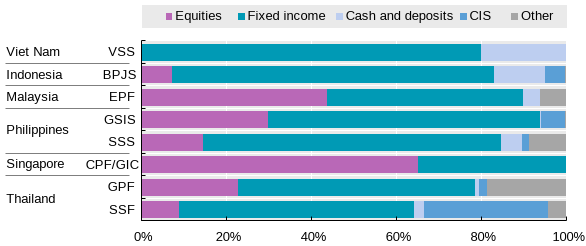
Note: CIS denotes collective investment schemes.
Source: AMRO (2026[72]), OJK (2025[103]), GIC (2026[104]), EPF (2024[105]), GPF (2026[106]), SSO (2025[107]), GSIS, (2025[108]), SSS (2025[109]), OECD consultations.
Private institutional investors
Investment restrictions and asset allocations
Ten years after the private pension sector was opened up through voluntary supplemental pensions, the sector is still relatively small. At the end of 2024 only four entities had been granted certificates to provide supplemental pensions fund management services. These collectively managed seven funds with VND 2.2 trillion (~USD 84 million) in assets under management. There were 28 500 participating employees, representing a twenty-one-fold increase since 2021. In absolute terms, however, the size of funds and number of participants is still limited (HMLF, 2026[110]).
The asset allocation of these funds remains conservative. Until early 2026, regulatory constraints required them to invest at least 50% in government bonds and a maximum of 20% in equities, through investment funds (although more is possible through a sub-fund of the overall pension fund), and no foreign assets. At the end of 2025, the asset allocation of private pension funds was largely concentrated in relatively conservative assets: government bonds constituted 50% of assets, receivables from interest and dividends 27%, securities investment fund certificates 15%, and cash and cash equivalents 8% (HMLF, 2026[110]).
The government has recently eased these restrictions, with the objective of strengthening supplementary retirement provision, reducing future fiscal pressures from an ageing population and providing an additional source of long-term capital for the market. The mandated investment in government bonds was decreased from 50% to 40% of net asset value for funds with net assets of at least VND 5 billion, and direct investments in listed securities, now including listed shares and listed corporate bonds, were increased up to 30% of fund assets, alongside the 20% in investment fund certificates. The remainder may also be allocated to local government bonds, government-guaranteed bonds and bank deposits. Risk management requirements have been strengthened by including maximum limits for listed securities and fund certificates, concentration limits on exposures to a single issuer and minimum eligibility criteria for each asset category. Each fund management company is responsible for developing detailed investment selection criteria under the fund charter. However, there still is no provision for investments in foreign assets (Government of Viet Nam, 2026[111]; National Assembly of Viet Nam, 2024[78]).
Importantly, the structure of the pension agreements between the employer and employees restricts the use of auto-enrolments, allows employers to restrict portability for employees with fewer than five years of employment and stipulates that members need to be part of the mandatory social insurance system.
Insurance companies represent a larger category of institutional investors, with assets of VND 1.1 quadrillion (~USD 42 billion) at the end of 2025, approximately 9% of GDP (Viet Nam News, 2025[112]). Their investment criteria are defined by recent regulations moving Viet Nam closer towards risk-based supervision, and a focus on capital requirements based on risk-based capital and asset and liability matching. Despite these amendments, the main investment restrictions from the previous regulations remain in place (National Assembly of Viet Nam, 2022[113]; Government of Viet Nam, 2023[114]).
As a result, life insurance companies can invest up to 50% of their insurance float in corporate securities or fund certificates, while non-life insurance companies are capped at 35%. Insurance companies are not permitted to invest in bonds where the proceeds are used for debt restructuring. There are no limitations on investing in government bonds (NRI, 2026[115]). The current investment regulations are set to expire on 31 December 2027. The MOF is expected to issue new rules effective after this date, more aligned with the risk-based supervision in Law No. 139/2025/QH15, amending the Law on Insurance Business No. 08/2022/QH15, and the supplementary Decree No. 97/2026/ND‑CP, amending Decree No. 46/2023/ND‑CP (National Assembly of Viet Nam, 2025[116]; Government of Viet Nam, 2026[117]).
Despite the regulatory updates partly intended to facilitate the expansion of the insurance industry, the growth of the sector between 2022 and 2025 slowed down. The asset allocation of Viet Nam’s life insurers also remains conservative. Deposits and government bonds are the largest asset classes and represented 39% and 36% of total assets respectively at the end of 2024, while corporate securities amounted to 20% (Insurance Business, 2025[118]; Ministry of Finance of Viet Nam, 2025[119]). By contrast, corporate securities and investment funds constituted 25% of the life insurance sectors’ assets in the Philippines, 28% in Thailand and 40% in Indonesia (OJK, 2025[120]; OECD, 2025[21]; PIC, 2023[121])
Investment funds constitute the third major institutional investor category and have grown significantly but remain limited in size relative to the economy. Assets under management of securities investment funds expanded from VND 603 trillion (~USD 26.6 billion) in 2021 to VND 839 trillion (~USD 31.9 billion) by end-2025, but this still only constitutes 6% of GDP (SSC, 2021[122]; SSC, 2025[123]). At the end of October 2025, there were 43 fund management firms, the same as in 2021. However, the number of investment funds has increased from 70 to 126 over the same period, with 18 exchange-traded funds (ETFs), 69 open-ended funds, 3 closed-ended funds, 1 real estate fund, and 35 member funds (these vehicles have less than 100 professional investors and cannot be offered to the public).
The introduction of Circular No. 136/2025/TT-BTC, effective as of February 2026, expands the regulatory framework with specific provisions on money market funds, infrastructure bond funds and index funds. There are already well-established ETFs and index-tracking open-ended funds, but the circular creates the basis for more standardised governance and clearer supervisory treatment. The circular also clarifies operational requirements regarding liquidity management for open-ended funds, increases the cap on public open-ended funds’ investments in privately placed corporate bonds from 10% to 20%, and establishes rules for the online distribution of fund certificates. IPO shares yet to be listed and publicly offered bonds are moved out of this category, increasing funds’ ability to invest in them as they are now considered public instruments. Meanwhile, the prudential framework is also strengthened through credit ratings, ongoing monitoring and potential forced disposal of these privately placed corporate bonds (Ministry of Finance of Viet Nam, 2025[124]).
Supervisory framework
Viet Nam is transitioning towards a more risk-based supervision framework, but there are important caveats. While the rules require supplementary pension fund managers to appoint a custodian bank to hold and safeguard assets, they also establish an additional “supervisory bank” role, which monitors the pension fund management company’s compliance, investment activities and calculation of net asset value, and reports violations to the Ministry of Finance (Government of Viet Nam, 2026[111]). These functions are similar to the custody and oversight roles performed by depositaries and scheme trustees in other markets. The depository and supervisory roles may be performed by the same institution, subject to internal separation of personnel and systems.
The risk-based supervisory framework is more developed for insurance companies but is still under development, particularly with respect to its quantitative components. Law No. 08/2022/QH15 established the statutory framework for the transition towards risk-based supervision, including provisions on risk-based capital and capital adequacy ratio. Law No. 139/2025/QH15 formally shifted Viet Nam’s insurance and reinsurance supervision from ex‑ante approvals to risk‑based, ex‑post supervision with a significant degree of enterprise self-responsibility. Decree No. 97/2026/ND‑CP amended the principal implementing decree, Decree No. 46/2023/ND-CP, to operationalise selected amendments introduced by the new law. While Law No. 139/2025/QH15 changes the supervisory architecture, some quantitative prudential measures have still not been fully implemented. These could include risk-based capital formulas, solvency thresholds, internal model-based solvency assessments and ‘own risk and solvency assessments’ (National Assembly of Viet Nam, 2025[116]; Government of Viet Nam, 2026[117]).
The risk-based framework in Viet Nam is being phased in. It is expected that implementation of core elements, including risk‑based capital and capital adequacy ratios, will begin on a transitional basis from 2028, while supervisory intervention measures will not be implemented before 1 January 2031. In the interim, from 2028 to 2030, insurers will be in a transition phase during which they are required to track their capital positions in line with risk-based capital principles and, where necessary, take proactive steps to address any shortfalls (Tilleke & Gibbins, 2026[125]).
These risk-based supervisory and capital frameworks may support more diversified investment strategies while limiting excessive concentration risks. They may also help address mismatches in duration between the assets and liabilities of life insurers. Ensuring that the capital framework appropriately captures asset-liability and duration risks would better reflect these exposures and may improve incentives to hold long-term infrastructure or corporate bonds where these assets are consistent with liability profiles. In the short term, the effect on asset allocations is not self-evident, and might even have the effect of pushing investments into more conservative asset classes to avoid high capital charges. Over time, as insurers build risk-management capabilities and become more familiar with the framework, risk-based supervision could give them greater scope to manage portfolios in line with their liabilities and investment expertise, potentially supporting greater participation in corporate securities.
Licensing, incentives and regulatory equality of investment forms
While some parts of the institutional investor base have grown rapidly, there is still much potential for growth across pension funds, insurance companies and investment funds. The Scheme on Restructuring the Investor Base and Developing the Securities Investment Fund Industry, approved in September 2025 (Decision No. 3168/QD-BTC), aims to shift the market’s investor structure, encouraging individual investors to invest through investment funds and increasing the participation of domestic institutional and foreign investors. The individual investor share of trading volume is also expected to decline to 70% of trading volume by 2030 and 60% in subsequent years. It also sets ambitious targets for the fund industry, with the number of investment funds set to grow to 500, quadrupling from current numbers (Ministry of Finance of Viet Nam, 2025[126]). By comparison, between the end of 2021 and mid-2025 the number of funds increased from 70 to 123. This points to a need to review barriers to facilitate the growth of the industry. There are three areas that warrant particular attention: licensing, incentives to invest and levelling the playing field between different savings and investment forms.
During OECD consultations, market participants identified fund licensing as a barrier and suggested that new fund management licences have in practice been difficult to obtain. They also indicated that this could constrain the establishment of new domestic fund vehicles and that the limited number of licences in circulation are expensive to obtain. The slow buildout of the voluntary supplemental pension funds is also partly attributed to a cautious and restrictive licensing process (VIR, 2025[127]). Meanwhile, besides moving towards risk-based supervision and less ex-ante approval requirements, Law No. 139/2025/QH15 is set to simplify licensing and operational requirements for insurance companies (Insurance Business, 2025[118]).
2.4.2. Households
Households in Viet Nam generate a substantial pool of savings, but these are not yet effectively channelled into capital market instruments. Viet Nam has maintained a persistently high savings rate over the past two decades, with gross domestic savings generally fluctuating between 25% and 35% of GDP before rising to around 37% in 2024. Even compared to regional peers, Viet Nam’s savings rate remains high. The 10-year average savings rate of 34% exceeds that of the Philippines (13%), Malaysia (30%) and Thailand (31%), and is broadly comparable to Indonesia (35%), although still below Singapore’s exceptionally high level (57%). Viet Nam’s high savings rate, combined with its relatively small capital market, channels a significant share of savings into bank deposits, reinforcing banks’ dominant role in the financial system (see Section 1.4).
This reliance on banks concentrates risks, limits the supply of long-term and risk-willing capital for firms, and constrains the development of a more balanced and resilient financial system. As a result, Vietnamese households are not directly participating financially in the profits of the corporate sector and the economic development of the country. As the rapidly expanding middle class accumulates savings, enabling their access to financial instruments can support their financial well-being while providing companies with much-needed capital (OECD, 2025[128]).

Source: World Bank (2026[129]), Gross Domestic Savings (% of GDP), https://data.worldbank.org/indicator/NY.GDS.TOTL.ZS?locations=VN
Household asset allocation
Household asset allocation in Viet Nam has historically been concentrated in real estate, gold and bank deposits, with relatively limited diversification into capital market instruments. For relatively higher-income households in Viet Nam, real estate has long been the primary channel for wealth accumulation. The extent of this concentration is reflected in housing affordability indicators. As of 2025, the house-price-to-income ratio, defined as the ratio of median residential property prices to median household disposable income, stands at around 34 in Ho Chi Minh City, ranking fifth globally among 281 cities surveyed, while Hanoi records a ratio of approximately 25 (17th) (NUMBEO, 2025[130]). Relatively low recurrent property taxation and modest capital gains taxes have further strengthened incentives to invest in real estate, reinforcing the preference for tangible assets.
Bank deposits and gold have a dominant position in household savings. Gold plays a distinctive role in household portfolios, with Vietnamese households estimated to hold between 400 and 500 tonnes, equivalent to roughly USD 35 to 40 billion or about 8% of GDP. It is often perceived as a hedge against inflation and exchange rate depreciation. In a context where formal investment channels have been limited and confidence in financial markets remains incomplete, holding gold has represented a rational portfolio choice for many households (Nguyen and Floro, 2020[131]). At the same time, bank deposits also remain attractive due to relatively elevated interest rates. As of December 2025, the SBV reported average VND deposit rates of 5.0 to 6.4% for maturities of 6 to 12 months, while some commercial banks offered promotional rates of 8 to 9% for similar tenors in March 2026 (Vietnam.vn, 2026[132]; State Bank of Viet Nam, 2026[133]).
Direct retail participation plays a dominant role in Viet Nam’s equity market, with domestic individual investors accounting for more than 80% of trading value in recent years, reflecting the highly retail-driven nature of the market (FiinGroup, 2025[134]). Retail participation has also expanded rapidly, with the number of trading accounts rising from 1.6 million in 2016 to over 12 million by January 2026 (Figure 2.21, Panel A). This suggests significant potential to support long-term investment and capital market development. However, the actual number of active investors is likely to be considerably lower, as investors are permitted to open multiple accounts across different securities companies. In addition, many accounts remain dormant, and a large number of inactive accounts were reportedly removed in 2023 (the-shiv, 2026[135]; The Investor, 2024[136]; FiinGroup, 2025[134]).
At the same time, the growing presence of retail investors has been accompanied by a rapid expansion of margin lending (Panel B). Outstanding margin loans increased from around VND 219 trillion (~USD 8.6 billion) in Q2 2024 to approximately VND 405 trillion (~USD 15.4 billion) by Q1 2026, highlighting the increasing role of leveraged trading in the domestic equity market. Given the dominance of individual investors in trading activity, margin lending is likely to be used primarily by retail investors engaging in short-term and momentum-based trading strategies.
Despite the expansion of retail participation in capital markets, the use of collective investment vehicles in Viet Nam remains limited. Mutual fund penetration is estimated at around 0.5% of the population, well below levels observed in regional peers. This reflects a combination of constraints. The range of products available to retail investors remains narrow, with limited differences across providers, reducing their attractiveness. Distribution is mainly bank-led, with fund sales concentrated in affiliated asset management companies, while independent advisory channels and open-architecture platforms remain underdeveloped, limiting investor choice. In addition, the prevailing sales model focuses on product sales rather than needs-based financial advice, with limited assessment of investor risk profiles and long-term financial objectives (Hubbis, 2025[137]).

Note: The number of active accounts is based on estimates from FiinRatings.
Source: VSDC (2026[138]), Statistics - Number of Investor’s Trading Accounts, https://www.vsd.vn/en/tra-cuu-thong-ke/TK_SL_TKGD_NDT?tab=7; FiinGroup (2025[134]), Navigating a Retail Dominated Markets: Strategic Considerations for Foreign Investors, https://fiingroup.vn/upload/docs/RE_Sector-Brief_Vietnam-Securities-Sector_%20April-2025.pdf; Vietnam.vn (2024[139]), Strangely, Loans “Play” Securities with Many Records but Shrinking Liquidity, https://www.vietnam.vn/la-ky-tien-cho-vay-choi-chung-khoan-nhieu-ky-luc-nhung-thanh-khoan-teo-top; Viet Nam News (2025[140]), Margin Lending Soars to Historic Highs amid Market Volatility, https://vietnamnews.vn/economy/1716326/margin-lending-soars-to-historic-highs-amid-market-volatility.html; Vietnam.vn (2025[141]), Securities Companies Reach Record Levels of Margin Lending, https://www.vietnam.vn/en/cong-ty-chung-khoan-cho-vay-margin-dat-ky-luc; Vietnam.vn (2026[142]), The State of the Securities Industry and Securities Companies in Vietnam for 2026, https://blog.investvietnam.co/the-state-of-the-securities-industry-and-securities-companies-in-vietnam-for-2026/
Viet Nam has offered limited tax incentives to encourage citizens to invest in financial products, such as private pensions and investment funds. In addition, bank deposits and government bonds continue to receive more favourable tax treatment than many capital market investments. Until 2026, corporations could contribute up to VND 3 million (~USD 114) monthly for voluntary pension schemes, whereas an employee could only contribute VND 1 million (~USD 38) without having to make deductions in personal income tax. This asymmetry is addressed through recent tax reforms, which raise the employee contribution ceiling to align with employer contributions (EY, 2026[143]; National Assembly of Viet Nam, 2025[144]). This has the potential to improve flows into pension funds and investment funds.
Viet Nam has also not offered tax incentives for investments in capital market instruments to boost retail participation. Among peer countries, Thailand has experienced a strong expansion of the mutual fund industry, which grew from 8% of GDP in 2001 to 30% in 2024 (OECD, 2025[21]). This has been supported by generous tax incentives. These include Retirement Mutual Funds (2001-present), Long-Term Equity Funds (2004-2019), Super Savings Funds (2020-2024) and the latest version, the Thai ESG Funds. These funds have had various structures but have included up to 30% annual income tax deduction, capped at THB 500K (~USD 15 500). The Thai ESG Fund has lowered the cap to THB 300K (~USD 9 300). The overall growth of the Thai mutual fund industry can also be attributed to flexibility of the fund structures allowed, including interval funds, finite-life funds, fund-of-fund structures, umbrella funds, along with alternative assets.
In Viet Nam, the growth of investments in corporate securities and investment funds is also challenged by a less favourable tax treatment relative to that of deposits and government bonds. Interest on the latter two is exempt from personal income tax, whereas distributions from listed securities are subject to a 5% withholding tax and a 0.1% transaction tax on gross transfer proceeds. This both puts investments in corporate securities at a relative disadvantage and disincentivises investments in government securities through investment funds. Recent tax reforms introduced partial relief by removing capital gains taxation on holdings of open-ended funds exceeding a specified holding period and reducing dividend taxation for certain fund investments. However, these measures fall short of achieving full tax neutrality across financial instruments (LuatVietnam, 2026[145]; National Assembly of Viet Nam, 2025[144]).
Professional investor eligibility
Viet Nam historically maintained relatively accessible criteria for individual investors to qualify as professional investors, facilitating broad retail participation in the securities market. Under the previous framework, professional investor status could be obtained by holding a listed securities portfolio valued at VND 2 billion or above, assessed at a single point in time. Following the corporate bond market disruptions in 2022, the authorities tightened eligibility requirements, requiring that the VND 2 billion threshold be met based on the average daily market value over a minimum of 180 consecutive days (Government of Viet Nam, 2022[59]).
Subsequent reforms adopted in 2024 and effective from 2025 further tightened the framework. The authorities continued to strengthen investor protection for domestic individual investors, including by introducing additional safeguards for privately placed bonds distributed to professional individual investors, such as requirements related to credit ratings, collateral or bank guarantees. Foreign investors were also automatically recognised as professional investors without being subject to domestic asset or income thresholds.
Despite these reforms, the criteria for qualifying as a professional individual investor in Viet Nam remain relatively lenient compared to several regional peers, although the degree of stringency varies depending on the qualification route. When normalised by GNI per capita, Viet Nam’s annual income threshold (8.7 times GNI per capita) is less demanding than in Thailand and the Philippines, though more stringent than in Singapore and Malaysia. The minimum portfolio asset threshold in Viet Nam of VND 2 billion (~USD 76 K) is substantially lower than in Indonesia, Malaysia, the Philippines, Singapore and Thailand, where thresholds are generally several times higher. Even when normalised by GNI per capita, Viet Nam’s portfolio asset threshold (17.5 times GNI per capita) is comparatively low, with only Singapore applying a lower threshold among the peer markets analysed. However, it is worth noting that the definition of qualifying portfolio assets does not explicitly exclude borrowed or leveraged positions in some countries, creating scope for investors to qualify despite having lower underlying net assets.
Beyond the financial thresholds, Viet Nam also remains relatively permissive in terms of knowledge and experience-based criteria. While Viet Nam recognises licensed financial professionals as qualifying professional investors, it imposes virtually no financial knowledge or experience requirements. Some peer countries require financial knowledge or prior investment experience in addition to asset or income criteria. In the Philippines, intermediaries are expected to assess whether investors have sufficient knowledge, experience and risk-bearing capacity (Manila Bulletin, 2026[146]). Similarly, in Thailand high-net-worth investors must meet knowledge or investment experience requirements, with regulated intermediaries responsible for verifying professional investor eligibility (SEC Philippines, 2026[147]; Tilleke & Gibbins, 2026[148]; SET, 2022[149]).
While the authorities have progressively tightened investor protection following the corporate bond market disruptions, the broader eligibility framework remains comparatively permissive. Notably, although the 2024 reform process considered stricter criteria for individual participation in private corporate bond markets, including experience-based requirements such as minimum trading history and transaction activity, these were not incorporated into the general professional investor classification framework (Đầu Tư Chứng Khoán, 2024[150]). As a result, Viet Nam continues to allow a broader segment of individuals to qualify as professional investors than many regional peers.

Note: GNI multiples are calculated by dividing the annual income or portfolio asset thresholds by 2024 GNI per capita (Atlas method). Indonesia does not apply an annual income criterion.
Source: World Bank (2026[151]), GNI per capita, Atlas method (current US$), https://data.worldbank.org/indicator/NY.GNP.PCAP.CD; see Annex for detailed professional investor eligibility criteria.
Financial literacy
Viet Nam has made rapid progress in expanding access to financial services, particularly through digital channels, which has significantly advanced financial inclusion. However, there remains considerable scope to strengthen financial literacy. Viet Nam has not participated directly in recent international assessments such as the OECD International Network on Financial Education (INFE) financial literacy surveys, meaning that recent internationally comparable evidence remains limited. The latest available benchmark dates back to 2017, when the Asian Development Bank Institute conducted a survey based on the OECD/INFE methodology. The survey estimated Viet Nam’s financial literacy score at 12 out of 21, placing it at the lower end of a 30-country sample, below peer countries such as Thailand and Malaysia (ADB, 2017[152]). While financial literacy levels may have improved in recent years alongside rising incomes, expanding access to financial services and ongoing efforts to strengthen financial education, the absence of updated internationally comparable data makes it difficult to assess the extent of progress. Recent studies point to the existence of considerable gaps in knowledge among the younger generation but also that younger adults have better saving and investment behaviour compared to older adults (Van Nguyen et al., 2022[153]; The Hung and Ha Khanh, 2025[154]).
In OECD consultations, market participants noted that some retail investors tend to favour short-term, higher-risk trading strategies, with equity investment in some cases perceived less as a vehicle for long-term wealth accumulation than as an opportunity for short-term gains. This is broadly consistent with Viet Nam’s retail-dominated market, where extensive margin financing and momentum-driven trading have raised regulatory concerns about excessive speculation. Vietnamese investors have also exhibited investment patterns associated with herding, overconfidence and a preference for short-term trading (Xuan and Van, 2025[155]). Such dynamics can contribute to higher market volatility, weaker reliance on diversified long-term investment vehicles such as mutual funds, and reduced incentives for long-term stewardship and informed capital allocation.
The authorities have implemented a range of policy initiatives to strengthen financial literacy and consumer protection as part of a broader financial inclusion strategy. The National Financial Inclusion Strategy adopted in 2020 sets targets for increasing account ownership, encouraging savings and promoting cashless payment through 2025 and beyond. Within this framework, financial education is treated as a core pillar, with targeted programmes focusing on rural populations, low-income households and women. Additional efforts include regionally tailored education campaigns by the Deposit Insurance of Viet Nam, which aims to raise public awareness of deposit protection, as well as partnerships with private sector actors to deliver financial education to students and vulnerable groups (DIV, 2024[156]).
Nevertheless, compared with several ASEAN peers, Viet Nam’s financial literacy framework remains relatively less developed and institutionalised. Countries such as Thailand, Singapore and Malaysia have adopted more comprehensive and co-ordinated approaches that integrate financial literacy into broader capital market development strategies, including dedicated investor education programmes, closer co-operation between regulators and educational institutions, and stronger integration of financial education into school curricula (OECD, 2025[21]).
2.4.3. Recommendations
To further develop the investor base, the Vietnamese authorities could consider:
Revising the investment criteria of the VSS to progressively allow it to invest in higher yielding asset classes, while safeguarding the fund’s long-term solvency.
Strengthening the VSS’s in-house investment, risk assessment, and asset-liability management capabilities.
Supporting the implementation of the expanded investment framework for supplementary pension funds and periodically reviewing the calibration of asset class, concentration and eligibility limits.
Ensuring the timely and effective implementation of the risk-based prudential framework for insurers.
Allowing auto-enrolment of organisation-wide pension plans for employers that contribute alongside their employees.
Introducing tax-advantaged long-term savings vehicles for retail investors.
Equalising the tax treatment of investment in funds relative to deposits and government bonds.
Reviewing the eligibility criteria for professional individual investors periodically and developing the criteria to ensure appropriate investment knowledge, experience and risk awareness.
Expanding financial literacy efforts with a capital market focus
Developing a deeper and more diversified investor base is central to strengthening Viet Nam’s capital markets and supporting economic growth. Institutional investors are uniquely positioned to pool long-term savings, absorb risk, and support productive investment through equities, corporate bonds and alternative assets. While Viet Nam has made progress in growing institutional assets, unlocking their full potential will require a recalibration of investment rules, supervision, incentives and the broader financial ecosystem. Similarly, a substantial share of household savings remains concentrated in bank deposits. Channelling some of these into capital market instruments could both strengthen the financial system and support household wealth creation.
A central priority is revisiting the investment framework of the VSS. As the country’s single largest institutional investor, VSS has significant potential to improve its own long-term sustainability while supporting domestic capital formation. The current investment strategy, heavily concentrated in domestic government bonds and bank deposits, prioritises capital preservation but exposes the fund to concentration risk and low returns. The authorities could consider gradually permitting investment in a broader range of assets, potentially including domestic corporate bonds, listed equities and carefully selected alternative assets such as infrastructure that could raise returns over the long term. Crucially, such changes would need to be paired with safeguards for solvency, including clear strategic asset allocation targets, stress testing and phased implementation aligned with liability profiles.
To support this transition, the professionalisation of VSS’s investment function is essential. Building in‑house capabilities for portfolio management, risk assessment and asset liability management would allow investment decisions to be based on strong technical analysis and clear long-term objectives. Many peer-country public pension funds have successfully combined strong public governance with independent, technically skilled investment teams operating under clear mandates and accountability frameworks. Developing similar competencies would allow the VSS to manage a more diversified portfolio prudently and act as a credible long-term investor in Viet Nam’s capital markets.
Beyond the VSS, the expanded investment framework for supplementary pension funds should be effectively implemented to support greater portfolio diversification and long-term return potential for pension beneficiaries while allowing for meaningful participation in corporate financing. Recent regulatory reforms reducing the mandatory government-bond allocation and broadening the eligible domestic investment universe are positive steps. The authorities could monitor implementation and periodically review the calibration of asset class, concentration and eligibility limits in light of investment outcomes and the risk management capacity of fund managers. Over time, further flexibility, including foreign diversification, could make these vehicles more attractive to both employers and employees as the sector and its investment governance capabilities develop.
Insurance companies represent another major pool of long-term savings that could play a greater role in capital markets. Viet Nam is transitioning towards risk-based supervision, with key capital-related provisions being phased in from 2028, and ensuring the timely and effective implementation of this framework should remain a priority. Well-designed risk-based capital charges can simultaneously promote diversification and discourage excessive concentration without mandating specific asset allocations.
Participation and the scale of investable assets also depend on incentives. Allowing auto-enrolment in organisation-wide pension schemes for employers that contribute alongside their employees, with opt-out provisions, could significantly expand coverage by leveraging behavioural effects, particularly in a labour market dominated by small firms and informal employment. Tax-advantaged long-term savings vehicles for retail investors could also be introduced. Introducing tax incentives for investments in investment funds could help expand the professional investor base while providing households with diversified capital market instruments. Equalising the tax treatment of investments in funds relative to deposits and government bonds is critical. Current tax asymmetries favour bank deposits and discourage households from channelling savings into market-based instruments, even through diversified and professionally managed funds.
The rapid increase in the number of securities accounts, from approximately 1.6 million to over 12 million between 2015 and early 2026, suggests strong underlying investor interest. However, access to complex or higher-risk products should remain subject to proportionate investor protection safeguards. This could include periodically reviewing the eligibility criteria for professional individual investors to ensure that access is aligned not only with financial capacity, but also with appropriate investment knowledge, experience and risk awareness.
Despite significant progress in financial inclusion, financial literacy in Viet Nam remains relatively limited. Expanding existing financial inclusion strategies to incorporate a stronger focus on capital market proficiency would therefore be important, particularly in areas such as risk-return trade-offs, diversification and long-term investing. Given the high level of mobile penetration, digital delivery channels and partnerships with fintech providers could help scale up financial education, especially among younger and rural populations where gaps are more pronounced. Participating more regularly in internationally comparable financial literacy surveys, such as those of the OECD/INFE, would also help authorities benchmark progress, identify gaps and better target future interventions.
Viet Nam has made significant progress in the internationalisation of its capital market. While this review was being conducted, FTSE Russell reclassified Viet Nam from Frontier to Secondary Emerging Market status. The upgrade could generate up to USD 6 billion in capital inflows into Vietnamese equities (Bloomberg, 2025[157]). The reclassification follows a multi-year reform programme aimed at improving market accessibility and trading infrastructure. Key measures included the removal of full prefunding requirements for foreign institutional investors, further refinements supporting global broker access, simplified foreign investor trading code procedures, improvements to trading and settlement arrangements, and gradual liberalisation of foreign ownership limits. In parallel, the establishment of the International Financial Centre, operating as a unified legal entity in Ho Chi Minh City and Da Nang, reflects the authorities’ broader ambition to position Viet Nam as a regional financial centre.
The potential inflows should also be considered in the context of sustained net foreign investment outflows, which the market upgrade could help moderate or reverse. Foreign investors have been persistent net sellers of Vietnamese listed equities for most of the past five years. Following a temporary surge of net foreign equity inflows in 2017 and 2018, net foreign portfolio investment in Vietnamese equities turned negative in 2020 and deteriorated further thereafter, reaching approximately negative USD 5 billion in 2025 (Figure 2.23, Panel A). Cumulatively, foreign investors have divested net Vietnamese equity positions of approximately USD 13 billion since 2020. Net foreign debt inflows have remained modest throughout the period. These outflows also coincided with the global monetary tightening cycle, a stronger US dollar and broad outflows from emerging markets (IMF, 2022[158]).
Against this background, foreign ownership stood at approximately 13% of total market capitalisation, well below the ASEAN average of 22% (Panel B). The composition of foreign ownership further underscores structural weaknesses in the investor base. Holdings are concentrated in foreign corporate investors (9%), while foreign institutional investors hold only 4%. This contrasts with regional peers, such as Singapore (13%) and Thailand (7%), where global asset managers and pension funds hold meaningful stakes. Together, these trends suggest scope for further integration into global capital markets and greater participation by long-term foreign institutional investors.

Source: OECD Capital Flow Policy dataset, OECD Capital Market Series dataset, LSEG, Bloomberg, see Annex for details.
Several structural barriers continue to constrain foreign investor participation in Viet Nam’s equity market. First, statutory foreign ownership limits apply to a significant share of listed companies. Second, although the offshore VND non-deliverable forward market exists, non-resident investors have only limited access to onshore hedging instruments. Third, listed companies’ financial reporting still operates under Vietnamese Accounting Standards, which are only partially converged with IFRS pending completion of the VFRS/IFRS roadmap. MSCI continues to classify Viet Nam as a Frontier Market. Its 2026 Global Market Accessibility Review assesses foreign ownership limit level, foreign room level and equal rights for foreign investors as areas requiring improvement, and identifies persistent constraints in mandatory investor registration and VSDC account approval, English-language information flow, and clearing and settlement (MSCI, 2026[159]). It is therefore important that these remaining constraints are addressed in order to build on recent reforms and strengthen the long-term participation of global institutional investors in Viet Nam’s capital markets.
2.5.1. Foreign access to public companies
The Foreign Ownership Limit (FOL) regime in Viet Nam for public companies comprises a three-tier structure. International treaty obligations are given precedence over domestic sector-specific caps where applicable, which themselves prevail over a residual default limit of 50% for business lines subject to conditional market access for foreign investors where no specific foreign ownership limit is prescribed (Government of Viet Nam, 2020[4]). Beyond this hierarchy, a limited number of activities, including defence, the press and other news media, remain entirely closed to foreign investment. Furthermore, a public company carrying out multiple business activities is subject to the lowest applicable cap (Government of Viet Nam, 2020[4]). Consequently, a single business activity subject to the residual 50% limit can bring an otherwise unrestricted issuer to the 50% ceiling on its entire share register.
Foreign ownership ceilings vary across sectors (Table 2.6). In addition to the prohibited sectors, the cap that the banking sector applies is one of the most restrictive, with foreign holdings in Vietnamese commercial banks capped at 30%. According to Decree No. 69/2025/ND-CP, the limit could be increased to 49% for non-state-controlled commercial banks receiving compulsory transfers, in accordance with the approved transfer plan and for its duration. The telecommunication industry has been liberalised, though the extent varies between subsectors. Under Viet Nam’s Comprehensive and Progressive Agreement for Trans-Pacific Partnership (CPTPP) schedule, non-facilities-based services are now fully open to eligible investors, while facilities-based services remain capped at 49% for basic services and 65% for value-added services. The Telecommunications Law 2023 brought newer services such as data centres, cloud computing and internet-based basic telecoms into the framework with no foreign equity cap.
Source: Based on official government and regulatory sources.
Until September 2025, public companies also had the discretion to set FOLs below the statutory ceiling. This was a common practice used to deter hostile takeovers or to reserve space for strategic investors (VietnamPlus, 2025[160]). In September 2025, this discretionary lower cap was abolished, and public companies are no longer permitted to set FOLs below the statutory ceiling (Government of Viet Nam, 2025[40]). The reform has had an effect on aggregate foreign room: the average FOL across HOSE-listed issuers rose from 41.7% to 44.6% in the months following its implementation (SSI, 2026[161]).
Despite this progress, the residual foreign ownership cap of 50% still places Viet Nam towards the more restrictive end of the ASEAN regulatory spectrum. The Philippines operates a Foreign Investment Negative List, under which activities not listed as restricted can generally be wholly foreign-owned (Republic of the Philippines, 1996[162]; Republic of the Philippines, 2025[163]). In Singapore, full foreign ownership is generally permitted, subject to sector-specific restrictions and national security safeguards.
A substantial proportion of listed companies are subject to foreign ownership restrictions. On the HOSE, 14% of listed companies are subject to a sector-specific cap or are closed to foreign investment altogether (Figure 2.24). A further 54% are subject to the default 50% cap applicable to conditional business lines. The remaining issuers are classified as unrestricted or not identified. The situation is even more pronounced in terms of market capitalisation, with over 80% of the HOSE’s market capitalisation subject to foreign ownership restriction. A broadly similar pattern prevails on the HNX and UPCoM.
Once a Vietnamese listed company has reached its FOL ceiling, further on-exchange purchases by foreign investors are blocked at the depository. Additional foreign demand may be met through off-exchange transactions between foreign investors, which are often set at a negotiated premium. Historically, the FOL premium has reached 30% and, for the issuers most in demand among foreign investors, as much as 50% (VinaCapital, 2021[164]). Since the launch of the VFM Diamond ETF in 2020, a domestic exchange-traded fund holding FOL-exhausted stocks that foreign investors can purchase without directly owning the underlying stock, the premium has moderated. Nevertheless, the underlying scarcity remains, and passive index funds, which by mandate generally cannot pay above the on-exchange reference price, are unable to invest in the affected companies.

Note: Companies are classified by their primary TRBC industry. “Sector-specific cap or prohibited” covers industries with a foreign ownership ceiling tighter than the 50% default (e.g. banking, aviation) or prohibited under the restricted market access list for foreign investors. “Conditional business line” covers industries on the conditional market access list, where the 50% default ceiling applies. “Unrestricted” covers industries with no foreign ownership restriction. “Not identified” covers industries spanning both conditional and non-conditional Vietnamese business lines. As Article 139 applies the lowest applicable cap across all of an issuer’s business lines, a classification based on primary industry may understate the share of issuers legally subject to the 50% default, since issuers with ancillary conditional activities can be subject to the lowest-cap rule even where their primary industry appears unrestricted.
Source: Based on LSEG data.
These FOL restrictions continue to weigh on Viet Nam’s market accessibility. As noted earlier, the MSCI 2026 Global Market Accessibility Review rates Viet Nam as needing improvement on foreign ownership limit level, foreign room level and equal rights for foreign investors (MSCI, 2026[159]). This highlights opportunities to further align Viet Nam’s foreign ownership framework with emerging market standards.
2.5.2. Capital mobility constraints
Viet Nam has advanced reforms aimed at facilitating foreign investors’ access to its capital markets. The country operates a managed exchange rate regime, and the use of the dong for portfolio investment is subject to foreign exchange controls. Portfolio investments by non-resident foreign investors must be made via Indirect Investment Accounts (IIAs) through authorised banks. Certain formalities and documents (such as notarisation or certification of certain documents) are required to open an account, while remittances abroad must comply with applicable tax and foreign exchange regulations. Recent regulatory reforms have simplified procedures for account opening, obtaining securities trading codes, and brokerage access procedures. However, foreign investors still encounter frictions in trade execution across portfolios and access to onshore currency hedging.
Viet Nam’s foreign exchange system comprises a tightly managed onshore regime and an offshore non-deliverable forward (NDF) market. During periods of stress, forward prices in these two markets can diverge significantly, which could make it more difficult for non-resident investors to hedge their VND exposure. Onshore, the SBV employs a managed exchange rate regime anchored to a daily central reference rate. Credit institutions authorised to provide foreign exchange services can quote USD/VND spot rates within a ±5% range of the central reference rate (an increase from ±3% in response to the 2022 dollar shock). Onshore deliverable FX forwards are also available, but non-resident investors may use them only to hedge their holdings of VND-denominated government bonds issued in the domestic market. Offshore, non-resident investors may manage their exposure to the VND using cash-settled NDFs, under which the net gain or loss is typically settled in US dollars without delivery of VND. Evidence from the region suggests that, when markets are under stress, the price gap between offshore NDFs and onshore forwards of comparable maturity can widen substantially (Schmittmann and Teng, 2020[165]).
Foreign portfolio investments by non-residents in Viet Nam must be channelled through IIAs. The IIA is a Vietnamese currency payment account opened by a non-resident foreign investor at an authorised bank in Viet Nam. All receipts and payments related to indirect foreign investment (capital inflows, securities purchases and sales, receipt of dividends and interest, tax and fee payments, and foreign currency purchases for remittance abroad) must go through IIAs (State Bank of Viet Nam, 2025[166]). The framework requires investment-related cash flows to pass through designated VND accounts, and the VND leg of every transaction must be traceable through the authorised bank.
The foreign investor account and trading framework has been significantly streamlined through a series of reforms (Figure 2.25). Circulars No. 03/2025/TT-NHNN and 25/2025/TT-NHNN have streamlined the processes for opening accounts and preparing documents. For non-resident foreign investors conducting indirect investment, consular legalisation is no longer required for account-opening documents issued by foreign authorities, although these documents must still be notarised or certified within the preceding 12 months. Decree No. 245/2025/ND-CP streamlined securities trading code procedures, retaining electronic confirmation within one working day after the VSDC receives valid registration information from the depository member and extending separate proprietary and client trading codes to foreign fund management companies. This lays the groundwork for omnibus trading accounts. Furthermore, Circular No. 08/2026/TT-BTC permits non-resident foreign investors to place orders via representative international brokers and standardises payment discipline rules, including suspension of access to non-prefunding arrangements following settlement failures.

Source: Based on official government and regulatory sources.
Although recent changes have simplified the registration and account opening procedures, investor-level identification requirements remain in place at the trading stage. Orders submitted through international brokers must include the investor’s securities depository account number. This can make it more difficult for a manager responsible for several funds to execute a consolidated order or allocate transactions after the trade has taken place. Where orders are executed separately, portfolios acting on a single investment decision may receive different prices or allocations. The 2025 market upgrade scheme includes plans for an omnibus trading account mechanism that could facilitate consolidated orders and fair post-trade allocation.
Some regional peers operate account structures that preserve client-level visibility at the central depository and can help streamline operations. Thailand operates a hybrid framework under which depository participants maintain omnibus or segregated client accounts. Under omnibus arrangements, participants are required to report the securities balance of each client account to the Thailand Securities Depository on a daily basis (Thailand Securities Depository, 2022[167]). Indonesia follows a model based on the Single Investor Identification system. Under this system, each investor has their own identification and maintains a sub-securities account under the main account of the custodian bank or securities company at the Indonesia Central Securities Depository (KSEI) (KSEI, 2016[168]; KSEI, 2026[169]).
In this respect, Viet Nam’s architecture, which involves investor-level identification and separate securities depository accounts, has similarities with Indonesia’s. Indonesia combines per-investor sub-accounts at depository level with post-trade processing through the S-INVEST platform operated by KSEI. This platform supports the trade allocation, trade confirmation and settlement instructions for investment products such as mutual funds. This illustrates that a segregated account architecture at depository level can be compatible with centralised post-trade processing.
Furthermore, persistent frictions remain at the entry and exit step for foreign exchange. For portfolio investments funded in USD, inbound USD must be converted to VND at the dealing bank’s buying rate. Meanwhile, VND proceeds remitted in USD are converted at the dealing bank’s USD selling rate. The bank’s USD/VND spot quotations must remain within ±5% of the SBV’s daily central reference rate. During the depreciation episode in October 2024, commercial bank USD selling rates reached the upper bound amid strong foreign currency demand (Prime Minister of Viet Nam, 2025[5]).
Onshore deliverable FX forward hedging is only available to non-resident investors in relation to holdings of VND-denominated government bonds issued in the domestic market, provided that the necessary documentation is submitted and the underlying bonds are blocked at the securities depository. Therefore, non-residents holding equities or corporate bonds cannot hedge these holdings under this facility and may use offshore non-deliverable forwards instead (State Bank of Viet Nam, 2021[170]). This segmentation can increase hedging costs and widen pricing gaps during periods of market stress, which could affect the attractiveness of local currency assets to some non-resident investors. The Prime Minister’s 2025 market upgrade scheme identifies the development of the FX market and the introduction of hedging instruments for indirect investment activities as priority reform tasks.
Malaysia and Indonesia have addressed similar constraints by broadening regulated access to non-resident hedging while retaining foreign exchange controls. Bank Indonesia participates directly by regularly undertaking domestic non-deliverable forward (DNDF) operations as part of its exchange rate stabilisation operations. By August 2025, the DNDF market recorded an average daily turnover of around USD 212 million, approximately ten times the level recorded at the instrument’s launch in 2018 (ANTARA, 2025[171]). Meanwhile, Malaysia operates the Appointed Overseas Office (AOO) framework, which allows appointed overseas offices to trade deliverable ringgit foreign exchange with non-residents on a back-to-back basis with licensed onshore banks (Bank Negara Malaysia, 2016[172]). As of October 2026, the framework comprised 213 AOOs across 36 jurisdictions and 23 banking groups (Bank Negara Malaysia, 2026[173]). In parallel, in December 2016, Bank Negara Malaysia (BNM) introduced the Dynamic Hedging Programme. This enables registered non-resident institutional investors to sell ringgit forwards up to 100% of their eligible underlying ringgit-denominated asset exposure and purchase ringgit forwards up to 25% of those assets, both on a net basis. Higher net forward purchase limits are subject to BNM approval. The documentation requirements differ across these frameworks. While retaining eligibility requirements, exposure limits and regulatory reporting, the Dynamic Hedging Programme does not require documentary evidence of underlying assets for individual forward transactions. The programme’s caps are directionally asymmetric, with different limits for net forward sales and net forward purchases of ringgit.
2.5.3. Narrowing the gap with international standards
High-quality and comparable financial reporting is essential for the development and internationalisation of Viet Nam’s capital markets. Adopting IFRS can help to build investor confidence, reduce information asymmetries, lower the cost of capital and facilitate cross-border capital allocation (IFRS, 2026[174]) (IFRS, 2026[174]). As Viet Nam progresses towards international market integration, evidenced by FTSE Russell upgrading Viet Nam from Frontier to Secondary Emerging Market status in September 2026, the gap between Viet Nam’s financial reporting regime and international standards is becoming increasingly significant. Among the ASEAN-6 economies, Viet Nam is the only country for which the main set of standards applied by listed companies has not substantially converged with the current IFRS.
The current Vietnamese accounting framework is largely based on 26 Vietnamese Accounting Standards (VAS) issued between 2001 and 2005, which are supplemented by detailed regulations and implementation circulars. Although the VAS were initially based on earlier IAS/IFRS standards, they have not been fully updated in line with the latest IFRS developments. Key standards under the current IFRS that are important in today’s capital market, such as those related to financial instruments, fair value, revenue recognition, leases and impairment, are either missing or only partially reflected.
The authorities have recognised these issues and have already begun a phased transition to IFRS, as set out in Decision 345/QD-BTC of March 2020. This decision outlines a roadmap comprising a preparation phase (2020-2021), a voluntary phase (2022-2025), and a mandatory phase planned to start in 2025. Under the roadmap, the Ministry of Finance is to define the scope, form, and timing of the latter phase at a later date (Figure 2.26). However, the implementation of the original roadmap has been slow and uneven. During the preparation phase, the Ministry published a Vietnamese version of the 2019 IFRS published in 2021. This translation is publicly available on the Ministry’s website. In practice, adoption during the voluntary phase (2022-2025) appears to have been concentrated among some large listed groups and financial institutions that have prepared IFRS-based consolidated or supplementary financial statements. A comprehensive official count of the number of entities that have voluntarily adopted IFRS is not publicly available. As of October 2026, the post-2025 mandatory IFRS phase has not yet been clearly operationalised.

Source: OECD elaboration.
Alongside the IFRS roadmap, Decision 345 also anticipates the development of a Vietnamese Financial Reporting Standards (VFRS) framework for eligible entities not reporting under IFRS. This framework was expected to be released as standards and supporting implementation guidelines before 15 November 2024, with application from 2025 onwards. By 2026, however, the operating legal framework is still largely based on existing VAS, supplemented by updated regulations, notably Circular No. 99/2025/TT-BTC which is effective from 1 January 2026. The implementation of the VFRS framework has taken longer than initially envisaged. In October 2026, the Ministry of Finance announced plans to develop and issue 42 VFRS between 2026 and 2029. The new standards are expected to become mandatory on 1 January 2031.
Compared to its regional peers, Viet Nam still lags behind in aligning its corporate reporting regime with IFRS (Table 2.7). Since 1 January 2018, Singapore has required companies incorporated and listed in Singapore to report according to SFRS(I), which is identical to IFRS. Malaysia uses Malaysian Financial Reporting Standards (MFRS), which have been in substance aligned word-for-word with IFRS since 1 January 2012. Thailand translates IFRS accounting standards into Thai and follows local adoption procedures, resulting in a general delay of one year to the effective date but allowing for early adoption. Indonesia has followed a stepwise convergence process since 2012. Its main reporting standards for listed companies (SAK Indonesia) are substantially converged with IFRS, generally with a delay of roughly one year in effective dates. Since 1 January 2024, Indonesia has also offered an optional full IFRS reporting framework (SAK Internasional), available to Indonesian companies whose equity is listed both in Indonesia and in another country. By contrast, Viet Nam continues to primarily use a domestic VAS-based framework based on older IAS/IFRS standards, and has not yet implemented a general mandatory IFRS reporting regime for listed companies.
The language of disclosure is another area where reform is under way. Until recently, listed and public companies were not generally subject to English-language disclosure, but a phased bilingual disclosure regime has been introduced. Listed companies and large public companies must disclose periodic information simultaneously in Vietnamese and English from 1 January 2025, while extraordinary, on-request and other public company information must be disclosed in both languages from 1 January 2026. For other public companies, the respective deadlines are 1 January 2027 and 1 January 2028 (Ministry of Finance of Viet Nam, 2024[175]). Where the English and Vietnamese versions differ, the Vietnamese version prevails. The requirement for English-language disclosure does not, however, entail an obligation to prepare financial statements in accordance with an internationally recognised accounting framework
Source: Based on IFRS Foundation jurisdictional profiles.
While the reform represents an important improvement, compliance remains partial in its early stage. As of late 2025, only around one-quarter to one-third of listed companies were reported to provide English-language disclosure (Vietnam Briefing, 2025[176]). In the absence of mandatory IFRS-based reporting, international investors may continue to rely largely on translated VAS-based accounts, while the underlying recognition and measurement gaps relative to IFRS remain unresolved.
2.5.4. Recommendations
To strengthen the internationalisation of capital markets, the Vietnamese authorities could consider:
Reforming the framework for foreign ownership limits by introducing a materiality carve-out from the aggregation rule and easing sector-specific caps where transactions deliver demonstrable system benefits.
Operationalising the omnibus trading account mechanism set out in the market upgrade scheme, enabling consolidated execution with fair allocation across portfolios.
Allowing non-resident investors to hedge the currency exposure arising from documented holdings of VND-denominated assets, by extending onshore forward access beyond government bond holders, under SBV oversight.
Accelerating implementation of the post-2025 mandatory IFRS phase under Decision 345/QD-BTC by clarifying scope, implementation dates and the legal status of IFRS-based financial statements.
Finalising and issuing the VFRS framework for entities outside the first mandatory IFRS wave, while positioning VFRS as a transitional modernisation framework rather than a substitute for IFRS convergence.
Strengthen bilingual disclosure in a phased sequence: standardise bilingual templates for key market documents, then clarify the application of English-language disclosure requirements to IFRS-prepared statements once the mandatory phase is operational, and consider progressive alignment of the legal status of English disclosures thereafter.
Viet Nam has made important progress in improving market accessibility, but foreign investor participation remains constrained by foreign ownership limits, constraints on cross-border capital flows, trading account procedures and gaps in reporting standards. The government has implemented significant measures to facilitate capital mobility such as procedures for opening and using indirect investment accounts. Continuing these efforts will be central for translating the FTSE reforms into a long-term institutional capital. The authorities may therefore consider the following recommendations.
Viet Nam may consider reforming its foreign ownership framework for public companies via two complementary channels. The first channel concerns the aggregation rule, under which a single ancillary activity subject to the residual 50% foreign ownership limit could bring an otherwise unrestricted issuer under that ceiling. Authorities could consider a materiality carve-out for companies with ancillary activities below a certain threshold.
The second channel concerns sector-specific caps. A case-based approach could be applied in certain sectors. Viet Nam already has mechanisms for such flexibility in the banking sector: a ceiling of up to 49% on foreign ownership in non-state-controlled banks that receive mandatory transfers of weak credit institutions, as well as a broader discretionary special-case power for the Prime Minister to allow for higher foreign ownership in weak or troubled joint-stock credit institutions. Viet Nam could consider further expanding the case-based higher foreign cap approach to other kinds of qualifying transactions, in particular those transactions involving capital injections supporting Basel III compliance or the addition of a strategic investor who would bring proven governance and risk management capabilities. This would preserve the general 30% default ceiling as a prudential discipline while channelling higher foreign participation to transactions with demonstrable system benefits. These reforms should be supported by periodic publication by the SSC or VSDC of a consolidated foreign room dataset, bringing together the current fragmented disclosure across HOSE, HNX, UPCoM and the depository.
Recent reforms have already introduced substantial improvements to the IIA framework and significantly simplified the onboarding processes that had discouraged foreign institutional investors. Nevertheless, there is still room for improvement at the trading level. The authorities could operationalise the omnibus-style trading account structure, which is already anticipated in the Prime Minister’s 2025 market upgrade plan. By allowing consolidated execution of transactions, with allocations made post-trade under predetermined allocation rules, including pro-rata allocation where appropriate, this mechanism could facilitate more efficient and consistent execution across multiple portfolios managed by the same institution, while supporting fair allocation among underlying investors.
Another area of improvement concerns hedging. In Viet Nam, non-resident investors can currently access the onshore deliverable VND forward market only to hedge their holdings of VND-denominated government bonds issued domestically. This means that non-resident investors holding other portfolio assets cannot hedge those holdings through this facility and may instead use offshore cash-settled NDFs, which may diverge significantly in pricing from onshore forwards of comparable maturity in times of market stress. To address this, Viet Nam could consider allowing for currency hedging on the VND assets held by non-resident investors. Given that all foreign portfolio investment flow through the IIA and VSDC custody framework, the authorities could check investors’ eligibility for currency hedging based on their actual portfolio holdings. Outstanding hedging positions could be limited by reference to verified underlying exposures. This is consistent with the Prime Minister’s 2025 market upgrade scheme, which identifies amending Circular No. 02/2021/TT-NHNN and developing hedging instruments for indirect investment as reform tasks. A sequenced approach could be considered.
Should the SBV consider further developing the onshore foreign exchange hedging market, reforms should be implemented in a gradual and market-driven manner, taking into account the level of domestic financial market development, market liquidity, supervisory capacity and the broader objectives of maintaining macroeconomic, monetary and financial stability. As market conditions evolve, the SBV may consider broadening access to foreign exchange hedging instruments through appropriate adjustments to the existing regulatory framework, including potential revisions to Circular No. 02/2021/TT-NHNN and other relevant regulations. Viet Nam remains the only ASEAN-6 economy whose main listed-company reporting framework has not substantially converged with current IFRS. To operationalise the post-2025 mandatory IFRS phase, the MOF could issue implementing guidance to set out the details of the IFRS mandatory application phase, including the effective date and the scope of IFRS-prepared financial statements. In parallel, the Vietnamese Financial Reporting Standards framework, which was originally scheduled to be published in November 2024, could be finalised and issued in line with the announced timetable as a transitional modernisation regime for those not in the first IFRS phase rather than as a stand-alone alternative to IFRS convergence.
Bilingual disclosure requirements could be strengthened in a phased sequence. First, the SSC could publish standardised bilingual disclosure templates for the most important market documents, such as periodic financial information, material disclosures and prospectuses, so that issuers could use these parallel text templates to complete the regulatory parts of these documents. Once the IFRS phase has become operational, the authorities could clarify how existing English-language disclosure requirements apply to the IFRS-prepared financial statements of in-scope issuers. The eventual alignment of the legal status of the English version could only be considered for a narrower class of disclosures at a later stage, for instance, those from issuers over a certain market capitalisation threshold, once the market has developed a solid translation control environment.
References
[84] A&O Shearman (2026), “New Law on Rehabilitation and Bankruptcy: Bringing Vietnam’s Bankruptcy Regime Closer to International Practice”, https://www.aoshearman.com/en/insights/new-law-on-rehabilitation-and-bankruptcy (accessed on 29 May 2026).
[9] ACMF (2026), 2024 ACGS Country Reports and Assessments, ASEAN Capital Markets Forum, https://acmfcms.assistasia.org/uploads/2024_ACGS_Country_Reports_and_Assessments_84d6089d23.pdf (accessed on 19 June 2026).
[69] ADB (2017), ASEAN+3 Bond Market Guide 2017: Philippines, Asian Development Bank, https://doi.org/10.22617/TCS179072-2.
[152] ADB (2017), Financial literacy and savings: Evidence from Cambodia and Viet Nam, Asian Development Bank, https://www.asiapathways-adbi.org/2017/08/financial-literacy-and-savings-evidence-from-cambodia-and-viet-nam/ (accessed on 21 May 2026).
[72] AMRO (2026), Unlocking Vietnam’s Government Bond Market through Broader Investor Base, ASEAN+3 Macroeconomic Research Office, https://amro-asia.org/unlocking-vietnams-government-bond-market-through-broader-investor-base (accessed on 9 November 2026).
[98] AMRO (2025), AMRO Country Report Vietnam-2024, ASEAN+3 Macroeconomic Research Office, https://amro-asia.org/wp-content/uploads/2025/03/2024-Vietnam-ACR_publication_21Feb2025.pdf.
[171] ANTARA (2025), BI encourages financial market deepening by increasing transaction volume, Indonesian News Agency, https://www.antaranews.com/berita/5139161/bi-dorong-pendalaman-pasar-keuangan-lewat-peningkatan-volume-transaksi (accessed on 10 November 2026).
[173] Bank Negara Malaysia (2026), Appointed Overseas Offices (AOO) Framework, Bank Negara Malaysia, https://www.bnm.gov.my/fep/flexibilities/aoo (accessed on 22 October 2026).
[172] Bank Negara Malaysia (2016), Statement by Financial Markets Committee: Appointed Overseas Office Framework, Bank Negara Malaysia, https://www.bnm.gov.my/-/statement-by-financial-markets-committee-appointed-overseas-office-framework.
[157] Bloomberg (2025), “Vietnam Stocks Closer to Upgrade in FTSE Review”, Bloomberg, https://www.bloomberg.com/news/articles/2025-04-08/vietnam-stocks-closer-to-upgrade-in-ftse-review-investors-say (accessed on 12 May 2026).
[38] Bunjamin, H. and Tandjung (2020), OJK Issues Revised Rules on Affiliated Party and Conflict of Interest Transactions by Public Companies, Hiswara Bunjamin & Tandjung, https://www.hbtlaw.com/insights/2020-09/ojk-issues-revised-rules-affiliated-party-and-conflict-interest-transactions-public (accessed on 24 October 2025).
[15] Bursa Malaysia (2026), Listing Criteria, Bursa Malaysia, https://www.bursamalaysia.com/listing/get_listed/listing_criteria (accessed on 23 June 2026).
[50] Bursa Malaysia (2026), Listing Process, Bursa Malaysia, https://www.bursamalaysia.com/listing/get_listed/listing_process (accessed on 3 June 2026).
[39] Cao, T. (2022), “Protection of Minority Shareholders - Vietnam”, Comparative Law Journal of the Pacific, Vol. 27, pp. 169-181, https://www.wgtn.ac.nz/law/research/publications/about-nzacl/publications/cljpjdcp-journals/volume-27-2022/11-cao-pdf (accessed on 8 April 2026).
[67] Central Bank of Malaysia (2026), Bond Info Hub-Intraday Trades Summary, Central Bank of Malaysia, https://apikijangportal.bnm.gov.my/openapi?category=Bond%20Info%20Hub%20(BIH) (accessed on 26 May 2026).
[68] Central Bank of Malaysia (2026), Bond Pricing Agencies, Central Bank of Malaysia, https://financialmarkets.bnm.gov.my/bond-pricing-agencies (accessed on 26 May 2026).
[37] Congress of the Philippines (2018), Corporation Code of the Philippines, https://lawphil.net/statutes/repacts/ra2019/ra_11232_2019.html (accessed on 24 October 2025).
[90] CPF (2025), Central Provident Fund Board Financial Statements 2024, Central Provident Fund (Singapore), https://www.cpf.gov.sg/content/dam/web/member/infohub/documents/CPF%20Annual%20Report%202024%20Part%202.pdf.
[32] Dat, P. (2025), “Corporate Group Governance in Vietnam: Issues and Legal Framework in Accordance with International Practices”, Journal of Finance - Marketing Research, Vol. 16/6, https://jfm.edu.vn/index.php/jfm/article/view/1125/751.
[150] Đầu Tư Chứng Khoán (2024), Securities Law Amendment: Proposal Requiring Professional Investors to Trade 10 Times per Quarter Officially Dropped, https://www.tinnhanhchungkhoan.vn/sua-doi-luat-chung-khoan-chinh-thuc-bo-de-xuat-nha-dau-tu-chuyen-nghiep-giao-dich-10-lan-moi-quy-post356114.html (accessed on 20 May 2026).
[156] DIV (2024), Role of DIV in Promoting Financial Inclusion in Vietnam, Deposit Insurance of Vietnam, https://www.div.gov.vn/role-of-div-in-promoting-financial-inclusion-in-vietnam1 (accessed on 21 May 2026).
[92] EPF (2025), EPF Records Total Investment Income of RM18.31 Billion for Q1 2025, Employees Provident Fund (Malaysia), https://www.kwsp.gov.my/en/w/epf-records-total-investment-income-rm1831-billion-q1-2025-fn (accessed on 4 May 2026).
[105] EPF (2024), Integrated Annual Report 2024, Employees Provident Fund (Malaysia), https://kwsp.hflip.co/007c86ddea.html.
[143] EY (2026), People Advisory Services Tax Alert | April 2026 | Draft Decree guiding the implementation of the Personal Income Tax Law 109/2025/QH15 – income from salaries and wages, Ernst & Young, https://www.ey.com/en_vn/technical/tax/tax-and-law-updates/draft-decree-guiding-the-implementation-of-the-personal-income-tax-law-109-2025-qh15-income-from-salaries-and-wages (accessed on 29 April 2026).
[134] FiinGroup (2025), Navigating a Retail Dominated Markets: Strategic Considerations for Foreign Investors, FiinGroup, https://fiingroup.vn/upload/docs/RE_Sector-Brief_Vietnam-Securities-Sector_%20April-2025.pdf.
[58] FiinRatings (2026), Deepening Vietnam’s Corporate Bond Market: Insights from International Experience, FiinRatings, https://fiinratings.vn/Data/2026/Report/FR_Commentary_April-2nd-Event_No.3.pdf.
[86] FiinRatings (2026), Five Key Takeaways from the Vietnam Corporate Bond Market Forum 2026, FiinRatings, https://fiinratings.vn/Data/2026/Tai-lieu/FR_Commentary_April-2nd-Event_05-Key-Messages.pdf.
[85] FiinRatings (2025), Vietnam’s Part to High Growth: Navigating Capital Market Challenges, FiinRatings, https://fiinratings.vn/en/news-fg/vietnam-s-path-to-high-growth--navigating-capital-market-challenges-id2390767.html.
[2] FT (2024), Vietnamese tycoon told to repay billions in fraud case to avoid death penalty, Financial Times, https://www.ft.com/content/31b8be6f-4b9c-4219-b9e5-df25c36b4ee9 (accessed on 2 April 2026).
[104] GIC (2026), Our Policy Portfolio, Government of Singapore Investment Corporation, https://www.gic.com.sg/how-we-invest/our-policy-portfolio/ (accessed on 11 May 2026).
[47] GLI (2025), Initial Public Offerings Laws and Regulations 2025 - Indonesia, Global Legal Insights, https://www.globallegalinsights.com/practice-areas/initial-public-offerings-laws-and-regulations/indonesia/#_edn15.
[80] Government Inspectorate of Viet Nam (2025), Inspection Conclusion No. 276/KL-TTCP on Compliance with Laws and Regulations on the Private Placement of Corporate Bonds and the Use of Proceeds, https://cdn.thuvienphapluat.vn/uploads/Hoidapphapluat/2025/NVT/2025/thang10/21/KL-276.pdf.
[56] Government of Viet Nam (2026), Decree No. 200/2026/ND-CP on the Private Placement and Trading of Corporate Bonds in the Domestic Market and the Offering of Corporate Bonds to the International Market, https://congbao.chinhphu.vn/van-ban/nghi-dinh-so-200-2026-nd-cp-469728.htm.
[111] Government of Viet Nam (2026), Decree No. 85/2026/ND-CP on Supplementary Pension Insurance, https://congbao.chinhphu.vn/van-ban/nghi-dinh-so-85-2026-nd-cp-469178/63611.htm.
[117] Government of Viet Nam (2026), Decree No. 97/2026/NĐ-C Amending and Supplementing a Number of Articles of Decree No. 46/2023/NĐ-CP Detailing the Implementation of Certain Provisions of the Law on Insurance Business, https://congbao.chinhphu.vn/van-ban/nghi-dinh-so-97-2026-nd-cp-469313.htm.
[31] Government of Viet Nam (2025), Decree No. 168/2025/ND-CP on Enterprise Registration, Government of Vietnam, https://congbao.chinhphu.vn/van-ban/nghi-dinh-so-168-2025-nd-cp-45354.htm.
[40] Government of Viet Nam (2025), Decree No. 245/2025/ND-CP amends and supplements a number of articles of Decree No. 155/2020/ND-CP, https://congbao.chinhphu.vn/van-ban/nghi-dinh-so-245-2025-nd-cp-46247.htm.
[52] Government of Viet Nam (2024), Proposed new regulations on investment for innovative start-up small and medium-sized enterprises, https://baochinhphu.vn/de-xuat-quy-dinh-moi-ve-dau-tu-cho-doanh-nghiep-nho-va-vua-khoi-nghiep-sang-tao-102241104145538539.htm.
[60] Government of Viet Nam (2023), “Decree No. 08/2023/ND-CP Amending, Supplementing and Suspending the Implementation of Certain Provisions of Decrees Governing Private Placements and Trading of Corporate Bonds in the Domestic Market and Corporate Bond Offerings in International Markets”, https://congbao.chinhphu.vn/van-ban/nghi-dinh-so-08-2023-nd-cp-39077.htm.
[114] Government of Viet Nam (2023), Decree No. 46/2023/NĐ-CP Detailing the Implementation of Certain Provisions of the Law on Insurance Business, https://congbao.chinhphu.vn/van-ban/nghi-dinh-so-46-2023-nd-cp-39715/45690.htm.
[59] Government of Viet Nam (2022), Decree No. 65/2022/NĐ-CP Amending and Supplementing a Number of Articles of Decree No. 153/2020/NĐ-CP on Private Placements and Trading of Corporate Bonds in the Domestic Market and Offerings of Corporate Bonds in International Markets, https://congbao.chinhphu.vn/van-ban/nghi-dinh-so-65-2022-nd-cp-37910.htm.
[4] Government of Viet Nam (2020), Decree No. 155/2020/ND-CP On Detailing and Guiding the Implementation of a Number of Articles of the Law on Securities, https://congbao.chinhphu.vn/van-ban/nghi-dinh-so-155-2020-nd-cp-32880.htm.
[22] Government of Viet Nam (2019), Decree No. 05/2019/ND-CP on Internal Audit, https://congbao.chinhphu.vn/van-ban/nghi-dinh-so-05-2019-nd-cp-28287/25558.htm.
[106] GPF (2026), Asset allocation, Government Pension Fund (Thailand), https://www.gpf.or.th/thai2019/3Investment/main.php?page=7&lang=en&size=n&pattern=n&menu=partinvest (accessed on 11 May 2026).
[108] GSIS (2025), Government Service Insurance System Notes to Financial Statements 2024, Government Service Insurance System, https://www.gsis.gov.ph/downloads/transparency/20250730-GSIS2024_Part1-Notes_to_FS.pdf (accessed on 11 May 2026).
[63] Hanoi Stock Exchange (2026), Bond Trading: General Regulations, https://www.hnx.vn/en-gb/huong-dan/chi-tiet-thu-tuc-24-53.html (accessed on 26 May 2026).
[110] HMLF (2026), Supplementary Pension Funds Expanding Investment Portfolios, Harley Miller Law Firm, https://hmlf.vn/labour/supplementary-pension-funds-expanding-investment-portfolios/ (accessed on 3 May 2026).
[137] Hubbis (2025), Navigating Vietnam’s Evolving Investment Landscape, https://www.hubbis.com/article/navigating-vietnam-s-evolving-investment-landscape (accessed on 21 May 2026).
[13] IDX (2026), General Information - Stocks, Indonesia Stock Exchange, https://www.idx.co.id/en/products/stocks/ (accessed on 23 June 2206).
[41] IDX (2026), Stocks, Indonesia Stock Exchange, https://www.idx.co.id/en/products/stocks/ (accessed on 24 April 2026).
[174] IFRS (2026), Why global accounting standards?, IFRS Foundation, https://www.ifrs.org/use-around-the-world/why-global-accounting-standards/ (accessed on 10 May 2026).
[100] IMF (2024), Vietnam Selected Issues, International Monetary Fund, https://www.imf.org/-/media/files/publications/cr/2024/english/1vnmea2024002-print-pdf.pdf.
[158] IMF (2022), Global Financial Stability Report, October 2022: Navigating the High-Inflation Environment, International Monetary Fund, https://www.imf.org/en/publications/gfsr/issues/2022/10/04/global-financial-stability-report-october-2022-navigating-the-high-inflation-environment-523390.
[118] Insurance Business (2025), Vietnam shifts to risk-based supervision in re/insurance overhaul, Insurance Business Magazine, https://www.insurancebusinessmag.com/reinsurance/news/breaking-news/vietnam-shifts-to-riskbased-supervision-in-reinsurance-overhaul-559942.aspx (accessed on 9 November 2026).
[142] Invest Vietnam (2026), The State of the Securities Industry and Securities Companies in Vietnam for 2026, Invest Vietnam, https://blog.investvietnam.co/the-state-of-the-securities-industry-and-securities-companies-in-vietnam-for-2026/ (accessed on 21 May 2026).
[93] ISM Insurance Services (2025), ISM Statistical Yearbook FYE 2024, ISM Insurance Services Malaysia Berhad, https://www.ism.net.my/ism-statistical-yearbook/ (accessed on 4 May 2026).
[27] KPMG (2025), Key Changes in Vietnamese Accounting System for Enterprises - Circular No. 99/2025/TT-BTC, KPMG, https://assets.kpmg.com/content/dam/kpmg/vn/pdf/2025/11/circular-99-en.pdf (accessed on 7 April 2026).
[169] KSEI (2026), Regulation of KSEI Number I-C regarding Securities Sub-Account, Kustodian Sentral Efek Indonesia (Indonesia Central Securities Depository), https://web.ksei.co.id/files/translation_of_Perubahan_Peraturan_KSEI_No._I-C_tentang_SRE.pdf.
[168] KSEI (2016), Regulation of KSEI Number I-E regarding Single Investor Identification (SID), Kustodian Sentral Efek Indonesia (Indonesia Central Securities Depository), https://web.ksei.co.id/files/Regulation_No._I-E_Regarding_Single_Investor_Identification_(SID).pdf.
[145] LuatVietnam (2026), List of two important Laws on tax passed by the National Assembly on December 10, 2025, LuatVietnam, https://english.luatvietnam.vn/legal-news/list-of-two-important-laws-on-tax-passed-by-the-national-assembly-on-december-10-2025-4729-106505-article.html (accessed on 29 April 2026).
[48] Mandalore Partners (2025), Valuation Realities: How Companies are Priced for an IPO in Singapore, Mandalore Partners, https://www.mandalorepartners.com/research/valuation-realities-how-companies-are-priced-for-an-ipo-in-singapore (accessed on 3 June 2026).
[146] Manila Bulletin (2026), “SEC Overhauls Qualified Buyer Rules to Ease Private Placements”, Manila Bulletin Publishing Corporation, https://mb.com.ph/2026/01/30/sec-overhauls-qualified-buyer-rules-to-ease-private-placements (accessed on 22 May 2026).
[57] Mayer Brown (2022), “New Decree on Corporate Bonds in Vietnam - Five Key Takeaways”, https://www.mayerbrown.com/en/insights/publications/2022/10/new-decree-on-corporate-bonds-in-vietnam-five-key-takeaways (accessed on 9 November 2026).
[64] Ministry of Finance of Viet Nam (2026), Circular No. 138/2026/TT-BTC Guiding Certain Provisions of Decree No. 200/2026/NĐ-CP on the Private Placement and Trading of Corporate Bonds in the Domestic Market and the Offering of Corporate Bonds in International Markets, https://congbao.chinhphu.vn/van-ban/thong-tu-so-138-2026-tt-btc-470615.htm.
[124] Ministry of Finance of Viet Nam (2025), Circular No. 136/2025/TT-BTC amending and supplementing several articles of Circular No. 98/2020/TT, https://vanban.chinhphu.vn/?classid=0&docid=216438&pageid=27160.
[28] Ministry of Finance of Viet Nam (2025), Circular No. 99/2025/TT-BTC Providing Guidance on the Enterprise Accounting Regime, https://congbao.chinhphu.vn/van-ban/thong-tu-so-99-2025-tt-btc-46529.htm.
[126] Ministry of Finance of Viet Nam (2025), Decision No. 3168/QD-BTC Approving the Scheme on Restructuring the Investor Base and Developing the Securities Investment Fund Industry, https://ssc.gov.vn/cs/idcplg?IdcService=GET_FILE&allowInterrupt=1&dDocName=APPSSCGOVVN1620159035&dID=165347&filename=Decision+3168+.pdf.
[119] Ministry of Finance of Viet Nam (2025), Vietnam’s Insurance Market in 2024, Ministry of Finance, https://www.mof.gov.vn/quan-ly-giam-sat-bao-hiem/nien-giam-thi-truong-bao-hiem-vn/thi-truong-bao-hiem-viet-nam-nam-2024 (accessed on 10 November 2026).
[175] Ministry of Finance of Viet Nam (2024), Circular No. 68/2024/TT-BTC Amending and Supplementing a Number of Articles of Circulars Regulating Securities Transactions, Clearing and Settlement, Securities Company Operations and Information Disclosure on the Securities Market, https://chinhphu.vn/?classid=1&docid=211243&orggroupid=4&pageid=27160.
[25] Ministry of Finance of Viet Nam (2020), Circular No. 96/2020/TT-BTC Guiding the Disclosure of Information on the Securities Market, https://congbao.chinhphu.vn/van-ban/thong-tu-so-96-2020-tt-btc-32793.htm.
[26] Ministry of Finance of Viet Nam (2020), Decision 345/QĐ-BTC Approving the Scheme on Application of Financial Reporting Standards in Viet Nam, https://baochinhphu.vn/ap-dung-chuan-muc-bao-cao-tai-chinh-tai-viet-nam-102272270.htm.
[159] MSCI (2026), MSCI Global Market Accessibility Review, MSCI Inc., https://www.msci.com/downloads/web/msci-com/indexes/index-resources/market-classification/MSCI%202026%20GLOBAL%20MARKET%20ACCESSIBILITY%20REVIEW%20REPORT.pdf (accessed on 11 September 2026).
[116] National Assembly of Viet Nam (2025), Law No. 139/2025/QH15 Amending and Supplementing a Number of Articles of the Law on Insurance Business, https://congbao.chinhphu.vn/van-ban/luat-so-139-2025-qh15-468699.htm.
[83] National Assembly of Viet Nam (2025), Law No. 142/2025/QH15 on Rehabilitation and Bankruptcy, https://congbao.chinhphu.vn/van-ban/luat-so-142-2025-qh15-468702.htm.
[30] National Assembly of Viet Nam (2025), Law No. 76/2025/QH15 Amending the Law on Enterprises, https://congbao.chinhphu.vn/van-ban/luat-so-76-2025-qh15-45505.htm.
[45] National Assembly of Viet Nam (2025), Law No. 93/2025/QH15 on Science, Technology and Innovation, https://congbao.chinhphu.vn/van-ban/luat-so-93-2025-qh15-45589.htm.
[144] National Assembly of Viet Nam (2025), Law on Personal Income Tax No. 109/2025/QH15, https://congbao.chinhphu.vn/van-ban/luat-so-109-2025-qh15-468671.htm.
[78] National Assembly of Viet Nam (2024), Law No. 41/2024/QH15 on Social Insurance, https://congbao.chinhphu.vn/van-ban/van-ban-42576.htm.
[17] National Assembly of Viet Nam (2024), Law No. 56/2024/QH15 Amending and Supplementing a Number of Articles of the Law on Securities, https://congbao.chinhphu.vn/van-ban/luat-so-56-2024-qh15-43561.htm.
[113] National Assembly of Viet Nam (2022), Law on Insurance Business No. 08/2022/QH15, https://congbao.chinhphu.vn/van-ban/luat-so-08-2022-qh15-37510.htm.
[73] National Assembly of Viet Nam (2021), Resolution No. 23/2021/QH15 on the Five-Year National Financial Plan and Public Debt Borrowing and Repayment Plan for 2021–2025, https://congbao.chinhphu.vn/van-ban/nghi-quyet-so-23-2021-qh15-34171.htm.
[20] National Assembly of Viet Nam (2020), Law No. 59/2020/QH14 of the Law on Enterprises, https://congbao.chinhphu.vn/van-ban/luat-so-59-2020-qh14-31674.htm.
[23] Nga, T., V. Binh and N. Loan (2025), “Linking Corporate Governance Mechanisms to Firm Performance: Evidence from Vietnam”, International Journal of Economics and Financial Issues, Vol. 15/5, pp. 139-147, https://doi.org/10.32479/IJEFI.19882.
[24] Nguyen, C. and H. Pham (2021), “Minority Investor Protection Mechanisms and Agency Costs: An Empirical Study Using the World Bank-Developed Approach”, SSRN Electronic Journal, https://doi.org/10.2139/SSRN.3796571.
[131] Nguyen, V. and M. Floro (2020), “Understanding Asset Holdings of Vietnamese Households”, Journal of the Asia Pacific Economy, Vol. 25(4), pp. 654–674, https://doi.org/10.1080/13547860.2019.1699986.
[115] NRI (2026), Key Suggestions for Reforming Corporate Bond Market in Vietnam: Corporate Bond Market Forum 2026, Nomura Research Institute, https://fiinratings.vn/Data/pdf/FR/Event/Event-Presentations-Vietnam-C-Bond-Forum-2026.pdf (accessed on 7 May 2026).
[130] NUMBEO (2025), Property Prices Index by City 2025, Numbeo, https://www.numbeo.com/property-investment/rankings.jsp?title=2025 (accessed on 31 March 2026).
[21] OECD (2025), OECD Capital Market Review of Thailand 2025, OECD Capital Market Series, OECD Publishing, Paris, https://doi.org/10.1787/0a975590-en.
[33] OECD (2025), OECD Corporate Governance Factbook 2025, OECD Publishing, Paris, https://doi.org/10.1787/f4f43735-en.
[128] OECD (2025), OECD Economic Surveys: Viet Nam 2025, OECD Publishing, Paris, https://doi.org/10.1787/fb37254b-en.
[55] OECD (2024), OECD Capital Market Review of the Philippines 2024, OECD Capital Market Series, OECD Publishing, Paris, https://doi.org/10.1787/80afb228-en.
[11] OECD (2023), G20/OECD Principles of Corporate Governance 2023, OECD Publishing, Paris, https://doi.org/10.1787/ed750b30-en.
[103] OJK (2025), Portofolio Investasi BPJS 2024, Financial Services Authority (Indonesia), https://pusatdata.kontan.co.id/infografik/73/Portofolio-Investasi-BPJS-2024.
[87] OJK (2025), Press Release: Financial Services Sector Stability Remains Secure Amid Increasing Economic Dynamics, Financial Services Authority (Indonesia), https://ojk.go.id/en/berita-dan-kegiatan/siaran-pers/Pages/Financial-Services-Sector-Stability-Remains-Secure-Amid-Increasing-Economic-Dynamics-RDKB-Feb-2025.aspx.
[89] OJK (2025), Press Release: Indonesian Capital Market Supports Government Strategic Programs, The Opening of Indonesia Stock Exchange Trading Year 2025, Financial Services Authority (Indonesia), https://ojk.go.id/en/berita-dan-kegiatan/siaran-pers/Pages/Indonesian-Capital-Market-Supports-Government-Strategic-Programs.aspx.
[120] OJK (2025), Statistik Asuransi Desember 2024, Financial Services Authority (Indonesia), https://www.ojk.go.id/id/kanal/iknb/data-dan-statistik/asuransi/Pages/Statistik-Asuransi-Desember-2024.aspx (accessed on 24 April 2026).
[88] OJK (2023), Laporan Perkembangan Dana Pensiun 2023., Financial Services Authority (Indonesia), https://www.ojk.go.id/id/kanal/iknb/data-dan-statistik/dana-pensiun/Documents/Pages/Buku-Laporan-Perkembangan-Dana-Pensiun-Indonesia-2023/Laporan%20Perkembangan%20Dana%20Pensiun%202023.pdf (accessed on 4 May 2026).
[35] OJK (2020), Regulation Number 42/POJK.04/2020 concerning Affiliated Transactions and Conflict of Interest Transactions, Financial Services Authority (Indonesia), https://peraturan.bpk.go.id/Details/226865/peraturan-ojk-no-42pojk042020-tahun-2020.
[49] Ong, C., R. Mohd-Rashid and K. Taufil-Mohd (2020), “Growth Opportunity and IPO Value: An Empirical Study of Malaysian IPOs”, Jurnal Pengurusan, Vol. 58, pp. 15-20, https://www.ukm.my/jurnalpengurusan/wp-content/uploads/2022/10/jp_58-2.pdf.
[97] P4H (2025), Social Insurance Coverage for Informal Sector Workers in Viet Nam, P4H Social Health Protection Network, https://p4h.world/en/news/social-insurance-coverage-for-informal-sector-workers-in-viet-nam/ (accessed on 22 April 2026).
[121] PIC (2023), Insurance Commission Annual Report 2022, Philippine Insurance Commission, https://insurance.gov.ph/wp-content/uploads/2025/02/2022-IC-Annual-Report.pdf (accessed on 24 April 2026).
[5] Prime Minister of Viet Nam (2025), Decision 2014/QD-TTg approving the Scheme for Upgrading Viet Nam’s Securities Market, https://congbao.chinhphu.vn/van-ban/quyet-dinh-so-2014-qd-ttg-46257.htm.
[12] PSE (2026), IPO Listing Requirements, The Philippine Stock Exchange, https://www.pse.com.ph/ipo-listing-requirements/#listing1 (accessed on 23 June 2026).
[10] Quinn, B. (2020), “Developing Fiduciary Culture in Vietnam”, Seattle University Law Review, Vol. 43/2, https://digitalcommons.law.seattleu.edu/sulr/vol43/iss2/8 (accessed on 16 April 2026).
[163] Republic of the Philippines (2025), Promulgating the 13th Regular Foreign Investment Negative List, https://lawphil.net/executive/execord/eo2026/pdf/eo_113_2026.pdf.
[162] Republic of the Philippines (1996), Republic Act No.7042, https://lawphil.net/statutes/repacts/ra1996/ra_8179_1996.html.
[102] Reuters (2025), Indonesian state-owned fund eyes overseas AI infrastructure opportunities, official says, Reuters, https://finance.yahoo.com/news/indonesian-state-owned-fund-eyes-092212462.html (accessed on 23 April 2026).
[94] SC Malaysia (2025), Malaysian Capital Market Developments in 2024, Securities Commission Malaysia, https://www.sc.com.my/annual-report-2024/capital-market-review-outlook/malaysian-capital-market-developments-in-2024 (accessed on 4 May 2026).
[165] Schmittmann, J. and C. Teng (2020), “Offshore Currency Markets: Non-Deliverable Forwards (NDFs) in Asia”, IMF Working Papers, Vol. 20/179, https://doi.org/10.5089/9781513556321.001.
[147] SEC Philippines (2026), SEC MC No. 15, series of 2026, Securities and Exchange Commission Philippines, https://www.sec.gov.ph/mc-2026/sec-mc-no-15-series-of-2026/#gsc.tab=0 (accessed on 21 May 2026).
[36] SEC Philippines (2019), Memorandum Circular 10/2019 on rules on material related party transactions for publicly listed companies, Securities and Exchange Commission Philippines, http://sec-mc-no.-10---rules-on-material-related-party-transactions.pdf.
[43] SET (2022), Common Shares Listing Admission, Stock Exchange of Thailand, https://media.set.or.th/set/Documents/2022/Jul/Common_Shares_Listing_Admission.pdf (accessed on 9 November 2026).
[16] SET (2022), Independent Director and Audit Committee Rules Summary, Stock Exchange of Thailand, https://media.set.or.th/set/Documents/2022/Jul/Independent_Director_and_Audit_Committee.pdf (accessed on 9 November 2026).
[149] SET (2022), No. PorKor. (Wor) 5 / 2022, Stock Exchange of Thailand, https://media.set.or.th/rulebook/circular-letter/RevisionoftheGuidelineontheScreeningofCustomerswhotradeSecuritiesviaDirectMarketAccess(DMA)System.pdf (accessed on 22 May 2026).
[34] SET (2003), Notification 22/01 on disclosure and other acts of listed companies concerning related-party transactions, Stock Exchange of Thailand, https://media.set.or.th/rulebook/regulation/DisclosureofInformation_and_OtherActsofListedCompaniesConcerningtheConnectedTransactions.pdf.
[14] SGX (2026), SGX Rulebook - Board Matters, Singapore Exchange, https://rulebook.sgx.com/rulebook/board-matters-1 (accessed on 23 June 2026).
[42] SGX (2025), Listing - Mainboard, Singapore Exchange, https://www.sgx.com/securities/mainboard (accessed on 24 October 2025).
[6] SSC (2026), Corporate Governance Code of Viet Nam 2026, State Securities Commission, https://ssc.gov.vn/cs/idcplg?IdcService=GET_FILE&allowInterrupt=1&dID=172904&dDocName=APPSSCGOVVN1620164551&filename=CG%20code_full_02022026.pdf.
[123] SSC (2025), Annual Report 2025, State Securities Commission.
[3] SSC (2025), Corporate Governance Manual of Viet Nam 2025, State Securities Commission, https://ssc.gov.vn/webcenter/portal/ubck/pages_r/l/chitit?dDocName=APPSSCGOVVN1620153410&dID=159290.
[46] SSC (2025), Decree No. 245/2025/ND-CP to create more favorable conditions for foreign investors to participate in the Viet Nam’s securities market, State Securities Commission, https://ssc.gov.vn/webcenter/portal/ssc/pages_r/l/chitit?dDocName=APPSSCGOVVN1620158762.
[7] SSC (2025), Vietnam Listed Company Awards 2025 - Corporate Governance: The Key to Elevating Vietnam’s Securities Market, State Securities Commission, https://ssc.gov.vn/webcenter/portal/ssc/pages_r/l/chitit?dDocName=APPSSCGOVVN1620157975 (accessed on 5 April 2026).
[29] SSC (2024), Announcement on Implementing Single-Point Information Disclosure System, State Securities Commission, https://ssc.gov.vn/webcenter/portal/ssc/pages_r/l/chitit?dDocName=APPSSCGOVVN1620143201 (accessed on 16 April 2026).
[122] SSC (2021), Annual Report 2021, State Securities Commission.
[161] SSI (2026), The Upgrade Awakens: Vietnam’s Leap to Emerging Market Status, SSI Securities Corporation, https://www.ssi.com.vn/en/organization-customer/strategy-report (accessed on 9 November 2026).
[107] SSO (2025), Report on the Status of Investment Management of the Social Security Fund 2024, Social Security Office, https://www.sso.go.th/wpr/assets/upload/files_storage/sso_th/615b8aa3660415bebb311bcde6c23180.pdf (accessed on 11 May 2026).
[109] SSS (2025), Schedule of investment and related income, Social Security System, https://www.sss.gov.ph/wp-content/uploads/2025/04/Proof-of-Accomplishment-First-Quarter.pdf (accessed on 11 May 2026).
[133] State Bank of Viet Nam (2026), Developments of interest rates applied by credit institutions (December 2025), State Bank of Viet Nam, https://sbv.gov.vn/en/w/developments-of-interest-rates-applied-by-credit-institutions-december-2025- (accessed on 21 May 2026).
[166] State Bank of Viet Nam (2025), Circular No. 03/2025/TT-NHNN of the State Bank of Vietnam: Regulations on opening and using Vietnamese Dong accounts for conducting indirect foreign investment activities in Vietnam, https://congbao.chinhphu.vn/van-ban/thong-tu-so-03-2025-tt-nhnn-44887.htm.
[170] State Bank of Viet Nam (2021), Circular No. 02/2021/TT-NHNN Guiding Foreign Exchange Transactions in the Foreign Exchange Market by Credit Institutions Authorised to Conduct Foreign Exchange Operations, https://congbao.chinhphu.vn/noi-dung-van-ban-so-02-2021-tt-nhnn-33584?cbid=35508.
[77] State Bank of Viet Nam (2016), Circular No. 41/2016/TT-NHNN on Capital Adequacy Ratios for Banks and Foreign Bank Branches, https://congbao.chinhphu.vn/van-ban/thong-tu-so-41-2016-tt-nhnn-21991.htm.
[66] ThaiBMA (2026), Corporate Bond Yield Curve, Thai Bond Market Association, https://www.thaibma.or.th/EN/Market/YieldCurve/Corporate.aspx (accessed on 9 November 2026).
[65] ThaiBMA (2026), The Thai Domestic Bond Market - Market Mechanisms, Thai Bond Market Association, https://www.thaibma.or.th/EN/Education/ThaiBondMarket.aspx (accessed on 26 May 2026).
[167] Thailand Securities Depository (2022), Disclosure of Principles for Financial Market Infrastructures, Thailand Securities Depository, https://media.set.or.th/set/Documents/2022/Sep/PFMI_TSD_Discloure.pdf.
[154] The Hung, D. and V. Ha Khanh (2025), “Factors Influencing the Financial Literacy of Gen Z in Vietnam”, International Journal of Economics, Business and Management Research, Vol. 9/06, https://doi.org/10.51505/IJEBMR.2025.9624.
[136] The Investor (2024), “Vietnam Welcomes 395,000 New Securities Accounts in 2023”, The Investor, https://theinvestor.vn/vietnam-welcomes-395000-new-securities-accounts-in-2023-d8100.html (accessed on 21 May 2026).
[62] The Investor (2023), “2023 in Review: Vietnam’s Top 10 Stock Market Events”, The Investor, https://theinvestor.vn/2023-in-review-vietnams-top-10-stock-market-events-d8027.html (accessed on 9 November 2026).
[91] The Strait Times (2025), Singapore financial sector growth doubles in 2024; assets managed cross $6 trillion in a first: MAS, The Strait Times, https://www.straitstimes.com/business/singapore-financial-sector-growth-doubles-in-2024-assets-managed-cross-6-trillion-in-a-first-mas (accessed on 4 May 2026).
[135] the-shiv (2026), “Vietnam Securities Industry 2026: Market Growth & Investor Trends”, the-shiv, https://the-shiv.com/vietnam-securities-industry (accessed on 21 May 2026).
[148] Tilleke & Gibbins (2026), Thailand Adds Digital Asset Operators to Institutional Investor Definition, Tilleke & Gibbins, https://www.tilleke.com/insights/thailand-adds-digital-asset-operators-to-institutional-investor-definition/ (accessed on 19 May 2026).
[125] Tilleke & Gibbins (2026), Vietnam Eases Burdens and Extends Compliance Deadline for Insurance Businesses, Tilleke & Gibbins, https://www.tilleke.com/insights/vietnam-eases-burdens-and-extends-compliance-deadline-for-insurance-businesses/ (accessed on 24 April 2026).
[153] Van Nguyen, H. et al. (2022), “Understanding Financial Literacy and Associated Factors among Adult Population in a Low-middle Income Country”, Heliyon, Vol. 2022 Jun 3/8(6):e09638, https://doi.org/10.1016/J.HELIYON.2022.E09638.
[74] VBMA (2026), Monthly Bond Market Highlights, Vietnam Bond Market Association, https://vbma.org.vn/en/market-data/monthly-highlight (accessed on 27 May 2026).
[101] VBMA (2026), Monthly Bond Market Highlights - Primary Market, Vietnam Bond Market Association, https://vbma.org.vn/en/market-data/monthly-highlight (accessed on 21 April 2026).
[82] Venture North Law (2024), Rights Of Dissenting Bondholders Who Disagree With A Restructuring Proposal For Corporate Bonds Issued Before September 2022, Venture North Law, https://vietnam-business-law.info/blog/2024/9/30/rights-of-dissenting-bondholders-who-disagree-with-a-restructuring-proposal-for-corporate-bonds-issued-before-september-2022 (accessed on 9 November 2026).
[81] Viet Nam News (2025), “Government Inspection Exposes Deep Flaws in Corporate Bond Market”, Viet Nam News, https://vietnamnews.vn/economy/1727954/government-inspection-exposes-deep-flaws-in-corporate-bond-market.html (accessed on 9 November 2026).
[112] Viet Nam News (2025), “Insurance sector assets projected to reach VNĐ1.1 quadrillion by year-end”, Viet Nam News, https://vietnamnews.vn/economy/1732449/insurance-sector-assets-projected-to-reach-vnd1-1-quadrillion-by-year-end.html (accessed on 3 May 2026).
[140] Viet Nam News (2025), “Margin Lending Soars to Historic Highs amid Market Volatility”, Viet Nam News, https://vietnamnews.vn/economy/1716326/margin-lending-soars-to-historic-highs-amid-market-volatility.html (accessed on 21 May 2026).
[79] Viet Nam News (2024), “Jury Says SCB Induced Depositors to Purchase Fraudulent Vạn Thịnh Phát Bond”, Viet Nam News, https://vietnamnews.vn/society/1665178/jury-says-scb-induced-depositors-to-purchase-fraudulent-van-thinh-phat-bond.html (accessed on 28 May 2026).
[176] Vietnam Briefing (2025), Vietnam Reclassified to Emerging Market Status by FTSE Russell, Vietnam Briefing, https://www.vietnam-briefing.com/news/vietnam-reclassified-to-emerging-market-status-by-ftse-russell.html/ (accessed on 9 November 2026).
[51] Vietnam Stock Exchange (2025), Regulation on Listing Securities and Trading of Listed Securities, Decision No. 22/QĐ-HĐTV, Vietnam Stock Exchange, https://stream.vnx.vn/VNX/Legal/2025042514234245522-QD-HDTV.pdf.
[132] Vietnam.vn (2026), Bank interest rates today, March 30, 2026: Generous returns for depositors, exceeding 9% per year, Department of Grassroots Information and External Information, https://www.vietnam.vn/en/lai-suat-ngan-hang-hom-nay-30-3-2026-chi-dam-cho-nguoi-gui-tien-vuot-9-nam (accessed on 21 May 2026).
[141] Vietnam.vn (2025), Securities Companies Reach Record Levels of Margin Lending., Department of Grassroots Information and External Information, https://www.vietnam.vn/en/cong-ty-chung-khoan-cho-vay-margin-dat-ky-luc (accessed on 21 May 2026).
[44] Vietnam.vn (2025), Vietnam currently has over 4 000 innovative startups, Department of Grassroots Information and External Information, https://www.vietnam.vn/en/viet-nam-hien-co-hon-4-000-doanh-nghiep-khoi-nghiep-sang-tao (accessed on 9 November 2026).
[95] Vietnam.vn (2024), Over 1.2 trillion VND in the Social Insurance Fund: This is the book balance, not the actual money in the account., Department of Grassroots Information and External Information, https://www.vietnam.vn/en/hon-12-trieu-ty-trong-quy-bhxh-la-so-du-so-sach-khong-phai-tien-o-tai-khoan (accessed on 3 May 2026).
[139] Vietnam.vn (2024), Strangely, Loans ’Play’ Securities with Many Records but Shrinking Liquidity, Department of Grassroots Information and External Information, https://www.vietnam.vn/la-ky-tien-cho-vay-choi-chung-khoan-nhieu-ky-luc-nhung-thanh-khoan-teo-top (accessed on 21 May 2026).
[99] VietNamNet (2024), Hơn 1,2 triệu tỷ trong Quỹ BHXH: Là số dư sổ sách, không phải tiền ở tài khoản, VietnamNet Global, https://vietnamnet.vn/hon-1-2-trieu-ty-trong-quy-bhxh-la-so-du-so-sach-khong-phai-tien-o-tai-khoan-2338903.html (accessed on 3 September 2026).
[160] VietnamPlus (2025), “Vietnam stock market to attract foreign investors with new reforms”, VietnamPlus, https://en.vietnamplus.vn/vietnam-stock-market-to-attract-foreign-investors-with-new-reforms-post332620.vnp (accessed on 9 November 2026).
[164] VinaCapital (2021), Understanding Vietnam’s Foreign Ownership Limits (FOLs), VinaCapital, https://vinacapital.com/wp-content/uploads/2022/08/VinaCapital-Insights-Understanding-Vietnams-Foreign-Ownership-Limits-FOLs.pdf (accessed on 9 November 2026).
[8] VIOD (2025), AF8 - Breakthrough boards: Beyond governance, positioning trust and reputation in the capital market, Vietnam Institute of Directors, https://viod.vn/en/af8-breakthrough-boards-beyond-governance-positioning-trust-and-reputation-in-the-capital-market/ (accessed on 5 April 2026).
[70] VIR (2026), “Corporate bond market shifts towards public issuance, transparency”, Vietnam Investment Review, https://vir.com.vn/corporate-bond-market-shifts-towards-public-issuance-transparency-149138.html (accessed on 9 November 2026).
[127] VIR (2025), Voluntary Pensions to Rejuvenate the Sector, Vietnam Investment Review, https://vir.com.vn/voluntary-pensions-to-rejuvenate-the-sector-110568.html (accessed on 25 April 2026).
[61] VIR (2023), “Creation of Trading Platform to Overhaul Bond Market”, Vietnam Investment Review, https://vir.com.vn/creation-of-trading-platform-to-overhaul-bond-market-102990.html (accessed on 9 November 2026).
[53] VIS Rating (2026), Corporate Bond Market Review: 2025 Annual Report, VIS Rating, https://visrating.com/research/corporate-bond-market-review-2025-annual-report.334.html.
[75] VIS Rating (2025), Vietnam Enforces Corporate Bond Market Reform, Reinforcing Investor Protection and Transparency to Rebuild Market Confidence, VIS Rating, https://visrating.com/research/view/vietnam-enforces-corporate-bond-market-reform-reinforcing-investor-protection-and-transparency-to-rebuild-market-confidence.324 (accessed on 10 November 2026).
[76] VIS Rating (2024), Banks will require VND 283 trillion of subordinated bonds over the next three years to support funding and capital needs, VIS Rating, https://visrating.com/research/view/banking-sector-comment-june-2024.240 (accessed on 9 November 2026).
[18] VLCA (2025), Vietnam Listed Company CG Assessment Report 2025, Vietnam Listed Company Awards, https://staticfile.hsx.vn/Uploads/UploadDocuments/2421948/VLCA%202025%20-%20Corporate%20Governance%20Assessment%20Report%20Vietnam%20Listed%20Companies%202025%20-%20EN.pdf.
[1] VNExpress (2024), “Manipulated: The rise and rise and ultimate fall of FLC, subsidiaries’ stocks”, VNExpress International, https://e.vnexpress.net/news/business/companies/manipulated-the-rise-and-rise-and-ultimate-fall-of-flc-subsidiaries-stocks-4717542.html (accessed on 2 April 2026).
[19] VNIDA (2023), Report on Independent Directors Survey in Public Companies in Vietnam, Vietnam Independent Directors Association, https://www.vnida.vn/wp-content/uploads/2019/09/Report-on-Independent-Directors-Survey-in-Public-Companies-in-Vietnam.pdf (accessed on 9 November 2026).
[138] VSDC (2026), Statistics - Number of Investor’s Trading Accounts, https://www.vsd.vn/en/tra-cuu-thong-ke/TK_SL_TKGD_NDT?tab=7 (accessed on 21 May 2026).
[96] VSS (2026), Resolution No.28-NQ/TW: Reforming social insurance policies and expanding social insurance coverage in Vietnam., Vietnam Social Security, https://vss.gov.vn/english/news/Pages/external-information.aspx?CateID=0&ItemID=12950 (accessed on 22 April 2026).
[54] World Bank (2026), A Turning Point for Viet Nam’s Capital Markets, World Bank Group, https://www.worldbank.org/en/news/feature/2026/04/22/a-turning-point-for-viet-nam-s-capital-markets.
[151] World Bank (2026), GNI per capita, Atlas method (current US$), World Bank Group, https://data.worldbank.org/indicator/NY.GNP.PCAP.CD (accessed on 21 May 2026).
[129] World Bank (2026), Gross Domestic Savings (% of GDP), World Bank Group, https://data.worldbank.org/indicator/NY.GDS.TOTL.ZS?locations=VN (accessed on 31 March 2026).
[71] World Bank (2001), Developing Government Bond Markets : a Handbook, World Bank Group, https://documents.worldbank.org/en/publication/documents-reports/documentdetail/334621468740683230 (accessed on 27 May 2026).
[155] Xuan, P. and P. Van (2025), “Impact of Overconfidence, Optimism, Pessimism and Herd Mentality on Trading Volume in Vietnam’s Stock Market”, International Journal of Innovative Research and Scientific Studies, Vol. 8/2, https://doi.org/10.53894/ijirss.v8i2.5728.
← 1. Provisions for exemptions apply for issuers that are state-owned enterprises, enterprises issuing bonds to implement real estate projects, credit institutions, insurance companies, reinsurance companies, insurance brokerage companies, securities companies and securities investment fund management companies.
← 2. The issuer is required to submit a report on the offering results to the SSC only for privately placed convertible bonds and privately placed bonds with warrants issued by public companies, securities companies and securities investment fund management companies.
← 3. This provision applies only to (i) privately placed bonds issued under Decree No. 153/2020/ND-CP and prior to the entry into force of Decree No. 65/2022/ND-CP; and (ii) privately placed bonds issued under Decree No. 200/2026/ND-CP. For privately placed bonds issued under Decree No. 65/2022/ND-CP and prior to the entry into force of Decree No. 200/2026/ND-CP, no maximum extension period is prescribed.