This chapter examines the nature and the depth of skills deficits across the adult population. It characterises what adults with low foundational skills can do, it analyses how skill deficits are distributed across domains, how deep they are within the proficiency distribution, and attempts to identify groups of countries facing different configurations of low-skills challenges.
Navigating Life with Low Literacy and Numeracy
New Results from the 2023 Survey of Adult Skills

Abstract
Do countries face different low-skill challenges?
Adults with low foundational skills do not constitute a uniform group. Two in three perform weakly in both literacy and numeracy, but a significant minority display deficits in a single domain only. In Austria, Czechia, Estonia, Latvia, Lithuania and Singapore around one in four adults with low skills is classified as such based on literacy alone. This pattern can be plausibly linked to language barriers in several of these countries.
Most adults with low skills can understand basic sentences: they answer most sentence comprehension items correctly. What they lack is not the absence of basic reading competence but its reliability and speed: decoding remains effortful rather than automatic, and this shows up in both slower response times and lower accuracy.
The depth of the literacy deficit matters: Four types of readers – fluent, effortful, surface and struggling – can be distinguished. These profiles are associated with labour market participation: among native-born adults, inactivity is ten percentage points higher among struggling readers than among fluent readers, suggesting that the pace and reliability of basic reading processing matter for economic participation independently of overall skill level.
Migrants are over-represented among struggling readers: they constitute 38% of that group on average across OECD countries, rising to over 80% in Norway and Sweden. For these adults, slow and inaccurate responses are likely to reflect a language acquisition barrier.
A meaningful share of adults with low foundational skills attains Level 2 capabilities outside their primary area of weakness. Around 32% reach Level 2 in adaptive problem solving, 20% of adults with low literacy reach Level 2 in numeracy, and 16% of adults with low numeracy reach Level 2 in literacy. Progression beyond Level 2 is rare across all domains, pointing to a ceiling on cross-domain competence within this population.
The depth and the breadth of foundational skill deficits are largely independent dimensions: two countries with identical low-skills shares can face fundamentally different challenges in terms of how far their low-skilled populations are from functional competence, how heterogeneous those populations are, and how fluently adults within them process text.
A typology based on proficiency levels and skill patterns identifies four broad groups of countries, each facing different configurations of low-skills challenges. In one group, adults with low skills tend to cluster close to the Level 2 threshold and have relatively similar proficiency levels (Canada, Czechia, Croatia, Estonia, Hungary, Ireland, Italy, Japan, Korea, Lithuania, Poland, the Slovak Republic, Spain and Sweden). In a second group, adults with low skills are further from the threshold and more heterogeneous, creating deeper and more uneven challenges (Chile, Denmark, Finland, Flemish Region (Belgium), France, Germany, Israel, Netherlands, Portugal). Two additional groups show uneven performance across domains: one where literacy deficits are more pronounced despite relatively stronger numeracy skills (Austria, Latvia, Norway, Singapore and Switzerland), and another where numeracy deficits are more pronounced despite comparatively stronger literacy skills (England (UK), New Zealand and the United States).
Chapter 1 established that around one in three adults across OECD countries has low literacy or numeracy skills, and that this share has grown in most countries over the past decade. But knowing how many adults have low skills says little about the depth and nature of the challenge for countries. This chapter asks whether deficits are concentrated in one domain or spread across several, how far adults with low skills are from achieving Level 2 proficiency, and whether distinct profiles of adults can be identified within the broader low-skilled population. It closes by establishing a typology of countries facing similar low-skill challenges.
Some adults perform poorly in literacy and numeracy, while others perform poorly in only one of these areas. The balance between joint and domain-specific deficits varies across countries and has implications for policy: A population whose low skills reflect a specific linguistic barrier will benefit from different policy interventions than a population with broad weaknesses in both literacy and numeracy.
Domain-specific versus joint deficits
Across OECD countries, 64% of adults with low foundational skills perform at or below Level 1 in both literacy and numeracy (Figure 2.1). Smaller shares display domain-specific weaknesses: 20% have low literacy but at least medium numeracy (Level 2 or above), while 16% have low numeracy but at least medium literacy (Level 2 or above). The predominance of joint deficits is consistent with patterns of educational disadvantage in which limited schooling and restricted opportunities to practise skills in adult life reinforce one another across domains.
Nevertheless, domain-specific deficits are not negligible. In Austria, Czechia, Estonia, Latvia, Lithuania and Singapore, more than one in four adults with low skills are classified as such based on literacy alone, a comparatively high share compared to the OECD average. In these contexts, low literacy may not reflect generalised cognitive disadvantage; it may instead be shaped by linguistic factors. Several of these countries have relatively large shares of adults with migrant or minority language backgrounds. In Singapore, where the assessment language was English, 54% of adults reported a different first language; in Austria, where it was German, the corresponding figure was 20% (OECD, 2024[1]). The patterns in Baltic states and Czechia are less easy to explain: shares of adults assessed in a language other than their first are comparatively low, at 2–8%, and Latvia and Estonia offered the assessment in Russian for minority language speakers, which should partially mitigate language-related barriers to literacy performance. In these cases, institutional and educational factors may play a more important role in explaining the concentration of literacy-specific deficits.
The reverse profile – low numeracy combined with medium literacy – is less common overall but represents more than one in five adults with low skills in Canada, England (UK), Ireland, New Zealand, Sweden and the United States. In all these countries (except Sweden), the assessment was available in English. Possibly, the global reach of English helped non-native speakers perform better in literacy than in the numeracy assessments. In Sweden, the systematic use of interpreters for the background questionnaire may have led more people with limited knowledge of the test language to attempt the subsequent assessment.
In sum, cross-country variation in domain-specific deficit profiles reflects linguistic context, migration history and survey design features that shape which deficits the assessment captures.
Share of adults with low foundational skills performing at or below Level 1 in both domains, in literacy only, or in numeracy only, by country, 2023
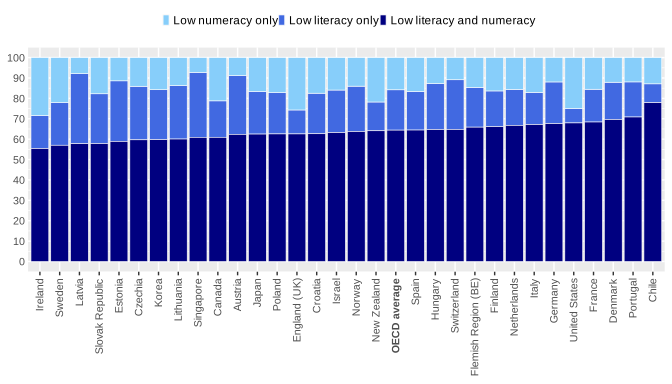
Note: Ordered by share of adults with low foundational skills with deficits in both domains
Source: OECD (2024), Survey of Adult Skills (PIAAC) database, http://www.oecd.org/skills/piaac/publicdataandanalysis/, Annex Table A.1.1
Capabilities outside the primary deficit domain
Adults may perform at different levels across domains, and the previous section established how deficits are distributed between literacy and numeracy among adults with low skills. This section looks beyond the low-skill boundary (Level 1 and below), asking if adults with low literacy or numeracy perform at higher proficiency levels in other domains, including adaptive problem solving.
A substantial minority of adults with low foundational skills attain functional capabilities outside their primary area of weakness, most commonly at Level 2 (Table 2.1). Specifically, 20% of adults with low literacy reach Level 2 in numeracy, 16% of adults with low numeracy reach Level 2 in literacy, and 23% of adults with low literacy or numeracy reach Level 2 in adaptive problem solving. Progression beyond Level 2 is rare in every domain: fewer than 1.5% reach Level 3 outside their primary deficit domain, and virtually none reach higher levels. This pattern is relatively uniform across countries, though there is slightly more cross-country variation in numeracy. In Austria and Latvia, around 3% of adults with low literacy reach Level 3 in numeracy; in Singapore this figure exceeds 5%, suggesting that in certain contexts stronger quantitative reasoning coexists with low literacy (see Annex Table A.2.1).
The sharp drop above Level 2 across all domains means that regardless of which domain defines their classification, adults with low skills rarely progress beyond basic functional competence in other areas. The data also reveal a population with low skills that is internally differentiated. A meaningful share retains Level 2 capabilities in at least one other domain – in some cases plausibly reflecting linguistic rather than generalised cognitive barriers – while others perform weakly across all domains assessed, with little evidence of residual capability at higher levels.1 Understanding where these residual capabilities lie, and how far they extend, matters for assessing the starting point from which adult learning can build.
Distribution across proficiency levels in non-deficit domain(s) among adults with low foundational skills, OECD average, 2023
Source: OECD (2024), Survey of Adult Skills (PIAAC) database, http://www.oecd.org/skills/piaac/publicdataandanalysis/, Annex Table A.2.1
Low foundational skills cover a wide range of abilities and learning needs. This section examines the severity of these skill gaps from two complementary perspectives: how far adults with low skills are, on average, from the Level 2 threshold, and how fluently they process written information. Together, these measures provide a clearer picture of the capabilities of adults with low foundational skills in each country and lay the groundwork for the country typology developed later in the chapter.
Literacy proficiency among adults with low skills
The median literacy score among adults with low skills across the OECD is 199 points, which sits firmly within the Level 1 band of 176 to 226 points. However, country-level medians range from 186 points in Chile to 212 points in Ireland, a difference of 26 points (Figure 2.2). This variation matters: an adult scoring near the Level 2 threshold is close to functional competence, while one near the bottom of Level 1 faces a considerably longer path to get there.2
At the upper end, Ireland (212 points), the Slovak Republic (208 points), England (UK) (207 points) and Canada (206 points) have the highest median literacy scores among their populations with low skills, placing the typical adult with low skills in these countries within short distance of the Level 2 threshold of 226 points (Figure 2.2). At the other end, Chile (186 points), Singapore (189 points) and Finland (189 points) have the lowest median scores, despite having very different rates of adults with low skills: 61%, 32% and 15% respectively. In Chile, a high rate and low median performance are consistent with a large population facing deep and widespread foundational deficits. Finland presents a contrasting profile: its low-skilled population is small but performs poorly compared to adults with low skills in other countries, suggesting a concentrated group facing severe disadvantage.
Beyond median performance, the dispersion of literacy scores within the population of adults with low skills also varies. Finland (127 points), the United States (128 points) and New Zealand (127 points) have by far the widest interdecile ranges, driven by long lower tails. At the other end of the spectrum, Estonia (75 points), Latvia (73 points), Lithuania (73 points) and the Slovak Republic (76 points) exhibit the smallest interdecile ranges. In these countries, the population of adults with low skills is clustered within a narrower section of the literacy proficiency scale and therefore more homogeneous.
10th, 50th and 90th percentiles of literacy scores among adults with low foundational skills, by country, 2023
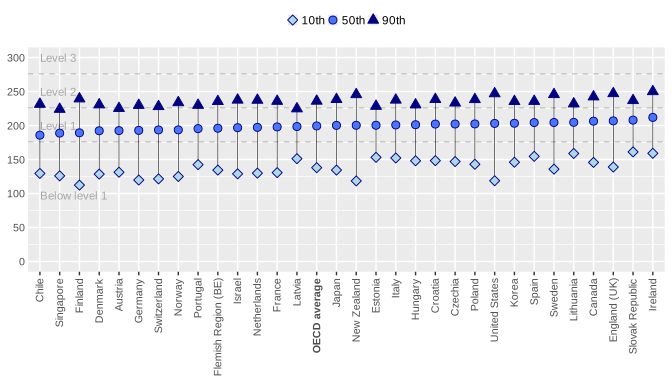
Note: Ordered by median literacy scores of adults with low foundational skills
Source: OECD (2024), Survey of Adult Skills (PIAAC) database, http://www.oecd.org/skills/piaac/publicdataandanalysis/, Annex Table A.2.2
Numeracy proficiency among adults with low skills
The depth of the numeracy challenge among adults with low foundational skills differs from literacy in several respects. The median numeracy score among adults with low skills in the OECD area is 203 points, four points higher than the literacy median, placing the typical adult with low skills slightly closer to the Level 2 threshold in numeracy than in literacy. The average dispersion is also wider in numeracy than in literacy (104 points interdecile range), indicating greater heterogeneity within the low-skill population in this domain.
The country ranking by average median numeracy among adults with low skills differs substantially from the ranking by literacy (Figure 2.3). Latvia (214 points), Estonia (212 points), Lithuania (211 points) and the Slovak Republic (211 points) have the highest median numeracy scores among adults with low skills. In the literacy domain, Estonia and Latvia sit closer to the middle of the distribution. At the other end, Chile (184 points) and the United States (188 points) have the lowest median numeracy scores among adults with low skills. The United States presents the sharpest contrast with its literacy profile: its literacy median of 203 points is above the OECD average, but its numeracy median of 188 points is among the lowest of any participating country.
The dispersion pattern in numeracy also differs from literacy (Figure 2.3). Singapore (128 points) and Sweden (126 points) have the widest interdecile ranges, neither of which stand out in the literacy dispersion analysis. By contrast, Ireland (88 points), Lithuania (85 points) and the Slovak Republic (85 points) have the narrowest interdecile ranges, alongside relatively high medians.
10th, 50th and 90th percentiles of numeracy scores among adults with low foundational skills, by country, 2023
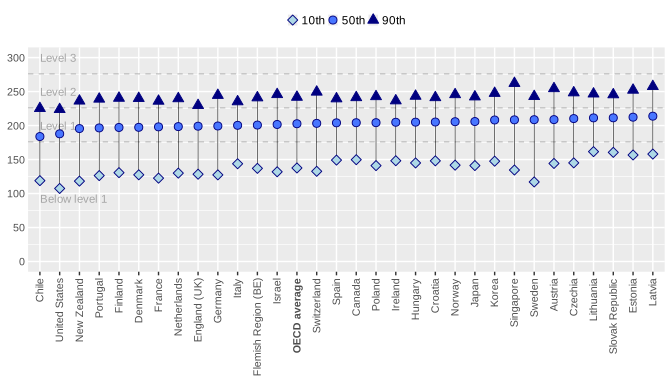
Note: Ordered by median numeracy scores of adults with low foundational skills
Source: OECD (2024), Survey of Adult Skills (PIAAC) database, http://www.oecd.org/skills/piaac/publicdataandanalysis/, Annex Table A.2.2
Reading fluency among adults with low skills
Reading fluency – the ability to read both quickly and accurately (Kuhn and Stahl, 2003[2]) – is closely linked to comprehension capacity. Fluent readers have automatised word recognition and sentence processing to the point where these require little working memory (LaBerge and Samuels, 1974[3]; Perfetti, 1985[4]), freeing up cognitive capacity for higher-level processes such as inference and reading strategies (Walczyk et al., 2004[5]). Adults who have not reached this level must direct more cognitive resources to basic decoding of words and phrases, leaving less cognitive energy available for understanding the underlying meaning and making sense of the words and phrases (García and Cain, 2014[6]; Klauda and Guthrie, 2008[7]; Richter et al., 2013[8]). The same logic extends to numeracy: adults for whom basic quantity recognition remains effortful face similar constraints on higher-order numerical reasoning.
The data collected in the 2023 Survey of Adult Skills allow to separately investigate response time and accuracy and can therefore be used to understand whether adults with low foundational skills have reached a sufficient level of fluency. Together these two dimensions enable the distinction of four profiles of adults with low skills that describe not just what they can do, but how they do it – a distinction with direct implications for where learning and instruction should focus. This section uses response time and accuracy data from the sentence comprehension component to construct these profiles; Box 2.1 describes the component assessment and the population it covers.3
Reading components measure the basic decoding skills essential for extracting meaning from written texts, capturing variation at the lower end of the literacy proficiency scale that the main assessment cannot reliably distinguish. Two types of component tasks are included in the direct assessment in the 2023 Survey of Adult Skills: sentence comprehension tasks, where the respondents must judge whether a sentence makes sense, and passage comprehension tasks, where the respondents must identify the word that gives meaning to each sentence in a short passage. Timing data are collected alongside accuracy for both task types and provide a measure of reading fluency, though they do not contribute to literacy proficiency scores.
Numeracy components, which are new to the 2023 Survey of Adult Skills, focus on number sense, i.e. the understanding of quantities and how numbers represent them. Two task types are included: how many, in which respondents must count items in an image, and which is biggest, in which respondents must identify the largest of four numbers.
The analysis that follows focuses on sentence comprehension only. This is because tasks in the passage comprehension components have more variation in length; and response times for numeracy components have low variance across countries and a limited link between response time and proficiency.
The sample covers adults who completed the sentence comprehension component. Background questionnaire and doorstep respondents are not included. Importantly, this implies that the analysis excludes the group of adults with low skills with the most limited knowledge of the assessment language.
Share of respondents by assessment paths

Source: OECD (2024), Survey of Adult Skills (PIAAC) database, http://www.oecd.org/skills/piaac/publicdataandanalysis/, Annex Table A.1.2
Reading speed
Reading speed, one of the key aspects of reading fluency, varies systematically with literacy proficiency. From Level 1 upward, response times fall consistently as proficiency rises: adults at Level 1 take around 6 seconds per item, while those at the highest levels complete each item in around 4 seconds – a gap that reflects increasing automatisation of word recognition and sentence processing (Figure 2.5). Below Level 1, however, the relationship between proficiency and speed is non-linear. Here, response time first increases with proficiency, peaking at a proficiency of 155, after which it declines. Adults on the verge of Level 1 take the longest: they are trying to engage with items they find genuinely difficult. Those at the very bottom respond more quickly despite lower accuracy, a pattern consistent with limited engagement or the quick realisation of engaged test-takers that they will not be able to complete the task.
Mean response time per item (seconds) on sentence comprehension tasks, by literacy proficiency score, OECD average, 2023
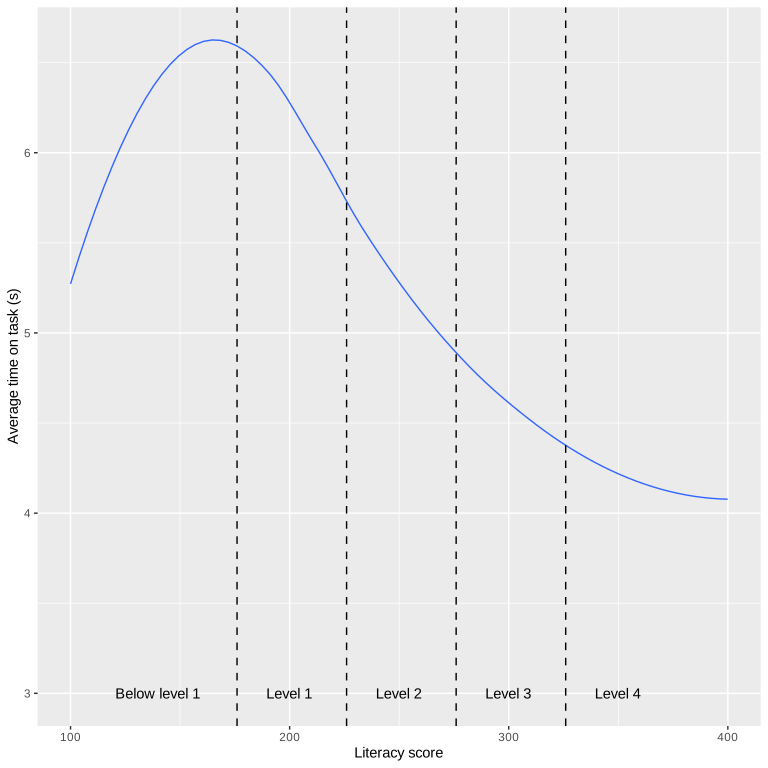
Note: Local polynominal smoothing function applied; includes adults who completed the sentence comprehension component and hence adults routed to the full assessment only; doorstep and background questionnaire respondents are excluded
Source: OECD (2024), Survey of Adult Skills (PIAAC) database, http://www.oecd.org/skills/piaac/publicdataandanalysis/
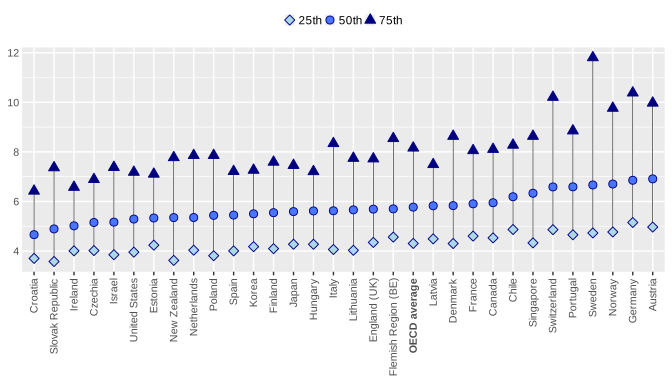
Within the population of adults with low skills, response times vary considerably across countries, and cross-country differences are most pronounced at the bottom end of the response time distribution (Figure 2.6). The median response time among adults with low skills is 5.8 seconds per item, ranging from below 5 seconds in Croatia and the Slovak Republic to above 6.5 seconds in Austria, Germany, Norway, Portugal, Sweden and Switzerland. The 25th percentile – the fastest quarter of low-skilled readers in each country – is relatively compressed across countries, suggesting that faster readers within the low-skilled population process text at broadly comparable speeds (between 3.5. and 5 seconds). The 75th percentile tells a different story: in Germany, Sweden and Switzerland, response times at the slow end exceed 10 seconds per item.
One likely contributor to this pattern is the composition of the population of adults with low skills (see Chapter 3). Non-native speakers with some knowledge of the assessment language may attempt items but process text more slowly than native speakers, stretching the upper tail of the response time distribution. When the analysis is restricted to native speakers with low skills, the median response time falls to 5.4 seconds – a reduction of 0.4 seconds – and the extreme values at the 75th percentile narrow considerably. By contrast, the median response time for non-native speakers is 7.5, although it should be noted that this cross-country average does not include all countries due to small sample sizes. The response time of the 75th percentile of non-native speakers is 10.9 seconds on average across countries and as high as 15.7 seconds in Sweden and over 14 seconds in Austria, Germany and the Flemish Region of Belgium. This is consistent with language barriers slowing text processing among non-native speakers.
Portugal is the country with the slowest readers when the analysis is restricted to native speakers. The median response time is 6.6 seconds, with a wide upper tail. Chile and Germany also have medians above six seconds among non-native speakers with low skills. This pattern is consistent with their deep deficit profile (see the next sub-chapter): in these countries, many adults are genuinely far from being functionally competent readers; they are not only slow due to language barriers.
Detailed country-level data for the full sample, as well as for native-born, foreign-born, native speakers and non-native speakers, are provided in Annex tables A 2.3. Overall, patterns of response times by migration status and language background are broadly aligned. However, notable differences in speed persist in some countries between foreign-born and non-native speakers, highlighting that these groups only partially overlap. Further analysis is warranted, considering country-specific linguistic and migration contexts.
25th, 50th and 75th percentile response times per item (seconds) on sentence comprehension tasks among adults with low foundational skills, by country, 2023
Note: Ordered by median response time; includes adults who completed the sentence comprehension component and hence adults routed to the full assessment only; doorstep and background questionnaire respondents are excluded
Source: OECD (2024), Survey of Adult Skills (PIAAC) database, http://www.oecd.org/skills/piaac/publicdataandanalysis/, Annex Table A.2.3
Reading accuracy
Accuracy naturally increases steeply with proficiency, with the sharpest gradient at the lower end of the scale (Figure 2.7). Among the lowest performers, around 55% of items are answered correctly – not much better than chance on a two-option task. Accuracy climbs rapidly through the below Level 1 and Level 1 bands, reaching around 94% at the Level 1 to Level 2 boundary. From Level 2 onward the curve flattens, with further gains in proficiency adding relatively little to accuracy on sentence comprehension tasks. The implication is that, as expected, the component tasks are most sensitive, and most informative, precisely in the range where the low-skilled population sits.
Despite lower accuracy overall, most adults with low skills answer most sentence comprehension items correctly. This means that for many adults with low skills, the foundation for building reading competence is already partially in place. But the range within the group is wide. An adult at the middle of the Level 1 band answers around 9 in 10 items correctly; one at the bottom of the below Level 1 band answers only around half correctly, a performance not different from what they would obtain under random guessing.
Mean share of sentence comprehension items answered correctly, by literacy proficiency score, OECD average, 2023

Note: Includes adults who completed the sentence comprehension component and hence adults routed to the full assessment only; doorstep and background questionnaire respondents are excluded
Source: OECD (2024), Survey of Adult Skills (PIAAC) database, http://www.oecd.org/skills/piaac/publicdataandanalysis/
Reading profiles among adults with low skills
The patterns in reading speed and accuracy described above can be combined into a single typology that captures how adults with low skills engage with text (Table 2.2). Two dimensions are used: accuracy, measured as the share of items answered correctly, and speed, measured as median response time per item. For accuracy, a threshold of less than two mistakes classifies adults as accurate readers, acknowledging that any respondent may make an occasional error regardless of underlying ability. For speed, the threshold of 5.5 seconds per item corresponds to the median response time observed among adults with low skills and produces four similarly sized groups with meaningful country-level variation.
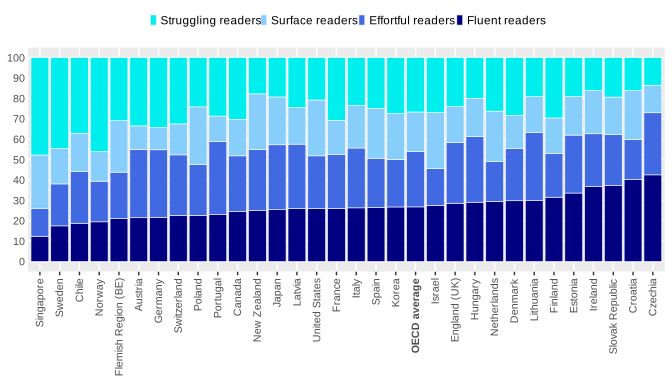
Across OECD countries, around one in four adults with low skills falls into each of the four reader profiles on average, but this conceals substantial cross-country variation (Figure 2.8).
The share of fluent readers – fast and accurate – ranges from around 12% in Singapore to over 40% in Croatia and Czechia. To understand these shares, it is key to remember how common low skills are in each country. Countries with the largest fluent reader shares tend to be those where the low-skilled population is clustered closer to Level 2 and internally more homogeneous, a pattern explored in more depth in the country typology in the remainder of this chapter. Estonia, Finland, Ireland, and the Slovak Republic also have above-average shares of fluent readers (at least 30%).
At the other end, struggling readers – slow and inaccurate – account for at least 45% of the low-skilled population in Norway, Singapore and Sweden. As the speed analysis showed, this pattern is partly driven by the composition of the low-skilled population in these countries: adults assessed in a non-native language tend to process text more slowly and less accurately. 4
Effortful readers – accurate but slow – are most prevalent in Austria, Lithuania and Portugal, where they account for a third or more of adults with low skills. In Austria, both the shares of effortful and struggling readers are above average, with relatively few fluent and surface readers. This pattern points to a low‑skilled population where slow processing predominates – with accuracy varying within that slow-processing group.
The surface reader profile is most prevalent in Israel, New Zealand, Poland and the United States. The high shares of adults with low skills of this group may capture something distinct from skill level as measured by proficiency scores, whether rapid guessing, limited engagement, or a response style that favours speed over deliberation. The data do not allow these to be distinguished.
Across OECD countries, foreign-born and non-native speaking adults are over-represented among struggling readers and under-represented among fluent readers. On average, 38% of struggling and 22% of effortful readers are foreign-born, compared to around 10% of fluent readers. A similar pattern emerges for language background: 31% of struggling readers and 18% of effortful readers are non-native speakers (Annex Table 2.5). In Norway and Sweden, over 80% of struggling readers are foreign-born. When focusing on language rather than migration status, Norway and Sweden again stand out, but Singapore also enters this group: in all three countries, over 80% of struggling readers are non-native speakers. In Singapore, this reflects the linguistic context, where English is the language of the assessment but not necessarily the main language spoken at home for a large share of respondents, rather than migration per se.
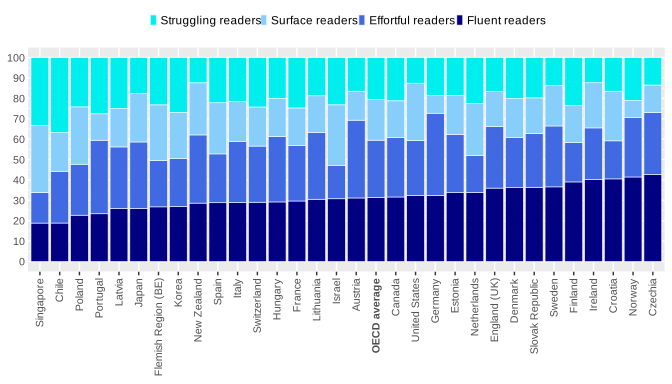
The picture shifts considerably when the analysis is restricted to native speakers with low skills (Figure 2.9). The share of struggling readers falls substantially in Norway and Sweden, countries where language barriers drove much of the slow and inaccurate response pattern in the full sample. Yet meaningful variation persists among native speakers. Chile, Korea, Portugal and Singapore have high shares of struggling readers even in the native-speaking sample, pointing to deeper foundational deficits that cannot only be attributed to language barriers.
A natural question is whether the cross-country variation in reader profiles simply mirrors differences in the share of adults with low skills. The data suggest this is not the case. The correlation between a country's share of adults with low skills and its share in any of the four reader profiles is negligible. Among countries with very similar shares of adults with low skills, the dominant reader profile varies considerably: Finland and Sweden both have around 15% of adults with low skills, yet in Finland fluent readers are the largest group (32% of low-skilled adults), while in Sweden struggling readers account for 45% of the low-skilled population. In Japan, with the lowest share of adults with low skills in international comparison (13%), low‑skilled adults are primarily effortful readers.
Share of adults with low foundational skills by reader profile, by country, 2023
Note: Ordered by share of fluent readers; for the definition of struggling, surface, effortful and fluent readers see Table 2.2; includes adults who completed the sentence comprehension component and hence adults routed to the full assessment only; doorstep and background questionnaire respondents are excluded
Source: OECD (2024), Survey of Adult Skills (PIAAC) database, http://www.oecd.org/skills/piaac/publicdataandanalysis/, Annex Table A.2.4
The diversity is equally striking at the other end of the distribution. Among the countries where more than 40% of adults have low skills – Chile, Israel, Italy, Lithuania, Poland, Portugal – there is no clear pattern. In Lithuania and Portugal, effortful readers are the most prevalent group; in Israel and Poland, surface readers are prominent. Chile stands apart: with the highest low-skills rate in the sample at 61%, struggling readers also dominate, highlighting the depth and breadth of its skill challenge. Reader profiles therefore appear to reflect the nature of the skill challenge in each country, which is shaped by factors such as language characteristics, migration and migration history, and education policy, rather than simply the scale of the challenge. For an analysis of the socio-demographic profiles of adults with low skills across countries, see Chapter 3.
Share of native-born adults with low foundational skills by reader profile, by country, 2023
Note: Ordered by share of fluent readers; for the definition of struggling, surface, effortful and fluent readers see Table 2.2; includes adults who completed the sentence comprehension component and hence adults routed to the full assessment only; doorstep and background questionnaire respondents are excluded
Source: OECD (2024), Survey of Adult Skills (PIAAC) database, http://www.oecd.org/skills/piaac/publicdataandanalysis/, Annex Table A.2.4
Reader profiles are associated with labour market participation, though differences are modest on average across OECD countries. Among adults with low skills, inactivity ranges from 28% among fluent readers to 33% among struggling readers. This association is more pronounced among native-born adults: inactivity reaches 38% among struggling readers, compared to 28% among fluent readers - a gap of 10 percentage points. A similar, though slightly smaller, gradient is observed among native speakers, with inactivity rising from 28% among fluent readers to 36% among struggling readers. These patterns suggest that, among migrants, factors other than reading processes – such as institutional, educational, language, legal and personal barriers – may play a larger role in shaping labour market outcomes. By contrast, among native‑born adults, where these confounding factors are less present, the association between effortful reading and labour market detachment is clearer (Annex Table A.2.6).
The data do not allow conclusions about the direction of causality underlying these patterns. The association between reader profiles and labour market inactivity may reflect several overlapping mechanisms. Lower literacy proficiency may reduce access to employment or make it more difficult to sustain jobs that require regular reading, while periods of inactivity may in turn limit opportunities to maintain or develop reading skills. In addition, other factors - such as socio-economic background, health conditions, educational pathways and local labour market opportunities - may simultaneously influence both literacy performance and the likelihood of being inactive. These interrelated influences make it difficult to disentangle the extent to which reading difficulties themselves drive labour market detachment.
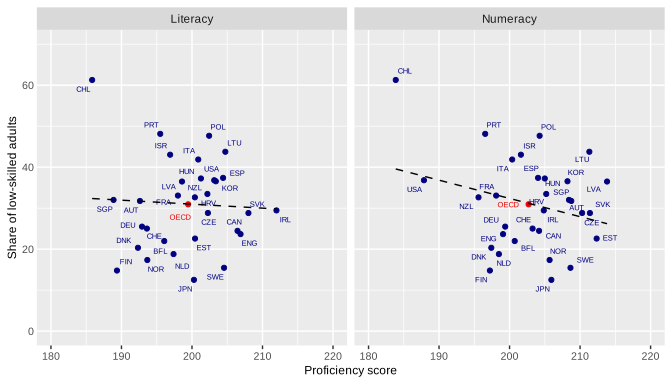
The share of adults with low foundational skills (Chapter 1) may be the most cited indicator of a country's skills challenge, but it provides an incomplete picture. The relationship between the share of adults with low skills and the depth of deficits within the low-skilled population is weak in literacy and only moderately stronger in numeracy (Figure 2.10). Lithuania combines a high rate (44%) with a relatively high median literacy score among its low-skilled population, meaning many adults fall below the threshold but most are close to it. Finland presents almost the mirror image: low rate (15%) but one of the lowest median scores, indicating a prevalence of severely disadvantaged adults. Japan, with the lowest rate of all (13%), has a median literacy score close to the OECD average for adults with low skills.
These patterns mean that two countries with identical rates can face fundamentally different challenges: in how far their low-skilled populations are from Level 2, in how internally homogeneous those populations are, and in how adults within them process text. The typology below makes these distinctions concrete.
Median literacy and numeracy scores among adults with low foundational skills versus share of adults with low foundational skills, by country, 2023
Source: OECD (2024), Survey of Adult Skills (PIAAC) database, http://www.oecd.org/skills/piaac/publicdataandanalysis/, Annex Tables A.1.1 and A.2.2
A typology of countries by breadth and depth of the skill challenge
Combining the share of adults with low skills, median proficiency and dispersion of skills within the group and reading processing patterns yields four distinct country profiles (Table 2.3). The primary dimensions are the depth of deficits – how far, on average, the low-skilled population sits below the Level 2 threshold – and the internal heterogeneity of that population, measured by the interdecile range of literacy and numeracy scores. A secondary but analytically important distinction is whether deficits are roughly balanced between literacy and numeracy or concentrated strongly in one domain. The share of adults with low skills in the total population is incorporated as a descriptor within each profile rather than as a defining criterion, because it is largely independent of depth and dispersion: each profile spans a wide range of rates, and the same share of adults with low skills can correspond to very different underlying challenges.
Country classification by share of adults with low foundational skills, median literacy and numeracy scores, interdecile range, and dominant reader profile among adults with low skills, 2023
Note: * Ireland: the gap between its literacy median (212, the highest in the sample) and numeracy median (205) is the largest negative gap in the near-threshold group; it is retained here because numeracy performance remains above average in absolute terms; ** Japan: the literacy interdecile range is above the OECD average *** Sweden: wide dispersion in both domains and high struggling reader share (45%) distinguish it from most countries in this profile **** Latvia: fluent and effortful are the dominant types of readers
Source: OECD (2024), Survey of Adult Skills (PIAAC) database, http://www.oecd.org/skills/piaac/publicdataandanalysis/
The largest group is the near-threshold, concentrated countries: Canada, Czechia, Croatia, Estonia, Hungary, Ireland, Italy, Japan, Korea, Lithuania, Poland, the Slovak Republic, Spain and Sweden. These countries share high median scores in both literacy and numeracy among their low-skilled populations and relatively narrow internal dispersion, meaning that adults with low skills are clustered relatively close to the Level 2 threshold and broadly similar to one another in proficiency level. This profile spans the widest range of rates of adults with low skills any group, from Japan at 13% to Poland at 48%. In lower-rate countries within this group – Canada, Japan and Sweden – effortful or struggling readers predominate: the low-skilled population is small and, even though it sits close to the threshold in proficiency terms, many of these adults do not process text fluently, suggesting a selected group in which language barriers or other disadvantages are relatively concentrated. In higher-rate countries – Croatia, Czechia, Ireland, and the Slovak Republic – fluent readers are the largest group, accounting for 37-43% of adults with low skills, consistent with a large population whose members are genuinely close to functional competence. Sweden somewhat stands apart from other countries in this group, with wider dispersion and a high struggling reader share, 80% of which are migrants.5
The deep deficit, dispersed countries – Chile, Denmark, Finland, France, Germany, Israel, the Netherlands, Portugal and the Flemish Region of Belgium – combine low median scores in both literacy and numeracy with wide dispersion. Their low-skilled populations are further from the Level 2 threshold on average and more internally heterogeneous than in other profiles, spanning a wide range of proficiency within the classified group. This profile also covers a wide range of rates of adults with low skills, from Finland at 15% to Chile at 61%, and the combination of low medians and wide dispersion means the policy challenge is more complex regardless of scale: there is no well-defined target group just below the threshold, but rather a heterogeneous population with varying degrees of foundational difficulty. Reader profiles within this group are correspondingly diverse. Chile, with the highest rate and lowest medians in the sample, has the largest struggling reader share (37%) of any deep deficit country; Germany and France are also struggling-dominated, partly reflecting migrant composition. Portugal leans toward effortful readers (36%), suggesting slower but often accurate processing among a large low-skilled population that is further from the threshold. Finland and the Netherlands, despite low rates, have low-proficient populations with substantial fluent reader shares, consistent with wide dispersion around a low mean – some individuals close to the threshold who process text well, others considerably further below it.
The literacy gap countries – Austria, Latvia, Norway, Singapore and Switzerland – are defined by a pronounced cross-domain imbalance: numeracy medians are substantially above literacy medians in all five, with gaps ranging from around 10 to 20 points. Median literacy among adults with low skills are below the OECD average in all cases. This pattern is consistent with the presence of large shares of adults assessed in a non-native language, for whom literacy performance is depressed by language barriers while numeracy – less language-dependent – remains comparatively strong. The reader profile data reinforce this interpretation: struggling readers account for an average of 37% of the low-skilled population across these countries, the highest of any profile, and in Norway over 80% of struggling readers are migrants. Dispersion varies within the group: Latvia has narrow dispersion in both domains, indicating a more homogeneous low-skilled population, while Norway, Switzerland and Singapore show wider or more mixed dispersion. Rates of adults with low skills range from 17% in Norway to 37% in Latvia, but the depth of literacy-specific deficits, rather than scale, is the defining challenge for all countries in this group.
The numeracy gap countries – England (UK), New Zealand and the United States – present the reverse imbalance: literacy medians are above average and among the highest in the sample, while numeracy medians are below average, with the United States showing the largest numeracy deficit relative to literacy in the entire dataset (15 points). Dispersion is wide in both domains, indicating internally heterogeneous low-skilled populations, but the nature of the challenge is domain-specific: adults in these countries are relatively close to the literacy threshold but considerably further from it in numeracy, with a substantial share scoring well below Level 1 in that domain. Reader profiles reflect the relative literacy strength: effortful and surface readers predominate, and struggling readers are comparatively rare (averaging 21%).
Taken together, these four profiles illustrate that the challenge of low foundational skills takes fundamentally different forms across countries, in scale, depth, domain balance, and in how adults process text. This has implications for policy (Chapter 4). For near-threshold, concentrated countries, the task is primarily one of enabling a relatively well-defined group to cross into medium proficiency, though even here, the reader profile evidence suggests that low-rate members of this group face harder processing challenges than their proficiency medians imply. For deep deficit, dispersed countries, the range of starting points is wider and the distance to functional competence greater for a substantial share of the population, with the policy implications differing sharply between a high-rate country like Chile, where the challenge is both broad and deep, and a low-rate one like Finland, where it is narrow but severe. The domain-divergent profiles – literacy gap and numeracy gap – point to a different kind of challenge altogether: one in which the nature of the deficit varies systematically across domains and in which any single programmatic response is unlikely to serve the full low-skilled population well.
References
[6] García, J. and K. Cain (2014), “Decoding and Reading Comprehension”, Review of Educational Research, Vol. 84/1, pp. 74-111, https://doi.org/10.3102/0034654313499616.
[7] Klauda, S. and J. Guthrie (2008), “Relationships of three components of reading fluency to reading comprehension.”, Journal of Educational Psychology, Vol. 100/2, pp. 310-321, https://doi.org/10.1037/0022-0663.100.2.310.
[2] Kuhn, M. and S. Stahl (2003), “Fluency: A review of developmental and remedial practices.”, Journal of Educational Psychology, Vol. 95/1, pp. 3-21, https://doi.org/10.1037/0022-0663.95.1.3.
[3] LaBerge, D. and S. Samuels (1974), “Toward a theory of automatic information processing in reading”, Cognitive Psychology, Vol. 6/2, pp. 293-323, https://doi.org/10.1016/0010-0285(74)90015-2.
[10] OECD (2025), Survey of Adult Skills 2023 Technical Report, OECD Skills Studies, OECD Publishing, Paris, https://doi.org/10.1787/80d9f692-en.
[1] OECD (2024), 2023 Survey of Adult Skills. Data compendium - background variables, https://www.oecd.org/content/dam/oecd/en/about/programmes/edu/piaac/data-materials/cycle-2/piaac-cy2-compendium-background-variables.xlsx.
[4] Perfetti, C. (1985), Reading Ability, Oxford University Press, New York.
[8] Richter, T. et al. (2013), “Lexical Quality and Reading Comprehension in Primary School Children”, Scientific Studies of Reading, Vol. 17/6, pp. 415-434, https://doi.org/10.1080/10888438.2013.764879.
[9] Schlögl, P., M. Mayerl and M. Kastner (2025), Mehr Menschen mit niedrigen Lesekompetenzen: Typologie, Soziodemografie und Handlungsempfehlungen für eine umfassende Leseförderung, Statistics Austria, https://www.statistik.at/fileadmin/publications/PIAAC_2022-23_Expert-innenbericht_bf.pdf.
[5] Walczyk, J. et al. (2004), “Children’s Compensations for Poorly Automated Reading Skills”, Discourse Processes, Vol. 37/1, pp. 47-66, https://doi.org/10.1207/s15326950dp3701_3.
← 1. This is partly explained by the fact that numeracy and adaptive-problem solving tasks require the understanding of written instructions, i.e. a minimum level of literacy proficiency in the language of assessment.
← 2. It should be noted that median literacy scores are calculated for the full low-skilled population, including adults whose classification is based on numeracy performance and who may perform above Level 1 in literacy. Median scores therefore reflect the central tendency of the group as defined throughout this report rather than the depth of literacy deficits specifically.
← 3. Example test questions of the reading components can be accessed here: https://www.oecd.org/en/about/programmes/piaac/piaac-released-items.html#readingcomponents [accessed 5. June 2026]
← 4. For the case of Sweden, the use of interpreters for the Background Questionnaire also plays a role in explaining this pattern. It means that adults with no or limited native language skills were routed to the direct assessment following the questionnaire, while this group would only have been interviewed using the doorstep interview in other countries and not progressed to the assessment.
← 5. See note 4