While trends in social media use are helpful, the linkages between using social media and other outcomes, such as academic performance and well-being, are more vital. This section examines several associations between social media use and academic outcomes.
Growing up in the social media age
A key worry for parents and educators is that social media use may negatively affect academic performance. For example, young people who use social media may become easily distracted by and attracted to the interactive nature of social media, diverting their time and focus from academic activities (OECD, 2023[55]). Some researchers also argue that use of digital applications like social media could have a direct cognitive effect on the brain’s development (Firth et al., 2019[64]; Montag and Markett, 2023[65]). In contrast, social media use might generate positive effects for young people, including increasing access to information and fostering social connections.
While the relationship between self-reported social media use and academic performance is an association rather than a causal relationship, data from PISA shed light on this issue. Young people who report moderate social media browsing and communication tend to have better mathematics performance compared to those with no or excessive social media use (Figure 5). Indeed, in 2022, young people who reported browsing social media on weekdays for less than one hour a day, or from one to three hours per day, outperformed the overall OECD mean score in mathematics (472 points). These cohorts also scored more in mathematics on average than students who spent no time at all browsing on weekdays. Similar results are observed for science, although those students who report spending between one to three hours browsing on weekdays score higher in reading than those who browse for less than an hour or not at all per weekday.
On the weekend, young people can browse for longer with lower associated declines in their academic performance. Across the OECD, those who browse one to three hours per day on the weekend score higher on mathematics assessments than those who do not browse at all, as well as those who browsed for less than an hour. A similar pattern is observed with other academic outcomes, including reading and science scores. Here, on average, students who browse one to three hours on the weekend outperformed their peers.
Average mathematics score by time spent browsing social media networks, or communicating and sharing digital content on social media or any communication platform, OECD average, 2022

Note: See Endnote.1
Source: Calculations based on OECD (2025[49]), Programme for International Student Assessment Database, https://www.oecd.org/en/data/datasets/pisa-2022-database.html (accessed on 24 June 2025).
A slightly different story emerges for communicating and sharing digital content on social media. On both weekdays and weekends, average performance peaks at less than one hour per day of social media communication and sharing digital content across mathematics, reading and science performance. For example, on average across the OECD, students who spend up to one hour communicating and sharing content on social media per weekday score higher in mathematics on average than their counterparts who spent no time on this activity on weekdays and much higher than their peers who spent more than seven hours per day.
Despite cross-country variation in the extent to which young people use social media, a consistent trend is observable across almost all OECD Member countries. For young people who use social media, mathematics performance tends to decline as time spent on social media increases. Excessive social media use correlates with lower performance: mathematics scores decline sharply for students who use social media for more than three hours per day on average. The lowest scores are often seen in the group that spends more than 11 hours per day on social media.
Socio-economic background is a strong determinant of academic performance and an important determinant of social media use. On average across the OECD, students with a disadvantaged socio-economic status scored 93 points lower in mathematics than counterparts who are socio-economically advantaged (OECD, 2023[56]). For reference, 20 points roughly correspond to one year of schooling (OECD, 2023[56]).
In parallel, girls and boys in the lowest socio-economic background quartile report spending on average eight and five hours more, respectively, per week on social media compared to their peers from the highest socio-economic background quartile. Analysis of PISA data exploring mathematics performance, social media and demographic variables suggests that declines in performance associated with social media use are more pronounced for students from privileged backgrounds. Indeed, weekly use of 35 hours corresponds to an estimated decrease of around 37 points in mathematics performance in students from advantaged backgrounds and to an estimated decrease of 19 points in students from disadvantaged backgrounds.
Social media offers opportunities to young people to be creative and express themselves in new ways (Anderson et al., 2022[66]; Faverio, Anderson and Park, 2025[67]). This is in part because social media exposes young people to diverse perspectives, content and ideas, which can stimulate creativity. Similarly, social networks available on social media platforms may also provide an avenue for feedback and collaboration with other people. This can help young people practise their ability to evaluate and improve their ideas – a key component of creative thinking (OECD, 2025[68]). On the other hand, some argue that the potential cognitive and attentional effects of digital technology use may be detrimental for creativity (Aru and Rozgonjuk, 2022[69]).
Creative thinking is an increasing focus for many education systems across the OECD (OECD, 2024[70]) and a core part of the complementary set of skills needed to thrive in highly digital environments (OECD, 2020[71]). In 2022, PISA assessed performance in creative thinking, defined as “the ability to generate, evaluate and improve ideas to produce original and effective solutions, advance knowledge and create impactful expressions of imagination” (OECD, 2024[72]). This assessment focused on young people’s cognitive capacity for creative work in four domains: visual expression, social problem solving, written expression and scientific problem solving.
As with the other academic competencies, a moderate amount of social media use is associated with better performance in creative thinking. Creative thinking scores peaked at a higher level of social media browsing (one to three hours) on either the weekend or weekday compared to sharing or communicating digital content on social media (Figure 6). Any more than one hour spent using social media to communicate or share digital content on either the weekend or the weekday results in a decline in measured creative thinking scores. Even after accounting for sex and socio-economic status of students and schools, students who spend at least one hour communicating and sharing digital content on social media or communication platforms scored two points2 below in creative thinking than those who spend less than one hour (OECD, 2024[72]).
Average creative thinking score of 15-year-old students, by time spent browsing social media networks, or communicating and sharing digital content on social media or any communication platform, OECD average, 2022
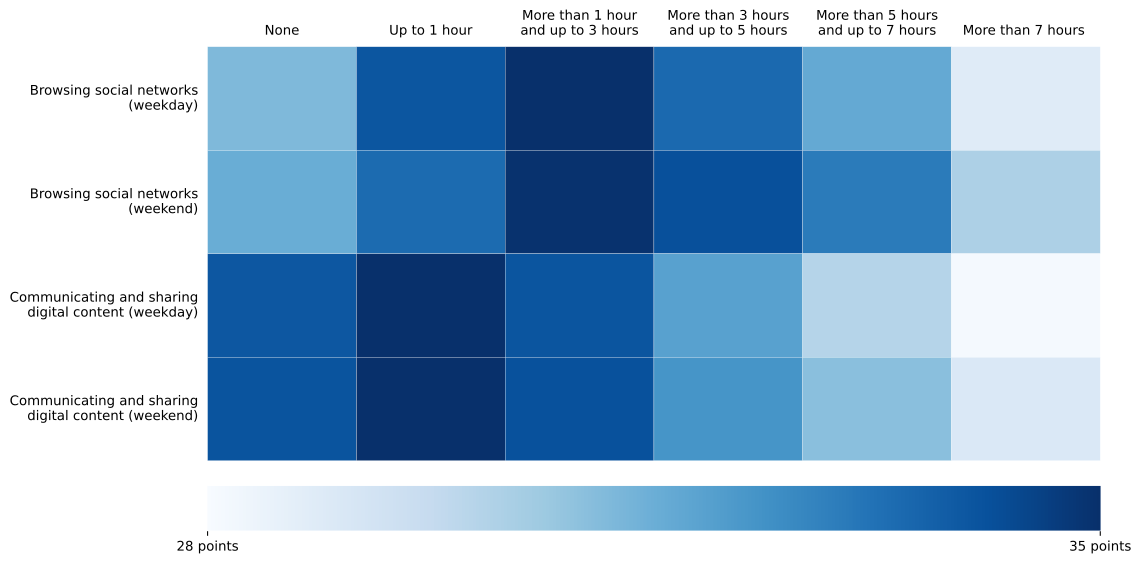
Note: See Endnote.3
Source: Calculations based on OECD (2025[49]), Programme for International Student Assessment Database, https://www.oecd.org/en/data/datasets/pisa-2022-database.html (accessed on 24 June 2025).
The data presented in this paper highlight that both no use and excessive use of social media are associated with poorer academic performance, while moderate use – typically less than three hours per day – is associated with better outcomes. This association is sometimes referred to as the “Goldilocks hypothesis”, meaning that a moderate amount of digital technology use offers benefits (OECD, 2024[17]). This hypothesis suggests that, on average, the effects of technology or social media use worsen at increasingly intense levels of usage. Researchers differ on how to interpret these associations and the extent to which they can be used to infer causality given that other factors, such as skills, can play a role.
← 1. 15-year-old students were asked, “During a typical weekend day [/weekday], how much time do you spend doing the following leisure activities?”, where two responses were: “Browse social networks (e.g. <Instagram®>, <Facebook®>)”; and “Communicate and share digital content on social networks or any communication platform (e.g. <Facebook®>, <Instagram®>, <Twitter®>, emails, chat)”. OECD average does not include Canada, Colombia, France, Luxembourg, Mexico, the Netherlands, New Zealand, Norway or Portugal.
← 2. PISA scores for creative thinking are not measured on the same scale as scores for mathematics, sciences and reading. A one-score point change (“small” change) corresponds to a one-tenth of the OECD standard deviation in creative thinking performance. A three-score points change (“large” change) is roughly equivalent to one-quarter of the OECD standard deviation in creative thinking performance. A change of two points is thus considered to be a “moderate” difference (OECD, 2024[72]).
← 3. 15-year-old students were asked, “During a typical weekend day [/weekday], how much time do you spend doing the following leisure activities?”, where two responses were: “Browse social networks (e.g. <Instagram®>, <Facebook®>)”; and “Communicate and share digital content on social networks or any communication platform (e.g. <Facebook®>, <Instagram®>, <Twitter®>, emails, chat)”. Data include the share of students reporting “No time at all”. OECD average does not include Canada, Colombia, France, Luxembourg, Mexico, the Netherlands, New Zealand, Norway or Portugal.