This chapter sets out the context and objectives for the Technical Support Implementation (TSI) project "Strengthening the system of evaluation and quality assurance in higher education and vocational education and training in Lithuania”, as agreed in the Detailed Project Description (DPD), defines key concepts underpinning the project, and the analytical framework and methodology guiding the analysis in this report.
Ensuring Quality Vocational and Higher Education in Lithuania

Abstract
In recent years, Lithuania has initiated several reforms in higher education and vocational education and training (VET) to tackle pressing demographic challenges and improve the quality and labour market relevance of higher education and VET. Building on these reforms, Lithuania’s Ministry of Education, Science and Sports (ŠMSM) identified a need to improve the coherence, effectiveness and efficiency of the external evaluation and quality assurance (QA) systems for higher education and VET. While the respective QA agencies for higher education and VET in Lithuania are well established, there is a shared perception that they could contribute more effectively to improving the quality and labour market relevance of these parts of the national education and training system. For instance, a 2021 review by the National Audit Office of Lithuania identified multiple weaknesses in the current approach to QA in higher education (National Audit Office of Lithuania, 2021[1]).
Against this backdrop, the ŠMSM initiated a request for support in identifying appropriate policy responses as part of the European Union’s Technical Support Instrument (TSI). The resulting TSI project was implemented between September 2023 and April 2025 by the OECD in partnership with the Lithuanian authorities and the European Commission. The Detailed Project Description (DPD) for this project identified the expected long-term effect of the project (impact) as improved quality and relevance of the education and training offered by higher education and VET providers in Lithuania, leading to a more competitive and attractive higher education and VET system. To achieve this, the project sought to produce the following effects in the short to medium term (outcomes):
Increased knowledge among the Lithuanian authorities, QA agencies and education sector of key challenges in the evaluation and quality assurance of higher education and VET in Lithuania; and
Strengthened institutional capacity of the QA agencies for higher education and VET to undertake high-quality analysis, evaluation and quality assurance of higher education and VET.
The main focus of the project was to develop recommendations and a roadmap to strengthen the external evaluation and quality assurance systems for higher education and VET in Lithuania, implemented by the country’s two external QA agencies responsible for these sectors. However, the project recognised that a wide range of other quality-related policies also influence the quality of teaching and learning. OECD research has identified three major categories of quality-focused policy: a) external evaluation and quality assurance in the strict sense; b) policies to create a wider ecosystem for pedagogical enhancement and innovation; and c) broader (“framework”) policies with a substantial influence on quality and relevance (see Figure 2.1 below).
With this in mind, the project set out to provide recommendations and a roadmap for Lithuania in three areas:
1. Strengthening external evaluation and quality assurance: Recommendations and a roadmap to improve the overall relevance, coherence, effectiveness and efficiency of the external evaluation and quality assurance systems for higher education and VET. The aim is to ensure that the standards, methods and procedures used by the external QA agencies for higher education and VET effectively support providers to enhance the quality of their education offerings and internal QA systems.
2. Developing an ecosystem for pedagogical enhancement and innovation: Recommendations and a roadmap to support the Lithuanian authorities with the mobilisation of other actors in the higher education and VET systems that can support teaching and learning enhancement, to supplement the quality assurance and enhancement work of QA agencies, and higher education and VET providers themselves.
3. Implementing policies to ensure effective “framework” conditions to support quality and relevance: Recommendations and a roadmap to support the Lithuanian authorities in re-calibrating three key framework conditions that influence the quality and relevance of teaching and learning: 1) the level of diversity and coherence across higher education and VET programmes and provider types, and their alignment with the skills needed by the economy and society; 2) the student admission and related public funding systems, and how these influence institutional behaviour to improve teaching quality and relevance; and 3) the availability of comparable, system-level information on the quality and relevance of higher education and VET, and how such information is used in policy planning and to guide student choice.

Note: This figure offers an overview of key policy levers governments are using – either consciously or not – to influence the quality of teaching and learning in VET and higher education. It is based on an analysis of recent policy developments in a sample of ten European jurisdictions n OECD (2025[2]). It does not claim to be comprehensive and recognises that other types of quality-focused policy may exist.
Source: OECD (2025[2]), “Fostering Excellence in Higher Education and VET: Going Beyond Quality Assurance”, OECD Education Policy Perspectives No. 119, p. 7, https://doi.org/10.1787/e6862056-en.
This section provides an overview of the higher education and VET landscapes in Lithuania, as well as how the external evaluation and quality assurance of both sectors is organised. It offers the necessary context for the analysis, roadmap and recommendations presented in the remaining four chapters of this report.
2.2.1. Higher education and vocational education and training in Lithuania
Lithuania’s higher education and VET systems are characterised by a diverse range of education providers and programmes. A diversification of provision has occurred over the last twenty-five years in Lithuania, especially within the higher education sector. This follows trends observed in other OECD and EU jurisdictions, where governments have supported the creation of more practically and professionally oriented higher education institutions (HEIs) – such as colleges or universities of applied science – and programmes – such as professional bachelor’s, master’s and doctoral programmes. Several countries have also supported the development of post-secondary, non-tertiary education and training programmes as an alternative to higher education, as well as short-cycle tertiary programmes to support transitions between VET and higher education (OECD, 2025[2]).
Post-secondary VET and higher education in Lithuania is offered by three types of providers
In the early 1990s and early 2000s, education in Lithuania underwent two major phases of education reform which contributed to an important diversification of the landscape of higher education and VET providers that is still visible today. The General Concept of Education, introduced in 1992 when Lithuania was a newly independent state, re-established universities with increased institutional autonomy (starting with Vytautas Magnus University in Kaunas) and transformed traditionally unified secondary schools into a variety of different types and models (including gymnasiums and vocational schools). A second wave of reform between 1998-2003 included the transformation of several post-secondary vocational schools into colleges of higher education (Zelvys, 2004[3]). These colleges, while re-classified as providers of higher education, had historically been subject to more direct management from the government than universities – a pattern that stakeholders report is still reflected in a cultural difference between the two sectors to this day.
Today, three types of institutions offer vocational and higher education in Lithuania: 16 universities (11 public institutions; 5 private providers), 19 colleges (12 public institutions; 7 private providers) and 285 VET providers (44 public VET institutions; 241 private and non-formal education providers) (see Table 2.1). For each of these three provider types, Lithuanian legislation specifies which programmes these institutions are allowed to offer – in principle, to ensure quality and diversity in the country’s overall education and training offer.
VET institutions (profesinė mokykla) are responsible for offering lower and upper secondary VET at levels 2 and 3 of the International Classification of Education (ISCED) (UNESCO Institute for Statistics, 2012[4]) and post-secondary, non-tertiary vocational programmes at ISCED level 4. Universities (universitetas) are responsible for offering academically oriented bachelor’s, master’s and doctoral programmes at ISCED levels 6-8, and colleges (kolegija) can offer professionally oriented short-cycle and bachelor’s programmes at ISCED levels 5 and 6. Colleges are not allowed to offer master’s, doctoral or academically oriented bachelor’s programmes and, vice-versa, as a rule universities cannot offer professionally oriented programmes. The only exceptions are when universities and colleges wish to deliver a joint study programme leading to a joint qualification, or if the Government determines that there is a need for more specialists in specific study field or profession, and a college is exceptionally given the right to offer a professional master’s programme (Republic of Lithuania, 2022[5]). In future, colleges that demonstrate sufficient research capacity will be allowed to offer professionally oriented master’s programmes. Their research capacity will be determined based on an external assessment of their research and development (R&D) activities and a comparative expert assessment (CEA), carried out by the Research Council of Lithuania (LMT) in 2028.
Number and type of VET and higher education providers in Lithuania, 2023/24
Note: For VET, the table excludes a limited number of general schools who also offer one or two VET programmes.
Source: Adapted from data included on ŠVIS (2024[6]), Švietimo Valdymo Informacinė Sistema (ŠVIS) [Education Management Information System (EMIS)], https://rsvis3.emokykla.lt/ (accessed on 24 April 2024).
Collectively, higher education and VET institutions offer ten different types of programmes
Collectively, the VET and higher education sectors offer ten different types of programmes: three of these are offered by VET providers, seven by HEIs (see Table 2.2). In VET, a distinction exists between two types: initial VET programmes (IVET), targeting students entering directly from lower secondary education, and continuing VET programmes (CVET), aimed at supporting the upskilling and reskilling of adults. Upper secondary IVET programmes at ISCED level 3 typically last three years and aim to either prepare learners for direct entry into the labour market or to access higher education (provided they pass the Matura examination). Post-secondary non-tertiary IVET programmes at ISCED level 4 typically last one year (although sometimes take two years to complete) and target students who have completed general upper secondary education and want to top up their education with a more vocationally oriented programme. CVET programmes are offered at ISCED levels 3-4 and target adults who have obtained at least an ISCED level 2 qualification. Additionally, ISCED level 4 programmes for students that have already obtained a VET qualification or work experience have recently been introduced. Lithuania’s system of learning credits in VET is based on the European Credit System for Vocational Education and Training (ECVET) and is used to indicate the average number of students working hours associated with each programme. One ECVET credit is equivalent to 27 student working hours.
In higher education, Lithuania applies the three-cycle bachelor’s-master’s-doctoral degree structure, thereby aligning with the qualifications framework of the European Higher Education Area (EHEA) (EHEA, 2005[7]). As in other European countries, some Lithuanian universities also offer single-cycle integrated programmes leading directly to a master’s diploma – for example, in the field of medicine – and, since 2018, colleges can offer short-cycle study programmes at ISCED level 5 in twelve professional fields determined by the ŠMSM, in consultation with professional organisations. The European Credit Transfer and Accumulation System (ECTS) is used to indicate the average number of students working hours associated with programmes at ISCED levels 5-7. In Lithuania, one ECTS credit corresponds to 26.5 student working hours, or 1 600 student working hours for one academic year of 60 ECTS (Republic of Lithuania, 2009[8]).
At the doctoral education level, Lithuania distinguishes between arts and science doctorates. Universities that offer doctoral education in these two fields are subject to different regulations. Doctoral education in the arts is regulated through the regulations on arts doctorates (LMT, 2017[9]), and structured as 240 ECTS, with some detail on the number and types of courses or activities doctoral students should engage in. Doctoral education in science is regulated through the regulation on science doctorates (LMT, 2020[10]), which specifies 30 ECTS credits which all PhD students in science must complete.
Programme types in Lithuanian post-compulsory education and training, 2023/24
Note: Master of Laws (LL.M.) or the Master of Business Administration (MBA) are allowed to be only 60 ECTS.
Sources: Adapted from Republic of Lithuania (2009[8]), Higher Education and Research Act, Ministry of Education, Science and Sports, Vilnius, https://e-seimas.lrs.lt/portal/legalAct/lt/TAD/548a2a30ead611e59b76f36d7fa634f8 (accessed on 23 January 2024) and Republic of Lithuania (2017[11]), Lietuvos Respublikos profesinio mokymo įstatymas [Vocational Education and Training Act of the Republic of Lithuania], Ministry of Education, Science and Sports, Vilnius, https://e-seimas.lrs.lt/portal/legalAct/lt/TAD/b0b6cda0eb0a11e7a5cea258c39305f6 (accessed on 26 January 2025).
2.2.2. External quality assurance and evaluation in Lithuania
The external evaluation and quality assurance of higher education in Lithuania is led by the Centre for Quality Assessment in Higher Education (SKVC), while the system for VET is co-ordinated by the Qualifications and Vocational Education and Training Development Centre (KPMPC). Besides these two agencies, a wide range of other actors plays a role in maintaining the external quality assurance systems.
SKVC and KPMPC have primary responsibility for external quality assurance
At the end of 2024, the SKVC Secretariat consisted of 29 staff members (see Figure 2.2). The Director and Deputy-Director were supported by a small team of financial and administrative support staff, and a Legal and General Affairs Division. SKVC’s evaluation activities are co-ordinated by an Institutional Review Division and Programme Review Division. Their main tasks consist of training, co-ordinating and reviewing the work of external experts conducting the external reviews of institution and programmes. The Directory of Experts is maintained in electronic format and updated every one to two years through dedicated calls for experts, as well as ad hoc proposals and recommendations made by major stakeholder bodies. Two advisory bodies, each composed of representatives from HEIs, the labour market, government, students and social partners, review the evaluation reports prepared by the Institutional and Programme Review Divisions and advise SKVC’s Director on the evaluation procedures and accreditation decisions. The Appeal Commission examines appeals made by HEIs against accreditation decisions made by SKVC.
The work of the SKVC Secretariat is overseen by a Council of 11 members, appointed by the ŠMSM for a period of six years. It includes representatives from the labour market, government, HEIs and social partners. The Council is responsible for overseeing the management, planning and accountability of SKVC. It does so by appointing the Director of SKVC, considering and approving the vision and mission of SKVC, reviewing SKVC’s annual activity plans and reports, making proposals to SKVC for the organisation of SKVC’s standards, methods and procedures.

Source: Adapted from SKVC (2024[12]), The organisational structure of the Centre for Quality Assessment in Higher Education (SKVC), Centre for Quality Assessment in Higher Education (SKVC), https://skvc.lrv.lt/en/about-us/structure/ (accessed on 13 October 2023).
KPMPC was first established by the ŠMSM in 1996 as the Methodological Centre for Vocational Education and Training. In 2010, its name was changed to the Qualifications and Vocational Education and Training Development Centre (KPMPC). The Minister of Education, Science and Sports has jurisdiction to appoint the Director of KPMPC. This contrasts to SKVC, where the appointment of the SKVC Director is directly managed by its co-ordinating Council. KPMPC’s activities are managed via its co-ordinating Council, which comprises three members from the ŠMSM from different educational areas (including the Council’s chairperson), one member from the Lithuanian Adult Education Association, one member representing the Association of VET Institutions and one member representing employers (see Figure 2.3). The Council serves to coordinate KPMPC’s activities, approve and change regulations, make decisions on the location reorganisation, or liquidation of KPMPC, and to decide on other issues assigned to the KPMPC in Lithuanian legislation.
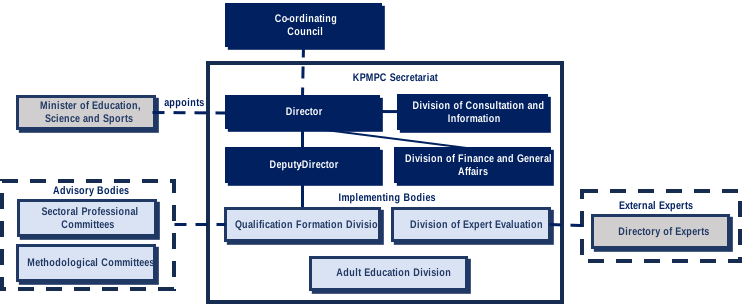
Source: Adapted from KPMPC (n.d.[13]), Kvalifikacijų ir profesinio mokymo plėtros struktūrą [Structure of the Qualifications and Vocational Education and Training Development Centre], Qualifications and Vocational Education and Training Development Centre (KPMPC), Vilnius, https://www.kpmpc.lt/kpmpc/apie-mus-2/kontaktai-ir-struktura/struktura/ (accessed on 4 June 2024).
A wide range of other actors shapes Lithuania’s external quality assurance systems for higher education and VET
While the primary responsibility for external evaluation and quality assurance in higher education and VET in Lithuania rests with SKVC and KPMPC, several other national bodies play an important role in the system. Presently, six national bodies are (or until recently have been) involved in the external evaluation and QA of higher education and VET in Lithuania.
In higher education, SKVC’s evaluation activities cover teaching and learning delivered in short-cycle, bachelor’s and master’s programmes. The external evaluation and QA of doctoral education is carried out by the Research Council of Lithuania (LMT). In the VET sector, SKVC was made responsible for the licensing new VET programmes in 2023, while the evaluation of applications by VET providers to start offering new programmes is still carried out by KPMPC. KPMPC’s periodic reviews of VET providers are also supplemented with annual performance reviews of VET Directors by the ŠMSM. In the past, the Government Strategic Analysis Centre (STATA) monitored the performance of the higher education and VET sectors using key performance indicators. In 2021, however, SKVC and KPMPC were made responsible for carrying out this activity, for which they must collaborate closely with the National Agency for Education (NŠA) as a major holder of relevant data. Finally, in the 2011-15 institutional review cycle SKVC made use of STATA’s monitoring data to inform its reviews of colleges.
Together this creates a complex and multi-actor external evaluation and quality assurance system, with three different external evaluation and QA systems operating in parallel to each other across the VET and higher education sectors (see Table 2.3).
Note: Prepared by the OECD team, based on an analysis of procedures for external evaluation and quality assurance across VET and higher education in Lithuania.
This section presents the analytical framework and methodology underpinning the project. It describes the research questions guiding the analysis in each of the report’s main chapters, as well as the primary and secondary research methods used to conduct the analysis and engage higher education and VET stakeholder organisations and institutions in the project, both across Lithuania and internationally.
2.3.1. Analytical framework
The project is guided by three overarching research questions:
Research question 1: How do Lithuania’s regulatory framework and external evaluation and quality assurance systems for higher education and VET support the quality and labour market relevance of teaching and learning – and how could these policies be improved?
Research question 2: What other types of support do higher education and VET institutions in Lithuania have access to for enhancing the quality and relevance of their teaching practices – and to what extent and how could additional support be developed?
Research question 3: What other system-level policies do the Lithuanian authorities use to influence the quality and relevance of teaching and learning in higher education and VET – and how might these policies be adjusted to ensure a supportive framework for VET and HEIs to operate in?
Regulatory framework and external quality assurance of higher education and VET
The first research question guides the analysis, recommendations and roadmap in chapters 2 and 3 of the report. It focuses on modernising Lithuania’s regulatory and external quality assurance frameworks for VET and higher education, to ensure these enable institutions to more effectively innovate and align their provision with the needs of the labour market and society (see Table 2.4). The analysis of Lithuania’s regulatory framework for higher education and VET covers three main areas of programme design and delivery: 1) the structure and content of study programmes; 2) the study formats in which VET and higher education providers can offer programmes; and 3) the teaching and assessment practices used by teaching staff. Under external quality assurance, the analysis covers the standards and procedures used by SKVC and KPMPC for the external evaluation and QA of higher education and VET, as well as other types of activities carried out by the two agencies to support teaching and learning enhancement.
The analysis of the situation in Lithuania is followed by a review of international policy and practice in relevant comparator systems identified for Lithuania, covering the same areas of diagnosis outlined above. Based on the findings from this international review – which are included in OECD (2025[14]) and OECD (2025[2]) – recommendations and a roadmap to modernise Lithuania’s regulatory frameworks and external QA systems for VET and higher education are proposed, to ensure they support the quality and relevance of teaching and learning.
Source: Based on OECD (2025[14]), “Ensuring Quality in Higher Education and VET: Getting Quality Assurance Right”, OECD Education Policy Perspectives, No. 118, https://doi.org/10.1787/812ff006-en and OECD (2025[2]), “Fostering Excellence in Higher Education and VET: Going Beyond Quality Assurance”, OECD Education Policy Perspectives, No. 119, https://doi.org/10.1787/e6862056-en.
Institutional practices and supports for pedagogical enhancement and innovation
The second research question guides the analysis, recommendations and roadmap presented in chapter 4 of the report and focuses on developing an ecosystem for pedagogical innovation and enhancement in Lithuanian VET and higher education. It covers two main areas of analysis (see Table 2.5): 1) an analysis of key trends in institutional quality management in Lithuanian higher education and VET providers, and their capacity to support teaching staff to engage in pedagogical enhancement and innovation; and 2) an examination of the bodies that support teaching and learning enhancement in higher education and VET in Lithuania, and their approach taken to supporting institutions.
The analysis of the situation in Lithuania is followed by a review of international policy and practice in relevant comparator systems identified for Lithuania, covering the same areas of diagnosis outlined above (an international review of institution-level practices for pedagogical enhancement and innovation was not included in the scope of the project). Based on the findings from this international review – which are included in OECD (2025[2]) – recommendations and a roadmap for Lithuania to develop additional supports for pedagogical enhancement in the VET and higher education sectors are proposed.
Source: Based on OECD (2025[14]), “Ensuring Quality in Higher Education and VET: Getting Quality Assurance Right”, OECD Education Policy Perspectives, No. 118, , https://doi.org/10.1787/812ff006-en and OECD (2025[2]), “Fostering Excellence in Higher Education and VET: Going Beyond Quality Assurance”, OECD Education Policy Perspectives, No. 119, https://doi.org/10.1787/e6862056-en.
Broader (“framework”) policies influencing teaching and learning quality
The third research question guides the analysis in chapter 5 of the report and focuses on broader framework policies that influence teaching and learning quality. It covers three main areas of analysis (see Table 2.6): 1) Lithuania’s approach to managing diversity and coherence across the network of higher education and VET providers and programmes, and its alignment with the skills needed by the economy and society; 2) Lithuania’s student admission system and the closely related public funding system; and 3) the availability of system-level information on the quality and relevance of teaching and learning in VET and higher education, and how this information is used in Lithuania to inform prospective students and influence student choice.
The analysis of the situation in Lithuania is complemented by a review of international policy and practice in relevant comparator systems identified for Lithuania, covering the same areas of diagnosis outlined above. Based on the findings from this international review – which are included in OECD (2025[2]) – recommendations and a roadmap to adapt Lithuania’s regulatory frameworks and external QA systems for VET and higher education, to ensure they support the quality and relevance of teaching and learning.
Source: Based on OECD (2025[14]), “Ensuring Quality in Higher Education and VET: Getting Quality Assurance Right”, OECD Education Policy Perspectives, No. 118, https://doi.org/10.1787/812ff006-en and OECD (2025[2]), “Fostering Excellence in Higher Education and VET: Going Beyond Quality Assurance”, OECD Education Policy Perspectives, No. 119, https://doi.org/10.1787/e6862056-en.
2.3.2. Methodology
To answer the three sets of research questions outlined above, the project was organised in three main phases (see Figure 2.4): 1) a diagnosis of Lithuania’s approach to ensuring quality in higher education and VET; 2) an international review of policies and practices for ensuring quality in higher education and VET in nine selected comparator jurisdictions for Lithuania; and 3) the development of recommendations and an associated roadmap for Lithuania, based on the findings from phase 1 and 2. The recommendations and roadmap were developed in close collaboration with key representatives and experts from the higher education and VET sectors in Lithuania and internationally.

Note: Based on the Detailed Project Description (DPD) agreed between the European Commission’s SG REFORM, ŠMSM and the OECD.
The report is structured as follows:
Chapter 1 offers an overview of the assessment, recommendations and roadmap presented in this report.
Chapter 2 offers an introduction to the report, including the focus of the context and objectives of the project, and the analytical framework and methodology guiding the analysis.
Chapter 3 examines Lithuania’s regulatory framework and external quality assurance system for higher education, followed by a roadmap and recommendations to support a modernisation of the system in support of enhanced quality and labour market relevance of provision.
Chapter 4 examines Lithuania’s regulatory framework and external quality assurance system for VET, followed by a roadmap and recommendations to support a modernisation of the system in support of enhanced quality and labour market relevance of provision.
Chapter 5 offers an assessment of VET and higher education institutions’ capacity for internal quality management and pedagogical innovation, as well as available institutional supports, followed by a roadmap and recommendations on how Lithuania can build an ecosystem for pedagogical innovation and enhancement.
Chapter 6 offers an analysis of the wider, system-level policy areas in Lithuania that have a substantial influence the quality and relevance of teaching and learning in higher education and VET, and offers recommendations on how these policy levers can be recalibrated to better serve the needs of Lithuanian students, the labour market and society.
References
[7] EHEA (2005), The framework of qualifications for the European Higher Education Area, European Higher Education Area (EHEA), http://ehea.info/media.ehea.info/file/WG_Frameworks_qualification/85/2/Framework_qualificationsforEHEA-May2005_587852.pdf (accessed on 9 August 2022).
[13] KPMPC (n.d.), Kvalifikacijų ir profesinio mokymo plėtros struktūrą [Structure of the Qualifications and Vocational Education and Training Development Centre], Qualifications and Vocational Education and Training Development Centre (KPMPC), Vilnius, https://www.kpmpc.lt/kpmpc/apie-mus-2/kontaktai-ir-struktura/struktura/ (accessed on 4 June 2024).
[10] LMT (2020), Dėl Mokslo doktorantūros vertinimo tvarkos aprašo patvirtinimo [On the approval of the methodology for science doctorates], Research Council of Lithuania (LMT), Vilnius, https://e-seimas.lrs.lt/portal/legalAct/lt/TAD/5879bb80745011eaa38ed97835ec4df6/asr (accessed on 6 March 2024).
[9] LMT (2017), Dėl Meno doktorantūros kokybės ir efektyvumo vertinimo tvarkos aprašo patvirtinimo [On the approval of the methodology for arts doctorates], Research Council of Lithuania (LMT), Vilnius, https://e-seimas.lrs.lt/portal/legalAct/lt/TAD/9cdf82e2c3ff11e782d4fd2c44cc67af?jfwid=bkaxm7va (accessed on 6 March 2024).
[1] National Audit Office of Lithuania (2021), Ar užtikrinama studijų kokybė aukštosiose mokyklose [Is the quality of studies ensured in higher education institutions], National Audit Office of Lithuania, Vilnius, https://www.eurosai.org/en/databases/audits/Is-the-quality-of-studies-ensured-in-higher-education-institutions/ (accessed on 4 March 2024).
[14] OECD (2025), “Ensuring Quality Higher Education and VET: Getting Quality Assurance Right”, OECD Education Policy Perspectives No. 118, https://doi.org/10.1787/812ff006-en (accessed on 19 February 2025).
[2] OECD (2025), “Fostering Excellence in Higher Education and VET: Going Beyond Quality Assurance”, OECD Education Policy Perspectives No. 119, https://doi.org/10.1787/e6862056-en (accessed on 19 February 2025).
[5] Republic of Lithuania (2022), Lietuvos Respublikos mokslo ir studijų įstatymo Nr. XI-242 [Science and Higher Education Act of the Republic of Lithuania XI-242], https://www.e-tar.lt/portal/en/legalAct/60718c50037311edb32c9f9d8ba206f8 (accessed on 18 December 2023).
[11] Republic of Lithuania (2017), Lietuvos Respublikos profesinio mokymo įstatymas [Vocational Education and Training Act of the Republic of Lithuania], Ministry of Education, Science and Sports (ŠMSM), Vilnius, https://e-seimas.lrs.lt/portal/legalAct/lt/TAD/b0b6cda0eb0a11e7a5cea258c39305f6 (accessed on 26 January 2025).
[8] Republic of Lithuania (2009), Higher Education and Research Act, Ministry of Education, Science and Sport (ŠMSM), Vilnius, https://e-seimas.lrs.lt/portal/legalAct/lt/TAD/548a2a30ead611e59b76f36d7fa634f8 (accessed on 23 January 2024).
[12] SKVC (2024), The organisational structure of the centre for quality assessment in higher education (SKVC), Centre for Quality Assessment in Higher Education (SKVC), Vilnius, https://skvc.lrv.lt/en/about-us/structure/ (accessed on 13 October 2023).
[6] ŠVIS (2024), Švietimo Valdymo Informacinė Sistema (ŠVIS) [Education Management Information System (EMIS)], https://rsvis3.emokykla.lt/ (accessed on 23 April 2024).
[4] UNESCO Institute for Statistics (2012), International Standard Classification of Education ISCED 2011, UNESCO Publishing, Paris, https://uis.unesco.org/sites/default/files/documents/international-standard-classification-of-education-isced-2011-en.pdf (accessed on 15 January 2025).
[3] Zelvys, R. (2004), “Development of education policy in Lithuania during the years of transformations”, International Journal of Educational Development, Vol. 24/5, pp. 559-571, https://doi.org/10.1016/j.ijedudev.2004.04.004 (accessed on 17 February 2025).