The Middle East conflict is driving a new energy crisis, bringing back a familiar dilemma over whether or how to support households and firms amid limited fiscal space.
Governments have already acted with a wide range of measures, including fuel tax cuts, subsidies, regulatory interventions, and export restrictions. The OECD 2026 Energy Support Tracker provides a central repository documenting these measures across countries.
Key lessons can be drawn based on the 2022/23 crisis and the support provided: target support toward vulnerable households and viable, exposed firms; embed clear sunset clauses or expiry dates; and preserve price signals to maintain incentives for energy savings.
In the medium term, policy should focus on strengthening resilience via energy supply diversification and energy efficiency, and on improving administrative capacity to deliver rapid and targeted support when future shocks arise.
Energy prices are spiking again
The sharp rise in energy prices linked to the Middle East conflict is reviving a familiar policy dilemma. When energy costs jump sharply, governments come under pressure to shield households and firms. With limited fiscal space, the question is not only whether to offer support, but also how to offer it.
Many governments have moved rapidly to shield households and firms from the current spike in energy prices. By 09 April 2026, 26 OECD countries implemented at least one support measure, most often in the form of price support, such as cuts in fuel taxes, VAT and excise duties, or direct price interventions aimed at limiting price increases at the pump. Broad-based price measures can be introduced quickly, but tend to be fiscally costly, particularly if they are long-lasting. Targeted income support, such as payments to vulnerable households or support for particularly exposed sectors, has also been used, but much less widely. Some governments have also used export restrictions or regulatory measures to safeguard domestic energy supply.
This brief draws on the 2026 OECD Energy Support Tracker, which summarises the support measures governments have implemented as of 09 April 2026. The Tracker classifies support measures into different categories (i.e. income, price and regulatory measures) and provides timely and granular cross-country information that can support the design of energy support policies. It will continue to be updated as measures are implemented or withdrawn. The brief also provides policy lessons for the design of energy support policies that can be drawn from the experience of the 2022-23 energy crisis.
The current shock differs from the 2022-23 crisis in that it stems from disruptions to oil, oil products and seaborne LNG flows, rather than from the collapse of Russian pipeline gas supplies to Europe. Even so, similar policy design issues arise, and the main policy lessons from the 2022-23 energy crisis remain relevant.
Three lessons stand out. First, targeting the most vulnerable households and otherwise viable, heavily exposed firms can limit fiscal costs and maximise impact of support. Second, embedding clear sunset clauses or automatic phase-out rules in support measures can prevent support from becoming entrenched and excessively costly. Third, designing support in ways that maintain price signals preserves incentives to save energy, which is particularly important during an energy supply crunch.
The current energy shock is still evolving and the duration remains uncertain. If disruptions persist or supply constraints intensify, the policy mix will need to become more flexible, with closer alignment to medium-term objectives such as energy security and improving resilience to shocks. Lowering structural exposure to future shocks, through greater energy efficiency and more diversified energy supply across fuels, technologies and locations will remain a medium-term priority. Improved administrative capacity, better data and more modern digitalised service delivery systems, in turn, can help governments provide rapid and targeted support in future crises.
The escalation of the conflict in the Middle East has roiled energy markets. Since late February, the near halt in shipments through the Strait of Hormuz and the closure or destruction of energy infrastructure have disrupted the flow of crude oil, oil products and liquefied natural gas. Oil and oil product exports through the Strait of Hormuz accounted for around one-fifth of global production in 2025 and one-quarter of global seaborne oil trade, while LNG exports transiting through the Strait represented almost one-fifth of global LNG trade.
With few alternative transport routes for the affected energy goods and limited scope to ramp up alternative supply sources in the short term, the recent disruptions have quickly fed into global energy prices (Figure 1). Brent crude prices had already begun to increase before the current conflict and rose by more than 70% between late February and 31 March 2026. Prices of refined oil products moved even more abruptly, reflecting both tighter crude supplies and bottlenecks in refining and distribution. Natural gas prices also rose in both Europe and Asia, with gas markets being more regionally segmented. The effects have also spread beyond energy markets. Fertiliser prices have increased sharply, and if sustained, this is likely to raise global food prices (OECD, 2026[1]). Overall, energy price hikes will increase household energy bills, business costs and, if sustained, gradually feed into broader consumer prices, with adverse consequences for growth, as projected in the latest OECD Interim Economic Outlook.
USD/barrel for oil and oil distillates prices, EUR/megawatt hour for natural gas prices
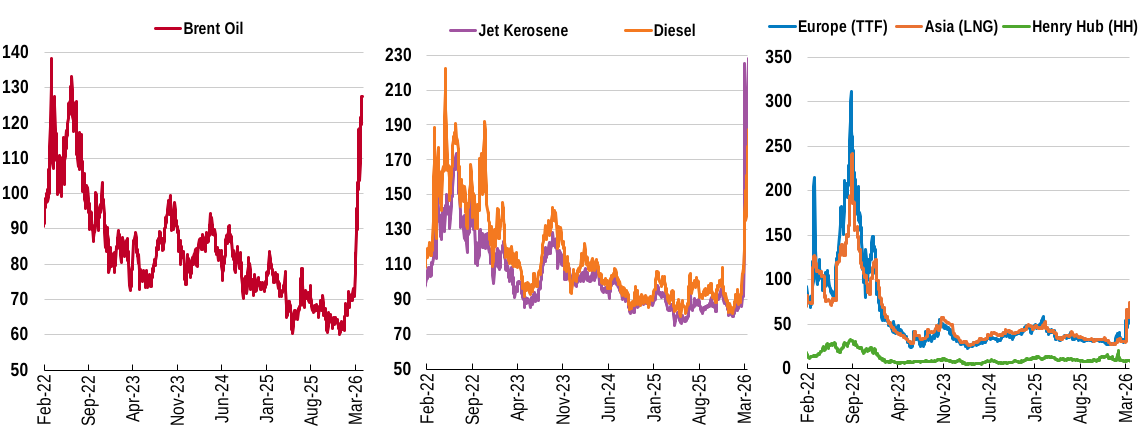
Note: Shows the evolution of U.S. Gulf Coast Ultra-Low Sulfur No 2 Diesel Spot Price for Diesel; TTF Natural Gas Price for Europe, Henry Hub for the United States and LNG for Asia. Latest data refers to 31 March 2026.
Source: LSEG; OECD calculations.
Current inventory levels provide only limited protection against prolonged energy supply disruptions. Natural gas markets are relatively tight, particularly in Europe, where seasonal inventories were already low before the onset of the Middle East conflict, reaching their lowest level for that time of year since 2022. Drawing on strategic oil inventories, IEA member countries agreed on 11 March to make 400 million barrels of oil available from emergency reserves. By increasing supply on global oil markets, the release is designed to dampen price spikes. Even so, it may take time for these additional supplies to reach markets and ease shortages in refined products. The breadth and duration of the shock therefore remain highly uncertain in both oil and gas markets.
Direct exposure to the current energy shock differs markedly across countries. Some economies rely heavily on oil and gas imports to meet their total energy supply, and some are even more directly exposed because those imports originate largely from the Middle East (Figure 2). Others are more indirectly exposed through third countries that themselves depend heavily on supply from the Middle East. At the same time, many of the large net importers of energy have significant strategic oil inventory stocks. For example, IEA member countries are required to ensure oil stock levels equivalent to no less than 90 days of net imports – and countries like Japan and Korea hold well in excess of those levels. IEA member countries have flexibility in how these stocks are held and in the mix of crude and refined products, as well as in domestic versus foreign holdings. For many emerging market economies, oil stocks can be significantly lower.
Household exposure to the current energy shock varies across and within countries, depending on the intensity of use of the affected energy goods. Energy costs account for a much larger share of consumer spending in some countries than in others, ranging from around 12% in Brazil to around 6% in Canada (Figure 3a). Cross-country differences in exposure also depend on how strongly international energy-price shocks pass through to retail prices, for example because of differences in countries’ energy mix and the frequency with which retail contracts are reset. Within countries, the burden of high energy prices also falls disproportionately on poorer households because energy accounts for a larger share of their consumption baskets (Figure 3b). Income is therefore a key determinant of household exposure to energy price shocks, though it is not the only one. Factors such as housing energy efficiency, the energy source used, households’ energy needs and geographical location (e.g. rural areas) also affect the degree of household exposure to energy price shocks.
% of total GDP in 2024

Note: Based on nominal goods import values. The red, blue and grey bars are respectively the share of oil and gas products originating from Middle East countries, selected OECD countries and the rest of the world. ‘Middle East’ includes Bahrain, Iran, Iraq, Kuwait, Oman, Qatar, Saudi Arabia, and United Arab Emirates. ‘Selected OECD’ includes Australia, Canada, Colombia, Mexico, Norway, and the United States. ‘Rest of the world’ includes all other countries. Oil and gas are defined as the total of HS2709 (Crude petroleum oils), HS2710 (Refined petroleum products) and HS2711 (Petroleum gases of which natural gas). Gas pipeline trade flows are not included.
Source: OECD Balanced International Merchandise Trade Statistics (edition 2024 November); and OECD calculations.

Note: Latest available information. Data in Panel A are based on weights used for national consumer prices indices (harmonised index of consumer prices for countries in the euro area) and generally include fuels for transport equipment as well as electricity, natural gas and other fuels. Source: OECD Consumer Price database; CEIC; Eurostat; Instituto Brasileiro de Geografia e Estatística; India, Ministry of Statistics and Program Implementation; United Kingdom, ONS; Reserve Bank of Australia; Statistics Canada; Statistics of Japan; Statistics Korea; Turkish Statistical Institute; US Bureau of Labor Statistics; and OECD calculations.
Exposure also varies across sectors and firm types. The most immediate effects are likely to be felt in sectors that use the affected energy goods intensively, including transport, petrochemicals and metals manufacturing. More generally, firms will be more vulnerable where gas, electricity and other fossil fuels account for a large share of production costs, where there is limited scope to switch away from affected energy inputs, and where higher costs cannot easily be passed on to consumers. Smaller firms may be particularly exposed, as they tend to be more liquidity-constrained, less diversified in their economic activities and more vulnerable to disruptions further up the supply chain. In some cases, shocks originating in energy markets can also spill over more broadly through shortages of raw materials, semi-finished products and other essential inputs.
Many governments across the OECD have moved quickly to shield households and firms from rising fuel costs (see Table 1). As of 09 April 2026, the dominant policy response has been fuel tax relief to reduce prices at the pump. Price caps and direct income support have also been introduced, though to a lesser extent. Around two-thirds of announced measures by OECD countries are temporary, meaning they carry an explicit end date or are designed as one-off interventions. Around a third are targeted, with most focusing on sectors most exposed to fuel price increases such as agriculture and road freight transport. Less than a third of measures are both temporary and targeted. This share is broadly similar to that during the comparable period of the 2022–23 energy crisis, when around 36% of measures announced within the first weeks of the crisis (March–April 2022) were both temporary and targeted.
Fuel tax reductions, the most widely used instrument so far, lower the tax component of retail prices directly - thereby reducing the marginal price faced by consumers - and can be implemented quickly through existing systems. The scale of relief, however, varies considerably across countries. For instance, Latvia reduced diesel excise duties by around 15% (EUR 0.07 per litre), while Ireland temporarily lowered them by EUR 0.22 per litre, broadly comparable in scale to the excise duty cuts implemented in Italy. Some countries achieved larger reductions through combined measures. Spain cut excise burdens sharply while simultaneously reducing VAT on fuels from 21% to 10%, resulting in pump price reductions of around EUR 0.30 to 0.40 per litre. Poland and Slovenia reduced fuel excise duties to the minimum levels permitted under EU law, with Poland complementing these cuts with a temporary VAT reduction and Slovenia with the suspension of environmental levies.
Direct price interventions have been used more selectively than fuel tax measures. These include retail price caps, ceilings on wholesale prices passed through to retail, and per-litre subsidies designed to limit the extent to which price increases reach final users. Some countries have opted for direct and transparent reductions in retail fuel prices. Greece has introduced a per‑litre subsidy for diesel applied directly at the pump, equivalent to about EUR 0.20 per litre, and Hungary imposed fixed maximum pump prices for petrol and diesel specifically for vehicles with domestic licence plates. In contrast, Japan and Korea have intervened upstream in the pricing chain. Japan capped retail gasoline prices nationwide by subsidising wholesalers, while Korea has imposed a ceiling on refiners’ wholesale gasoline and diesel prices, limiting the maximum prices at which fuels could be supplied to gas stations.
Direct income support has also been deployed, though its scope varies considerably across countries. Such measures can take the form of energy‑related income support, which lowers the average cost of energy consumption by linking transfers to energy use or bills. Sweden has introduced nationwide compensation for electricity and gas bills as part of a SEK 4.7 billion relief package. Payments will be based on actual household energy consumption in January and February 2026 and delivered automatically through the social insurance system. In other cases, income support has been provided without being explicitly tied to energy consumption, offering households greater disposable income to absorb higher living costs. Greece has introduced a targeted fertiliser‑cost subsidy for farmers that refunds 15% of fertiliser invoice values for a limited period, alongside a digital fuel wallet for vulnerable households. Some measures have been designed to reflect both fuel type and consumer vulnerability. The United Kingdom targeted aid for off-grid and heating-oil-dependent households, while Portugal introduced a EUR 15 reimbursement per bottled-gas cylinder, distributed through local parish councils.
Beyond price relief and income support, governments have also introduced regulatory and market‑functioning measures. Slovenia capped fuel purchases at EUR 400 per transaction, Portugal prohibited energy suppliers from disconnecting electricity or gas in cases of billing disputes, and Spain introduced requirements for flexible electricity and gas contracts during the crisis period. The United Kingdom has introduced a new anti-profiteering framework that strengthens the ability of the Competition Market Authority and regulators to challenge price increases linked to the Middle East conflict through stronger monitoring and mandatory data disclosure. To limit the pass-through of higher energy costs to essential services, Chile has frozen fares for all public transport systems (including urban systems and rural transport operators) operating under a contract with the Ministry of Transport until end-2026. Lithuania has halved domestic rail fares for April and May 2026. New Zealand has adopted a supply‑side regulatory approach, temporarily aligning domestic fuel quality specifications with less strict Australian standards to widen import options. Export restrictions are less common among OECD countries but feature in some emerging markets. Argentina has introduced a variable export tax that raises crude oil export duties from 3.36% to 8% once Brent prices exceed USD 80 per barrel, to discourage exports and redirect supply domestically.
Examples drawn from the 2026 OECD Energy Support Tracker
Note: Support measures are classified along two dimensions: (i) support type, which captures the economic channel (energy price relief, income support (energy-related or not energy-related), credit and equity support, export restrictions, or other), and (ii) mechanism, which identifies how the measure is implemented (e.g. tax reductions, regulated or capped prices, budgetary transfers, or financial support instruments). Energy price relief is classified based on whether it affects the marginal price (the cost of an additional unit of energy) or the average price (total expenditure per unit consumed). Income support is defined as energy-related when it is conditional on energy use or bills (e.g. energy vouchers), thus reducing the average price of energy, and as non-energy-related when it is not tied to energy consumption (e.g. general cash transfers). Data as of 09 April 2026.
Source: 2026 OECD Energy Support Tracker, https://www.oecd.org/en/topics/sub-issues/economic-outlook/oecd-energy-support-measures-tracker.html.
The 2022-23 energy crisis showed how costly broad-based support can become. Across 41 OECD and non-OECD countries, announced support measures totalled about USD 400 billion in 2022 and USD 405 billion in 2023 in gross terms. In the median OECD economy, this corresponded to gross fiscal costs of 0.7% of GDP in 2022 and 0.8% in 2023, with support exceeding 2.5% of GDP in some countries. Untargeted support measures accounted for nearly 80% of the estimated total fiscal costs (Figure 4), while energy price relief measures alone accounted for over half of total spending. Although the current shock differs in its initial source of disruption from the 2022-23 crisis, similar policy design issues arise as fossil-fuel price spikes are putting pressure on household budgets, firms’ costs and inflation.
Gross fiscal costs of support measures, % of GDP in 2022-23
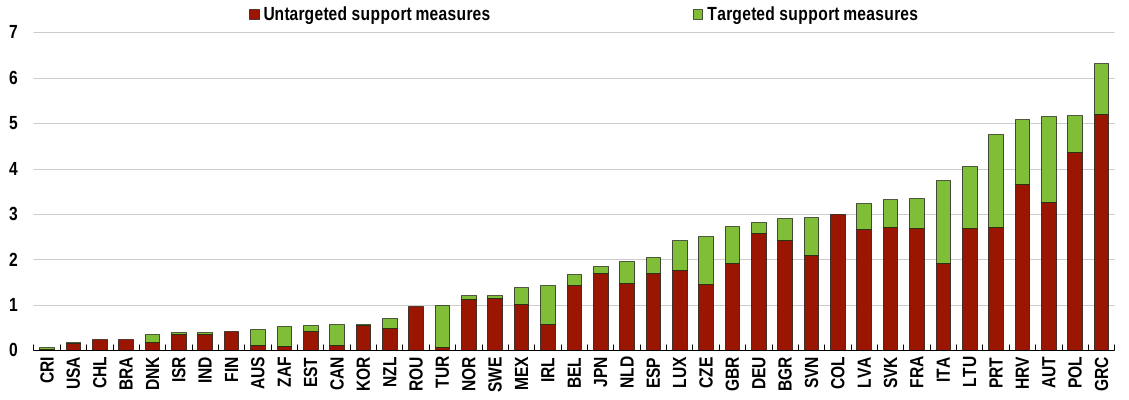
Note: Support measures are considered targeted if their main beneficiaries are not “all households” or “all firms” or “all energy users”. The figure includes both price and income measures. The gross fiscal cost does not account for the impact of accompanying energy-related and revenue-increasing measures, such as the taxation of windfall profits.
Source: OECD Energy Support Measures Tracker 2022-23.
The current energy crisis comes at a time when public finances are more strained than at the onset of the previous energy crisis. In many countries, budget deficits are still relatively high, debt is elevated, and debt servicing costs are higher than in 2022-23. The average public debt-to-GDP across OECD countries is now 113% of GDP – up from 110% in 2022 and 73% in 2007. Energy support measures add to other spending pressures, including higher defence spending in some countries and higher spending linked to population ageing and the energy transition.
Broad-based measures, while easier and faster to implement, will further weigh on budgets. In countries where social benefits or public sector salaries are closely linked to inflation, interventions that lower energy prices may generate some offsetting fiscal effects. However, broad and untargeted measures have higher fiscal costs than targeted measures – in particular if they are long-lasting. They are also politically difficult to withdraw, even once the crisis abates. In this respect, three lessons from the 2022-23 energy crisis stand out: support should be targeted, temporary and preserve incentives to save energy (Hemmerlé et al., 2023[2]).
Given limited fiscal space in most countries, support should focus on preventing severe hardship among the most vulnerable households and avoiding failures of the most affected and otherwise viable firms. For firms, this means support should be targeted at firms that are both vulnerable to the shock and otherwise viable, for example, where the energy price spike creates temporary liquidity stress rather than revealing solvency problems. While identifying such firms in real time is challenging, using pre-crisis benchmarks and exposure thresholds is one way to determine eligibility. Firm support should, furthermore, not come at the expense of business dynamism or distort competition in domestic markets. SMEs may warrant particular attention as they tend to be particularly vulnerable to energy price shocks (Hemmerlé et al., 2023[2]). Policymakers may, however, also want to target large, energy-intensive firms or industries for strategic or national security reasons.
Emergency top-up payments to existing welfare recipients are often the simplest and fastest ways to support households most in need. However, in the 2022-2023 energy crisis only around 10% of the total costs of energy-price relief measures exploited existing social transfer programmes to deliver support (Hemmerlé et al., 2023[2]). As low-income households are generally the most exposed to high energy prices, income remains the main basis for targeting. But among low-income and near-poor households, exposure can still differ depending on factors such as housing energy efficiency and geographical location. Existing benefits systems therefore provide a useful starting point to identify and reach households in need of protection but may need to be complemented with additional information to calibrate support and reach vulnerable households that existing benefit systems may miss.
The 2022-23 crisis showed that targeting support is feasible (Hemmerlé et al., 2023[2]). Costa Rica, for instance, provided income support directly into bank accounts of poor households that were registered in a digital database that recorded all past and present beneficiaries entitled to social transfers. In Ireland, household support was channelled mainly through existing welfare schemes, especially higher regular and lump-sum payments to recipients of an existing means-tested fuel allowance. Ireland also provided targeted support to SMEs and the self-employed whose energy bills had increased by 50% or more in a reference period, covering 40% of the increase in the reported energy bill, up to a monthly cap of EUR 10 000. Likewise, Italy granted energy intensive firms tax credits covering 20% of electricity and gas costs when prices rose more than 30% above 2019 levels. This shows that, even in a crisis, support can be targeted by relying on existing administrative systems for households and clear eligibility thresholds for firms.
Some measures introduced in 2026 move in a similar direction, for instance, through one-off payments to vulnerable households, temporary extensions of existing allowances, and more targeted support for exposed sectors such as farming and transport. Even so, broad-based measures still dominate the current policy mix.
A second lesson is that support should be temporary. Temporary support limits costs and helps keep crisis measures focused on acute energy price pressures, thereby avoiding unnecessary and long-lasting social payments or subsidies. The 2022-23 crisis showed that some governments kept broad support measures in place even well after energy prices abated, adding to fiscal costs and blurring the case for continued intervention. Targeted support, e.g. through existing welfare systems, can also be politically difficult to reverse once implemented.
New support could therefore come with clear end dates or automatic phase-out rules linked, for instance, to retail energy prices falling back to a pre-defined benchmark. For example, Germany’s support for households in 2022-23 was tied to contract prices, so the value of support declined automatically as retail energy prices fell, helping to contain fiscal costs as market conditions improved. For firms, Bulgaria’s measures in 2022-23 covered 75% of electricity costs for SMEs, but only for four consecutive months in 2022, at the firms’ choice.
Some measures introduced in 2026 also include explicit support windows, one-off interventions or temporary extensions of existing schemes. Others, however, lack clear expiry dates or phase-out rules.
A third lesson is that support should preserve energy-saving incentives. Measures lowering energy prices for households and firms weaken incentives to reduce energy demand – which is particularly problematic when facing an energy supply crunch. By contrast, direct income transfers can cushion hardship for vulnerable households while preserving price signals and thereby incentives to save energy. For firms, support can be linked to requirements and incentives that encourage innovation and improve energy efficiency, including in industrial processes.
When governments reduce energy bills directly (e.g. through energy bill vouchers), support that applies only up to a basic level of energy consumption is preferable to support that covers the entire energy bill. This limits relief to basic energy needs without weakening incentives to reduce consumption above that basic level. Because information on basic energy needs is often unavailable, many countries during the 2022-23 crisis based support (often price caps) on average electricity consumption thresholds instead. Setting such thresholds at a low enough level would help to preserve incentives to save energy.
Some countries designed support in this direction during the previous energy crisis. In the Netherlands, for example, energy price relief applied different consumption thresholds in warmer and colder months. Hence, energy usage above the seasonal threshold continued to face market prices, preserving incentives to save energy throughout the year. Croatia provided an electricity-cost subsidy for energy-intensive firms conditional on an energy audit and on investments that either substantially reduced greenhouse gas emissions or increased the share of renewable energy in electricity consumption to at least 60%.
In the current 2026 response, some measures preserve energy-saving incentives through one-off payments, capped discounts or non-energy-related income support. However, most measures introduced so far have taken the form of fuel-tax reductions or direct price interventions that lower marginal fuel prices, thereby weakening incentives to curb energy use.
This new energy shock is a reminder of the global economy’s enduring vulnerability to disruptions in energy markets. The 2022-23 energy crisis not only showed how support can be better designed; it also highlighted the importance of being better prepared before a shock hits.
Providing support may be suited to a short-lived price shock, but the appropriate policy response will also depend on how the shock evolves. Persistent disruptions may require a broader and more flexible policy mix, with closer alignment links with medium-term objectives such as energy security, resilience to shocks. Greater energy efficiency and a more diversified energy supply are crucial to strengthen resilience and reduce exposure to energy shocks – and should be seen as key policy objectives. At the same time, temporary, effective and targeted support hinges on stronger administrative capacity, including more digitalised delivery systems, timely and comprehensive data on vulnerability indicators beyond low income, and social protection mechanisms that can be scaled up quickly when needed (Hemmerlé et al., 2023[2]).
Digital tools, and in particular AI and big data, can offer innovative solutions to strengthen administrative capacity. The 2022-23 crisis already provided concrete examples in this respect (Hemmerlé et al., 2023[2]). Denmark combined household energy information from the national real estate register with income data to identify households most exposed to higher heating costs and to deliver heating cheques automatically. The United Kingdom linked postal code data to local weather-station information so that eligible households received an automatic payment during severe cold spells. Italy delivered a means-tested social bonus automatically by cross-referencing social-security, electricity, gas and water databases, avoiding the low take-up that often arises when households must apply for support themselves. Five years later, governments can harness improved digital tools, AI and linked administrative databases to identify vulnerable households and deliver targeted support in a timely way.
References
[2] Hemmerlé, Y. et al. (2023), “Aiming better: Government support for households and firms during the energy crisis”, OECD Economic Policy Papers, No. 32, OECD Publishing, Paris, https://doi.org/10.1787/839e3ae1-en.
[1] OECD (2026), OECD Economic Outlook, Interim Report March 2026: Testing Resilience, OECD Publishing, Paris, https://doi.org/10.1787/d4623013-en.