The teacher workforce in any education system is usually as diverse as the total workforce. This means different ages, experiences, and life-phases shape how teachers work and think. It also means that teachers might think very differently about their work, now and in the future. In addition, it is important for policymakers to ask how proposed policy changes influence a diverse teacher workforce in different ways. This chapter presents, based on both international and Welsh research and data, seven sets of teacher personas, with different backgrounds, ages, experiences, motivations and other traits that shape the teacher workforce in Wales.
Constructing Scenarios for the Future of Teaching in Wales

Abstract

Highlighted indicators - starting primary teachers
From qualified teacher status to induction
Investing in well-structured and well-resourced induction programmes is considered an important starting point for the continuous professional development of new teachers (Schleicher, 2011[1]). Research has suggested that a clear shared vision, co-construction of programme materials and collaborative governance between schools and university are key to well-designed partnerships for Initial teacher education (ITE) (Glover et al., 2023[2]).
After teachers in Wales (and elsewhere in the United Kingdom) complete a period of ITE, the EWC awards them a Qualified Teacher Status (QTS). Newly qualified teachers (NQTs) are subsequently asked to begin their induction period, which can be done either full- or part-time or on a supply basis and lasts a minimum of one school year (Welsh Government, 2022[3]). The evolution of NQTs over the last decade is depicted in Figure 3.1.
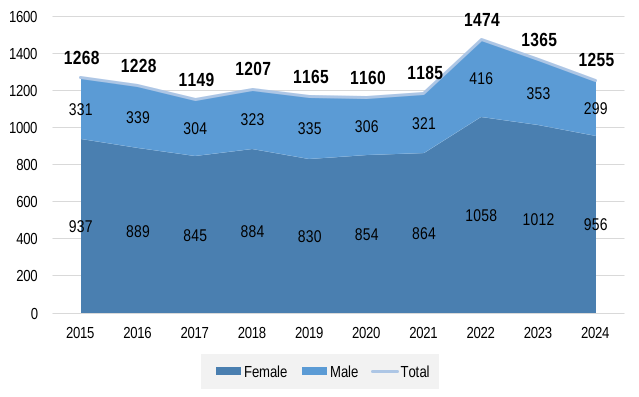
Note: from 2021 to 2023 the EWC’s total figure is 1 higher than pictured in the graph due to having 1 non specified per year which rose to 3 in 2024.
Source: (Education Workforce Council, 2023[4]), NQT Data Insight 2023, https://www.ewc.wales/site/index.php/en/documents-eng/about/workforce-statistics/leadership-npqh/1110-nqt-data-insight-2023/file (accessed on 26 February 2025); (Education Workforce Council, 2019[5]), Data Insights: Registered Newly Qualified School Teachers (NQTs) in Wales, https://www.ewc.wales/site/index.php/en/documents-eng/about/workforce-statistics/leadership-npqh/526-nqt-data-analysis-2019/file (accessed on 26 February 2025), (Education Workforce Council, 2024[6]) NQT Data Insight 2024, Unpublished data (accessed on 19 March 2025).
However, the current practice and quality of induction is met with dissatisfaction by both NQTs and schools (Milton et al., 2020[7]; OECD, 2018[8]; Welsh Government, 2020[9]). As the Welsh Government states: “NQTs report a system that is unwelcoming, hard to get into, unwilling to commit to them and, at times, taking advantage of them” (2020, p. 9[9]), and quotes a NQT: “we see all the signs everywhere saying, ‘Come and teach for Wales!’. When you do, Wales doesn’t seem to want you” (2020, p. 10[9]).
Problems regarding the induction programme for NQTs – such as teachers having a less positive perception of induction and mentoring than school leaders and a widespread agreement that processes and practices are not good enough – have been identified by the Welsh Government and in research (Milton et al., 2020[7]; Welsh Government, 2020[9]), particularly among NQTs in the first five years of working as a teacher and in short-term supply.
Retaining Welsh teachers in the first five years of their career
More than one fifth of all teachers in Wales who have obtained Qualified Teacher Status have been teaching for five years or less (Education Workforce Council, 2023[10]), with the share of teachers with less than five years of experience increasing from 18% in 2007 to 29% in 2022 (StatsWales, 2023[11]). It is of the upmost importance to keep these teachers motivated, and satisfied to develop a career, as they will constitute the backbone of the future teacher workforce in Wales. Out of 756 teachers who left the teaching profession in 2022, 221 (or 29%) had less than 5 years’ experience of working as a teacher (see Figure 3.2 for further details).

Note: Schools’ data are derived from Pupil Level Annual School Census (PLASC) and STATS 1 returns supplied by schools open on Census Day in January each year, returns authorised by headteachers and validated by Local Authorities.
Source: StatsWales (2023[11]), Teacher Retention: Teachers Who Left the Profession by Subject, Year and Number of Years Experience, https://statswales.gov.wales/Catalogue/Education-and-Skills/Schools-and-Teachers/teachers-and-support-staff/pupil-Level-annual-school-census/Teacher-Recruitment-and-Retention/teacherretentionyears-by-subject-destination (accessed on 5 March 2025).
Stability in contract, flexibility in jobs
According to the 2021 National Education Workforce Survey, 75.6% of teachers described their contract status as permanent, 9.4% as temporary or fixed term and 12.6% as supply (Education Workforce Council, 2021[12]). Being on short-term supply or temporary contracts has been identified as detrimental to a good quality induction in Wales (Welsh Government, 2020[9]).
Teacher work is generally not considered as having flexible working arrangements, making it difficult sometimes to align a professional career in education with personal life duties and obligations, such as informal care and childcare. Flexibility is considered attractive and as something that is promising for the future of education (Veletsianos and Houlden, 2020[13]). Recent (small-scale) research in Welsh teacher education suggests that blended learning opportunities and a focus on flexibility are considered attractive to a more diverse group of possible future teachers, who otherwise might not have taken up teaching (Glover and Stewart, 2023[14]). Steps towards creating more flexible working have been taken in the healthcare sector. In April 2024, the Employment Relations Act 2023 became law, which grants employees in the United Kingdom the right to request flexible working from their first day in service (UK Public General Acts, 2023[15]). NHS Wales suggests that its efforts towards more flexible work can improve (among others) recruitment and retention, well-being, a reduced sickness rate and improved quality of work (NHS Wales, 2023[16]).

Highlighted indicators - Future part-time returning secondary school teachers
Furthering the Welsh language through education
The Welsh Government attaches great value to the survival and thriving of the Welsh language, whose survival is considered vulnerable, being restricted to certain domains (Asher and Moseley, 2018[17]). In 2017, the Welsh Government presented “Cymraeg 2050”, the ambition of having one million Welsh speakers in 2050, creating favourable conditions for the language (Welsh Government, 2017[18]). The Welsh education sector has been asked to contribute to several targets: Expanding Welsh-medium education for each school year group to 30% in 2031 and 40% by 2050; and having more teachers who can teach Welsh as a subject in secondary schools, from 500 in 2017 to 900 in 2031 and 1200 by 2050. Currently, there are 1057 registered secondary school teachers teaching Welsh, but only 957 certified to teach Welsh (see Figure 3.3 for further details), suggesting some do not have the qualifications to do (Education Workforce Council, 2023[19])1. The Welsh Government has developed an incentive scheme, providing a GBP 5 000 (United Kingdom pounds) grant to student teachers who either study through the medium of Welsh or teach Welsh (Welsh Government, 2018[20]).
Furthering the Welsh language through education
The Welsh Government attaches great value to the survival and thriving of the Welsh language, whose survival is considered vulnerable, being restricted to certain domains (Asher and Moseley, 2018[17]). In 2017, the Welsh Government presented “Cymraeg 2050”, the ambition of having one million Welsh speakers in 2050, creating favourable conditions for the language (Welsh Government, 2017[18]). The Welsh education sector has been asked to contribute to several targets: Expanding Welsh-medium education for each school year group to 30% in 2031 and 40% by 2050; and having more teachers who can teach Welsh as a subject in secondary schools, from 500 in 2017 to 900 in 2031 and 1200 by 2050. Currently, there are 1057 registered secondary school teachers teaching Welsh, but only 957 certified to teach Welsh (see Figure 3.3 for further details), suggesting some do not have the qualifications to do (Education Workforce Council, 2023[19])2. The Welsh Government has developed an incentive scheme, providing a GBP 5 000 (United Kingdom pounds) grant to student teachers who either study through the medium of Welsh or teach Welsh (Welsh Government, 2018[20]).
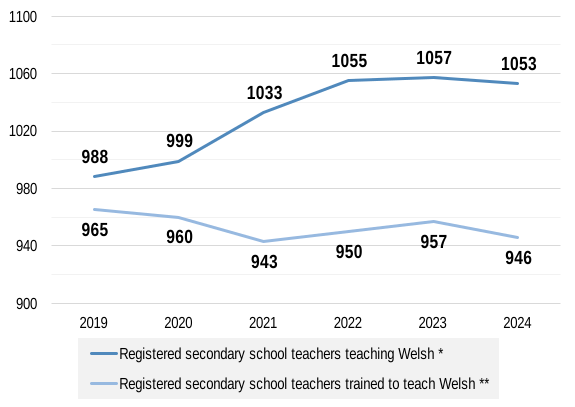
Note: * Number of registered school teachers teaching Welsh (middle or secondary phase working only) – Other years also incorporate middle phase but graph key does not indicate this. ** Number of registered school teachers by initial teacher education in Welsh. Secondary trained school teachers only.
Source: (Education Workforce Council, 2023[19]), Annual Education Workforce Statistics for Wales 2023, https://www.ewc.wales/site/index.php/en/documents-eng/about/workforce-statistics/annual-statistics-digest/current/931-2023-education-workforce-statistics-english/file (accessed on 5 March 2025). (Education Workforce Council, 2024[21]), Annual Education Workforce Statistics for Wales 2024, https://www.ewc.wales/site/index.php/en/documents-eng/about/workforce-statistics/annual-statistics-digest/current/1245-annual-education-workforce-statistics-report-2024/file (accessed on 19 March 2025).
Working full time
Most teachers in Wales work full time and the education sector can be considered as offering mostly ‘traditional’ forms of employment. Data shows that the FTE-FPE ratio (full-time equivalent to full-person equivalent ratio) is 1:1 for headteachers, deputy headteachers and assistant headteachers (see Figure 3.4). The FTE-FPE equivalent among teachers is 0.9:1, which implies that at least some teachers work part time (StatsWales, 2023[22]). Working part time is more common in Wales as a whole, where 12.9% of men and 37.2% of women work part time in 2022 (UK Government, 2023[23]).

Note: Teachers by measure (full-person equivalent [FPE] and full time equivalent [FTE]) and staff category. The FTE is an employee's scheduled hours divided by the employer's hours for a full time workweek e.g. a part time worker employed for 20 hours a week where full time work is 40 hours is counted as 0.5 FTE. The FPE is the proportion of a person's total working time that is spent in a particular role. As the FPE is concerned with the individual, a person's FPE will always sum to 1, even if their FTE is not equal to 1.
Source: StatWales (2023[22]), School Workforce Annual Census (SWAC), https://statswales.gov.wales/Catalogue/Education-and-Skills/Schools-and-Teachers/teachers-and-support-staff/school-workforce-annual-census/teachers/teachers-by-staffcategory-agerange (accessed on 5 March 2025).
In countries where part time working in education is more common, such as The Netherlands and Belgium, this is both seen as an opportunity (more people participate in the workforce) and a concern (not enough people work full time) (Arbeidsmarktplatform primair onderwijs, 2019[24]). Research among Dutch primary school teachers showed that 65% of teachers who work part time, do so to have the time to care for their children. 97% indicated that they found it important that the possibility to work part time existed. Research among German teachers show no relationship between part time working and increased risk of burnout or health status (Seibt and Kreuzfeld, 2021[25]; Seibt et al., 2011[26]). This is in line with the Teaching and Learning International Survey (TALIS) 2018 results, which showed no significant difference in primary school teachers experiencing stress between part and full time teachers (OECD, 2021[27]).
Consortia improving the quality of education
In the past years, the Welsh education system has invested in four regional consortia to support schools to develop as learning organisations (OECD, 2018[8]). Consortia are identified as having the opportunity to link schools with higher education institutions, focus on putting research evidence-into-use (Tyler et al., 2018[28]; Tyler et al., 2019[29]), linking schools with one another, supporting career development, school leadership and in general, support schools in becoming learning organisations (OECD, 2018[8]).

Highlighted indicators - future second-career teachers with industry connections
Education workforce diversity
According to the Education Workforce Council (2023[19]), from the 35 837 registered school teachers in 2023, only 1.8% identified as mixed or from multiple ethnic groups, Asian or Asian British, Black, African, Caribbean or Black British, or from other ethnic groups. This means 608 of teachers in 2023 identified themselves as other than White. While this figure is still very low, it represents a growth of 40% from 2019.
Newly qualified schoolteachers with the Education Workforce Council have experienced an increase in the percentage of teachers identifying themselves as other than British White. Whereas in 2019 this proportion was 2.4%, by 2023 it had already increased to 4.2% (Education Workforce Council, 2023[4]).
There are a disproportionate number of teachers of colour (ToC) in Wales in comparison to pupils and teacher students of colour (see Table 3.1). Teachers in Wales are less ethnically diverse than the pupils they are teaching: 16% of pupils aged 5 and over being from families other than White British. This proportion worsens among school leaders, where only 15 out of 3 433 are from a minority background, whereas it improves among student teachers, as on teacher training programmes in Wales at all levels (undergraduate and postgraduate), 7% of student teachers categorised themselves as being from a diverse background (Davis et al., 2022[30]).
Teachers from a diverse background tend to view themselves as role models for young learners of colour, believing that it is their responsibility to support the younger generation, especially if they have a similar background to themselves (Davis et al., 2022[30]).
Different routes into teaching
In 2020, the Welsh Government introduced two flexible routes into teaching through the Open University, allowing for (i) students currently already working in school to undertake teacher studies, and (ii) for individuals who continue to work part time outside of schools but integrating this with practical teaching experience in schools (Glover and Hutchinson, 2022[32]). In part, the reforms making these routes possible were targeted at shortage subjects, at rural schools, at those in areas of high disadvantage facing difficulties in recruitment, and to address the lack of teachers of colour (Davis et al., 2022[30]).
Although different routes into teaching and the associated government interventions have been criticised in England as sometimes being too complex and confusing (Mutton et al., 2021[33]), there is real value in well-designed and thoroughly guided second career tracts for motivated individuals (Ruitenburg and Tigchelaar, 2021[34]; Paniagua and Sánchez-Martí, 2018[35]).
Research on participants in the Open University initiative in Wales shows that new routes into teaching are helping to diversify the teaching workforce. Specifically, the percentage of 25-to-39-year-olds in these new routes is double that of those training through a one-year Postgraduate Certificate in Education (PGCE) (see Figure 3.5). More mature student teachers are seen to bring valuable transferable skills from their prior life and work experiences into their own and their colleagues’ teaching practices (Glover and Stewart, 2023[14]). However, enrolment in these new programmes remains limited: In 2022, only 138 students were undertaking the flexible PGCE programme (Glover et al., 2023[2]).

Note: One-year Post Graduate Certificate in Education (PGCE) n=1255; Open University Partnership PGCE n=138
Source: Glover and Stewart (2023[14]), “Using a blended distance pedagogy in teacher education to address challenges in teacher recruitment”, Teaching Education, Vol. 35/1, pp. 104-126, https://doi.org/10.1080/10476210.2023.2223526.
In general, the new generation of teachers is slowly changing regarding its age composition. If in 2019 the newly qualified schoolteachers under 30 years old represented 82.6% of the total, in 2023 this proportion dropped to 79.2%, whereas the proportion of newly qualified school teachers between 30 and 49 rose from 16.8% to 19.5% (Education Workforce Council, 2023[4]) .

Highlighted indicators - Welsh secondary teachers
Teaching and learning in Welsh
Since 2018-2019, the proportion of schools that provide education through the medium of Welsh has remained consistent at 30% of the total number of schools in Wales. In addition, the proportion of pupils in schools where at least half of the subjects are available through the medium of Welsh has remained consistent at 23%. The percentage of pupils taught in designated Welsh-medium schools has increased from 16% in 2012-2013 to 17% in 2022-2023 (ESTYN, 2024[36]).
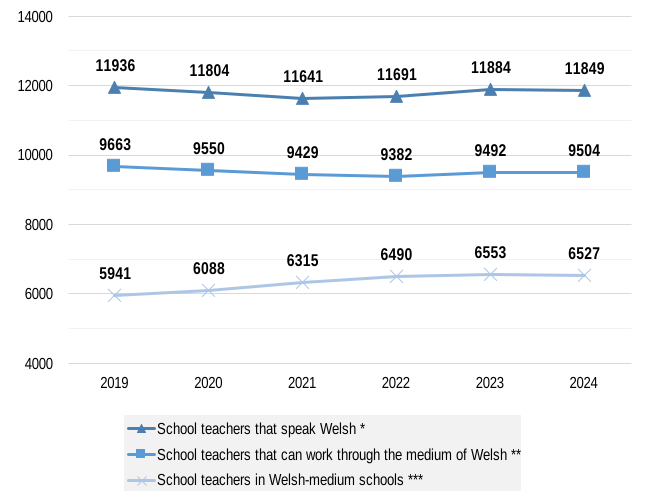
Note: “School teachers that speak Welsh” refers to those registrants who have declared whether they are fluent, or fairly fluent, in the Welsh language. “School teachers that can work through the medium of Welsh” refers to those registrants who have declared whether they were either trained to work, currently work, or have ever worked through the medium of Welsh or feel confident to do so. “School teachers in Welsh-medium schools” refers to those registrants working in Welsh-medium, dual stream, transitional, and/or bilingual (Type A, B, C) schools.
Source: (Education Workforce Council, 2023[19]), Annual Education Workforce Statistics for Wales 2023, https://www.ewc.wales/site/index.php/en/documents-eng/about/workforce-statistics/annual-statistics-digest/current/931-2023-education-workforce-statistics-english/file (accessed on 5 March 2025). (Education Workforce Council, 2024[21]), Annual Education Workforce Statistics for Wales 2024, https://www.ewc.wales/site/index.php/en/documents-eng/about/workforce-statistics/annual-statistics-digest/current/1245-annual-education-workforce-statistics-report-2024/file (accessed on 19 March 2025).
A third of registered teachers in 2023 speak Welsh, although only 26.5% declared whether they were either trained to work, currently work, or have ever worked through the medium of Welsh or feel confident to do so. Furthermore, just 18% of registered teachers work in a Welsh-medium school (Education Workforce Council, 2023[19]). The number of Welsh-speaking teachers and those with the ability to work through the medium of Welsh have remained constant since at least 2019 (see Figure 3.6). The number of teachers working in Welsh-medium schools has grown 10% between 2019 and 2023.
The challenges of overcoming poverty
In Wales, one out of five people live permanently in official poverty, whereas an extra one out of three live close to the poverty line. Regarding children, if considering the eligibility of their families for free school meals, about a third of Welsh children live in official poverty (Egan, 2016[37]).
One of the main challenges of the Welsh education system is the underachievement of children experiencing poverty, both those who are entering the education system and the ones who are currently in it. The proportion of students eligible for free school meals (eFSM) who were at a stage of developed that would be consistent with or greater than their age was lower than non-eligible students (nFSM) in on-entry assessments in all areas of learning (Welsh Government, 2019[38]). Furthermore, the performance of eFSM students was lower than nFSM students at the end of Foundation Phase at age 7, Key Stage 2 at age 11 and Key Stage 3 at age 14 (Welsh Government, 2019[38]).
The difference in achievement by free school meal entitlement has decreased over the years. If we consider a composed indicator of Language, Mathematics and Science for pupils aged 14, the difference dropped from nearly 30 percentage points in 2012 to 20 in 2019 (see Figure 3.7).

Note: The Core Subject Indicator (CSI) represents the percentage of pupils achieving Level 5 or above in English or Welsh (first language), Mathematics and Science in combination at the end of Key Stage 3. Data show the percentage of pupils achieving at least the expected level (Level 5) in teacher assessments.
Source: Welsh Government (2019[38]), Achievement and entitlement to free school meals: 2019, https://www.gov.wales/achievement-and-entitlement-free-school-meals-2019 (accessed on 5 march 2025).

Highlighted indicators - middle leaders
Leadership composition and evolution
The role of assistant headteachers has become increasingly important in Welsh schools. Throughout the 2010s, their numbers steadily rose, with 275 more assistant headteachers in 2020 than in 2010. By 2020, assistant headteachers were nearly as common as deputy headteachers. In contrast, the number of headteachers, acting headteachers, and deputy headteachers has declined, with 155 fewer headteachers, 75 fewer acting headteachers, and 140 fewer deputy headteachers (see Figure 3.8).
Despite these figures, senior leader turnover in Welsh schools does not appear to be a major issue. Compared to England, Wales experiences a lower level of attrition among senior leaders. However, latest data indicates that Wales is currently experiencing higher turnover levels relative to previous years (Aleynikova et al., 2024[39]).

Source: Aleynikova, E. et al. (2024[39]), Recruitment and Retention of Senior School Leaders in Wales, https://epi.org.uk/wp-content/uploads/2024/02/Recruitment-and-Retention-of-Senior-School-Leaders-in-Wales-FINAL.pdf (accessed on 5 March 2025).
Number of hours worked by senior leadership
The main challenges reported by Welsh senior leaders were high workloads, poor work-life balance, a sense of isolation in leadership roles, excessive bureaucracy and administrative responsibilities, the roles negatively impacting on the health and well-being of senior leaders, and training and development not being sufficient to prepare senior leaders for the challenges of the roles, among others (Aleynikova et al., 2024[39]).
A recent study on the working situation, well-being and work-related stress of senior school leaders in Wales and Northern Ireland suggests that senior school leaders reported high workloads: 79% of leaders in Wales were working at least 50 hours per week (Marchant et al., 2024[40]).
Since the pandemic, schools have shouldered additional responsibilities beyond their traditional educational roles, including support for other public services like social care (Phillippo et al., 2022[41]). This expansion of duties, combined with an increased workload, places greater stress on those in senior positions. Such stress can lead to retention problems, including prolonged sick leave, early retirement, or career shifts. An increased departure rate among headteachers can aggregate existing shortages, as experienced in Scotland (MacBeath et al., 2009[42]).
Differences in salary between men and women
As of November 2022, the average full time employee salary of teachers was GBP 43 740 (British pounds), an increase of GBP 1 660 (3.9%) since 2021. However, there are strong differences. For instance, classroom teachers received an average salary of GBP 40 546, whereas headteachers received GBRP 72 776. Furthermore, the average salary of headteachers was considerably higher in secondary schools (GBP 96 979) compared to primary schools (GBP 67 752).
Even though females (GBP 40 602) were paid more than males (GBP 40 309) as classroom teachers, in leadership roles, males (GBP 67 732) were paid more than females (GBP 62 405) on average, in both headteacher and other leadership posts (acting, deputy and assistant headteacher) (see Table 3.2).
Note 1: Includes executive headteacher.
Note 2: Includes acting, deputy and assistant headteacher.
Source: (Welsh Government, 2023[43]), School Workforce Census results: as at November 2022. https://www.gov.wales/sites/default/files/pdf-versions/2023/7/2/1689669035/school-workforce-census-results-november-2022.pdf (accessed on 10 March 2025)
It should be noted that a difference in salary between men and women is not something that is specifically common in education or in Wales. Median hourly pay for full time employed women in the United Kingdom was 7.7% less than men in 2023 (Francis-Devine, 2024[44]).

Highlighted indicators - experienced teachers
Reform fatigue
In 2014 the OECD highlighted that Wales has been, and according to Evans (2021[45]) susceptible to ‘reform fatigue’. Reynolds (2016[46]) suggests that “Wales is attempting to do in a small number of years what other countries have done over a much more extended time period”. The fatigue has been identified among teachers by Grigg (2016[47]) and suggests that teachers feel policy changes have interrupted with their teaching practices and can lead to anxiety over the impact (Hutt and Lewis, 2021[48]). Evans (2021[45]) argues that Wales has seen three phases of policy development since Devolution in 1999 transferred education as a responsibility to the Welsh Government (see Table 3.3 for further details). In contrast, it is argued that the many ambitions that Wales strives for in education require a new long-term approach to both policy reform and teacher development (Evans, 2021[45]).
Source: (Evans, 2021[45]), “Back to the future? Reflections on three phases of education policy reform in Wales and their implications for teachers”, Journal of Educational Change, Vol. 23/3, pp. 371-396, https://doi.org/10.1007/s10833-021-09422-6
Having a sense of autonomy and the new curriculum in Wales
The concept of teacher autonomy has been explained in many different ways and is difficult to enact as demonstrated by Pearson and Hall (1993[49]), for example. OECD’s TALIS 2018 research identifies the concept of autonomy as the degree in which they practice their profession in their classroom, as well as professional knowledge base, their decision making power over their work, and their opportunities for exchange and support (Schleicher, 2020[50]). Research in Belgium, where teachers score high on autonomy in the TALIS 2018 research, suggests that having autonomy is a reason for teachers to stay in the profession (Mombaers, Vanlommel and Van Petegem, 2020[51]; Mombaers et al., 2023[52]). It also suggests that teachers consider it important that their school leaders involve them in school decisions and they are given autonomy in their own classroom practice (Backers, Tuytens and Devos, 2020[53]; De Neve, Devos and Tuytens, 2015[54]; Ladd, 2011[55]).
In the Welsh context, autonomy is often associated with schools as an indicator of decentralisation and accountability (OECD, 2018[8]). On the teacher level, Wales has developed professional standards for teaching and leadership, which state:
‘The teacher has a professional right to be part of a school that sees itself as a learning organisation. The teacher has the autonomy to be a contributing part of a local, national and global profession and has the right to instigate and support improvement to the school to the benefit of learners.’ (Welsh Government, 2017[56])
Despite the sense of ‘too much’ reform, the Curriculum for Wales, which allows all schools to design their own curriculum, is a clear reform that focused on an increase in teachers’ autonomy and hailed as “a newfound sense of optimism” (Evans, 2021, p. 105[45]). At the same time, the opportunity for teachers to have the space to develop their teaching can lead to increased workload and accountability issues (Hughes and Lewis, 2020[57]). Implementation will require support for changing mindsets as well as building expertise and experiences to utilise the autonomy available.
Professional learning at the heart
Investing in teachers’ continuing professional learning has been a critical part of Welsh education policy for a number of years now, with schools playing a central part in this development (OECD, 2018[8]; OECD, 2021[58]) In 2021 the OECD recognised that continuing professional learning was ‘at the heart of a coherent and co-constructed strategy for schools in Wales, clearly positioned to support the introduction of the Curriculum for Wales and backed by significant public investment’ (2021[58]). A threat to this development is that roles and mandates that support schools with this are not always clear, and that the value of external expertise is not always recognised among school leaders and teachers (OECD, 2021[58]).

Highlighted indicators - students training to become teachers
Education workforce
The registration of the education workforce in Wales provides a perspective of some of the professionals that student teachers will work with when they enter the profession (see (Education Workforce Council, 2024[21]).

Source: Education Workforce Council (2024[21]), Annual Education Workforce Statistics for Wales 2024, https://www.ewc.wales/site/index.php/en/documents-eng/about/workforce-statistics/annual-statistics-digest/current/1245-annual-education-workforce-statistics-report-2024/file (accessed on 26 February 2025).
The Education Workforce Council (EWC) statistics show there are more School learning support workers registered than School teachers which highlights an important relationship. There is a need to consider the training for professionals in collaborating with different roles. The third largest group in these EWC statistics are people holding multiple registrations. This will be of interest for policy makers to examine career path opportunities as well as benefits from holding expertise in multiple categories.
Who has an assigned mentor? Who is a mentor?
Benefits of mentoring have been noted in Wales (Bristow, 2021[59]) and internationally. Based on TALIS 2018 data, Figure 3.10 shows the spread between systems for the percentage of (a) teachers in their first five years of practice who have an assigned mentor and (b) all teachers who were mentoring another teacher at the time of the TALIS survey.

Note: Wales is not included in TALIS 2018 data but the graph shows a representation across TALIS 2018 systems.
Source: Adapted from Table I.4.64 in (OECD, 2019[60]), TALIS 2018 Results (Volume I): Teachers and School Leaders as Lifelong Learners, TALIS, OECD Publishing, Paris, https://doi.org/10.1787/1d0bc92a-en.
Based on TALIS 2018, 21.9% of teachers in the first five years of practice had an assigned mentor. Some innovative approaches, such as “Collaborative Teacher Research teams” seek to build a collaborative, inquiry on practice, innovation culture starting with ITE by establishing groups comprising pre-service teachers, in-service teachers and a teacher educator (Willegems et al., 2018[61]).
Based on TALIS 2018, 5.8% of all teachers were a mentor for a colleague at the time of the survey. There are benefits to be gained for those mentoring others, as well as for those they are mentoring and collectively for the school team and profession. Supporting mentors can include continuous professional learning opportunities. In some innovative approaches, teacher educators work with the experienced teachers as mentors to build their expertise and are then responsible for working with the new teachers (Shanks et al., 2022[62]; Tonna, Bjerkholt and Holland, 2017[63]).
References
[39] Aleynikova, E. et al. (2024), Recruitment and Retention of Senior School Leaders in Wales, https://epi.org.uk/wp-content/uploads/2024/02/Recruitment-and-Retention-of-Senior-School-Leaders-in-Wales-FINAL.pdf (accessed on 10 March 2025).
[24] Arbeidsmarktplatform primair onderwijs (2019), Deeltijdwerk nader bekeken [A closer look at part-time work], https://arbeidsmarktplatformpo.nl/wp-content/uploads/2023/12/Deeltijdwerk_in_primair_onderwijs.pdf (accessed on 20 January 2025).
[17] Asher, R. and C. Moseley (2018), Atlas of the World’s Languages, Routledge.
[53] Backers, L., M. Tuytens and G. Devos (2020), Het aantrekken en behouden van leraren in een grootstedelijke context [Attracting and Retaining Teachers in a Metropolitan Context],, https://data-onderwijs.vlaanderen.be/documenten/bestand.ashx?nr=12917 (accessed on 10 March 2025).
[59] Bristow, E. (2021), The Impact of Professional Learning on Practitioners, Pupils and School Improvement: An Evidence Review, Welsh Government & Cardiff University, Cardiff, https://hwb.gov.wales/api/storage/bdbac816-4ee1-4c97-89df-7ed12460893e/the-impact-of-professional-learning-on-practitioners-pupils-school-improvement-an-evidence-review.pdf (accessed on 17 March 2025).
[30] Davis, S. et al. (2022), “The recruitment and retention of teachers of colour in Wales. An ongoing conundrum?”, The Curriculum Journal, Vol. 34/1, pp. 118-137, https://doi.org/10.1002/curj.175.
[54] De Neve, D., G. Devos and M. Tuytens (2015), “The importance of job resources and self-efficacy for beginning teachers’ professional learning in differentiated instruction”, Teaching and Teacher Education, Vol. 47, pp. 30-41, https://doi.org/10.1016/j.tate.2014.12.003.
[21] Education Workforce Council (2024), Annual Education Workforce Statistics for Wales 2024, https://www.ewc.wales/site/index.php/en/documents-eng/about/workforce-statistics/annual-statistics-digest/current/1245-annual-education-workforce-statistics-report-2024/file (accessed on 26 February 2025).
[6] Education Workforce Council (2024), NQT Data Insight 2024 (unpublished data).
[19] Education Workforce Council (2023), Annual Education Workforce Statistics for Wales 2023, https://www.ewc.wales/site/index.php/en/documents-eng/about/workforce-statistics/annual-statistics-digest/current/931-2023-education-workforce-statistics-english/file (accessed on 25 February 2025).
[10] Education Workforce Council (2023), Further Education and Work-Based Learning Education Workforce Survey Report 2023, https://www.ewc.wales/site/index.php/en/documents-eng/about/workforce-statistics/national-education-workforce-survey-1/787-fe-and-wbl-education-workforce-survey-report-2023/file (accessed on 10 March 2025).
[4] Education Workforce Council (2023), NQT Data Insight 2023, https://www.ewc.wales/site/index.php/en/documents-eng/about/workforce-statistics/leadership-npqh/1110-nqt-data-insight-2023/file (accessed on 26 February 2025).
[12] Education Workforce Council (2021), 2021 National Education Workforce Survey Report, https://www.ewc.wales/site/index.php/en/documents-eng/about/workforce-statistics/national-education-workforce-survey-1/451-national-education-workforce-survey-report-2021-1/file (accessed on 10 March 2025).
[5] Education Workforce Council (2019), Data Insights: Registered Newly Qualified School Teachers (NQTs) in Wales, https://www.ewc.wales/site/index.php/en/documents-eng/about/workforce-statistics/leadership-npqh/526-nqt-data-analysis-2019/file (accessed on 26 February 2025).
[37] Egan, D. (2016), “Educational equity in Wales”, Cylchgrawn Addysg Cymru / Wales Journal of Education, Vol. 18/1, https://doi.org/10.16922/wje.18.1.4.
[36] ESTYN (2024), HMCI Annual Report 2022-2023, https://annual-report.estyn.gov.wales/app/uploads/2024/01/Estyn-Annual-Report-2022.23.pdf (accessed on 17 March 2025).
[45] Evans, G. (2021), “Back to the future? Reflections on three phases of education policy reform in Wales and their implications for teachers”, Journal of Educational Change, Vol. 23/3, pp. 371-396, https://doi.org/10.1007/s10833-021-09422-6.
[44] Francis-Devine, B. (2024), The Gender Pay Gap, https://researchbriefings.files.parliament.uk/documents/SN07068/SN07068.pdf (accessed on 10 March 2025).
[32] Glover, A. and S. Hutchinson (2022), “Delivering education reform in Wales: a flexible route into teaching”, Education Inquiry, Vol. 14/4, pp. 442-457, https://doi.org/10.1080/20004508.2022.2051822.
[14] Glover, A. and S. Stewart (2023), “Using a blended distance pedagogy in teacher education to address challenges in teacher recruitment”, Teaching Education, Vol. 35/1, pp. 104-126, https://doi.org/10.1080/10476210.2023.2223526.
[2] Glover, A. et al. (2023), “How do we achieve the third space? The challenges and strengths of partnership working to deliver a flexible PGCE Programme in Wales”, Cylchgrawn Addysg Cymru / Wales Journal of Education, Vol. 25/1, https://doi.org/10.16922/wje.25.1.2.
[47] Grigg, R. (2016), “’Leave me alone and let me teach.’ Teachers’ views of Welsh Government education policies and education in Wales”, Cylchgrawn Addysg Cymru / Wales Journal of Education, Vol. 18/1, https://doi.org/10.16922/wje.18.1.6.
[57] Hughes, S. and H. Lewis (2020), “Tensions in current curriculum reform and the development of teachers’ professional autonomy”, The Curriculum Journal, Vol. 31/2, pp. 290-302, https://doi.org/10.1002/curj.25.
[48] Hutt, M. and N. Lewis (2021), “Ready for reform? Narratives of accountability from teachers and education leaders in Wales”, School Leadership & Management, Vol. 41/4-5, pp. 470-487, https://doi.org/10.1080/13632434.2021.1942823.
[55] Ladd, H. (2011), “Teachers’ perceptions of their working conditions”, Educational Evaluation and Policy Analysis, Vol. 33/2, pp. 235-261, https://doi.org/10.3102/0162373711398128.
[42] MacBeath, J. et al. (2009), The Recruitment and Retention of Headteachers in Scotland, https://eprints.gla.ac.uk/45173/ (accessed on 10 March 2025).
[40] Mahmoud, A. (ed.) (2024), “The well-being and work-related stress of senior school leaders in Wales and Northern Ireland during COVID-19 “educational leadership crisis”: A cross-sectional descriptive study”, PLOS ONE, Vol. 19/4, p. e0291278, https://doi.org/10.1371/journal.pone.0291278.
[7] Milton, E. et al. (2020), “Can schools really provide the learning environment that new teachers need? Complexities and implications for professional learning in Wales”, Professional Development in Education, Vol. 48/5, pp. 878-891, https://doi.org/10.1080/19415257.2020.1767177.
[52] Mombaers, T. et al. (2023), “‘To teach or not to teach?’ An exploration of the career choices of educational professionals”, Theory and Practice, Vol. 29/7-8, pp. 788-820, https://doi.org/10.1080/13540602.2023.2201425.
[51] Mombaers, T., K. Vanlommel and P. Van Petegem (2020), De Loopbaan van Onderwijsprofessionals [The Careers of Education Professionals], https://data-onderwijs.vlaanderen.be/documenten/bestand.ashx?nr=12911 (accessed on 10 March 2025).
[33] Mutton, T. et al. (2021), “The complex policy landscape of initial teacher education in England: What’s the problem represented to be?”, in Teacher Education Policy and Research, Springer Nature Singapore, Singapore, https://doi.org/10.1007/978-981-16-3775-9_5.
[16] NHS Wales (2023), Flexible Working - Briefing and Guidance, https://www.nhsconfed.org/system/files/2023-08/All%20Wales%20Flexible%20Working%20Guidance%20v0.2.pdf%20%28pdf%20version%29.pdf (accessed on 10 March 2025).
[27] OECD (2021), Teachers Getting the Best out of Their Students: From Primary to Upper Secondary Education, TALIS, OECD Publishing, Paris, https://doi.org/10.1787/5bc5cd4e-en.
[58] OECD (2021), “Teachers’ professional learning study: Diagnostic report for Wales”, OECD Education Policy Perspectives, No. 33, OECD Publishing, Paris, https://doi.org/10.1787/caf912c7-en.
[60] OECD (2019), TALIS 2018 Results (Volume I): Teachers and School Leaders as Lifelong Learners, TALIS, OECD Publishing, Paris, https://doi.org/10.1787/1d0bc92a-en.
[8] OECD (2018), Developing Schools as Learning Organisations in Wales, Implementing Education Policies, OECD Publishing, Paris, https://doi.org/10.1787/9789264307193-en.
[35] Paniagua, A. and A. Sánchez-Martí (2018), “Early Career Teachers: Pioneers Triggering Innovation or Compliant Professionals?”, OECD Education Working Papers, No. 190, OECD Publishing, Paris, https://doi.org/10.1787/4a7043f9-en.
[49] Pearson, L. and B. Hall (1993), “Initial construct validation of the Teaching Autonomy Scale”, The Journal of Educational Research, Vol. 86/3, pp. 172-178, https://doi.org/10.1080/00220671.1993.9941155.
[41] Phillippo, K. et al. (2022), ““Why wasn’t I doing this before?”: Changed school social work practice in response to the COVID-19 pandemic”, Qualitative Social Work, Vol. 22/3, pp. 431-447, https://doi.org/10.1177/14733250221076061.
[46] Reynolds, D. (2016), “Education in Wales: How do we move from troubled and troubling to transformational?”, Cylchgrawn Addysg Cymru / Wales Journal of Education, Vol. 18/1, https://doi.org/10.16922/wje.18.1.10.
[34] Ruitenburg, S. and A. Tigchelaar (2021), “Longing for recognition: A literature review of second-career teachers’ induction experiences in secondary education”, Educational Research Review, Vol. 33, p. 100389, https://doi.org/10.1016/j.edurev.2021.100389.
[50] Schleicher, A. (2020), TALIS 2018: Insights and interpretations, https://www.oecd.org/education/talis/TALIS2018_insights_and_interpretations.pdf (accessed on 10 March 2025).
[1] Schleicher, A. (2011), Building a High-Quality Teaching Profession: Lessons from around the World, OECD Publishing, Paris, https://doi.org/10.1787/9789264113046-en.
[25] Seibt, R. and S. Kreuzfeld (2021), “Influence of work-related and personal characteristics on the burnout risk among full- and part-time teachers”, International Journal of Environmental Research and Public Health, Vol. 18/4, p. 1535, https://doi.org/10.3390/ijerph18041535.
[26] Seibt, R. et al. (2011), “Working conditions of female part-time and full-time teachers in relation to health status”, International Archives of Occupational and Environmental Health, Vol. 85/6, pp. 675-687, https://doi.org/10.1007/s00420-011-0715-7.
[62] Shanks, R. et al. (2022), “A comparative study of mentoring for new teachers”, Professional Development in Education, Vol. 48/5, pp. 751-765, https://doi.org/10.1080/19415257.2020.1744684.
[31] StatsWales (2023), Number of Pupils Aged 5 or Over by Local Authority, Region and Ethnicity, 2022/2023, https://statswales.gov.wales/Catalogue/Education-and-Skills/Schools-and-Teachers/Schools-Census/Pupil-Level-Annual-School-Census/Ethnicity-National-Identity-and-Language/pupilsaged5andiover-by-localauthorityregion-ethnicity (accessed on 10 March 2025).
[22] StatsWales (2023), School Workforce Annual Census (SWAC), https://statswales.gov.wales/Catalogue/Education-and-Skills/Schools-and-Teachers/teachers-and-support-staff/school-workforce-annual-census/teachers/teachers-by-staffcategory-agerange (accessed on 10 March 2025).
[11] StatsWales (2023), Teacher Retention: Teachers Who Left the Profession by Subject, Year and Number of Years Experience, https://statswales.gov.wales/Catalogue/Education-and-Skills/Schools-and-Teachers/teachers-and-support-staff/pupil-Level-annual-school-census/Teacher-Recruitment-and-Retention/teacherretentionyears-by-subject-destination (accessed on 10 March 2025).
[63] Tonna, M., E. Bjerkholt and E. Holland (2017), “Teacher mentoring and the reflective practitioner approach”, International Journal of Mentoring and Coaching in Education, Vol. 6/3, pp. 210-227.
[29] Tyler, E. et al. (2019), “The Collaborative Institute for Education Research, Evidence and Impact: a case study in developing regional research capacity in Wales”, Cylchgrawn Addysg Cymru / Wales Journal of Education, Vol. 21/1, pp. 89-108, https://doi.org/10.16922/wje.21.1.6.
[28] Tyler, E. et al. (2018), “Research note: The Collaborative Institute for Education Research, Evidence and Impact (CIEREI)”, Cylchgrawn Addysg Cymru / Wales Journal of Education, Vol. 20/1, pp. 135-140, https://doi.org/10.16922/wje.20.1.8.
[23] UK Government (2023), Full Time and Part Time Employment, https://www.ethnicity-facts-figures.service.gov.uk/work-pay-and-benefits/employment/full-time-and-part-time-employment/latest/#data-sources (accessed on 10 March 2025).
[15] UK Public General Acts (2023), Employment Relations (Flexible Working) Act 2023, https://www.legislation.gov.uk/ukpga/2023/33 (accessed on 10 March 2025).
[13] Veletsianos, G. and S. Houlden (2020), “Radical flexibility and relationality as responses to education in times of crisis”, Postdigital Science and Education, Vol. 2/3, pp. 849-862, https://doi.org/10.1007/s42438-020-00196-3.
[43] Welsh Government (2023), School Workforce Census results: as at November 2022, https://www.gov.wales/sites/default/files/pdf-versions/2023/7/2/1689669035/school-workforce-census-results-november-2022.pdf (accessed on 10 March 2025).
[3] Welsh Government (2022), Induction for Newly Qualified Teachers in Wales., https://hwb.gov.wales/professional-learning/career-long-professional-learning/induction/induction-guidance-and-related-documents/induction-for-newly-qualified-teachers-in-wales/ (accessed on 26 June 2024).
[9] Welsh Government (2020), Learning to be a Teacher for Wales: The Induction of Teachers into the Profession, https://www.gov.wales/sites/default/files/publications/2020-11/learning-to-be-teacher-wales-induction-teachers-into-profession.pdf (accessed on 10 March 2025).
[38] Welsh Government (2019), Achievement and entitlement to free school meals: 2019, https://www.gov.wales/achievement-and-entitlement-free-school-meals-2019 (accessed on 10 March 2025).
[20] Welsh Government (2018), Welsh medium initial teacher education incentive (Iaith Athrawon Yfory): guidance for students, https://www.gov.wales/welsh-medium-initial-teacher-education-incentive-iaith-athrawon-yfory-guidance-students (accessed on 10 March 2025).
[18] Welsh Government (2017), Cymraeg 2050: A million Welsh speakers, https://www.gov.wales/sites/default/files/publications/2018-12/cymraeg-2050-welsh-language-strategy.pdf (accessed on 10 January 2025).
[56] Welsh Government (2017), Professional standards for teaching and leadership, https://hwb.gov.wales/professional-learning/identifying-professional-learning-needs/professional-standards (accessed on 10 March 2025).
[61] Willegems, V. et al. (2018), “Pre-service teachers as members of a collaborative teacher research team: A steady track to extended professionalism?”, Teaching and Teacher Education, Vol. 76, pp. 126-139, https://doi.org/10.1016/j.tate.2018.08.012.
← 1. Data on teachers in Wales mostly derives from the Education Workforce Council (EWC) and Statistics Wales (Statwales). This data is not comparable and should not be viewed as such. For the school sector in particular, EWC data includes all supply staff, peripatetic workers, freelance workers and others who provide education or training in a school as well as other education settings.
← 2. Data on teachers in Wales mostly derives from the Education Workforce Council (EWC) and Statistics Wales (Statwales). This data is not comparable and should not be viewed as such. For the school sector in particular, EWC data includes all supply staff, peripatetic workers, freelance workers and others who provide education or training in a school as well as other education settings.