Public procurement is a major economic activity of governments, accounting for approximately 13% of GDP and 30% of government expenditure across OECD countries. Effective competition is therefore essential to achieving value for money, better public outcomes, including more resilient public service delivery.
Competition in public procurement is under pressure in many economies, with single bidding, reliance on non-competitive procedures and concentration in some supplier markets pointing to challenges in maintaining diverse and competitive markets over time.
Strengthening competition requires action at both the procurement system level, and throughout the procurement lifecycle. Planning and market engagement, sound procurement design, digital technologies, professionalisation of both public and private stakeholders, and risk-based approaches, prioritisation of policy interest goals can help create the conditions for suppliers to participate, compete and deliver value effectively. Beyond these enabling factors, the regulatory framework should be designed in a way to ensure the effective participation of suppliers in the public procurement market. In addition, the multiple changes to the regulatory framework and the lack of communication on reforms can also represent key obstacles to the participation of companies to public procurement opportunities.
Competition should be assessed through complementary market and procurement indicators. Market concentration, entry, exit and market size can be combined with indicators measuring competitive procurement outcomes and the enabling factors influencing competition. No single indicator provides a definitive assessment, and results should always be interpreted in light of market and procurement characteristics.
Robust procurement data and continuous monitoring are essential to sustaining competitive markets. They enable governments to identify emerging risks, including supplier concentration, dependence and market resilience, understand the factors affecting competition and adapt procurement policies and strategies accordingly.
Competition in public procurement
Competition: a pre-requisite to efficient public procurement
Public procurement is one of government’s major economic activities. Accounting for approximately 13% of GDP and 30% of government expenditure across OECD countries in 2024, it plays a central role in delivering public services. Through their purchasing decisions, governments could have considerable market-shaping power, influencing demand, investment and the structure of supplier markets, as they encourage businesses to develop the capacities needed to pursue public contracts and remain engaged in procurement opportunities over the long term. This is particularly relevant in markets where governments are among the main buyers, such as health, defence and infrastructure.
Given the significant purchasing power of governments, ensuring effective competition in procurement markets is essential to maximising the value generated through public tendering and awarding. Competition in public procurement has two closely related dimensions: ensuring that a broad range of qualified suppliers have effective access to procurement opportunities and are able to compete on a level playing field, and ensuring that bidders compete independently, without coordinating their bidding behaviour. Procurement systems (including regulatory, institutional and strategic frameworks, tools, and the procurement strategies of contracting authorities) can play a significant role in supporting both dimensions. (OECD, 2025[1])
Competition also requires procurement frameworks that ensure fair, transparent and non-discriminatory access to opportunities while preserving competitive neutrality among suppliers. (OECD, 2024[2]) (OECD, 2021[3]) Maintaining such conditions requires the combined efforts of contracting authorities, policymakers, competition authorities, oversight bodies and economic operators.
OECD countries face increasing fiscal constraints with public debt in advanced economies rising sharply from around 73% of GDP in 2007 to over 110% in 2024. (OECD, 2026[4]) This shrinking fiscal room for manoeuvre represents a major hurdle to government action. Yet, the strategic use of scarce resources extends beyond how the budget is composed to how it is spent. Empirical evidence from the European Union shows that competition can significantly reduce procurement costs, with prices estimated to have declined from 2.5% to 10% in around 20% of the procurement market, (Vogel, 2009[5]) while collusion can generate substantial overcharges estimated at around 20%. (Smuda, 2014[6])
The benefits of competition, however, extend well beyond lower prices. Procurement systems that promote fair competition ensure that businesses compete on legitimate competitive advantages rather than by lowering labour, human rights or other relevant standards, thereby supporting identified policy priorities across supranational, national and subnational levels (OECD, 2022[7]) (OECD, 2023[8]). Competitive procurement procedures also stimulate productivity, innovation and investment, strengthen trust among businesses and citizens, and ultimately contribute to more resilient public service delivery (OECD, 2025[1]).
Furthermore, competition is closely linked to access, transparency, integrity, efficiency, accountability and digitalisation which are key principles of the OECD Recommendation on Public Procurement. (OECD, 2015[9]). To reduce opportunities for collusion, the OECD Recommendation on Fighting Bid Rigging in Public Procurement further emphasises the relevance of procurement design and the co-operation between procurement and competition authorities including through the sharing of information and evidence in bid-rigging investigations, the design of and access to procurement databases, decisions on bidder exclusion, and advice on pro-competitive tender design. (OECD, 2023[8])
Competition in public procurement is under pressure
Despite the well-established benefits of competition, evidence suggests that competition in public procurement is under pressure in many economies around the world. Several indicators point to declining participation of companies in a number of procurement markets, including increasing rates of single bidding, continued reliance on non-competitive procedures and increasing market concentration in certain sectors, which derive from a multitude of complex reasons. In the European Union and in the European Economic Area (EEA), for instance, evidence from the Public Procurement Data Space1, reports of the European Court of Auditors and OECD country work suggests that these trends are observed across a number of jurisdictions, although their magnitude varies considerably across countries, sectors and types of procurement.
The effective access of companies to public procurement opportunities remains challenging due to several factors, including:
Frequent legal and policy changes can reduce system legibility and the attractiveness of procurement opportunities. This is further exacerbated by the lack of communication on public procurement reforms.
Administrative and financial costs of participation for the private sector.
Administrative burden for contracting authorities as conducting a competitive procurement process may be perceived as lengthy, complex and resource-intensive.
Inadequate contract management practices, including delayed payments
The lack of professionalisation of stakeholders in the public procurement system, on both sides of the fence, public and private.
Integrity breaches including corruption and collusive practices that impact trust in governments.
Addressing these challenges requires co-ordinated action from all stakeholders involved in public procurement. Strengthening competition depends on creating the conditions for companies to participate and invest in procurement markets over the long term through transparent and accessible procurement opportunities, well-designed procurement processes, effective use of digital technologies, professional procurement capabilities and sound risk management practices.
Competition is shaped by a combination of strategic, operational, institutional and regulatory factors throughout the procurement lifecycle. A key element to ensure and enhance access to public procurement opportunities is the complexity and design of the public procurement regulatory framework. Further simplification of rules and reduction of the administrative burden for companies would impact their participation in the public procurement market. Indeed, a recent OECD survey on priority areas for regulatory simplification and reform identifies public administration and procurement as the second-highest priority area for regulatory burden reduction and simplification, based on the views of government respondents and business organisations. This is particularly relevant for small and medium sized companies that represent 99% of companies and generate 50 to 60% of value added on average in OECD countries. Figure 1 summarises the main enabling factors that the public and private sectors can leverage to strengthen competition.
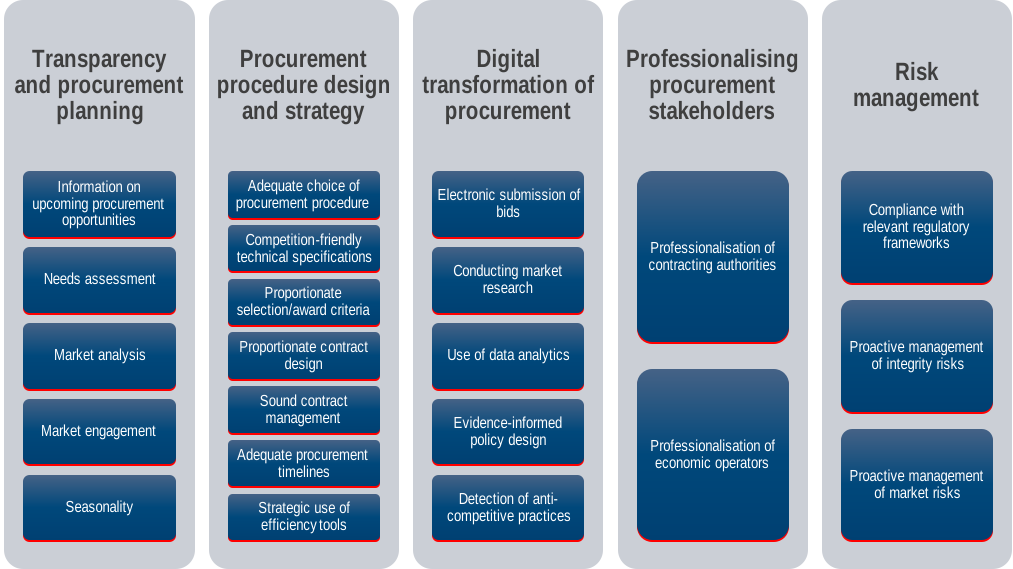
Note: Information on upcoming procurement opportunities includes the publication of procurement plans and pre-information notices of specific procurement opportunities
Source: Author
Ensuring transparency and procurement planning
Transparency is a foundational principle of sound public procurement systems, playing a key role in promoting competition and value for money, by i) ensuring equal access to information and reducing information asymmetries that may deter participation and, ii) strengthening accountability by enabling scrutiny of procurement decisions. Yet, transparency should be achieved in a balanced manner, avoiding the dissemination of competitively sensitive information beyond legal requirements where this could facilitate collusion among bidders. In this context the OECD Recommendation on Public Procurement recommends ensuring an “adequate and timely degree of transparency in each phase of the public procurement cycle”.
Decisions taken during the pre-tendering phase determine whether companies are aware of procurement opportunities, whether requirements reflect market capabilities and whether barriers to participation are minimised. Conducting effective market research can help public buyers better understand the characteristics and competitive dynamics of the market before designing the tender. (OECD, 2025[10]). Table 1 summarises the key elements of this process.
Designing sound procurement processes to maximise competition
Procurement design directly influences supplier participation. Choices relating to procedures, specifications, qualification requirements, evaluation criteria and contract design can either encourage or restrict competition. These decisions should be informed by market research and tailored to market conditions and procurement objectives. Table 2 summarises some of the main procurement design decisions that influence competition. It is key to highlight that co-operation between procurement and competition authorities can also be beneficial, particularly for large or complex tenders, by helping identify design choices that may unnecessarily restrict competition and ways to maximise supplier participation.
Leveraging the digital transformation of procurement
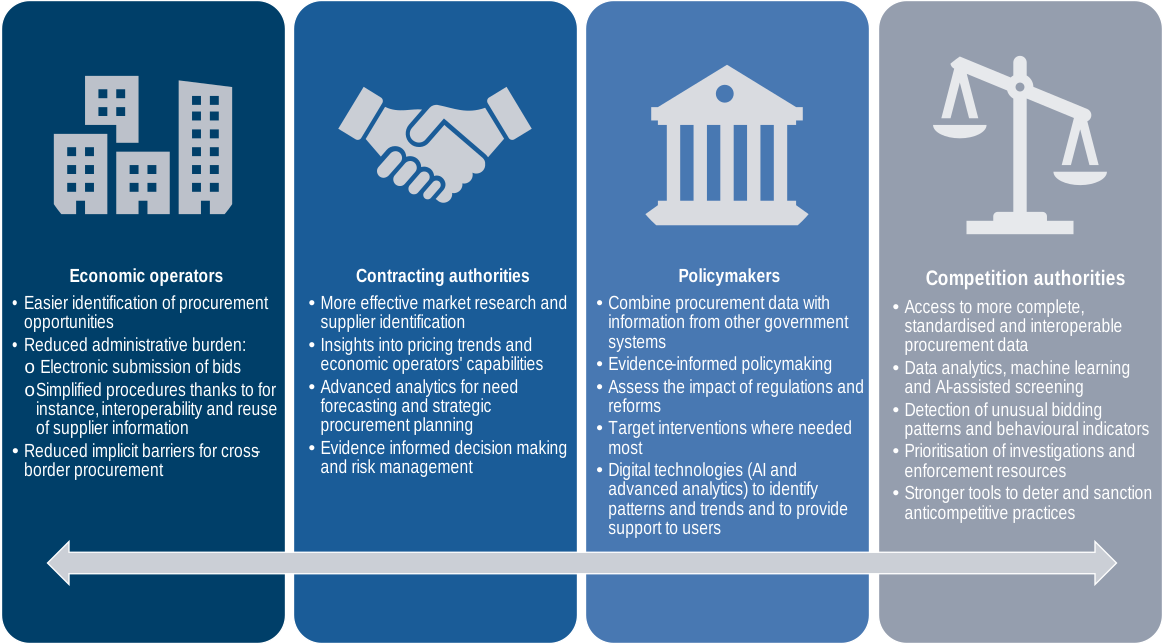
The digital transformation of public procurement entails a stronger focus on the full procurement lifecycle, rethinking traditional operations and their integration with the broader public sector. In this context, the adoption of digital tools and digital technologies, such as artificial intelligence, cloud computing, big data, machine learning, offers significant potential to enhance efficiency and deliver better outcomes, including for broader policy priorities driving a fundamental shift towards more effective, innovative, and transparent governance. (OECD Publishing, 2025[11])
Beyond improving efficiency, digital technologies can help strengthen competition by reducing barriers to participation and widening access to procurement opportunities. Electronic tendering and submission systems can lower administrative and geographic barriers, facilitating participation by SMEs and foreign suppliers. Digital technologies can also support better procurement decisions throughout the procurement lifecycle, including by helping contracting authorities assess supplier reliability and, where appropriate under applicable rules, identify grounds for exclusion linked to infringements including in the competition domain, such as collusion or corruption, while generating actionable insights for policy and enforcement (see Figure 2). From an enforcement perspective, electronic procurement systems and procurement databases can facilitate the detection of collusive behaviour by providing structured data that can be screened for suspicious bidding patterns and other indicators of potential collusion.
Strengthening the capacities of procurement stakeholders
Strengthening competition in public procurement ultimately depends on the capabilities of the stakeholders involved in procurement processes. Beyond legal and procedural knowledge, both public procurement professionals and economic operators require a combination of technical and behavioural skills to design, manage and participate effectively in competitive procurement processes. (OECD, 2023[13]). These skills can be reinforced for both contracting authorities and economic operators through trainings, guidance and practical tools. In particular, accessible guidance and support mechanisms can also help both groups address practical difficulties throughout the procurement process, reducing barriers to participation and supporting competitive procurement. For contracting authorities, skills can be further reinforced through the implementation of competency and certification frameworks and the participation in communities of practice. These professionalisation tools for contracting authorities can cover multiple topics such as market analysis and engagement, procurement design, technical specifications and contract management. For economic operators, it could be particularly relevant to develop accessible training resources and guides that do not require prerequisite knowledge, with the intention to build their capacity on procurement rules and procedures, the use of e-procurement platform and competition laws and related obligations (OECD, 2023[13]), (OECD, 2024[14]). This will equip economic operators with the technical and behavioural skills to provide a competitive, higher standard of response that meets and exceeds requirements.
Embedding risk management in procurement processes
The volume of purchases, the complexity of the processes, and the number of stakeholders make public procurement a high-risk activity subject to different categories of risks. As illustrated in Table 3, these risks can affect competition in different ways. Market, integrity (including collusion and corruption risks) and regulatory risks may have a particularly direct impact on competition, while other risks, including operational and sustainability risks, can also influence suppliers’ ability and willingness to compete. (OECD, 2023[15]). To address these risks, public buyers should take a structured and systematic approach, beginning with the application of the risk management cycle to public procurement and embed it into their procurement strategy.
Competition in public procurement cannot be assessed through a single metric. While indicators such as the average number of bids received or the share of single-bid procedures provide valuable insights, they capture only part of the dynamics that shape supplier participation. Competition is influenced by a combination of market characteristics, procurement design choices, regulatory settings and supplier capabilities. Measuring competition therefore requires combining procurement and market data to identify barriers to participation, monitor market developments and assess the efficiency of policy interventions to broaden supplier participation over time. (OECD, 2024[2])
Assessing relevant market structures
Competition outcomes should always be interpreted in light of the characteristics of the market in which procurement takes place. Similar procurement outcomes may reflect very different market realities. For example, a low number of bids may indicate restrictive procurement practices in a highly competitive market, but it may equally reflect a market characterised by few qualified suppliers, high market entry barriers or strong supplier concentration. Market analysis therefore complements procurement indicators by helping distinguish between structural market conditions and factors that governments can influence through procurement policy (OECD, 2024[2]). Several indicators can help define market characteristics and structures including:
Market concentration, which measures how contract awards are distributed among suppliers within a given market (e.g. using the Herfindahl-Hirschman Index2). Lower concentration may indicate higher competition, particularly when combined with high market entry.
Market entry, which measures i) the proportion of suppliers awarded their first public contract within a given period or; ii) the proportion of suppliers who participated in a procurement process for the first time within a given period. Higher market entry suggests procurement markets remain accessible to new suppliers.
Market exit, which measures i) the proportion of suppliers that no longer submit bids within a given period; ii) or those who submit bids but no longer win contracts within a given period. Lower market exit suggests suppliers remain engaged in procurement markets over time.
Market size, which measures the total value and number of contracts awarded within a given sector, or market segment. Together, these dimensions provide context on the scale and structure of procurement opportunities available to suppliers.
The globalisation of economies helps governments deliver public services efficiently and effectively, but may add an extra challenge in identifying the market structures and the market characteristics. Governments should monitor market concentration, entry, exit and supplier diversity to identify emerging risks and adjust procurement strategies where necessary. This analysis can be complemented by benchmarking across markets and buyers (both public and private) that can further support evidence-based decision making.
Selecting relevant indicators to assess competition in public procurement markets
Market characteristics alone do not explain competition outcomes. Governments should therefore complement market analysis with procurement indicators that capture how procurement practices influence supplier participation. The number of bids received can provide a useful proxy for competitive conditions but should not be interpreted as a conclusive measure of effective competition, since a high number of bids does not necessarily mean that suppliers are competing independently and may, for example, include cover bids submitted as part of a bid-rigging arrangement. Measuring competition should therefore be part of a wider performance measurement framework for public procurement. (OECD, 2024[2])
For this purpose, the OECD has developed a comprehensive performance measurement framework that countries can use to develop their own framework based on their priorities and the challenges they are facing. The Framework already contains several competition-centred indicators, which should be measured as a first step to draw a picture of the state of play of competition in the country. Nonetheless, to get a better vision of the system, it is pivotal to read these specific competition indicators in the light of other indicators which may either have a direct or indirect impact on the level of competition (OECD, 2023[16]). Table 4 provides the list of indicators that are relevant for competition, distinguishing indicators to measure competition from those linked to enabling factors to enhance competition.
Note: Unsuccessful procedure refers to a procurement process that is cancelled due to the absence of any acceptable bid. Domestic bidder refers to a bidder established in the country of the contracting authority. Number of bidders per contract size measures the relationship between contract value and supplier participation. Direct award refers to the award of a public contract to an economic operator without prior publication of a contract notice and without a competitive tendering procedure. Procurement complaints indicators measure the frequency of challenges to procurement decisions and may provide insights into the perceived fairness, transparency and quality of procurement processes
Source: (OECD, 2023[16])
The critical role of data in measuring and enhancing competition
Data sits at the core of the digital transformation of public procurement. It plays a pivotal role in strengthening and measuring competition. Indeed, many key enabling factors depend heavily on data such as market analysis, procurement planning, risk management and the related procurement procedure design and strategy. In addition, data is also relevant for the effective measurement of competition. To this end, digital technologies and data go hand-in-hand, as digital technologies rely on standardised, qualitative, and usable data, while these technologies can also tackle some data challenges. In addition, a comprehensive assessment of competition requires an end-to-end approach to procurement data. Indeed, procurement should be viewed as an integrated process spanning planning, tendering, contract management, invoicing and payment, rather than as a collection of disconnected stages.
However, several challenges regarding data have been identified, namely the availability, accessibility and quality of procurement data. While e-procurement systems have significantly expanded governments' ability to collect and analyse procurement information, interoperability between e-procurement systems and other government databases (such as business registers, tax administrations and contract management systems), enables governments to develop a more complete understanding of supplier participation, market concentration and procurement outcomes. These challenges impact also competition authorities activities as from a competition-enforcement perspective, the usefulness of procurement data depends on whether data are sufficiently high-quality, standardised, accessible and interoperable across databases and systems to support effective screening for potential collusion and subsequent investigations.
Embed competition considerations throughout the procurement lifecycle, as. competition is ultimately a means to better procurement outcomes rather than an objective. Decisions taken during procurement planning, market research and engagement, procurement design, contract management and contract implementation all influence companies’ willingness and ability to participate. While broad bidder participation is an important metric in most cases, better procurement outcomes are not achieved solely by the number of bids received. Instead, competition should be understood in the light of market characteristics and the extent to which bidders are able and willing to compete in support of procurement objectives.
Design procurement systems and processes to remove unnecessary barriers to participation while ensuring that procurement objectives are achieved effectively. The public procurement regulatory framework and related processes should be designed in a way to ensure a wide participation of companies and reduce their administrative burden. The choice of procedure, technical specifications, selection and evaluation criteria, contract design, prioritisation of policy interest goals and the use of efficiency tools should be adapted to market conditions and procurement objectives. Procurement design and strategies should also be informed by risk-based approaches embedding competition aspects.
Leverage digital technologies and procurement data to strengthen competition. When used appropriately and transparently, integrated e-procurement systems, advanced analytics and artificial intelligence improve market access, support better procurement decisions, enable evidence-informed policymaking and strengthen the detection of potential anticompetitive practices. High-quality procurement data are essential for evidence-informed policymaking. Governments should invest in end-to-end digital procurement systems, interoperable data and robust monitoring frameworks to enable continuous assessment of procurement markets, identify emerging risks and evaluate the impact of competition-enhancing reforms.
Build the capabilities of both public buyers and suppliers. Building competitive procurement markets requires procurement professionals, economic operators and other stakeholders to possess the technical and behavioural competencies needed to design, participate in and oversee procurement processes effectively, supported by competency frameworks, continuous learning and practical guidance.
Monitor competition using complementary indicators and act on the findings. No single indicator adequately captures the competitiveness of procurement markets. Governments should combine market indicators, such as market concentration, market entry and market size, with procurement indicators that measure both competitive outcomes (e.g. single bidding) and the enabling factors that influence competition (e.g. procurement timeliness), to provide a more comprehensive understanding of competitive dynamics. Where competition appears limited, examine the underlying causes before defining appropriate interventions, and monitor their effects over time.
References
[4] OECD (2026), Restoring Public Finances: Enabling Effective Government, OECD Publishing, Paris, https://doi.org/10.1787/fbcf9161-en.
[17] OECD (2026), Smart Regulations, Strong Business: Enabling Growth and Societal Protection in a Fast‑Changing World, OECD Publishing, Paris, https://doi.org/10.1787/93d38770-en.
[18] OECD (2025), Generative AI and the SME Workforce: New Survey Evidence, OECD Publishing, Paris, https://doi.org/10.1787/2d08b99d-en.
[1] OECD (2025), Implementing the OECD Recommendation on Public Procurement in OECD and Partner Countries: 2020-2024 Report, OECD Public Governance Reviews, OECD Publishing, Paris, https://doi.org/10.1787/02a46a58-en.
[10] OECD (2025), OECD Guidelines for Fighting Bid Rigging in Public Procurement (2025 Update), https://www.oecd.org/en/publications/oecd-guidelines-for-fighting-bid-rigging-in-public-procurement-2025-update_cbe05a56-en.html.
[2] OECD (2024), Improving Competitive Practices in Hungary’s Public Procurement: Reducing Single-bids and Enhancing Supplier Participation, OECD Public Governance Reviews, OECD Publishing, Paris, https://doi.org/10.1787/5d1c1ec1-en.
[14] OECD (2024), Maximising the benefits of effective competition in public procurement in Slovenia.
[15] OECD (2023), “Managing risks in the public procurement of goods, services and infrastructure”, OECD Public Governance Policy Papers, No. 33, OECD Publishing, Paris, https://doi.org/10.1787/45667d2f-en.
[13] OECD (2023), “Professionalising the public procurement workforce: A review of current initiatives and challenges”, OECD Public Governance Policy Papers, No. 26, OECD Publishing, Paris, https://doi.org/10.1787/e2eda150-en.
[16] OECD (2023), Public procurement performance A framework for measuring efficiency, compliance and strategic goals, https://doi.org/10.1787/0dde73f4-en.
[8] OECD (2023), Recommendation of the Council on Fighting Bid Rigging in Public Procurement, https://legalinstruments.oecd.org/en/instruments/OECD-LEGAL-0396 (accessed on 30 August 2023).
[12] OECD (2022), “Data Screening Tools for Competition Investigations”, OECD Roundtables on Competition Policy Papers, No. 284, OECD Publishing, Paris, https://doi.org/10.1787/4c5bbb9d-en.
[7] OECD (2022), “Integrating responsible business conduct in public procurement supply chains: Economic benefits to governments”, OECD Public Governance Policy Papers, No. 14, OECD Publishing, Paris, https://doi.org/10.1787/c5350587-en.
[3] OECD (2021), Recommendation of the Council on Competitive Neutrality, https://legalinstruments.oecd.org/en/instruments/OECD-LEGAL-0462.
[9] OECD (2015), OECD RECOMMENDATION OF THE COUNCIL ON PUBLIC PROCUREMENT - Directorate for Public Governance and Territorial Development, https://www.oecd.org/gov/public-procurement/OECD-Recommendation-on-Public-Procurement.pdf (accessed on 1 February 2023).
[11] OECD Publishing (2025), “Digital transformation of public procurement: Good practice report”, OECD Public Governance Policy Papers, No. 77, OECD Publishing, Paris, https://doi.org/10.1787/79651651-en.
[6] Smuda, F. (2014), “CARTEL OVERCHARGES AND THE DETERRENT EFFECT OF EU COMPETITION LAW”, Journal of Competition Law & Economics, Vol. 10/1, pp. 63-86, https://doi.org/10.1093/joclec/nht012.
[5] Vogel, L. (2009), Macroeconomic effects of cost savings in public procurement, European Commission, https://doi.org/10.2765/29810.
Erika Bozzay (Erika.Bozzay@oecd.org)
Kenza Khachani (Kenza.Khachani@oecd.org)
Sanda Jugo (Sanda.Jugo@oecd.org)
← 1. The Public Procurement Data Space is a service launched by the European Commission where policy makers, public buyers, companies, and other stakeholders can access public procurement information. The PPDS includes data from the EU’s Tenders Electronic Daily (TED), and national datasets extracted from e-procurement platforms and portals deployed at the national level.
← 2. The Herfindahl-Hirschman Index measures the share of contract values for one year compared to the total annual market value. It looks at the total number of companies on a specific market and the share of each company from the total market value in a particular year