This chapter explores the aspiration of bringing innovation into the classroom, as envisioned across future scenarios in Austria, Flanders and Wales. It identifies four ideas for the Future of Teaching that offer practical entry points to embed innovation in everyday teaching: Nurturing teacher creativity, strengthening partnerships with researchers, building interdisciplinary collaboration, and redefining teacher and learner roles with clarity and shared responsibility. These ideas highlight the importance of teacher agency, collaboration, and professional trust as drivers of meaningful change.
Co‑constructing Visions for the Future of Teaching

Abstract
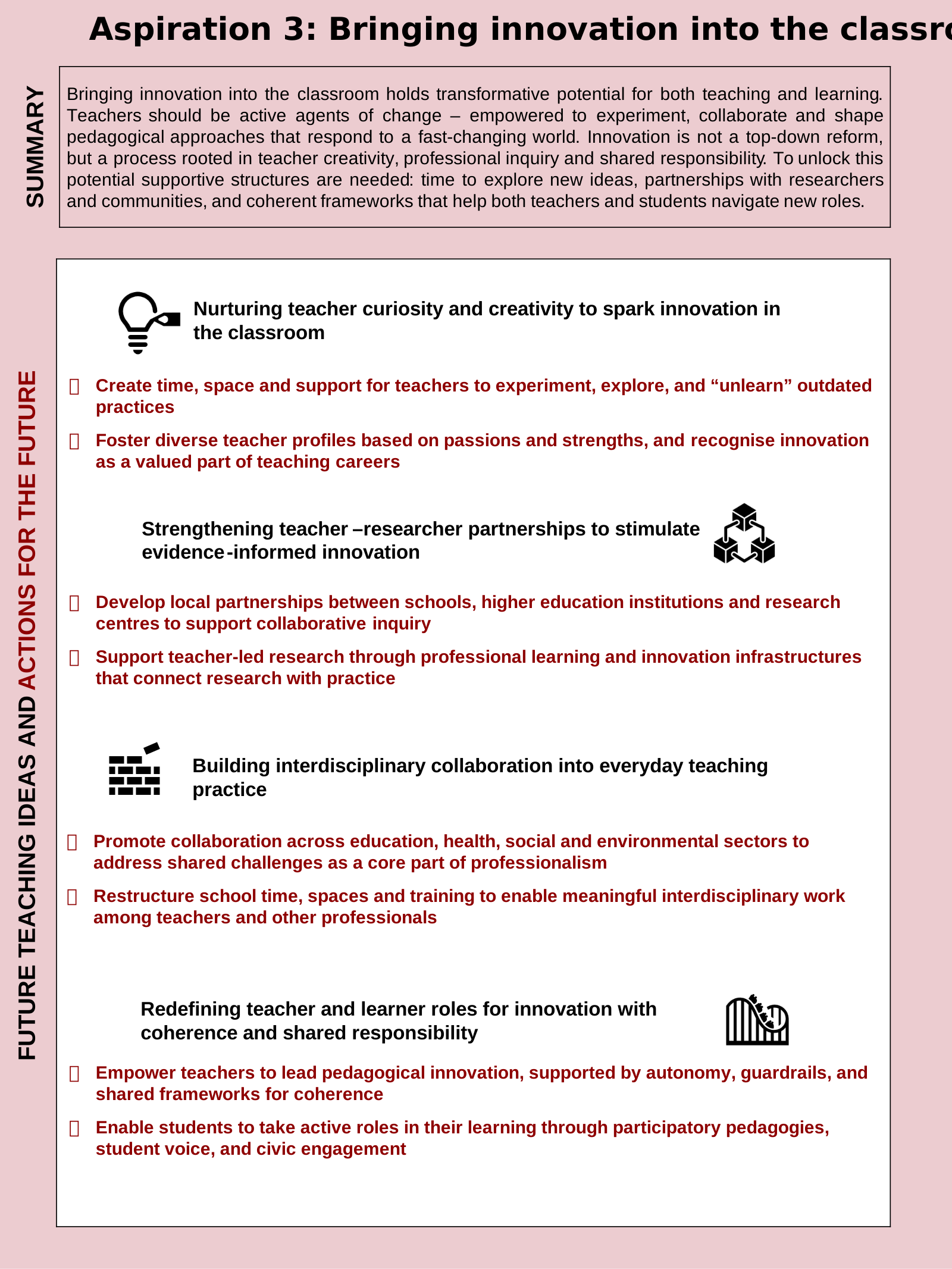
The three Future of Teaching studies revealed one aspiration that stood out as both a challenge and an opportunity: Enabling innovation to thrive in everyday teaching practice. There is an openness to explore ways to experiment and to be creative in ways that can innovate and lead to new practices that address current and future challenges. Stakeholders from Austria, Flanders and Wales consistently imagined future schools where teachers are trusted as experimenters, collaborators and designers of learning, equipped not only to adapt to, but to shape responses to emerging educational needs. Innovation, in this sense, is not just about new tools or technology, but about new mindsets, relationships, and possibilities for teaching and learning.
This aspiration builds on the idea that teachers can be powerful agents of system transformation – when they are supported to take risks, collaborate across boundaries, and connect classroom practice to broader change (Mezza, 2022[1]; Nilsson Brodén, 2022[2]). Whether through cross-sector partnerships, inclusive pedagogies, or creative uses of digital tools, innovation becomes a way to strengthen teacher professionalism, improve the learning experience, and increase the system’s responsiveness to contemporary challenges.

Note: This illustration is intended to provide a concrete example of a fictitious, but evidence-based, teacher persona.
Source: For description of the persona, see Chapter 3 in OECD (2025[3]), Constructing Scenarios for the Future of Teaching in Wales, https://doi.org/10.1787/2e0ac4e6-en.
OECD work on public sector transformation reinforces the importance of innovation grounded in co-design, evidence use, and ethical experimentation (OECD, 2024[4]; Vincent-Lancrin, 2023[5]). Within education, this includes engaging teachers in shaping new practices, anticipating future needs, and connecting their work to democratic values and student agency. Importantly, innovation is not a one-off intervention – it is a capacity to be cultivated and sustained across time, people, and places.
This chapter builds on the cross-country analysis introduced earlier, focusing on the aspiration of bringing innovation into the classroom. It explores the kinds of environments, supports and practices that can allow innovative teaching to flourish as a driver of meaningful, system-wide transformation.
Across Austria, Flanders and Wales, the aspiration of bringing innovation into the classroom reflects a shift in how education systems think about change and innovation – not as something imposed from outside, but as something that grows from within schools and classrooms. Stakeholders envisioned futures where teachers are empowered to explore, adapt and lead, sparking meaningful change that reaches far beyond the walls of their own classrooms.
Innovation flourishes when teachers are trusted to experiment, question and co-create new approaches to learning. In the scenarios, they were portrayed not as implementers of pre-designed solutions, but as active designers of inquiry-rich, future-facing pedagogy. This includes responding to contemporary challenges such as disinformation, digitalisation or climate change – and drawing on professional knowledge, community partnerships and creativity to do so.
Professional learning systems also play a vital role in supporting innovation. Stakeholders called for more personalised, practice-connected and research-informed opportunities that nurture teachers’ curiosity and deepen their expertise. This includes peer collaboration, co-design with universities and professional inquiry focused on solving real challenges. In this vision, professional development becomes a lever for inspiration and growth rather than a compliance exercise.
These ideas were vividly expressed in the preferred future scenarios co-created by participants. Box 5.1 illustrates how teachers were imagined as pedagogical leaders and knowledge creators – from Austria’s schools as curiosity-driven innovation hubs to Flanders’ co-researching teachers and Wales’ system-wide support for grassroots innovation.
Flanders: What if… Teachers develop their expertise together within a dynamic school team supported by trusted partners?
Teachers are seen as active users and co-creators of research, both within the core school team and with higher education partners, to deepen expertise on areas of interest to their work. In fact, this scenario sees teachers as career-long learners, committed to using educational research and having opportunities to co-create educational research that explores issues identified as important for their student group.
Wales: What if… part of teaching means innovation in collaboration with society and the education sector?
Teacher-led initiatives are celebrated as integral to professional practice, with schools and education systems actively facilitating and supporting these efforts. Teachers are given the time, resources, and autonomy to pursue projects that align with their interests and intrinsic motivations. These initiatives are shared widely, allowing other schools and educators to learn from their success, creating a ripple effect of innovation across the entire system.
Austria: What if… Schools provide space to foster curiosity and autonomy among students, teachers, and school leaders?
Schools are envisioned as dynamic spaces promoting openness, curiosity, and creativity, moving away from traditional hierarchical models. Schools can act as innovation hubs for societal change, debating real-world issues with diverse perspectives and empowering students to become active, engaged citizens in a pluralistic society. This transformation requires supporting teachers to create learning environments that recognise students' individuality and broader relationships.
Austria: What if… we enable a culture of innovation for and with the teaching profession?
Teachers are pedagogical innovators with the time and space to unleash their curiosity and innovation. Providing resources (financial, physical or human resources), allows the space for “unlearning”, exploring innovation beyond current resource requirements, and changes in routine and beliefs. Benefits for teachers include professional growth and deeper professional satisfaction from undertaking research and development. Benefits for schools and systems come from using the current experiences of teachers and other partners to create solutions to contemporary challenges such as mis- or disinformation or climate change. Constant attention is paid to placing adequate value on innovation and how it sits alongside formal assessments.
Source: OECD (2024[6]), Constructing Scenarios for the Future of Teaching in Flanders, https://doi.org/10.1787/b5bd68c4-en; OECD (2025[3]), Constructing Scenarios for the Future of Teaching in Wales, https://doi.org/10.1787/2e0ac4e6-en; OECD (2025[7]), Constructing Scenarios for the Future of Teaching in Austria, https://doi.org/10.1787/73545285-en.
Box 5.2 highlights how collaboration with communities and partners outside the school can fuel this vision – providing real-world relevance, diverse perspectives, and shared responsibility for educational change.
Flanders: What if… We unleash the unlimited potential of shared responsibility?
This scenario emphasises the need to ensure that new teachers are familiar with the school community that they are working in. In the future, the teacher population is more representative of Flemish society, including individuals from diverse social, cultural and economic backgrounds. This is supported by a respect for diversity within schools that opens students’ minds to a teaching career. Individual students feel they have the space to develop their strengths and interests and attach high value to their educational career and the art of learning. Diversity is represented in the current student population in Flanders, but less so in the teaching population.
Wales: What if… Teachers benefit from integral and structural community support, redefining schools as community hubs?
In this scenario, schools in Wales evolve into vibrant community hubs, where educators, families, and local organisations collaborate to support learners' holistic development. Rooted in strong, nurtured community relationships, these schools go beyond traditional education, actively engaging with community leaders, local authorities, and diverse agencies to address the broader social, emotional, and practical needs of both learners and their families.
This approach fosters a multi-agency framework that seamlessly integrates formal education with community resources, allowing for personalised and flexible learning experiences that extend beyond the classroom. Teachers, as central figures in the community, redefine their roles – not only as educators but also as facilitators who connect learners and families to local opportunities and services, supported by (and relying on) the school and the community structures. This vision also acknowledges the complexity of geographical and social barriers, seeking innovative ways to bridge these divides and ensure that all learners have access to quality education and support.
Source: OECD (2024[6]), Constructing Scenarios for the Future of Teaching in Flanders, https://doi.org/10.1787/b5bd68c4-en; OECD (2025[3]), Constructing Scenarios for the Future of Teaching in Wales, , https://doi.org/10.1787/2e0ac4e6-en. Source: OECD (2024[6]), Constructing Scenarios for the Future of Teaching in Flanders, https://doi.org/10.1787/b5bd68c4-en; OECD (2025[3]), Constructing Scenarios for the Future of Teaching in Wales, https://doi.org/10.1787/2e0ac4e6-en.
By strengthening teacher agency and aligning professional learning with authentic inquiry and creativity, education systems can embed innovation at the heart of everyday teaching. In doing so, they open the door to more adaptive, meaningful and future-ready learning experiences for both teachers and students.
Bringing innovation into the classroom requires more than isolated projects or occasional reforms – it calls for reshaping the professional environments in which teachers work and learn. This section presents a set of ideas for the Future of Teaching that describe the conditions schools and systems can cultivate to unlock teacher-led innovation, grounded in the preferred future scenarios co-created in Austria, Flanders and Wales.
Each idea was developed through analysis of the “What if…” statements and Ambition Loops that underpin these scenarios. Together, they highlight how innovation can be made sustainable and systemic by building on teachers’ curiosity, professionalism, and agency. The four ideas focus on enabling conditions for innovation: Nurturing creativity, building research partnerships, embedding interdisciplinary collaboration, and redefining the roles of teachers and learners with coherence and shared responsibility.
For each idea, a set of Actions for the Future proposes targeted, actionable changes to bring these conditions to life. These Actions identify concrete levers – from redesigning school time and space, to strengthening local research networks – that education systems can use to foster teacher-led innovation and create future-ready learning environments. While each idea offers a distinct entry point, their combined implementation supports a systemic shift toward more adaptive, inclusive, and creative schools.
Idea for the Future of Teaching 9: Strengthening teacher–researcher partnerships to build evidence-informed innovation
Teachers are not just users of educational research, they can also be co-creators of it. Stakeholders in Austria, Flanders and Wales imagined a future in which research and innovation are tightly interwoven, and teachers are empowered to contribute to both. This means developing local partnerships between schools, higher education institutions and research centres to support collaborative inquiry – partnerships that recognise the value of teachers’ professional insights and position them as active participants in generating and applying knowledge. This includes valuing both practice and research (Ulferts, 2021[8]; Oates and Bignell, 2022[9]; Forester, 2020[10]) as well as distinguishing between what is of value to all teachers and where there are opportunities to extend expertise of interested teachers.
Developing such partnerships begins with building a culture of evidence-informed practice. Teachers need access to research that is relevant, curated, and responsive to their context. Models such as local “knowledge centres” or advisory bodies (Brinckman and Versluys, 2021[11]) can support the translation of research into practice, while creating feedback loops for teachers to reflect on and evaluate implementation. When research engagement becomes a collective endeavour, schools are better placed to respond to complex challenges such as digital transformation, misinformation, or climate change (OECD, 2021[12]) (Hill, 2022[13]) (OECD, 2022[14]).
Beyond using research, teachers can also conduct it. Supporting teacher-led research through professional learning and innovation infrastructures that connect research with practice is essential to deepen professional learning and improve outcomes for students. Opportunities to take part in practitioner inquiry, co-design studies with researchers, or explore problems of practice can deepen professional learning and improve outcomes for students. Higher education institutions can support this by offering structured research training as part of career-long professional learning and involving experienced teachers as guest lecturers in teacher education programmes (Willegems et al., 2018[15]) (ESTYN, 2017[16]). Further engagement of teachers with research evidence and carrying out research themselves has been recommended to improve their professional learning (ESTYN, 2017[16]). Systems could nurture what some call the “extended professional”: A teacher who engages in critical reflection, collaborates with researchers and colleagues, uses evidence to improve teaching, and contributes to collective knowledge-building (Willegems et al., 2018, p. 126[15]).
Some systems are exploring ways for researchers to work within schools to better understand real classroom dynamics – helping to bridge the gap between research and practice. With the right structures in place – from school leadership support to national policies for research-rich schools (Bristow, 2022[17]) – teachers can shape innovation not just in their classrooms, but across the wider system. To achieve this, national and local government will play a central role in developing and sustaining research and enquiry activity in schools, supported by a collaboration between higher education institutions and schools developing the research skills of practitioners through career-long coherent and relevant professional learning, and school leaders developing a school culture of research use (Bristow, 2022[17]).
Idea for the Future of Teaching 10: Nurturing teacher curiosity and creativity to spark innovation in the classroom
As noted above, teachers can actively add to the evidence base for their profession, trying out different ways to improve the effectiveness of their teaching. Innovation begins with curiosity – and teachers, as lifelong learners, need environments that fuel their sense of wonder, creativity and critical thinking. In the preferred scenarios across Austria, Flanders and Wales, stakeholders imagined schools where teaching was not bound by rigid routines but opened space for exploration, experimentation and play. These scenarios recognised that teachers bring more than content expertise – they bring ideas, passions and perspectives that, when supported, can transform learning for students.
Schools can act as hubs of innovation, where inquiry-based and experiential learning are normalised and nurtured, helping students become engaged citizens in pluralistic societies (Pedretti and Iannini, 2020[18]; Halsey, 2022[19]; Halsey, 2018[20]). This transformation requires supporting teachers to create learning environments that recognise students' individuality, diversity, and voice within communities, and establishing broader relationships.
To bring this vision to life, education systems must actively support teacher-led innovation and document the effectiveness of novel practices. This means creating time, space and support for teachers to experiment, explore, and “unlearn” outdated practices, and to develop new pedagogical approaches that respond to real-world challenges (Yang, Chou and Chiu, 2014[21]). Creative and critical thinking – increasingly vital in a constantly-changing digital and AI-influenced world – need to be part of both teacher development and evolving student learning goals (Vincent-Lancrin et al., 2019[22]) (OECD, 2021[12]). The benefits for focusing on creative and critical thinking include positive outcomes for the labour market, civic life, and personal and social well-being (Vincent-Lancrin et al., 2019[22]). There is opportunity to create space for teachers to innovate pedagogy in line with a reframing of the purposes of education (Hannon and Peterson, 2017[23]).
This also requires a shift in how the teaching profession is framed. Rather than focusing only on “minimum competencies”, systems can foster diverse teacher profiles based on passions and strengths, and recognise innovation as a valued part of teaching careers. This includes teachers with deep subject expertise, those skilled in mentoring and student well-being, or those passionate about community engagement. Recognising and cultivating these specialisations strengthens the profession while opening career pathways aligned with teachers’ interests and strengths. Such change could be developed through a focus on the school team (Clemson et al., 2020[24]; OECD, 2024[25]) rather than solely on just basic competencies for all teachers in a school.
Finally, fostering innovation includes empowering teachers to amplify student voice. Research shows that when students participate meaningfully in their learning, it enhances inclusion, civic engagement and well-being (Gottschalk and Borhan, 2023[26]). But to support this shift, teachers need dedicated time, training and trust. When teachers themselves feel curious, creative, and confident to innovate, they can create learning environments where students do too.

Note: This illustration is intended to provide a concrete example of a fictitious, but evidence-based, teacher persona.
Source: For description of the persona, see Chapter 3 in OECD (2024[6]), Constructing Scenarios for the Future of Teaching in Flanders, https://doi.org/10.1787/b5bd68c4-en.
Idea for the Future of Teaching 11: Building interdisciplinary collaboration into everyday teaching practice
To meet the demands of an increasingly complex world, teachers need to collaborate beyond traditional professional silos. Across the Future of Teaching studies, schools were imagined not as isolated institutions, but as part of broader ecosystems – connected to other sectors, disciplines and community actors. In this future, collaboration across education, health, social and environmental sectors to address shared challenges is not an exception, but a common feature of professional life, enriching both teaching and learning.
Interdisciplinary partnerships allow teachers to engage with real-world challenges such as climate change, digital trust or mental health through a broader lens – connecting education with health, social work, industry or environmental fields (Candan Helvaci and Helvaci, 2019[27]); (Wang et al., 2020[28]) (OECD, 2021[12]). These collaborations can deepen student engagement, build transversal skills, and help reposition schools as relevant, responsive actors in society. They also provide opportunities for career specialisation and professional renewal – especially for motivated teachers seeking to develop expertise in curriculum areas or student well-being (Song and Wang, 2021[29]; Wang et al., 2020[28]; Choi et al., 2022[30]). This approach builds on general trends across professions for increased interdisciplinary connections (Mezza, 2022[1]).
To make this vision a reality, systems must restructure school time, spaces and training to enable meaningful interdisciplinary work among teachers and other professionals. This means allocating and restructuring time and designing physical environments that enable team teaching, co-planning or joint projects – both within schools and across sectors (Castoldi, 2020[31]) (Sinnema and Stoll, 2020[32]). Effectively engaging in cross-sector relationships that benefit all requires skills (Nilsson Brodén, 2022[2]). It requires targeted professional development: Collaboration skills must be explicitly taught and modelled across teacher education and leadership training (Lawson and Veen, 2016[33]). Learned collaboration skills are valued in work and teachers and schools can model practices for students (Bax et al., 2023[34]).
Effective interdisciplinary work depends on trust, clarity, and shared purpose. As Box 5.3 illustrates, interprofessional education and training – long embedded in the health and social care sectors – can help break down barriers and foster meaningful collaboration. Preparing teachers, social workers, and other professionals together strengthens joint problem-solving and supports vulnerable learners more holistically. Embedding such approaches in higher education and school systems could radically improve how schools support students and communities.
If we want teachers and service providers to work together in service of students, we must prepare them together. Interprofessional education and training is well-established in the health professions, and treatment teams are the norm in hospitals and medical clinics worldwide. Social services disciplines, particularly social work, also have a firm trajectory with interprofessional education in service of collaborative practice and as team leaders.
Where teachers, school and district leaders, and the education workforce overall are concerned, interprofessional education and training in service of team formation and expanded communities of practice is a bold idea. However, it is of immense importance for the education workforce, students challenged by barriers to learning and school success, and service providers working with school-aged children. These service providers have a vested interest in children’s school engagement and success, just as educators have a stake in service providers’ success with the children and youths in their joint care. The teams and communities of practice they form and seek to optimise benefit the participating adults in tandem with students’ improvements.
Thus, interprofessional education and training for educators, in service of collaborative practice in schools and communities, is an idea whose time has come. The core idea is compelling. If we want and need educators, social workers, health professionals, mental health professionals, and social services professionals to work together, we must prepare them together. Because degree programmes in every specialised field tend to be jam‑packed with requirements, the initial strategy may be to prepare and offer short‑term courses, modular experiences, and provide online resources. More fundamentally, if higher education institutions are expected to take the lead, professional development for professors, particularly professors of education, is a practical necessity.
Source: Original contribution by Hal A. Lawson (University at Albany).
Ultimately, interdisciplinary collaboration benefits not just students, but also teachers themselves. It helps reduce isolation, broaden teachers’ understanding of student needs, and deepen their sense of purpose. Partnerships across the education sector focused on interdisciplinary teaching (Choi et al., 2022[30]) expand interprofessional connections which enrich careers for teachers. In doing so, it strengthens the collective capacity of the teaching profession to respond to contemporary challenges with creativity and shared responsibility.

Note: This illustration is intended to provide a concrete example of a fictitious, but evidence-based, teacher persona.
Source: For description of the persona, see Chapter 3 in OECD (2025[7]), Constructing Scenarios for the Future of Teaching in Austria, https://doi.org/10.1787/73545285-en.
Idea for the Future of Teaching 12: Redefining teacher and learner roles for innovation with coherence and shared responsibility
Innovation in education depends not only on new practices, but also on rethinking the roles of teachers and students themselves. The preferred scenarios in Austria, Flanders and Wales pictured classrooms where teachers act as facilitators of agency, curiosity and critical thinking, and where students become active contributors to their own learning and to wider society. This reimagining opens up space for new pedagogies, shared responsibilities and more responsive education systems – but also demands careful attention to coherence, support, and professional identity.
In this future, teachers are empowered to lead pedagogical innovation, supported by autonomy, guardrails, and shared frameworks for coherence. They are given the time, autonomy and support to experiment with new approaches aligned with their passions and goals (Song and Wang, 2021[29]). These teacher-led innovations are seen not as isolated initiatives, but as professional contributions that ripple across the system. Systems can nurture this innovation culture by creating enabling environments – including innovation infrastructures and professional communities that connect and amplify promising ideas (Clemson et al., 2020[24]).
Clarifying and supporting the evolving role of the teacher means fostering professional autonomy, teacher leadership and a strong professional identity (Mezza, 2022[1]; Suarez and McGrath, 2022[35]), which has potential benefits for teacher professional satisfaction (Backers, Tuytens and Devos, 2020[36]; Mombaers, Vanlommel and Van Petegem, 2020[37]; Spruyt et al., 2023[38]; Bristow, 2021[39]). This includes providing “discretionary authority” to make pedagogical decisions (Baker and Milner, 2016[40]), and recognising that critical reflection and co-creation with peers and students are central to contemporary teaching (Bristow, 2021[39]). At the same time, coherent pedagogical frameworks and clear guardrails are needed to ensure that innovation is not fragmented, but aligned with shared values and goals (Reichert, Lange and Chow, 2021[41]; Fletcher and Ní Chróinín, 2022[42]).
Reframing the teacher’s role is closely tied to reframing the role of the learner. Students are no longer just passive recipients of instruction, but co-agents in their own learning and development. Students are enabled to take active roles in their learning through participatory pedagogies, student voice, and civic engagement:
Most importantly, the role of students in the education system is changing from participants in the classroom learning by listening to directions of teachers with emerging autonomy to active participants with both student agency and co-agency in particular with teacher agency, who also shape the classroom environments. (OECD, 2019, p. 13[43])
Emerging pedagogies – such as inquiry-based learning, dialogic approaches, peer teaching and experiential learning – empower learners to think critically, participate actively, and contribute meaningfully to their communities (Burns and Gottschalk, 2020[44]; OECD, 2023[45]). This also includes supporting students’ voice in classroom and school decisions (Gottschalk and Borhan, 2023[26]), and helping them connect with wider democratic processes and civic responsibilities (OECD, 2022[46]; OECD, 2022[47]).

Note: This illustration is intended to provide a concrete example of a fictitious, but evidence-based, teacher persona.
Source: For description of the persona, see Chapter 3 in OECD (2024[6]), Constructing Scenarios for the Future of Teaching in Flanders, https://doi.org/10.1787/b5bd68c4-en.
For these role shifts to be successful, systems must invest in meaningful collaboration with stakeholders (Darling-Hammond, 2024[48]), supported by researchers and policy makers to ensure alignment between teaching, learning and other parts of the education system (Bingham and Burch, 2018[49]). Together, they can explore how evolving roles affect curriculum, assessment and school culture – and how to align innovations with systemic priorities. Providing flexibility within curriculum structures alone is not enough: Teachers and students need the time, tools and support to use that flexibility effectively (Newton, 2020[50]).
When roles are redefined with clarity, trust and shared vision, the potential for transformation multiplies. Teachers and students can become co-constructors of knowledge, culture and change – and schools can become spaces where curiosity and responsibility go hand in hand.
The aspiration of bringing innovation into the classroom reflects a growing recognition that teachers are not just implementers of change – they are agents of it. Across Austria, Flanders and Wales, stakeholders envisioned education systems where teachers are supported to experiment, collaborate and lead – sparking new pedagogies, stronger partnerships, and more responsive learning environments. Innovation, in this sense, is not about novelty for its own sake or just the adoption of new technologies, but about empowering teachers and learners to respond creatively to the evolving challenges of their world.
This chapter introduced four ideas for the Future of Teaching that define the enabling conditions for teacher-led innovation. They call for nurturing teacher curiosity and creativity, strengthening research partnerships, embedding interdisciplinary collaboration in everyday practice, and redefining teacher and learner roles with coherence and shared responsibility. Together, these ideas suggest a culture of innovation that is embedded in the daily realities of teaching and learning, not confined to isolated initiatives.
For each idea, a set of Actions for the Future identifies concrete entry points for change – from rethinking school time and structures, to recognising diverse teacher profiles and fostering participatory pedagogies. These Actions are not just supportive measures, but strategic levers that help align innovation with teacher development, learner engagement, and system-wide goals.
Supporting innovation in the classroom is ultimately a shared endeavour. It requires leadership that protects space for experimentation, structures that connect ideas across contexts, and policies that treat teachers as knowledge creators. By investing in the conditions that allow teachers to innovate with purpose and confidence, education systems can shape futures that are both imaginative and grounded.
References
[36] Backers, L., M. Tuytens and G. Devos (2020), “Het aantrekken en behouden van leraren in een grootstedelijke context [Attracting and retaining teachers in a metropolitan context]”, https://biblio.ugent.be/publication/8713246 (accessed on 8 September 2026).
[40] Baker, S. and J. Milner (2016), “Building discretionary authority in a teacher education program”, Action in Teacher Education, Vol. 38/2, pp. 91-103.
[34] Bax, W. et al. (2023), What works best in the school-to-work transition?, OECD, Paris, https://www.oecd-forum.org/posts/what-works-best-in-the-school-to-work-transition (accessed on 8 April 2023).
[49] Bingham, A. and P. Burch (2018), “Reimagining complexity: Exploring organizational ambidexterity as a lens for policy research”, Policy Futures in Education, Vol. 17/3, pp. 402-420, https://doi.org/10.1177/1478210318813269.
[11] Brinckman, P. and K. Versluys (2021), “Naar de kern: de leerlingen en hun leer-kracht [To the core: the pupils and their learning power]”, Rapport van de Commissie Beter Onderwijs, https://onderwijs.vlaanderen.be/sites/default/files/2021-10/RAPPORT-OK19%20oktober.pdf (accessed on 27 May 2026).
[17] Bristow, E. (2022), Developing an evidence-informed education profession in Wales: a review of research evidence, https://hwb.gov.wales/api/storage/5e004a8c-d30d-45e4-8aab-14b02fe6c9fd/developing-an-evidence-informed-education-profession-in-wales.pdf.
[39] Bristow, E. (2021), The Impact of Professional Learning on Practitioners, Pupils and School Improvement: An Evidence Review, Welsh Government & Cardiff University, Cardiff.
[44] Burns, T. and F. Gottschalk (eds.) (2020), Education in the Digital Age: Healthy and Happy Children, Educational Research and Innovation, OECD Publishing, Paris, https://doi.org/10.1787/1209166a-en.
[27] Candan Helvaci, S. and İ. Helvaci (2019), “An Interdisciplinary Environmental Education Approach: Determining the Effects of E-STEM Activity on Environmental Awareness”, Universal Journal of Educational Research, Vol. 7/2, pp. 337-346, https://doi.org/10.13189/ujer.2019.070205.
[31] Castoldi, M. (2020), Gli ambienti di apprendimento. Ripensare il modello organizzativo della scuola, Carocci.
[30] Choi, S. et al. (2022), “Professional Learning Communities: Supporting Interdisciplinary Teaching in STEM”, in Bobis, J. and C. Preston (eds.), 7th STEM in Education Conference 2022 Proceedings, University of Sydney, Sydney, Australia.
[24] Clemson, H. et al. (2020), “Supporting teacher and school leader careers: A Policy Guide”.
[48] Darling-Hammond, L. (2024), “Reinventing Systems for Equity”, ECNU Review of Education, doi: 10.1177/20965311241237238, p. 20965311241237238, https://doi.org/10.1177/20965311241237238.
[16] ESTYN (2017), The Annual Report of Her Majesty’s Chief Inspector of Education and Training in Wales 2015-2016, https://www.estyn.gov.wales/system/files/2020-07/ESTYN_Annual%2520Report%25202015_2016_English.pdf (accessed on 27 May 2026).
[42] Fletcher, T. and D. Ní Chróinín (2022), “Pedagogical principles that support the prioritisation of meaningful experiences in physical education: conceptual and practical considerations”, Physical Education and Sport Pedagogy, doi: 10.1080/17408989.2021.1884672, pp. 455-466, https://doi.org/10.1080/17408989.2021.1884672.
[10] Forester, J. (2020), “Five generations of theory–practice tensions: Enriching socio-ecological practice research”, Socio-Ecological Practice Research, Vol. 2/1, pp. 111-119, https://doi.org/10.1007/s42532-019-00033-3.
[26] Gottschalk, F. and H. Borhan (2023), “Child participation in decision making: Implications for education and beyond”, OECD Education Working Papers, No. 301, OECD Publishing, Paris, https://doi.org/10.1787/a37eba6c-en.
[19] Halsey, J. (2022), Don’t expect schools to do all the heavy lifting to close the education divide between the big cities and the rest of Australia, The Conversation, https://theconversation.com/dont-expect-schools-to-do-all-the-heavy-lifting-to-close-the-education-divide-between-the-big-cities-and-the-rest-of-australia-186586 (accessed on 4 April 2023).
[20] Halsey, J. (2018), Independent Review into Regional, Rural and Remote Education, Australian Department of Education, https://www.education.gov.au/quality-schools-package/independent-review-regional-rural-and-remote-education (accessed on 27 May 2026).
[23] Hannon, V. and A. Peterson (2017), Thrive: Schools Reinvented for the Real Challenges We Face, Innovation Unit Press.
[13] Hill, J. (2022), “Policy responses to false and misleading digital content: A snapshot of children’s media literacy”, OECD Education Working Papers, No. 275, OECD Publishing, Paris, https://doi.org/10.1787/1104143e-en.
[33] Lawson, H. and D. Veen (2016), “A planning framework for the five core components”, in Developing Community Schools, Community Learning Centers, Extended-service Schools and Multi-service Schools, Springer.
[1] Mezza, A. (2022), “Reinforcing and innovating teacher professionalism: Learning from other professions”, OECD Education Working Papers, No. 276, OECD Publishing, Paris, https://doi.org/10.1787/117a675c-en.
[37] Mombaers, T., K. Vanlommel and P. Van Petegem (2020), “De loopbaan van onderwijsprofessionals”, Gent: Steunpunt Onderwijsonderzoek, https://hwb.gov.wales/api/storage/5e004a8c-d30d-45e4-8aab-14b02fe6c9fd/developing-an-evidence-informed-education-profession-in-wales.pdf (accessed on 8 September 2026).
[50] Newton, N. (2020), “The rationale for subsidiarity as a principle applied within curriculum reform and its unintended consequences”, The Curriculum Journal, Vol. 31/2, pp. 215-230, https://doi.org/10.1002/curj.37.
[2] Nilsson Brodén, D. (2022), “Cross-sector and interprofessional collaborations: A powerful tool for the teaching profession?”, OECD Education Working Papers, No. 283, OECD Publishing, Paris, https://doi.org/10.1787/7144c6ac-en.
[9] Oates, C. and C. Bignell (2022), “School and university in partnership: A shared enquiry into teachers’ collaborative practices”, Professional Development in Education, Vol. 48/1, pp. 105-119, https://doi.org/10.1080/19415257.2019.1689520.
[7] OECD (2025), Constructing Scenarios for the Future of Teaching in Austria, Educational Research and Innovation, OECD Publishing, Paris, https://doi.org/10.1787/73545285-en.
[3] OECD (2025), Constructing Scenarios for the Future of Teaching in Wales, Educational Research and Innovation, OECD Publishing, Paris, https://doi.org/10.1787/2e0ac4e6-en.
[6] OECD (2024), Constructing Scenarios for the Future of Teaching in Flanders, Educational Research and Innovation, OECD Publishing, Paris, https://doi.org/10.1787/b5bd68c4-en.
[4] OECD (2024), Global Trends in Government Innovation 2024: Fostering Human-Centred Public Services, OECD Public Governance Reviews, OECD Publishing, Paris, https://doi.org/10.1787/c1bc19c3-en.
[25] OECD (2024), What should the teaching profession look like in the future?, https://soundcloud.com/oecdtopclasspodcast/what-should-the-teaching-profession-look-like-in-the-future (accessed on 5 February 2025).
[45] OECD (2023), “Engaging young citizens: Civic education practices in the classroom and beyond”, OECD Education Policy Perspectives, No. 65, OECD Publishing, Paris, https://doi.org/10.1787/2166378c-en.
[14] OECD (2022), Are Students Ready to Take on Environmental Challenges?, PISA, OECD Publishing, Paris, https://doi.org/10.1787/8abe655c-en.
[47] OECD (2022), Building Trust and Reinforcing Democracy: Preparing the Ground for Government Action, OECD Public Governance Reviews, OECD Publishing, Paris, https://doi.org/10.1787/76972a4a-en.
[46] OECD (2022), Delivering For Youth: How Governments Can Put Young People t the Centre of the Recovery, OECD Publishing, Paris., https://doi.org/10.1787/92c9d060-en.
[12] OECD (2021), OECD Digital Education Outlook 2021: Pushing the Frontiers with Artificial Intelligence, Blockchain and Robots, OECD Publishing, Paris, https://doi.org/10.1787/589b283f-en.
[43] OECD (2019), OECD Future of Education and Skills 2030 OECD Learning Compass 2030 A Series of Concept Notes, https://www.oecd.org/en/about/projects/future-of-education-and-skills-2030.html (accessed on 26 May 2026).
[18] Pedretti, E. and A. Iannini (2020), “Towards Fourth-Generation Science Museums: Changing Goals, Changing Roles”, Canadian Journal of Science, Mathematics and Technology Education, Vol. 20/4, pp. 700-714, https://doi.org/10.1007/s42330-020-00128-0.
[41] Reichert, F., D. Lange and L. Chow (2021), “Educational beliefs matter for classroom instruction: A comparative analysis of teachers’ beliefs about the aims of civic education”, Teaching and Teacher Education, Vol. 98, p. 103248, https://doi.org/10.1016/j.tate.2020.103248.
[32] Sinnema, C. and L. Stoll (2020), “Learning for and realising curriculum aspirations through schools as learning organisations”, European Journal of Education, Vol. 55/1, pp. 9-23.
[29] Song, G. and Z. Wang (2021), “Factors influencing middle school students’ interdisciplinary competence in science education”, Journal of Research in Science Teaching, Vol. 58/7, pp. 1041-1072, https://doi.org/10.1002/tea.21692.
[38] Spruyt, B. et al. (2023), “Het lerarentekort kritisch bekeken vanuit internationaal vergelijkend perspectief, [A critical examination of the teacher shortage from an international comparative perspective]”, Tijdschrift voor Onderwijsrecht en Onderwijsbeleid, Vol. 2022/september-oktober, pp. 19-27, https://cris.vub.be/ws/portalfiles/portal/93235824/Spruyt_et_al_Lerarentekort_talis_TORB.pdf (accessed on 26 May 2026).
[35] Suarez, V. and J. McGrath (2022), “Teacher professional identity: How to develop and support it in times of change”, OECD Education Working Papers, No. 267, OECD Publishing, Paris, https://doi.org/10.1787/b19f5af7-en.
[8] Ulferts, H. (ed.) (2021), Teaching as a Knowledge Profession: Studying Pedagogical Knowledge across Education Systems, Educational Research and Innovation, OECD Publishing, Paris, https://doi.org/10.1787/e823ef6e-en.
[5] Vincent-Lancrin, S. (ed.) (2023), Measuring Innovation in Education 2023: Tools and Methods for Data-Driven Action and Improvement, Educational Research and Innovation, OECD Publishing, Paris, https://doi.org/10.1787/a7167546-en.
[22] Vincent-Lancrin, S. et al. (2019), Fostering Students’ Creativity and Critical Thinking: What it Means in School, Educational Research and Innovation, OECD Publishing, Paris, https://doi.org/10.1787/62212c37-en.
[28] Wang, H. et al. (2020), “Defining interdisciplinary collaboration based on high school teachers’ beliefs and practices of STEM integration using a complex designed system”, International Journal of STEM Education, Vol. 7/1, p. 3, https://doi.org/10.1186/s40594-019-0201-4.
[15] Willegems, V. et al. (2018), “Pre-service teachers as members of a collaborative teacher research team: A steady track to extended professionalism?”, Teaching and Teacher Education, Vol. 76, pp. 126-139, https://doi.org/10.1016/j.tate.2018.08.012.
[21] Yang, K., C. Chou and Y. Chiu (2014), “How unlearning affects radical innovation: The dynamics of social capital and slack resources”, Technological Forecasting and Social Change, Vol. 87, pp. 152-163, https://doi.org/10.1016/j.techfore.2013.12.014.