Detailed information on the methodologies used to account for climate finance provided and mobilised towards the USD 100 billion goal are presented in annexes of a previous report (OECD, 2020[12]). The following sections of the present report provide an overview of the accounting framework and data sources, as well as of a selection of methodological elements relating to countries considered respectively as developed countries (providers) and developing countries (beneficiaries), percentages calculated by the OECD Secretariat to account for the share of finance provided and mobilised by multilateral institutions that is attributable to developed countries, as well as the scope of the measure of private finance mobilised.
Climate Finance Provided and Mobilised by Developed Countries in 2013‑2024

OECD figures capture four distinct components of climate finance provided and mobilised by developed countries:
Bilateral public climate finance provided by developed countries’ institutions, notably bilateral aid agencies and development banks (flow A.1 and A.2 in Figure 14).
Multilateral public climate finance provided by multilateral development banks and multilateral climate funds, attributed to developed countries (flow B.2).
Climate-related officially supported export credits, provided by developed countries’ official export credit agencies (flow C).
Private finance mobilised by bilateral and multilateral public climate finance, attributed to developed countries (flow D).

Note: Outflows from the core budget of multilateral organisations and private finance mobilised by multilateral organisations are adjusted to only reflect the share attributable to developed countries.
Source: (OECD, 2020[12])
Climate finance counted towards the USD 100 billion goal does not capture all finance for climate action in developing countries. The figures include neither developing countries' domestic public climate finance, nor bilateral public climate finance between developing countries, or multilateral and mobilised private climate finance attributable to developing countries themselves. Further, figures neither include private finance resulting from public policy interventions, nor private finance invested in the absence of public interventions altogether (see the Measure of private finance mobilised section below).
The four components are captured drawing on three sources of official activity-level data reported by bilateral and multilateral providers of climate finance. Table 2 provides an overview of the coverage and financial instruments for each of the components and indicates the official data source.
Note: Bilateral providers are listed in Table 7. Developed countries. Multilateral providers in Table 8. Calculated shares of multilateral climate finance attributable to developed countries.
Source: Updated from (OECD, 2020[12])
Table 3 summarises the different time lags in the availability of the relevant data, which accounts for the time required each year to produce verified and quality-assured figures of progress toward the USD 100 billion goal. Producing aggregate figures within a shorter timeframe requires international providers to report ahead of official reporting arrangements. This primarily applies to bilateral providers, as under the UNFCCC Enhanced Transparency Framework (ETF) reporting rules, there would be a three- to four-year time lag between the reported year and when information is made available. As a result, for the purpose of the present report, the OECD Secretariat requested advanced data from bilateral public finance providers, which will only be reported to the UNFCCC by the end of 2026.
Note: DAC: Development Assistance Committee; ECG: Export Credit Group. The timing indicated relates to standard reporting and quality assurance practices. Experience shows that some countries and institutions typically report earlier, while others experience delays. Starting in 2024, reporting to the UNFCCC is to be based on the Paris Agreement’s Enhanced Transparency Framework (ETF); while the implementation of the ETF is intended to result in more climate finance data being reported to the UNFCCC (e.g. on private finance mobilised), it also increased time lags as relevant Parties are to report at the end of every second year rather than the start of such year under pre-ETF arrangements.
In rare cases where data for a specific provider are not available for one or more components, the OECD Secretariat takes steps to produce estimates based on the best available information. In the context of the present report, this was the case for 2023 and 2024 bilateral public climate finance for one provider. Estimates are based on the official development finance data reported by the provider to the OECD DAC for 2023 and 2024, which includes data on climate-related activities (OECD, 2026[13]). The resulting volumes were compared with official information and statements issued by the provider, as well as the expected climate finance trajectory of its climate finance as projected by the OECD in 2021 (OECD, 2021[2]), to check for consistency and ensure estimates are credible. Furthermore, comparative analyses of annual climate finance levels reported to the UNFCCC by the provider for 2016-2022 with climate-related development finance reported to the OECD DAC in in those same years were conducted and support the chosen estimation approach. The activity-level granularity of DAC data enables a consistent granular analysis of climate finance by climate theme and other dimensions analysed and presented in the Key trends chapter of this report. Climate themes are assigned based on their tagging through DAC climate change markers (“Rio markers”): activities marked solely for mitigation or adaptation are classified accordingly, while those marked for both are treated as cross-cutting. Alternative approaches to assign climate themes were tested and yielded similar results in terms of estimated thematic distribution. The resulting estimated thematic distribution was compared in absolute and relative terms to historic volumes and thematic distribution of bilateral climate finance for that provider to check for coherence.
For this report, the following classifications are used, without prejudice to the definitions of those terms, noting that neither group is defined under the Paris Agreement:
“Developing countries”, which refer to countries and territories included on the 2024 Development Assistance Committee (DAC) List of Official Development Assistance (ODA) Recipients for development finance and/or on the non-Annex I list of Parties to the UNFCCC.
“Developed countries”, which include Annex II Parties to the UNFCCC, all Member States of the European Union, as well as Liechtenstein and Monaco.
Countries and territories that do not fall in these categories are not covered by the analysis.
Data on multilateral core budget outflows are sourced from the standardised activity-level data on development finance reported to the OECD DAC by multilateral institutions on an annual basis. OECD reports on “Climate Finance and the USD 100 billion goal”, however, only consider the share of finance that is attributable to developed countries. Multilateral institutions are typically funded or capitalised by core contributions from both developed and developing countries. Institutions that operate with a financial business model use these contributions as a basis for raising additional finance from the capital markets.
A specific methodology is needed to calculate, for each institution, the share of its outflows attributable to developed countries, with the remainder being attributable to developing countries (see Box 1 below). Such calculation considers the most recent and historical replenishment participations by individual countries, as well as, where applicable, the institutions’ capacity to raise funds from the capital markets. Table 8 provides the resulting attribution shares, which were last updated in 2020, except for the International Monetary Fund Resilience and Sustainability Trust (IMF RST) that first committed funds in 2022, and for which an attribution share was calculated in the context of preparing the previous report (OECD, 2024[1]).
Note: The 2015 percentages apply to 2013, 2014 and 2015 multilateral climate finance outflow data. The 2018 percentages apply to 2016, 2017 and 2018 data, and those for 2020 to 2020, 2021, and 2022. For some multilateral institutions, the 2015 and 2018 were adjusted compared to the ones previously used, to reflect retroactive data updates. The merger of the AsDB ordinary capital resources (OCR) balance sheet with the lending operations of the AsDF and the transfer of the IADB-FSO assets to the IADB OCR became effective at the start of 2017. Climate finance outflows from the GCF, the IDB Invest (previously Inter-American Investment Corporation; IIC) and the AIIB were first recorded in OECD DAC statistics in 2015, 2016 and 2017 respectively. Climate finance outflows from IFAD, CEB and CAF were first included in the present figures in 2018 and those from BSTDB, CABEI, NADB and PIDG in 2020 (climate finance in relation to these institutions was recorded either at the inflow point or was not covered altogether), and the IMF RST in 2022 (first commitments by the fund).
Source: OECD calculations based on annual reports and websites of each of the listed institutions.
The scope of the USD 100 billion goal refers only to climate finance provided and mobilised by developed countries, including through multilateral channels. For each multilateral development bank and climate fund, this is based on the calculated share of its outflows (as well as of the private finance mobilised by such outflows) attributable to developed countries (Table 8). However, based on the underlying data on total multilateral finance, it is possible to display the volumes attributable to developing countries, reflecting their shareholding and contributions to each multilateral institution.
Figure 15 presents, for 2024, total multilateral public climate finance (panel A) and private finance mobilised by such finance (panel B). In both cases, the totals are split between the share attributable to developed and developing countries respectively. For instance, out of a total USD 71.3 billion of MDB climate finance, USD 50.5 billion was attributed to developed countries (and accounted for in the present report (Table 1), and USD 20.8 billion to developing countries. Similarly, for private finance mobilised, based on the same shares, USD 17.4 billion for MDBs and USD 4.5 billion for climate funds were attributed to developed countries and accounted for in this report. However, this figure also shows the volumes of private finance mobilised by multilateral providers that is attributable to developing countries, i.e. USD 6.6 billion for MDBs and USD 0.1 billion for climate funds.
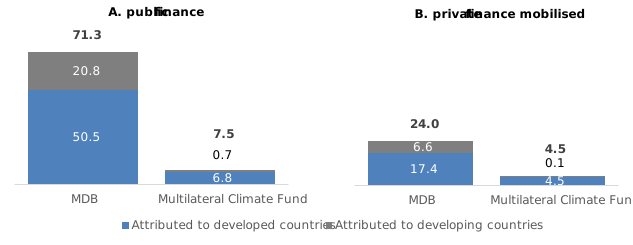
Note: “Developed” and “developing” countries reflects the list of countries used for the rest of the analysis presented in this report.
Source: Based on OECD DAC statistics and attribution percentages as detailed in Table 8.
Based on multiple years and successive rounds of research, stakeholder consultations, surveys, methodological developments, and implementation, the OECD DAC, through its Working Party on Development Finance Statistics (WP-STAT) has developed an international standard for measuring the amounts mobilised from the private sector by bilateral and multilateral official development finance interventions, including for activities contributing to climate change mitigation and adaptation. The standard was fully implemented in the regular CRS data collection as of 2017, covering the main mechanisms used by development finance providers to mobilise private finance, as summarised in Table 9. Since 2024 (starting with reporting on 2023 activities), mobilisation through certain technical assistance activities is also reportable, provided that these activities meet the causality criteria set out in the DAC Reporting Directives (OECD, 2024[14])).
Multiple official financiers are often in the same project or vehicle together with the private sector. To avoid double-counting when measuring private finance mobilised at the international level, the DAC methodologies request each official reporting entity amounts to only account for its attributed share following an instrument-specific approach to reflect the role (e.g. arranger of syndications) and position (e.g. investment seniority) played by each official actor. In addition, the mobilisation methods are designed to consider the participation and role played by all official actors involved, including both international and domestic public agencies, e.g. national development banks.
In line with the increased role and importance of private finance mobilisation to address the SDG and climate financing gap, the WP-STAT’s mandate includes continued work to enhance the measurement and reporting on mobilisation in DAC statistics. Building on consultations with members, bilateral development finance institutions and MDBs, a range of opportunities are being explored. These include a more systematic alignment of the definition of mobilised private finance with the OECD DAC Blended Finance Principles (OECD, 2018[15]), the expansion of the methodology for shares in collective investment vehicles’ to capture second-level flows mobilised and the revision of the guidance related to technical assistance to further clarify the delineation between the measure of private finance mobilisation from analyses of catalytic interventions conducted with the intent to create an enabling environment conducive to private investment (See Box 2).
Under the Paris Agreement Enhanced Transparency Framework, as part of reporting on climate finance provided and mobilised, developed countries shall (and other Parties should) report information on finance mobilised by public interventions. For OECD DAC members, ensuring maximum coherence with data reported on private finance mobilised to the OECD DAC would contribute to minimise discrepancies and burden across reporting streams.
Investment and financing decisions by private entities is influenced by a combination of public finance and policy interventions, in the context of broader policy environments and enabling conditions. The effects of these numerous factors differ, as can be illustrated when conducting sector-specific analyses (Haščič et al., 2015[16]) or country-specific case studies (McNicoll et al., 2017[17]). While some mobilise private finance at the transaction level by improving the risk-return profile of specific activities at a given point in time, others help improve the readiness of private sector actors to invest in a country, sector, or technology over time. Development finance interventions by bilateral and multilateral providers, depending on their type, can fall within either category.
In this context, alongside established efforts to measure private finance mobilised by official development finance, the international development finance community increasingly seeks to better understand the role of its interventions in enabling private investment more indirectly and over longer time horizons. The effects of such catalytic interventions, often upstream, policy‑based or demonstration‑oriented, are only partly captured by existing mobilisation metrics. The OECD DAC and MDBs have notably undertaken joint exploratory work to clarify and help structure the concept of private finance catalysation, while safeguarding the credibility of development finance statistics.
Through an MDB–OECD DAC Working Group on Mobilisation, convergence has been achieved on a shared definition of private finance catalysation, clearly distinguished from transaction‑level mobilisation. Catalysation is understood as the indirect and downstream private investments enabled by public interventions, generally within a maximum period of three years after the completion of a project (in some cases, e.g. for projects in nascent or frontier markets, the catalytic effects may however take longer to materialise). Catalytic activities are conducted by official development actors with the intent to create an enabling environment conducive to private investment. Such activities involve more complex causal chains and timing between the public intervention and private investments.
This work led to the development of an MDB-OECD DAC harmonised taxonomy of catalytic interventions, which distinguishes advisory and policy‑based interventions (funded and unfunded; macro and micro) on the one hand, and investment‑based catalytic pathways (associated, connected, demonstration and secondary effects) on the other hand.
In line with OECD DAC members’ guidance, work on private finance catalysed is separate and complementary to the measurement of private finance mobilised. Current efforts focus on qualitative assessments rather than monetary quantification and place strong emphasis on evidence‑building through case studies illustrating how catalytic intent and mechanisms operate in practice. Possible next steps include a voluntary taxonomy‑based tracking of catalytic interventions in DAC reporting, further joint analytical work and case studies, as well as a time‑bound and voluntary joint MDB-OECD pilot on Catalysation to explore methodological approaches for learning purposes. These next steps would involve strong safeguards and have no implications for existing official statistics.
Source: (OECD, 2024[14])