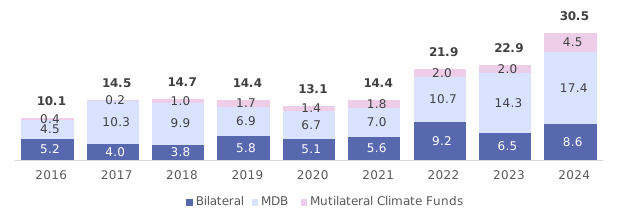
The 2021 Glasgow Climate Pact urged developed countries to at least double their collective provision of adaptation finance to developing countries from 2019 levels by 2025. Work under the UNFCCC Standing Committee on Finance (UNFCCC SCF) addressed issues relating to the baseline, methods and available evidence up to 2020 (UNFCCC SCF, 2023[4]). The outcomes of the first Global Stocktake of the Paris Agreement reiterated this urging (UNFCCC, 2023[5]). More recently, the outcome of COP30 called for efforts to at least triple adaptation finance by 2035 in the context of the New Collective Quantified Goal on Climate Finance.
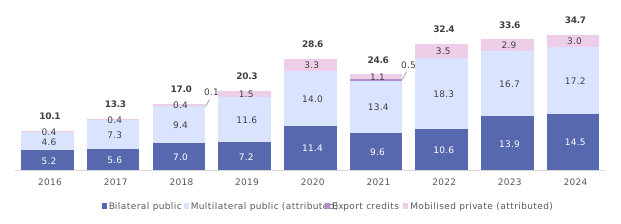
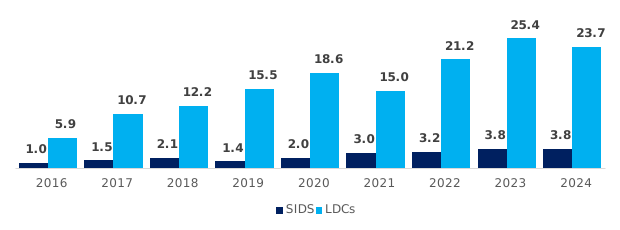
The amount of adaptation finance tracked by the OECD in 2019 based on data reported by bilateral and multilateral providers was USD 18.8 billion. If OECD public finance figures are taken as the baseline, adaptation finance would need to increase by a further USD 5.8 billion (18%) in 2025 to meet the doubling of the goal. In addition, between 2019 and 2024, adaptation finance mobilised from the private sector doubled, from USD 1.5 billion to USD 3 billion, despite some year-to-year fluctuations over the period.
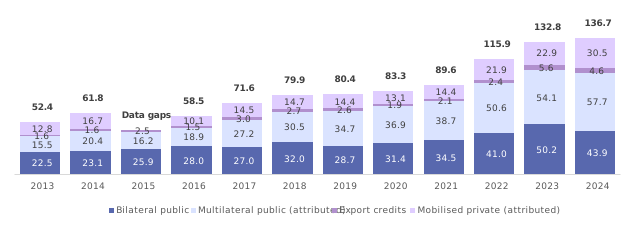
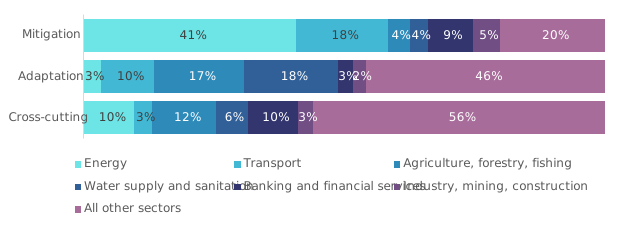
Year-on-year variations in aggregate amounts, as well as in the thematic distribution of climate finance, may be influenced by both large individual projects (notably infrastructure) and adjustments in the methodologies used by providers to determine climate-specific amounts (percentage or component of a total project value reported as climate finance). The marked increase in total climate finance provided and mobilised in 2023 was in part due to a limited number of large-scale projects, which also influence the distribution across climate themes. Furthermore, 2023 and 2024 bilateral climate finance data was unavailable for one provider and thus had to be estimated on the basis of best available evidence (see the Data sources section of the Data and methods chapter). Such estimates may also influence the thematic split.
There are in practice a range of challenges and opportunities to scale up adaptation finance in developing countries. Challenges can relate to economic and financial constraints, technical and knowledge-based limitations, institutional capacity and fragmentation. Potential action areas for international providers include targeted support to strengthen developing countries’ capacities and enabling environments for adaptation finance, improvements in the delivery of finance for adaptation, further deployment of blended finance instruments to mobilise private finance for adaptation, and tapping into alternative financing sources (OECD, 2023[6]).
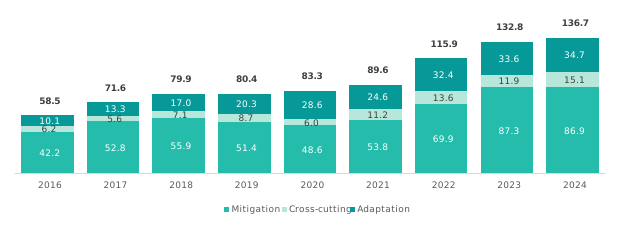
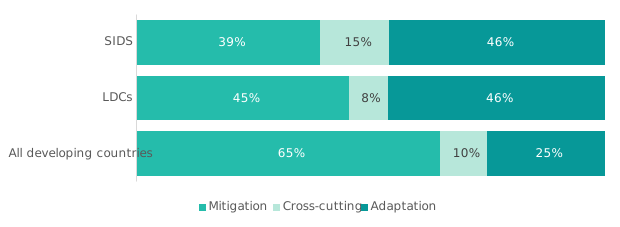
In terms of the overall thematic composition of total climate finance provided and mobilised by developed countries (Figure 3), the share of adaptation previously increased, from 17% in 2016 to a peak of 34% in 2020 and was around 25% in both 2023 and 2024. Mitigation finance continues to represent the large majority of total climate finance, accounting for nearly two-thirds of the total. In 2023, mitigation finance reached USD 87.3 billion, growing by USD 17.4 billion compared to 2022, after a similarly strong increase between 2021 and 2022. In 2024, volumes plateaued at USD 86.9 billion. Meanwhile, cross-cutting activities that address both mitigation and adaptation increased from USD 11.9 billion in 2023 to USD 15.1 billion in 2024. The share of cross-cutting activities fluctuated over the observed period within a relatively stable range of 7% to 13%.