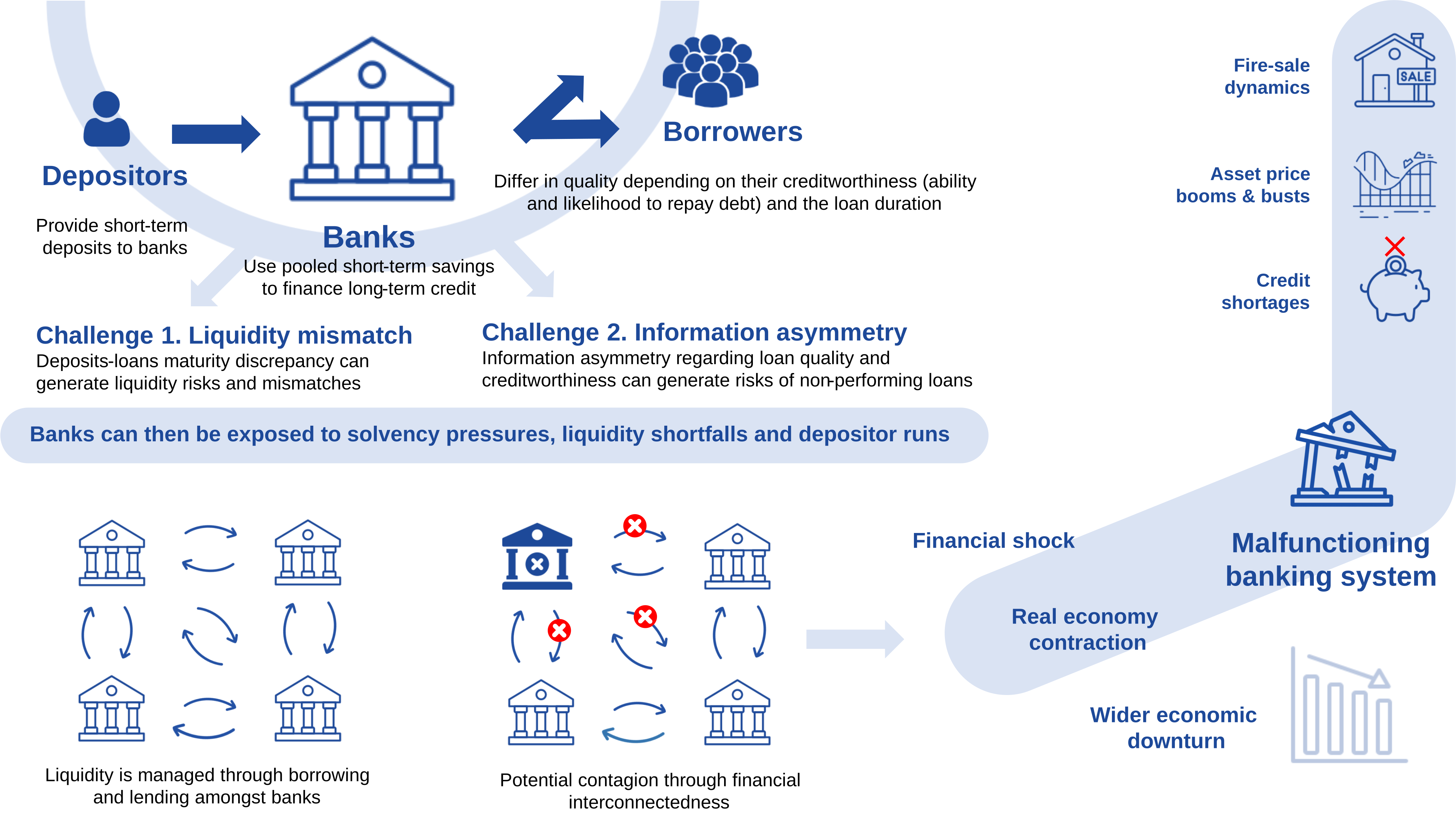
Competition in the banking sector can fuel efficiency, quality and innovation. It determines how widely and affordably households and firms can access deposits and credit: services that underpin investment, consumption and long-term growth for the economy (OECD, 2011[2]; de Serres et al., 2006[13]). Where competition is weak, consumers face higher prices, lower quality and fewer choices (OECD, 2011[2]). Prudential regulation and competition policy can be complementary, but they are not substitutes; each achieves outcomes that the other cannot (Vives, 2025[14]). When pursued together and balanced, they can reinforce productivity and resilience. The following discussion, though not exhaustive, highlights certain complementarities.
First, historically intense competition was perceived as a potential risk factor for stability (Vives, 2016[4]). The concern was that excessive competition could erode margins, reduce franchise value and lead banks to take on excessive risk, undermining depositor trust and sparking runs. It was also thought to worsen co-ordination problems and increase systemic risk (Cœuré, 2025[15]). For decades, these concerns shaped regulatory approaches, leading to exemptions, limited enforcement, or sector-specific regimes that constrained the application of competition law in banking.
However, evidence suggests that competition can support stability when coupled with appropriate prudential safeguards (Vives, 2016[4]). For example, Schaeck et al. (2009[16]) show, using data from forty-five countries, that competition reduces the likelihood of a crisis and that the time between crises is longer in a more competitive environment. Other studies confirm that competition can enhance systemic stability and that a more competitive market can go hand in hand with a lower level of bank risk (Shehzad and de Haan, 2009[17]; Anginer et al., 2019[18]; Kick and Prieto, 2013[19]). Additional studies conclude that competition in the loan market may reduce risks in banks’ portfolios by influencing borrowers’ risk-taking behaviour (OECD, 2017[3]).5 For borrowers, less competition in banking means higher loan rates, lower profits and increased risk-seeking behaviour. Evidence shows that, as a result, increased competition in loan markets can lower the risk of bank failure by reducing borrowers’ default risk. Studies also examine how competition may increase the cost of bankruptcy and thus act as a disincentive to risk-taking (OECD, 2017[3]; Boyd and De Nicolo, 2003[20]). Generally, empirical and policy evidence suggest that competitive banking markets can support efficiency and strengthen financial stability (OECD, 2011[2]; Vives, 2016[4]; BCA, 2023[21]).
Well-calibrated prudential rules can reinforce the benefits of competition by promoting contestability and enabling exit, while preserving resilience in deposit and lending markets. This shift in perception reflects cross-country research and post-crisis reforms showing that competition and stability can be complementary (OECD, 2017[3]; Vives, 2016[4]). It also underscores the recognition that a lack of competition can pose prudential risks, for example, by entrenching institutions whose failure would have severe systemic consequences (Inderst, 2013[22]). Competition enforcement can thus play a crucial role in strengthening prudential objectives by ensuring a level playing field, preventing anticompetitive effects from materialising.
Second, competition can help amplify the effectiveness of prudential regulation and vice versa. Competition can fuel better-quality institutions, improve monitoring and reporting incentives and reduce the scope for excessive risk-taking (OECD, 2017[3]). That is, competition improves the monitoring incentives of better-quality banks (Carletti and Vives, 2008[23]). When banks differ in the underlying riskiness of their operations, stronger competition tends to discourage additional risk-taking by already prudent institutions (Inderst, 2013[22]).6 Prudential rules that enforce sound risk management and reporting obligations enable well-managed banks and reduce information asymmetries for depositors. Well-regulated markets build trust, which in turn enables competition. In this sense, competition provides a strong foundation for successful policy implementation.
Third, effective competition can help reduce the systemic importance of inefficient banks. The benefits of competitive pressure are manifold. Contestability and the threat of entry may not only discipline incumbents to manage risks more effectively but also spur efficiency and innovation. Diversity also reduces the reliance on a few systemically important firms. More contestable and less concentrated markets can ensure that the failure of one institution poses less systemic risk. In turn, large banks may tend to be more interdependent, increasing systemic risk (Laeven, Ratnovski and Tong, 2014[24]). Higher concentration can be associated with greater potential for financial instability due to the cost of credit, diversification and the ease of monitoring (Calice and Leonida, 2018[25]). Where the market is both concentrated and firms are interdependent or interconnected, acting as counterparties to each other, should one such firm fail, the financial viability of all of its counterparties is called into question (OECD, 2011[26]).
Moreover, too-big-to-fail (TBTF) institutions face moral hazard or distorted incentives: they may take excessive risks, expecting bailouts or benefit from implicit guarantees that lower their funding costs. This can undermine both stability and competition. Prudential and competition authorities thus share an interest in addressing moral hazard and limiting TBTF distortions.7 While limiting moral hazard is typically the role of prudential regulators, competition can help limit the emergence of TBTF institutions and, where they exist, subject them to competitive pressure, taming distorted incentives (OECD, 2017[10]).
Fourth, competition can facilitate the exit of inefficient banks. Without it, weak institutions may persist, draining resources and increasing the risk of contagion. In turn, poorly designed prudential policies may inadvertently prop up failing institutions. As addressed in Section 3.1.2, post-crisis resolution regimes can be designed to facilitate a “safe” exit while minimising systemic fallout. This represents growing convergence between prudential and competition authorities: both recognise that shielding inefficient institutions may undermine stability and distort competition (Cœuré, 2025[15]).
Fifth, competition and effective prudential oversight can encourage banks to take on more diversified risks, making the banking system less fragile to shocks (Anginer, Demirguc-Kunt and Zhu, 2014[27]). Competition can reduce co-ordination risks that may undermine both market outcomes and prudential objectives. Such risks, like in other sectors, arise when relatively homogeneous products and concentrated market structures enable market participants to anticipate and align their behaviour. In deposit and lending markets, similar pricing frameworks and product designs enable banks to monitor rivals’ actions, even when consumers perceive offers as heterogeneous due to complex terms and conditions. This asymmetry: transparency among banks but opacity for consumers, weakens rivalry, facilitates co-ordination and harms both consumers and financial stability (BCA, 2023[21]). Competitive pressure helps counteract these tendencies by fostering greater strategic differentiation, innovation and diversity of risk exposures.8 In this way, competition can support prudential objectives by reducing the likelihood that parallel decisions or common shocks translate into systemic fragility (Anginer and Demirguc-Kunt, 2014[28]).
Section 3.2 highlights certain concrete examples of how competition policy and enforcement may advance stability objectives. For example, competition can help reduce interest rate spreads: the gap between what banks charge on loans and pay on deposits. Protecting rivalry between lenders can lower borrowing costs and help reduce borrower defaults, decreasing systemic risk (OECD, 2017[3]). In sum, competition drives efficient financial intermediation, supporting growth and innovation across the wider economy (Siciliani et al., 2023[29]).
Taken together, these complementarities illustrate that prudential regulation and competition policy, when designed with an awareness of their interaction, can be complementary. However, this alignment is not automatic. Measures that enhance stability may sometimes constrain rivalry and vice versa. The next section examines these areas of possible tension and the trade-offs they present for policymakers.