A critical requirement for deploying AI systems is to ensure end‑to‑end digitalisation across the entire supply chain, involving all relevant actors. In this context, the enabling environment for AI in trade facilitation is critical and requires a set of mutually reinforcing conditions across the digital, regulatory, and policy landscape. Since AI systems depend on reliable digital inputs and seamless data flows, economies need an ecosystem that supports the availability of digital services, the legal certainty of electronic transactions, and the consistent digitalisation of border procedures. At the same time, AI adoption relies on the ability to move data securely across borders, supported by interoperable systems and trusted governance frameworks. International co‑operation is equally essential to prevent fragmentation, align standards, and ensure that digital infrastructure and data practices remain compatible across jurisdictions. These elements form altogether the foundation that allows AI to be deployed effectively and to realise its potential in strengthening and modernising trade facilitation.
Strengthening Supply Chains through Efficiency, Resilience, AI and Environmental Performance

Access to AI capabilities is increasingly taking place through cross-border delivery of AI services, including access to models, inference capacity, and managed AI platforms, which rely on cloud computing and high-capacity digital infrastructure. Therefore, the adoption and diffusion of AI technologies at the border and along global supply chains depend critically on the openness of the digital services sectors that support them, in particular computer (encompassing software development, data processing, and database management) and telecommunication services (internet connectivity required for AI systems). The OECD Services Trade Restrictiveness Index (STRI) 2025 data highlights that these sectors continue to face significant barriers, which can hinder the broader deployment of AI solutions. The average STRI for the computer services sector (across 51 countries) has increased by 4.1% from 2014 to 2025, while the STRI for the telecommunications sector has increased by 1.2% over the same period (Figure 3.1).
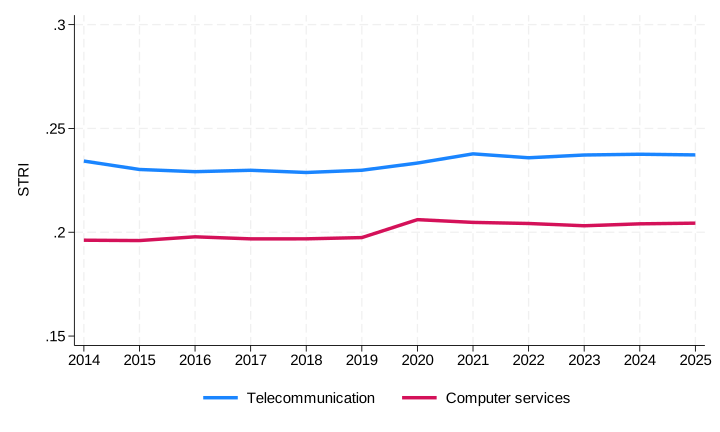
Note: The OECD Services Trade Restrictiveness Index (STRI) takes values between 0 and 1, with 1 being the highest level of restrictiveness. The figure includes data for 51 economies.
Source: OECD STRI database, 2026.
AI systems for trade facilitation require a supportive regulatory environment for digital transactions. AI tools do not exist as stand‑alone applications but are built on underlying e‑transaction and e‑payment systems, which enable AI to process digital transaction records, including payment confirmation and verification. The OECD Digital STRI highlights that, at the global level, while regulatory frameworks for e‑transactions are becoming more supportive, barriers affecting electronic payments are increasing, offsetting some of the efficiency and resilience gains that AI can deliver (Figure 3.2 and Figure 3.3).
Digital Services Trade Restrictiveness Index (STRI) in electronic transactions
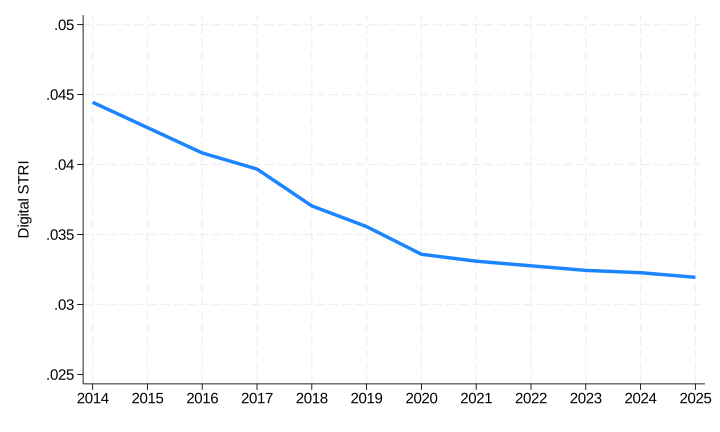
Note: The OECD Digital STRI takes values between 0 and 1, with 1 being the highest level of restrictiveness. The figure includes data for 129 economies.
Source: OECD Digital STRI database, 2026.
Digital Services Trade Restrictiveness Index (STRI) in electronic payments
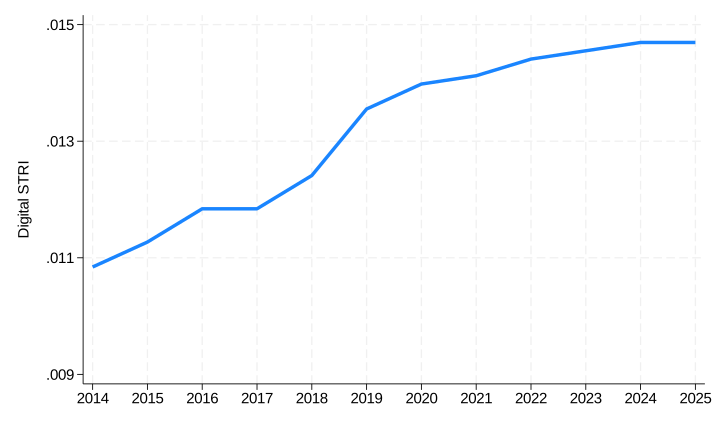
Note: The OECD Digital STRI takes values between 0 and 1, with 1 being the highest level of restrictiveness. The figure includes data for 129 economies.
Source: OECD Digital STRI Database, 2026.
The automation of border processes predates the recent wave of advanced AI technologies and has traditionally been one of the most challenging are of trade facilitation (Figure 3.4). Improvements in automation have been driven by the gradual introduction of tools such as automated pre-arrival processing, automated risk management, electronic payments of duties and charges, and digital Single Windows for trade (OECD, 2025[14]).
A key reason for this is that automation is difficult to implement without prior simplification of documentary requirements and streamlining of processes. While countries have made progress in simplifying documentation through alignment with international standards and documentary requirements reviews (Figure 3.4), the benefit is yet to fully translate into equivalent gains in automation. Where traditional automation has not been able to advance, gains from the deployment of AI tools will be hard to materialise.
Progress in streamlining border processes has also decelerated in recent years. This largely reflects challenges in the operational implementation of tools such as Authorised Operators (AOs), post-clearance audits and Single Windows, as well as the still low coverage in practice of transactions by pre-arrival processing and simplification of release from clearance.
2 = maximum performance that can be achieved by area, 2012‑24

Note: The figure shows the global average by area between 2012 and 2024.
Source: OECD Trade Facilitation Indicators (TFIs) database, 2025 (https://sim.oecd.org/default.ashx?ds=TFI).
Domestic and cross-border agency co-operation are the top areas of progress, yet remain the hardest to further improve (Figure 3.4). Economies worldwide scaled up investments in domestic border agency co‑operation since the COVID‑19 pandemic, when flexible arrangements helped adapt border processes and facilitate trade in selected goods. Ongoing supply chain disruptions and shifting trade patterns have increased the need to formalise previously informal or sector-specific taskforces. This is reflected, first, in stronger institutional mechanisms for domestic inter-agency co-ordination, including the establishment of permanent technical secretariats, the expansion of participating agencies, and more regular meetings to set strategy and oversee implementation, with proceedings increasingly made public (though with varying levels of detail). Second, regulatory frameworks have advanced to enable a wider set of agencies to delegate controls to another authority involved in cross-border management, particularly Customs, and to facilitate intelligence sharing to improve risk management efficiency and support certified trader programmes (Authorised Operators, AOs). In parallel, cross-border agency co-operation is increasingly driven by strengthened co-ordination mechanisms between Customs administrations, including initiatives to align data requirements and improve interoperability between IT systems (OECD, 2025[18]) (Figure 3.5).

Note: The size of the individual squares highlights the contribution of the showcased measures to the improvement in the areas of domestic and cross-border agency co-operation, respectively.
Source: OECD Trade Facilitation Indicators (TFIs) database, 2025 (https://sim.oecd.org/default.ashx?ds=TFI).
The use of AI in optimising supply chains is also closely linked to the digital exchange of trade‑related documents and the digitalisation of processes. The Digital STRI data shows that restrictions affecting interconnection and connectivity have remained high over time (Figure 3.6). These barriers to cross‑border data flows can add challenges to maximising the potential of AI tools deployed for trade facilitation along supply chains.
Digital Services Trade Restrictiveness Index (STRI) in infrastructure and connectivity
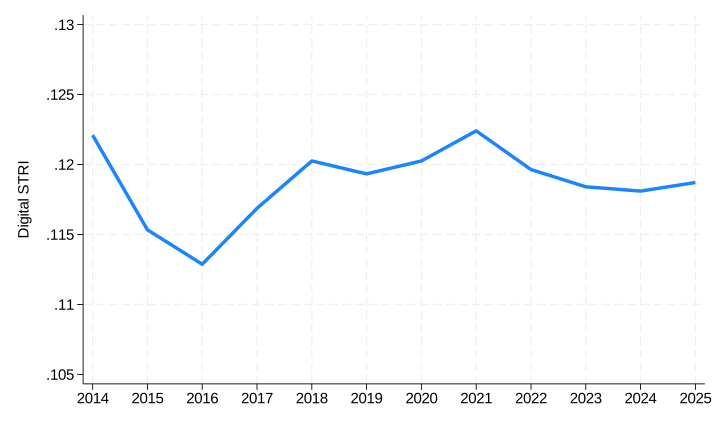
Note: The OECD Digital STRI takes values between 0 and 1, with 1 being the highest level of restrictiveness. The figure includes data for 129 economies.
Source: OECD Digital STRI database, 2026.
Fragmented approaches to AI governance across countries can hinder AI adoption and diffusion. International discussions are therefore critical for bridging gaps in AI policy frameworks and for ensuring that domestic AI policies do not become unnecessary barriers to trade. Aligning standards and domestic policy frameworks around trustworthy AI can help create a more predictable global trade policy environment (Ferencz, López González and Oliván García, 2022[4]).
As global discussions on digital trade have expanded rapidly in recent years, there is particularly strong momentum in international dialogue on AI, through both trade agreements and non‑trade instruments (Figure 3.7). The cumulative number of trade agreements, including bilateral and regional trade agreements with AI‑related provisions has increased from zero to 14 over the past six years. The OECD Index of Digital Trade Integration Openness (INDIGO), which monitors digital trade policies and openness, additionally captures the growing intensity of international co‑operation on AI, signalling that governments are increasingly engaging in trade agreements and multilateral fora to foster interoperable AI frameworks (OECD, 2025[19]).
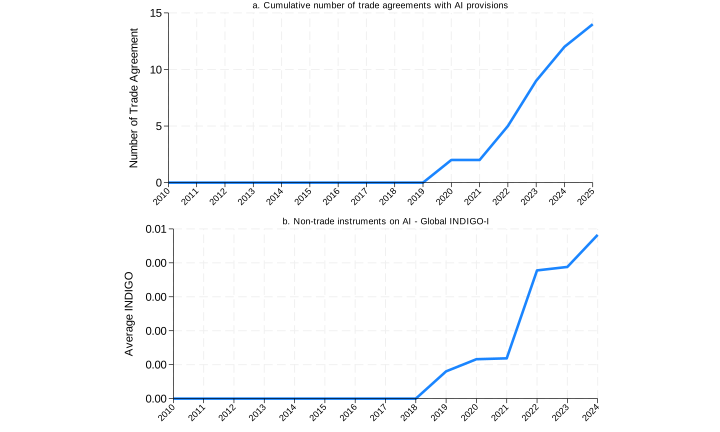
Note: The method underlying OECD Index of Digital Trade Integration and Openness (INDIGO) is described in (OECD, 2025[19]). For any given year, a country will score full points, 1, in its INDIGO if it has fully binding agreements or hard commitments across all areas in “enabling e‑commerce” with all partner countries. It will score zero if it has no agreement with any country. This bilateral method of aggregation enables capturing both the depth and the spread of digital trade discussions.
Source: Cumulative number of trade agreements with AI provisions is from (Burri, Callo-Müller and Kugler, 2025[20]). Data on non‑trade instruments on AI (Global INDIGO‑i) is from OECD INDIGO Database.
The case of Korea Customs Service (KCS) shows how digital tools, data standardisation, and interoperable border systems can enable rapid, integrated deployment of AI applications and resilient supply chains – from X‑ray threat detection to automated document linking and predictive risk analysis. Korea’s experience illustrates that AI effectiveness depends on the strength of the underlying digital ecosystem and the interoperability of systems across agencies.
KCS’ efforts towards digitalisation and AI adoption show how effective digital ecosystem can enable the swift deployment of advanced AI technologies at the border as well as behind- and beyond-the-border. Faced with a more than threefold increase in cross-border e-commerce transactions between 2015 and 2025,1 KCS transitioned to AI-driven customs procedure management. This shift is built on decades of digitalisation with its electronic clearance and trade systems at the centre.
Applications of AI technologies across various stages of the trade process not only promote the efficiency of cross‑border goods movement but also enhance resilience across global supply chains.
Korea Customs uses AI‑driven risk profiling and tax‑compliance risk modelling to more accurately identify high‑risk cargo, passengers, and traders across the clearance process.
AI X‑ray screening, import price and transshipment route analysis strengthens inspection accuracy and efficiency, helping detect illicit goods, undervaluation and abnormal logistics patterns.
Document and classification automation, including HS code prediction, certificate of origin authenticity checks, and linking unstructured documents and data reduces manual workload and improves consistency in procedures at the border.
Robotic Process Automation streamlines internal operations by automating repetitive tasks such as data extraction, trade statistics processing, and audit planning reporting.
AI‑driven intelligence tools, including company profiling, analysis of unusual trade patterns, and vessel route visualisation strengthen supply‑chain transparency and resilience.
These AI applications operate as integrated services within Korea’s trade facilitation ecosystem, rather than as isolated pilots, and part of KCS’s efforts towards end-to-end digitalised trade processes, encompassing the full range of actors and trade-related documents across the entire supply chain. Using the lens of the going paperless conceptual framework (see (OECD, 2025[14]) and (Figure 2.1)), KCS’ approach is summarised below, with Figure 3.8 illustrating where Korea’s policy efforts are positioned within this framework:
The adoption of enabling regulation: Korea has established a legal framework for going paperless, significantly lowering barriers to e‑transactions and cross‑border data exchange over the past decade. The Electronic Trade Facilitation Act standardises e-documents and operationalises the National Electronic Trade Platform. The Framework Act on Electronic Transactions and the Digital Signature Act complement this framework by providing the necessary legal certainty for electronic records and digital signatures (Koh, 2024[21]). Korea ranks among the top APEC economies in trade facilitation performance, particularly in the areas related to paperless trade environment (Figure 3.9) reflecting the strength of its enabling regulatory environment. Korea also has relatively low digital services restrictiveness in areas essential for going paperless among APEC regional peer economies, highlighting its readiness for the adoption of advanced digital and AI‑driven systems (Figure 3.10).
The digitisation of trade-related documents: uTradeHub (electronic trade platform that links trading companies with banks, logistics providers, and government agencies) facilitates the digital trade documents, including e-Letters of Credit and electronic Bills of Lading. E-Certificates of Origin and simplified export declarations specifically designed for e-commerce significantly reduced data entry burdens for businesses. The system also allows firms to handle negotiation documents electronically without visiting financial institutions. The KCS has also formalised a digital data sharing arrangement with private sector and domestic border agencies for supply chain risk management. These include collaboration with express carriers to report delivery destinations for information-sharing with market surveillance authorities to detect illicit goods.
The digitalisation of trade-related processes: The seamless integration of UNI-PASS and uTradeHub creates a comprehensive Single Window environment connecting regulatory agencies. To further streamline operations, the KCS deployed automation software to handle repetitive administrative tasks, such as trade statistics processing and overtime computations.
The adoption of digital technologies (other than AI): Blockchain technology is deployed for the Electronic Origin Data Exchange System for the electronic submission of Preferential Certificate of Origin and e-Declaration of Origin.
The standardisation of data elements: To ensure cross-border interoperability, the KCO adheres to global standards, including the World Customs Organization (WCO) Data Model and UN/LOCODE for location identification. Postal operators are required to use electronic versions of WCO/Universal Postal Union standard forms (CN 22 and CN 23) to enable pre-advice and efficient clearance. Additionally, the United Nations Centre for Trade Facilitation and Electronic Business (UN/CEFACT) modelling methodology has been adopted for supply chain data to ensure compatibility with foreign customs systems.

Source: based on (Korea Customs Service, 2025[22]) and (Koh, 2024[21]).
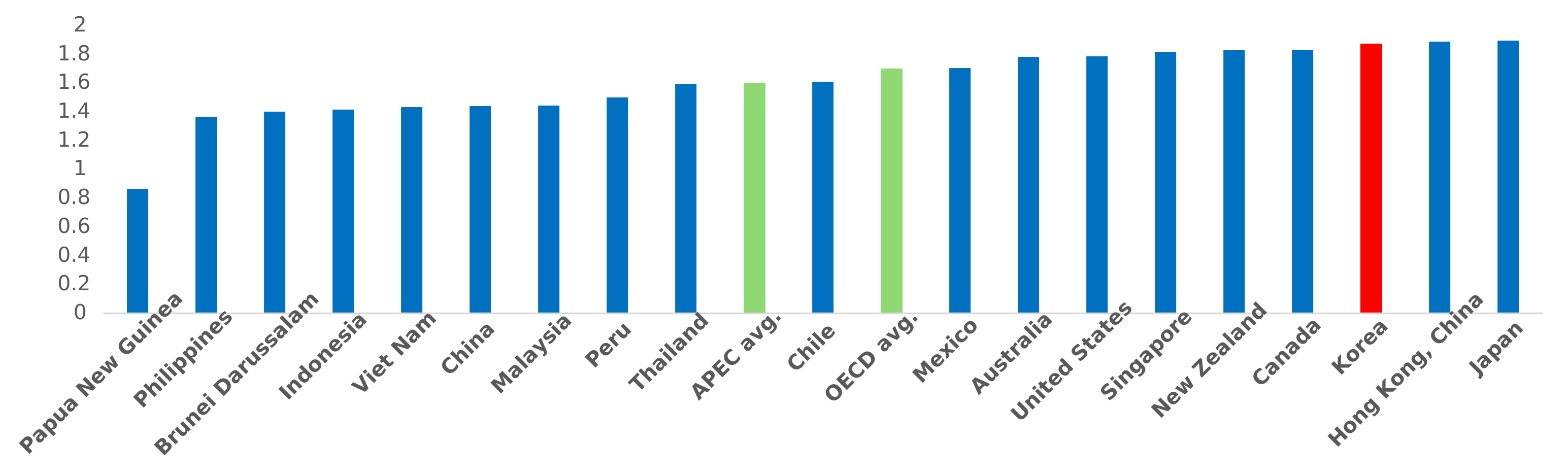
Note: This figure presents, for each APEC economy, the average of OECD Trade Facilitation Indicators (TFIs) scores across five areas: automation, documents, procedures, internal border agency co-operation and external border agency co-operation.
Source: OECD TFIs database, 2025.
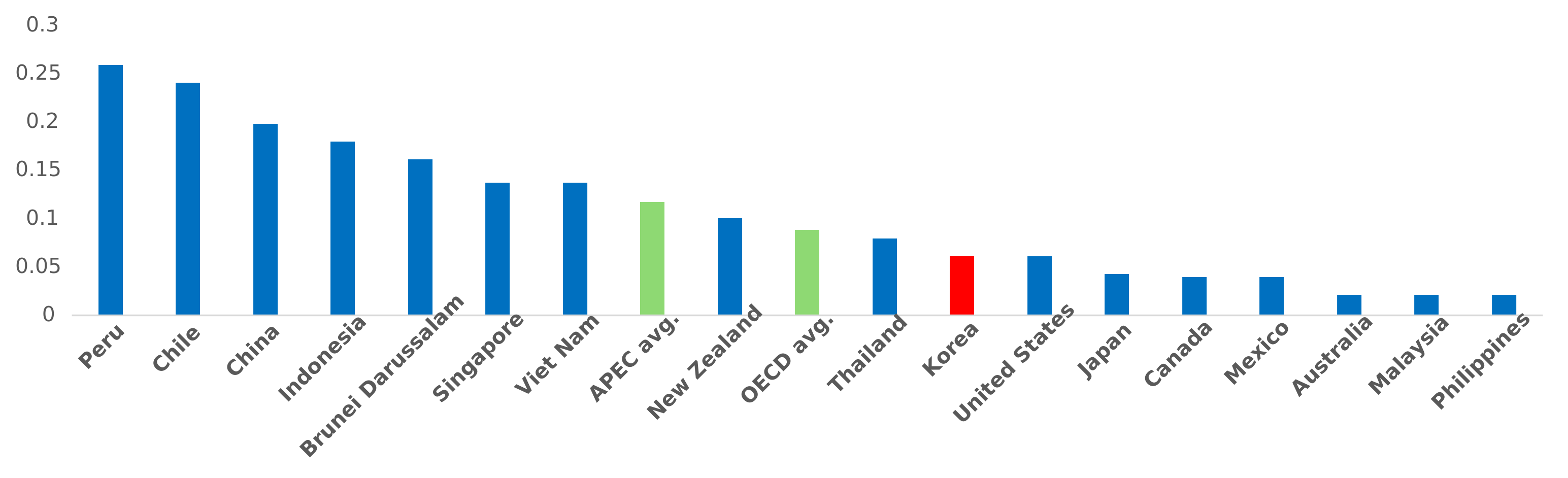
Note: This figure presents, for each country, the sum of digital services restrictiveness across three areas: (1) infrastructure, (2) electronic transactions, and (3) payment systems.
Source: OECD Digital Services Trade Restrictiveness Index (Digital STRI) Index, 2026.
Korea’s experience shows that digital and AI‑enabled customs reform is not just about improving border procedures but about strengthening the efficiency and resilience of entire supply chains with participation of various actors across multiple layers of key policy components. Such co‑ordination can help reduce delays, mitigate risks, and maintain supply chain resilience even under rapidly expanding trade volumes and external shocks.
← 1. The total cross‑border e‑commerce flow (imports and exports combined) reached USD 3.2 billion in 2025, which is 3.5 times larger than the USD 908 million recorded in 2015, reflecting an average annual growth rate of 9.7% (Authors’ calculation based on figures from the Korea Trade Statistics Service).