Non‑compete and related agreements: Germany
Table of contents
This country note summarises key findings on non-compete and related clauses for Germany, based on Chapter 5 of the OECD Employment Outlook 2026, which provides the first comparative analysis of their use, regulation, and links with wages and productivity across 15 OECD countries.
Job mobility is essential for efficiency and equity – enabling structural adjustment, better worker – firm matching, knowledge diffusion, and stronger worker bargaining power – but it is increasingly constrained by the expanded use of non-compete and related agreements across OECD countries. While some post-employment restraints legitimately protect trade secrets, client relationships, or training investments, growing evidence suggests they are often overused, limiting worker mobility, wage growth, and innovation. These restraints typically take two forms. First, long‑standing contractual non‑compete clauses in individual employment agreements, traditionally regulated to balance employer interests with workers’ occupational freedom. Second, firm‑to‑firm no‑poaching or wage‑fixing agreements – which restrict labour market competition through employer co‑ordination – are coming under increasing scrutiny from competition authorities in OECD economies.
This note highlights the main findings for Germany from the first cross‑country, employee‑ and employer‑level surveys of non‑compete and related clauses – see Box 1. The full analysis and policy discussion are presented in Chapter 5 of the OECD Employment Outlook 2026.
The OECD and Bocconi University jointly designed and implemented harmonised employee‑ and employer‑level surveys to assess the prevalence and characteristics of non‑compete and related clauses across 14 OECD countries (15 for the employer survey), building on methodologies used in comparable studies in the United States, Australia and Italy. Fielded by Ipsos in mid‑2025, the employee survey was conducted online (CAWI) and covered private‑sector workers aged 18‑64 using a representative general population sample complemented by a targeted boost sample of workers with non‑compete clauses, yielding nearly 32 000 responses (2 300 in Germany) and enabling both incidence measurement and in‑depth analysis of clause content. The employer survey was fielded by phone (CATI) and targeted contract‑ and HR‑responsible respondents in for‑profit firms with five or more employees, using stratified random sampling by firm size and sector and a mixed employee‑ and firm‑proportional allocation to ensure representativeness of both the workforce and the firm population, resulting in over 6 000 firm responses (408 in Germany) covering more than 1.4 million employees. The two surveys rely on independent sampling frames and are not linked at the firm level. Both surveys included pilot testing, post‑stratification weighting, and extensive quality controls, and while standard survey limitations apply, high internet coverage, neutral survey framing and very low drop‑out rates suggest that selection and response biases are limited.
Non-compete and related clauses are fairly common in Germany. According to employers, between 24% and 35% of private‑sector employees are currently bound by a non-compete clause compared to an average of 20% to 30% across the OECD countries covered by the survey (Figure 1, Panel A). Results from the employee survey confirm a high prevalence: 14% of workers report being bound by a non-compete clause, with an additional 20% who believe they “probably” are, compared to an average of 15% and 21% across the OECD countries covered by the survey (Figure 1, Panel B).

Note: Both employees and employers were offered graded response options (“definitely yes” / “probably yes” / “probably no” / “definitely no”) alongside a distinct “don’t know” category, allowing respondents to express uncertainty. Estimated incidence rates are similar across many countries, and differences between countries with comparable estimates fall well within the associated margins of error. As a result, the precise country ranking should not be interpreted as definitive. Nevertheless, meaningful cross‑country variation does emerge: using 95% confidence intervals, the estimated incidence in the top three countries is significantly higher than in the bottom three, indicating robust differences at the extremes of the distribution. For a detailed explanation of how the incidence rates are calculated, see Figure 5.4 in Chapter 5 of the OECD Employment Outlook 2026.
Source: OECD-Bocconi employer and employee surveys on non-compete and related clauses.
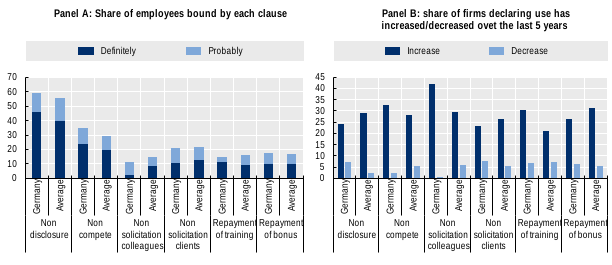
Beyond non-compete clauses, non-disclosure agreements (NDAs) are by far the most common form of restraint (Figure 2): employers report that 59% of private‑sector employees are covered by an NDA compared to an average of 55% across the countries covered by the survey. Other restrictive clauses are also relatively common: according to employers, 21% of employees are covered by a non-solicitation of clients clause (vs. 22% on average), 17% by a repayment of benefits or bonuses clause (vs. 17% on average), 11% by a non-solicitation of colleagues clause (vs. 15% on average), and 15% by a training-cost repayment clause (vs. 16% on average). Importantly, firms in Germany like in the other OECD countries report an upward trend: significantly more employers declare having increased than decreased the use of each type of clause over the past five years, suggesting growing reliance on contractual restrictions in German labour markets.
Source: OECD-Bocconi employer survey on non-compete and related clauses.
These clauses are often used in bundles and applied indiscriminately across the workforce: among firms using non-compete clauses, 45% apply them to all employees, regardless of role or seniority; for NDAs, the share rises to 57%.
To capture the stringency of national (and, where relevant, subnational) regulations governing non-compete clauses, the OECD developed a policy index that measures: i) the regulatory framework (who regulates non-compete clauses – the law, courts, or collective agreements – and what is regulated); ii) the terms of exchange (e.g. any compensation requirements for signing non-compete clauses); and iii) the procedural requirements, judicial modification powers, validity after dismissal and sanctions for overly broad agreements. Each dimension is scored and weighted, with higher overall values indicating a more employer-friendly regime in which non-compete clauses are more likely to be upheld.
Among OECD countries, Germany is among those with a relatively more stringent regulation of non-compete clauses, as illustrated in Figure 3. The regulation is grounded in statutory law, principally the German Commercial Code (HGB), which establishes a strict reasonableness test within legislatively defined boundaries; collective agreements do not play a meaningful role. Non-compete clauses must protect legitimate business interests and require mandatory compensation of at least 50% of the employee’s last contractual benefits. Courts may treat clauses as only partially non-binding where, for example, the permissible maximum duration is exceeded. Where dismissal occurs without notice, the clause becomes unenforceable if the terminating party declares within one month that they wish to be released from it; similarly, employees may be released following ordinary termination by the employer under the relevant statutory provisions. Employers face no sanctions for including unenforceable clauses.
Higher values indicate that non‑compete clauses are more likely to be upheld in court (i.e. a regime more favourable to companies)
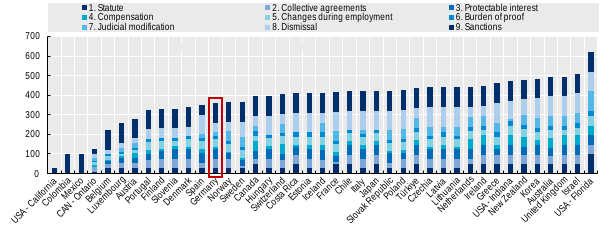
Note: The index measures the restrictiveness of non-compete clause regulations on a 0‑700 scale, where higher scores indicate more employer-friendly (less restrictive) environments. The OECD index scores nine legal dimensions: (1) Statutory regulation (whether legislation governs non‑compete clauses and, if so, the maximum duration, and geographic and sectoral scope) with weight 10; (2) Collective agreements (whether sectoral or firm‑level CBAs add limits or conditions beyond law) with weight 5; (3) Employer’s protectable interest (how broadly “legitimate interests” are defined) with weight 10; (4) Compensation (if monetary compensation is required and any minimum threshold) with weight 5; (5) Changes during employment (whether a new clause after hiring needs fresh consideration) with weight 5; (6) Burden of proof (the elements that an employer needs to bring an employee to court) with weight 5; (7) Judicial modification, also called “blue pencilling” (courts’ power to narrow overbroad clauses) with weight 10; (8) Dismissal (if the clause can be used even in the case of dismissal) with weight 10; (9) Sanctions (whether employers face penalties for using invalid clauses) with weight 10. The score for Canada excludes the province of Ontario which is evaluated separately.
Source: Andrews et al. (2026), The regulation of non-compete clauses across OECD countries”, OECD Social, Employment and Migration Working Papers No. 332, https://doi.org/10.1787/88e3eb6e-en.
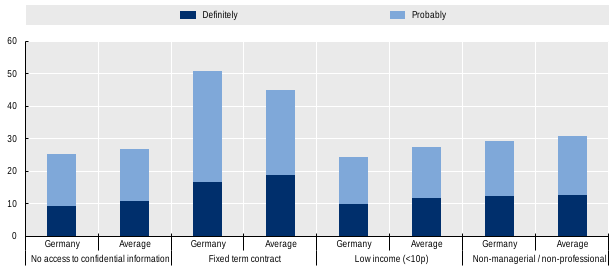
In line with the original intent, the prevalence of non-compete clauses is highest among managers and professionals, increases with earnings and access to confidential information, and appears more frequently in large firms and knowledge‑intensive sectors. However, the surveys show that in Germany as in several other OECD countries, non-compete clauses have spread into parts of the labour market where the traditional justification – protecting sensitive information or high-value investments – appears weak or absent. In particular, Figure 4 shows that:
Between 9% and 25% of workers with no access to confidential information nonetheless declare having signed a non-compete clause (between 11% and 27% on average in the other countries covered by the survey).
Between 17% and 51% of workers on fixed-term contracts report a non-compete clause (between 19% and 45% on average in the other countries covered by the survey).
Between 10% and 24% of low-pay workers (earning less than EUR 2 500 per month, broadly the bottom 10% of the labour income distribution) are covered (between 12% and 27% on average in the other countries covered by the survey).
Between 12% and 29% of workers in non-managerial/non-professional occupations report being bound by a non-compete clause (between 13% and 31% on average in the other countries covered by the survey).
Share of employees bound by non-compete clauses, by type of employee
Source: OECD-Bocconi employee surveys on non-compete and related clauses.
A further concern is the prevalence of clauses that appear unenforceable under German law, which requires non-compete clauses to specify duration (up to 2 years), pay a compensation of at least 50% of the salary and specify the sectoral or geographical scope to be upheld in court. Figure 5 shows that many clauses may not fulfil these legal requirements: both employers and employees indicate that a sizeable share of non-compete clauses do not specify a duration, compensation, or fail to define geographical or sectoral scope.
International evidence places these findings in context: in the United States, non-compete clauses are common even in states where they are formally banned. What shapes behaviour is often not actual enforceability but workers’ perceptions about the likelihood of enforcement – the so-called “in terrorem” or chilling effect. Consistently, the survey finds that, across the countries included in the survey, the share of employees who report they would not violate a non-compete clause is high (over 40%) even among those covered by a clause that is unlikely to be upheld in court, while employees with potentially valid clauses are much more likely to report having been prevented from moving to another job.
Share of non-compete clauses unlikely to fulfil country-specific requirements to be upheld in court
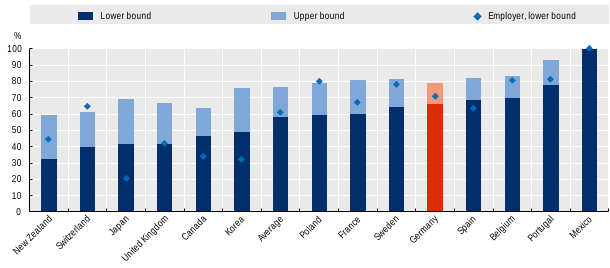
Note: For the employee survey, lower/upper bound differ in how an employee saying “don’t know” or “prefer not to answer” on questions on the duration/compensation/scope is considered. For the lower bound, answering “don’t know” or “prefer not to answer” does not make the clause invalid, while it does for the upper bound. For employers, the figures reflect lower bound estimates, classifying all clauses used by a firm as likely to be upheld by courts if the firm “sometimes” includes the required conditions. These estimates should be interpreted with caution: not only may employees not fully recall the precise terms of the non-compete clauses they have signed, but also the scope for such measurement error is likely to be correlated with the complexity of the legal framework. Therefore, cross-country differences in the share of apparently non-compliant clauses also reflect differences in regulatory complexity as well as reporting noise.
Source: OECD-Bocconi employee and employer surveys on non-compete and related clauses.
The survey evidence also raises concerns about the potential presence of firm-to-firm no-poaching and wage‑fixing agreements, which are generally illegal under competition law. No-poaching agreements involve employers agreeing not to recruit each other’s employees. Wage‑fixing agreements involve employers agreeing to set wages or other compensation at certain levels.
In light of the sensitive nature of these questions, the employer survey did not ask firms directly whether they engaged in these practices. Instead, respondents were asked whether they were aware of such practices in their industry. The results in Figure 6 suggest they may be more prevalent than expected: about 30% of surveyed firms report knowledge of either no-poaching, wage‑fixing, or both occurring within their industry compared to 47% on average across the surveyed countries. This does not imply that 30% of firms engage in these practices themselves, but high reported awareness suggests that such practices may not be isolated occurrences, particularly in service sectors.
These findings, while at this stage essentially suggestive, align with the increasing attention that the competition authorities around the world are devoting to labour market conduct.
Share of companies reporting knowledge of no-poaching or wage‑fixing agreements in their industry

Note: Responses to the questions “Are you aware of any companies in your industry entering into agreements not to hire each other’s employees?” (interviewer could specify “also known as no-poaching agreements”) and “Are you aware of any companies in your industry entering into agreements to fix employees’ salaries or other employment benefits?” (interviewer could specify “also known as wage-fixing agreements”).
Source: OECD-Bocconi employer survey on non-compete and related clauses.
Contact
Dan ANDREWS (✉ dan.andrews@oecd.org).
Andrea GARNERO (✉ andrea.garnero@oecd.org).
Sara HOLTTINEN (✉ sara.holttinen@oecd.org).
This work is issued under the responsibility of the Secretary-General of the OECD, and does not necessarily reflect the official views of OECD Member countries.
This document, as well as any data and map included herein, are without prejudice to the status of or sovereignty over any territory, to the delimitation of international frontiers and boundaries and to the name of any territory, city or area.
The statistical data for Israel are supplied by and under the responsibility of the relevant Israeli authorities. The use of such data by the OECD is without prejudice to the status of the Golan Heights, East Jerusalem and Israeli settlements in the West Bank under the terms of international law.
Revised version, October 2026. The following changes have been made: Sweden has been removed from Figure 6 due to a translation error in the questionnaire, which affected the results on wage fixing agreements.
© OECD 2026
 A grey and black sign with a person in a circle
Description automatically generated
Attribution 4.0 International (CC BY 4.0)
A grey and black sign with a person in a circle
Description automatically generated
Attribution 4.0 International (CC BY 4.0)
This work is made available under the Creative Commons Attribution 4.0 International licence. By using this work, you accept to be bound by the terms of this licence (https://creativecommons.org/licenses/by/4.0/).
Attribution – you must cite the work.
Translations – you must cite the original work, identify changes to the original and add the following text: In the event of any discrepancy between the original work and the translation, only the text of original work should be considered valid.
Adaptations – you must cite the original work and add the following text: This is an adaptation of an original work by the OECD. The opinions expressed and arguments employed in this adaptation should not be reported as representing the official views of the OECD or of its Member countries.
Third-party material – the licence does not apply to third-party material in the work. If using such material, you are responsible for obtaining permission from the third party and for any claims of infringement.
You must not use the OECD logo, visual identity or cover image without express permission or suggest the OECD endorses your use of the work.
Any dispute arising under this licence shall be settled by arbitration in accordance with the Permanent Court of Arbitration (PCA) Arbitration Rules 2012. The seat of arbitration shall be Paris (France). The number of arbitrators shall be one.