This Chapter examines cross-border worker flows in three EU border regions: Luxembourg and the bordering countries (Belgium, Germany and France), the Meuse-Rhine Region (Belgium, Germany and the Netherlands) and the Austria/Germany border region. These regions feature high cross-border mobility, a significant share of TCNs or posted workers, and well-developed governance structures and EURES (EURopean Employment Service) networks.
Mobility and Integrated Labour Markets for Third‑country Nationals in Greater Copenhagen

Abstract
In the EU, there are several types of cross-border workers. These include frontier workers or commuters (residing in border regions and regularly commuting) and posted workers (sent temporarily by their employer to work in another EU Member State). A further distinction can be made between mobile persons (temporarily or permanently moved for work) and cross-border commuters (who travel at least once a week).
The cross-border regions of Austria-Germany, the Meuse-Rhine Region and the Greater Region are among the EU’s most mobile. Approximately 1.9 million cross-border workers exist in the EU and the European Free Trade Association (EFTA), with the Meuse-Rhine Region (Belgium, Germany and the Netherlands) and the Greater Region (Belgium, Germany, France and Luxembourg) accounting for 23% and 8% of total EU cross-border flows. A smaller but also significant flow is seen between Austria and Germany.
Data indicate that TCN cross-border workers are limited in all three regions, despite rising labour and skills shortages. In Luxembourg, TCNs represent around 5% of cross-border commuters. However, data on TCNs in the Meuse-Rhine Region and the Austrian-German cross-border region is scarce, relying largely on input from consulted stakeholders. They suggest that TCNs cross-border commuting is limited in these regions.
A common challenge is that national and EU labour mobility schemes for TCNs are not designed for cross-border commuters. These schemes are generally designed for TCNs wishing to reside in a country for work, and hence, often tied to a residence permit. In some countries (e.g., the Netherlands, Germany, and Luxembourg), legislative changes allow for the issuance of work permits without an accompanying residence permit. Germany’s cross-border commuter card and the Netherland’s cross-border endorsement sticker are examples of procedures for verifying TCNs’ legal border crossing for work.
Despite recent changes, access to labour mobility schemes in most EU countries remains restricted to high-skilled workers. Many EU countries limit access to their labour markets to high-skilled workers or those in occupations facing shortages, such as through labour market tests. Countries like Germany and Luxembourg have recently expanded access for more TCNs, but national requirements still create barriers for TCNs wishing to work as cross-border commuters.
Even when TCNs are granted a work permit in a bordering country, their cross-border mobility can be restricted due to rules on residence permits. In theory, TCNs whose residence permit is not linked to their work permit can access cross-border commuting without risking their residence status. These include long-term residence permit holders, family members of EU citizens or TCNs and refugees or holders of international protection. However, even in these cases, there are differences in the rules applied across EU countries. Across all countries, TCN family members of EU cross-border workers are the only category of TCNs that can engage in cross-border work without applying for a work permit. This group derives the EU free movement rights and, consequently, the right to work from their family member.
EU Directives facilitate short-term intra-EU mobility but not cross-border commuting. For example, the EU Blue Card provides TCNs with some mobility rights (90 days within 180 days), but these options are limited to short-term relocations. The EU Single Permit Directive, which combines work and residence permits, assumes that TCNs will reside and work in one Member State, potentially limiting their access to labour markets in the second Member State.
While cross-border information points support workers in all three regions, their focus on TCN-specific rules is limited. These services generally provide valuable information and support for those wishing to cross the borders (see Chapter 5). However, they do not address how work and residence permit rules interact for TCNs seeking to become cross-border commuters. National and regional authorities provide information on permits, but identifying the responsible authorities and clarifying cross-border legislation remains a challenge.
Cross-border labour mobility is at the heart of EU integration, with approximately 1.9 million cross-border workers in the EU and European Free Trade Association (EFTA) (Hassan et al., 2024[1]). Every day, individuals exercise their right to free movement by working in another country than their country of residence. Around 87% of the cross-border workers have the nationality of their country of residence. The main destinations for cross-border workers include Austria, Belgium, Germany, Luxembourg, the Netherlands and Switzerland, which together accounted for around 80% of all incoming cross-border workers (Hassan et al., 2023[2]). The top five countries of origin are Belgium, Germany, France, Poland and Romania.
Cross-border workers in the EU fall into different categories. A distinction can be made between frontier workers or commuters (who live in border regions and regularly commute across the border) and posted workers (who are temporarily sent by employers to another EU Member State for work) (Hassan et al., 2024[1]). Mobile persons who have moved to another country for both work and residence differ from cross-border commuters, who maintain their primary residence in their home country and return regularly (at least once per week, according to the official EU definition). Third-country nationals (TCNs) represent a significant proportion of mobile workers. In 2020, around 10% of the EU labour market is made up of mobile persons, 62% of whom were TCNs (Hassan et al., 2024[1]).
EU cross-border regions with notable numbers of cross-border workers include the Greater Region, Upper Rhine and Alpine regions, Meuse-Rhine Regino, the Tri-border Region and the Centrope Region. These macro cross-border regions collectively account for around 70% of all cross-border flows in the EU. Smaller but also relevant flows can be observed between Sweden and Denmark, Austria and Germany, the Czech Republic and Germany, Slovakia and the Czech Republic, and Slovenia and Austria (Gasperini and Geraci, 2024[3]). Austria, Belgium, France, and the Netherlands are the main receiving countries for posted workers, and the proportion of TCNs among posted workers exceeds 20% in these countries (De Wispelaere, De Smedt and Pacolet, 2022[4]).
While the EU regulates the legal framework for labour market integration of TCNs and cross-border work, national differences can either facilitate or hinder mobility and integration. This chapter examines cross-border worker flows in three EU border regions: Luxembourg and the bordering countries (Belgium, Germany and France), the Meuse-Rhine Region (Belgium, Germany and the Netherlands) and the Austria/Germany border region. These regions feature high cross-border mobility, a significant share of TCNs or posted workers, and well-developed governance structures and EURES (EURopean Employment Service) networks (Durà et al., 2018[5]; Chilla, 2020[6]). Stakeholder interviews with cross-border information points, municipalities, and national agencies were conducted in each region. Unlike the Greater Copenhagen case study (Chapter 3), these case studies focus on short-term work and residence permits, excluding permanent residence or naturalisation. They also concentrate on cross-border mobility between two countries within regions that involve multiple countries. It should be noted that cross-border mobility for TCNs is often affected by legal uncertainty, limiting the ability to draw firm conclusions across countries.
The Meuse-Rhine Region, situated at the border of the Netherlands, Belgium and Germany (North Rhine-Westphalia), is one of the EU's key macro-regions for cross-border work. It spans the Dutch provinces of Zealand, North-Brabant and Limburg, the Belgian provinces of Limburg, Antwerp, East-Flanders and Liège and the German regions of Düsseldorf and Cologne. This region accounts for around 8% of the EU’s total cross-border work (Hassan et al., 2023[2]). This case study examines the region’s socio-economic characteristics, cross-border worker flows, and TCN population. It then explores the legislative and administrative framework for the labour market integration of TCNs, focusing on their mobility between Belgium and the Netherlands. As shown in Figure 4.1, the primary cross-border flows in the region are in this direction.
Selected Dutch, Belgian and German regions (NUTS3) that form the Meuse-Rhine Region.

Notes The cross-border region Meuse-Rhine consists of 14 NUTS3 regions in Germany, the Netherlands and Belgium.
Source: (Interreg, 2025[7]).
About the cross-border region and its commuter flows
The Meuse-Rhine Region has a population of over 19 million across 34 000 km2, making it a densely populated area with around 559 inhabitants/km2. In 2020, 12.8% of the population had a foreign nationality, with 1.3% holding the nationality of a neighbouring country (Belgian, Germany or the Netherlands), 6% from another EU country, and 6.8% from outside the EU. The region falls within the territory of the Benelux Union and is served by two Euroregions.1 Euregio Scheldemond and Euregio Meuse-Rhine, the latter being Europe’s first tri-border Euroregion. Both are metropolitan cross-border regions with major urban centres (Durà et al., 2018[5]). The Benelux Union, established as a customs union in 1944 and an economic union in 1958, promotes European integration and cross-border co-operation, reinforced by the Benelux Treaty from 2014. Cross-border co-operation is also supported by the European Intereg programmes Netherlands-Flanders, Netherlands-Germany, and a specific programme for the Meuse-Rhine Region (Wassenberg and Reitel, 2020[8]).
In 2023, the labour force (aged 15 to 65 year-old) in the region was over 9 million, with an average unemployment rate of 6.8%. Unemployment rates are lower and employment rates higher on the Dutch side, while the province of Liège in Belgium has significantly higher unemployment levels. This trend holds for both younger and low-skilled workers, where employment levels are higher in the Netherlands (Steunpunt, 2017[9]). Additionally, the Dutch regions in the Meuse-Rhine Region have fewer individuals with foreign nationalities in the labour force, with the share of foreign nationals being twice as high in the German and Belgian regions.
In 2021, there were 75 000 cross-border commuters in the Meuse-Rhine Region. Commuting flows are higher from Belgium and Germany to the Netherlands than in the opposite direction. While commuting to the Netherlands has remained stable, the flow from the Netherlands to neighbouring countries has slightly decreased. The highest concentration of commuters (or frontier workers) is along the border of the Dutch provinces of North Brabant and Limburg (Table 4.1) (CBS, 2020[10]). Many commuters from Belgium to the Netherlands are Dutch nationals (about 55% in 2021). Lower housing prices in Belgium are a key factor driving Dutch nationals to move there (Steunpunt, 2017[9]). While the Netherlands historically had higher wage levels, this gap has largely narrowed in recent years (CBS, 2024[11]). Expert interviews suggest that TCNs living in Belgium are keen to commute to the Netherlands attracted by more favourable working conditions, including better salaries, social security benefits and English-language job opportunities.
Commuting of employees across the border in the Meuse-Rhine Region per region and country, 2021
Note: The data is collected by CBS, in co-operation with Steunpunt Werk (Flanders) and Statistik der Bundesagentur für Arbeit (NRW), and is based on social security information. The data only concerns employees, excludes self-employed. The reference point is the month December for the Dutch numbers and June for the German numbers. The Belgian numbers are the annual average of that year.
Source: CBS (2024), Grenspendel werknemers; nationaliteit, woonland, werkregio (NUTS 3), https://grensdata.eu/#/InterReg/nl/dataset/22003NED/table?ts=1723553370124
While the share of commuters from a national perspective may seem minor, it is significant regionally. In North Limburg (Netherlands), over 5% of employees are commuters from Germany. Similarly, the labour markets of South Limburg and Zeeuwsch-Vlaanderen (Netherlands) have high shares of commuters (4% and 4.5%, respectively) (CBS, 2024[12]). In absolute terms, commuters from Belgium to the Netherlands predominantly work in industry, health care and trade. Commuters from the Netherlands to Belgium are mainly employed in industry, followed by business services such as trade and transport. Commuters from Germany to the Netherlands mainly work in business services (CBS, 2020[13]).
About TCNs in the cross-border region
In 2020, around 7% of the Meuse-Rhine Region’s population (about 1.3 million people) had a non-European nationality. The highest shares of TCNs are found in the German regions, at around 10%, significantly higher than in the Netherlands (3.3%) and Belgium (4.2%). In 2023, approximately 600 000 TCNs were part of the labour force, representing 6.2% of the total workforce (Table 4.2). The share of TCNs in the German regions of Düsseldorf and Cologne is notably higher than that of EU nationals, while the opposite is true for the Dutch and Belgian regions.
Foreign nationalities in the labour force, divided into EU nationals and third-country nationals of the age of 15 to 65 years, in absolute numbers and as a share of the total labour force, by region and country, 2023
Note: The data is collected in the European Labour Force Survey. The numbers for EU nationalities exclude nationals of the respective country. The shares of the total labour force are own calculations based on the absolute numbers of EU nationals and TCNs and the absolute numbers of the total labour force in 2023 (see also table 4.1)
Source: Data from European Labour Force Survey. Eurostat, 2024 (lfst_r_lfsd2pwn), own calculations for the cross-border region and shares
Labour market integration in the Meuse-Rhine Region is lower for TCNs than for mobile EU nationals. The average employment rate for TCNs is 53.4%, compared to 73.1% for mobile EU nationals (i.e. EU nationals who have moved to the region). These rates are slightly higher than the national averages, where the employment rate gap between TCNs and EU nationals is around 20 percentage points. TCN employment rates are highest in North-Brabant and the Netherlands as a whole (Table 4.3). In contrast, TCN unemployment is significantly higher in the Liège region of Belgium.
Employment and unemployment rates for persons in the labour force (age 15 to 65 years) with national citizenship, EU citizenship and non-EU citizenship, 2023
Note: (u) is not available. Eurostat mentions low reliability for the regional unemployment data. The data for the Meuse-Rhine Region are averages based on OECD calculations.
Source: Data from European Labour Force Survey. Eurostat, 2024 (lfst_r_lfe2emprtn) & (lfst_r_lfu2gan); (u) is not available
There is limited evidence of TCN cross-border commuting in the Meuse-Rhine Region, as national statistics offices in Belgium, Germany, and the Netherlands do not track the nationality of cross-border commuters. Therefore, information on TCN commuting relies on regional stakeholder input. However, data on the nationality of posted workers is available. About one-third of the posted workers in the Netherlands are TCNs, one-quarter in Belgium, and one in twenty in Germany. TCNs posted to the Netherlands primarily come from Ukraine and Belarus, with most posted from Poland and Lithuania, and are mostly employed in transportation and storage, agriculture and road freight transport (De Wispelaere, De Smedt and Pacolet, 2022[4]). TCNs posted to Belgium have similar nationalities and sectors of activity, notably construction and road freight. However, most posted workers in the regions are from other EU countries, particularly the Netherlands. While posting is significant, it is not a common route for TCNs to live in one country and work in another.
Legislative, regulatory and administrative barriers to cross-border labour mobility of TCNs in the Meuse-Rhine Region
Labour market integration for TCNs is regulated differently across the Meuse-Rhine Region. In the Netherlands, work and residence permits are managed by separate entities: the Immigration and Naturalisation Service (Immigratie- en Naturalisatiedienst, IND) handles residence permits, while the Public Employment Service (Uitvoeringsinstituut Werknemersverzekeringen, UWV), issue work permits. For the single permit procedure (combined work and resident permit), the IND is the lead agency, consulting UWV. In Belgium, work permits are managed at the regional level (Brussels, Flanders, and Wallonia and the German-speaking Community), while residence permits are regulated at the federal level (Rasnaca, 2021[14]). TCNs apply for work permits in the region where their employer is based, and for residence permits at the federal level, though the employer submits both applications via a single procedure under the Single Permit Directive.
The following sections outline the options for TCNs residing in Belgium to cross-border commute to the Netherlands. This includes a review of the labour migration schemes available to various TCN groups and how they interact with Belgian residence permit rules. It also examines the practices for providing information and support services to TCNs in the Meuse-Rhine Region.
Options for TCNs to enter the Netherlands as a cross-border worker
The main labour migration schemes for TCNs wishing to work in the Netherlands are summarised in Table 4.4. These include the national system for highly skilled workers (kennismigrantenregeling), the EU Blue Card Directive, the EU scheme for researchers and the international corporate transferee programme (ICT). Workers who do not fit into these schemes may apply for a single permit (gecombineerde vergunning verblif en arbeid, GVVA) or a work permit (tewerkstellingsvergunning, TWV), which requires a labour market test. Additionally, specific EU provisions exist for long-term residents and TCN family members of EU citizens residing in another country. Intra-corporate transfers and posting are also available under EU law.
Source: Compilation by the OECD based on publicly available information/legislation and information shared by consulted stakeholders in the Netherlands.
There are several options for highly skilled TCNs to enter the Dutch labour market, such as obtaining an EU Blue Card or using the national scheme for highly skilled workers (kennismigrantenregeling). While the EU Blue Card does not specifically target cross-border commuting, it grants intra-EU mobility rights under the EU Directive provisions. A TCN holding an EU Blue Card from one Member State may move short-term (less than 90 days within 180 days) or long-term (over 90 days within 180 days) to another Member State. Long-term mobility requires a new EU Blue Card application in the second Member State, while short-term mobility allows the TCN to work in the second country without a new permit, maintaining their original residence permit. Similar rights apply to TCN researchers (EU Directive 2016/801) and intra-corporate transferees (EU Directive 2014/66). These mobility rights refer to relocation, not cross-border commuting. The Netherlands does not require a labour market test for the EU Blue Card (Government of the Netherlands, 2000[15]).
Legislative changes in 2011 improved options for highly skilled TCNs to cross-border commute to the Netherlands. Before 2011, TCNs from Belgium or Germany could not access the kennismigranten scheme because a residence permit was required to obtain a work permit. In response to this barrier, legislation was amended to allow work permits without a residence permit (Donner, 2010[16]). This procedure does not apply to TCNs under EU schemes such as the ICT or Blue Card systems.
The EU directive on posted workers facilitates another form of cross-border mobility. Posted workers from other EU countries to the Netherlands generally do not need a work permit if they comply with regulations on accommodation, social security and the equivalence of work during their posting to the Netherlands (Government of the Netherlands, 2024[17]). However, if the posting exceeds three months, the employer or posted worker must apply for a temporary residence permit (IND, 2024[18]).
Other TCNs, not covered by these schemes, must obtain a work permit subject to a labour market test. This requires the employer to demonstrate that no Dutch or EU/EEA candidates are available, providing proof of search for internal candidates and the candidate selection procedures (UWV, 2024[19]). This process is also applicable for TCN cross-border commuters. However, consulted stakeholders have noted that work permits are often issued restrictively, with many TCNs failing the labour market test. Data from 2023 confirms that 64.5% of work permit applications were refused (UWV, 2024[20]). For TCNs who secure a work permit in the Netherlands, a cross-border endorsement sticker can be applied to facilitate cross-border work. This sticker, available free of charge to cross-border workers with a valid residence permit in another EU country, allows TCNs to enter the Netherlands for work. While the sticker facilitates border crossing, it does not grant a worker permit (IND, 2024[21]). The sticker is primarily useful for verification during border checks.
TCN family members of EU citizens who work cross-border can access a special cross-border work permit in the Netherlands. TCN family members of EU citizens living in another country and working in the Netherlands have the right work without a work permit. The right is derived from their family member’s status, as confirmed by a Dutch court ruling (Raad van State, 2015[22]). Family members can use the cross-border permit to enter the Netherlands for work purposes without needing to apply for a work permit.
Interaction with residence permit schemes in Belgium for TCN cross-border commuters to the Netherlands
The options for TCNs to commute from Belgium to the Netherlands are complicated by rules regarding the retention of their residence permit in Belgium As outlined in Table 4.5, only a few groups of TCNs residing in Belgium can cross the border to work in the Netherlands (or any other EU Member State) without risking their residence permit. According to the Belgian Immigration Office (De Federale Overheidsdienst Binnenlandse Zaken - Dienst Vreemdelingenzaken), the main challenge for TCN cross-border commuters is the uncertainty surrounding the potential consequences of cross-border work on their residence status. Issues include whether cross-border commuting is allowed under their current residence status, the maximum period of absences for employment, the need for a work permit or temporary residence document in the second Member State, and concerns regarding social security and taxation. Eures Scheldemond, a cross-border partnership between Flanders (Belgium) and the Netherlands, also identified the single permit procedures, which combined work and residence permits, as an obstacle for TCN commuters.
In practice, cross-border commuting to the Netherlands while maintaining a residence permit in Belgium seems only feasible when the residence right is not tied to employment in Belgium. Similar to the Greater Copenhagen Region, TCNs residing in Belgium for work reasons are generally exempt from cross-border work due to the link between their residence and work permits. However, for TCNs with long-term residence status (under either EU or national law), TCN family members of EU or Belgian citizens and refugees or beneficiaries of international protection, cross-border commuting is allowed as long as they return to Belgium regularly (at least once a week), ensuring they are not considered continuously absent. This allows them to retain their primary residence and meet the requirements for a residence permit in Belgium. If their absence exceeds three months, the TCN must notify the municipality of their residence. For other TCNs with a temporary residence permit, such as TCN family members of TCNs residing in Belgium, cross-border commuting can have negative consequences. These TCNs must meet certain stay conditions, which can be difficult to fulfil if they spend significant time outside Belgium due to cross-border work (Table 4.5).
Source: Compilation by the OECD based on publicly available information/legislation and information shared by consulted stakeholders in Belgium.
Information provision and other support services for cross-border commuters
Several information-sharing measures and support services are available for cross-border commuters in the Meuse-Rhine Region. At the national level, the Netherland’s newly established National Support Point of Labour Migration (Het Landelijk Steunpunt Arbeidsmigratie) at the Public Employment Service provides information to employers about TCN workers, including procedures for obtaining work permits (UWV, 2024[23]). At the regional level, Cross-border Information Points in locations such as Maastricht, Scheldemond, and Aachen-Eurode provided guidance to cross-border workers. These points are funded by provinces, municipalities and ministries, focusing on aspects of living and working in the cross-border regio, including taxes, social security, pensions and labour law. In the Euregio Meuse-Rhine, various actors collaborate through the Cross-border Employment Service (Service Grensoverschrijdend Arbeidsbemiddeling, SGA), advising employers and jobseekers on finding staff or work across borders (see Chapter 5) (Grensoverschrijdende Arbeidsbemiddeling, 2024[24]). Interactive digital services such as the Fair Mobility Tool (De Interregionale Vakbondsraad Schelde-Kempen, 2023[25])and grensinfo.nl (Grensinfopunt, 2024[26]) offer information to cross-border workers about their specific situation regarding taxation, social security benefits and practical matters. Table 4.6 provides an overview of the main organisations and initiatives in the Meuse-Rhine Region.
Source: Compilation by the OECD based on publicly available information and information shared by consulted stakeholders in Belgium.
The Expat Centre in Maastricht collaborates with Cross-border Information Points to attract and retain international talent in the Maastricht Region. It offers information services for newly arrived TCNs, including cross-border workers and those relocating, and guides integration. The Expat Centre also operates a fast-track procedure for highly skilled TCNs and researchers to register their arrival and collect their residence permit (Expat Centre Maastricht Region, 2024[27]). Another initiative supporting the labour market integration of TCNs is the International Labour Market South Limburg project, launched in March 2024. The project aims to attract and retain both highly skilled TCNs and those with practical experience. Various municipalities in the, alongside the Expat Centre and Cross-border Information Points, are collaborating on this project, with support from EURES. The project plans to expand next year, involving stakeholders from the Belgian and German sides.
Legal barriers to TCN cross-border mobility affect the information available to TCNs in the region. The Expat Centre and the Cross-border Information Points are challenged by the complexity of work and residence permit procedures across the three countries. Consequently, they provide general information on their websites, with individual advice offered on a case-by-case basis. These organisations generally do not focus on advising TCNs on work and residence permits in cross-border commuting scenarios. Furthermore, there is no clarity on which organisations in each country are responsible for providing comprehensive advice on cross-border commuting for TCNs.
Cross-border commuting from Germany to Austria, particularly from Bavaria to Western Austria, has grown significantly over the years (Gasperini and Geraci, 2024[3]). Co-operation is facilitated through the Interreg programme Bavaria-Austria, which covers the German regions of Upper Bavaria, Lower Bavaria and Schwaben (which are part of the German state of Bavaria) and the Austrian provinces of Vorarlberg, Tyrol, Salzburg and Upper Austria (which are part of Western Austria) (Figure 4.2). Several co-operation structures, including the Euroregions Inntal, Via Saliina and Inn-Salzach support cross-border collaboration between the two countries. In addition to these co-operation structures, labour mobility is further supported by cross-border EURES networks, political agreements and legislation. The following sections briefly describe the socio-economic characteristics, commuter flows and TCN presence in the Bavaria/Austria cross-border region, focusing on the legislative and administrative framework for TCN labour market integration. The description will cover movements from Germany to Austria and vice versa.
Selected German and Austrian regions (NUTS 3) that form the Bavaria-Austria cross-border region.

Notes: The cross-border region Interreg Bavaria-Austria consists of 40 German and Austrian regions.
Source: (Interreg, 2025[28])
About the cross-border region and its commuter flows
The cross-border region Bavaria/Austria has a total population of over 11 million inhabitants, spanning 72 000 km2, with a population density of approximately 152 inhabitants/km2. In 2022, 15.5% of the population in Bavaria had a foreign nationality, with 6.9% holding an EU nationality and 8.5% a non-EU nationality (Bayerisches Landesamt für Statistik, 2024[29]). In the Austrian provinces of Tyrol, Upper Austria, Vorarlberg and Salzburg, 14% had a foreign nationality, of which 8.4% were EU nationals and 5.3% were non-EU nationals.
Unlike the Meuse-Rhine Region, Luxembourg and the Greater Copenhagen Region, this cross-border area is not a densely populated metropolitan hub. Only Salzburg is somewhat metropolitan, attracting workers from Bavaria. In 2023, the total labour force (ages 15 to 64) in the region was nearly 6 million, with an average unemployment rate of 2.7%. There are no significant regional differences in employment rates. The share of foreign nationals in the labour force is 20.6%, with the highest proportion found in Upper Bavaria, where nearly a quarter of the labour force is foreign-born.
In 2024, there were 18 000 cross-border commuters from Bavaria to Western Austria (Gasperini and Geraci, 2024[3]). National data, based on social security information, corroborates these figures. In 2021, around 78 450 incoming workers joined the labour markets of Upper Austria, Salzburg, Tirol and Vorarlberg in 2021, out of which 40 450 had a secondary residence in Austria (with their main residence abroad). These two groups are classified as cross-border commuters by Statistics Austria, representing approximately 5.5% of the total labour force in the four provinces. While the data does specify the country of residence, citizenship can be used as a proxy.2 As shown in Table 4.7, 18 821 workers with German citizenship commuted to Western Austria in 2021. Additionally, 2 692 of the cross-border commuters to Western Austria held TCN citizenship.
The labour market in Austrian provinces with residence abroad subdivided to TCN, EU, German and Austrian citizenship, 2021
Note: This data includes persons with place of residence not in Austria and secondary place of residence in Austria. It includes employees and self-employed. The data of Statistics Austria makes an extra division in the category of EFTA. Persons with the nationality of EFTA-countries are counted as EU citizenship, in accordance with the European definition of third-country national. Citizenship can be used as approximation for commuting flows.
Source: Statistics Austria, 2024, Census of Local Units of Employment, OECD calculations of citizenship.
The share of commuters from abroad to Austria has doubled over the past decade. In 2011, nearly 2.5% of all employed persons in Austria had a residence abroad. This figure rose to 5.2% in 2021. While in 2011, commuters were predominantly German nationals (25.3% of all commuting), this proportion has since fallen to 10.3%, though the absolute number of German commuters has remained stable. Meanwhile, the number of commuters from Hungary, Romania and Slovenia has increased during the same period (Statistics Austria, 2024[30]).
Conversely, there were 13 215 cross-border commuters from Austria to Germany in 2021, with the majority (10 042) residing resided in Western Austria (Upper Austria, Tirol, Salzburg and Vorarlberg). Among them, 155 were TCNs, primarily from Türkiye and former Yugoslavia (Statistics Austria, 2024[31]). While the data does not provide further breakdowns by German region, Bavaria likely hosts the largest share of cross-border commuters from Austria. Bavaria receives the highest number of incoming cross-border commuters in Germany, and Austria ranks among the top three countries of residence for these commuters.3 Table 4.8 provides a breakdown of cross-border commuters from the Austrian regions, including the number of TCNs.
Workplace commuters abroad, to neighbouring countries and Germany by region for 2021
Note: This data includes persons with a place of residence in Austria, including employees and the self-employed. Commuters are filtered by state of place of work and citizenship.
Source: Statistics Austria, 2024, Register-based labour market statistics – Commuters – time series since 2009.
About TCNs in the cross-border region
In 2023, 8.1% of the population in Western Austria and 8.6% of the population in Bavaria had a non-EU or foreign nationality (Bayerisches Landesamt für Statistik, 2023[32]). In Germany, regional data only distinguishes between nationals and individuals with foreign nationality (Bayerisches Landesamt für Statistik, 2024[33]). In Austria, however, regional data is more detailed and identifies TCNs as a sub-group. Table 4.9 provides an overview of the EU nationals and TCNs within the foreign national group in the labour force. About 20% of the labour force in the cross-border region of Bavaria/Austria has a foreign nationality. Of this, nearly 11% had an EU nationality, and 10% had a non-EU nationality. The greatest share of TCNs in the labour force can be found in Upper Bavaria, almost equal to the share of EU nationals.
Foreign nationalities in the labour force divided into EU nationals and TCNs of the age of 15 to 65 years, in absolute numbers and as a share of the total labour force, by region and country, 2023
Note: The data is collected in the European Labour Force Survey. The numbers for EU nationalities exclude nationals of the respective country. The shares of the total labour force are own calculations based on the absolute numbers of EU nationals and TCNs and the absolute numbers of the total labour force in 2023 (see also table 4.5).
Source: Data from European Labour Force Survey. Eurostat, 2024 (lfst_r_lfsd2pwn), OECD calculations for the cross-border region and shares.
Labour market integration is lower for TCNs than mobile EU citizens in the cross-border region of Bavaria/Austria. The average employment rate for TCNs is 68.4% compared to 81.8% for EU nationals, a difference of nearly 13 percentage points. TCNs have the highest employment rate in Upper Bavaria, while the lowest rate is found in the Austrian province of Vorarlberg (Table 4.10). Overall, the regional statistics of Bavaria and Western Austria are slightly better than the national figures of Germany and Austria, including the employment rates for EU mobile nationals.
Employment and unemployment rates for persons in the labour force (age 15 to 65 years) with national citizenship, EU citizenship and non-EU citizenship, 2023
Note: (u) is not available. Eurostat mentions low reliability for the regional unemployment data. The data for the Meuse-Rhine Region are averages based on own calculations.
Source: Data from European Labour Force Survey. Eurostat, 2024 (lfst_r_lfe2emprtn) & (lfst_r_lfu2gan); (u) is not available
Legislative, regulatory and administrative barriers to cross-border labour mobility of TCNs in the cross-border region
Legislative, regulatory and administrative barriers to cross-border labour mobility of TCNs in the cross-border region Austria/Germany
This section examines cross-border work options for TCNs between Austria and Germany, focusing on commuting options in both directions: from Germany to Austria and from Austria to Germany. It looks at the interaction between work and residence permit regulations in both countries. In both directions, TCNs face significant challenges in maintaining their residence permits while engaging in cross-border work. In Germany, the only categories of TCNs whose residence rights are not tied to work include family members (of TCNs or EU nationals), long-term residents (under either EU or national law), refugees, and beneficiaries of international protection. In Austria, similar categories include long-term residents, family members of EU or Austrian citizens, and refugees or beneficiaries of international protection whose residence permits are not dependent on employment.
Cross-border commuting to and from Austria
Table 4.11 outlines the key work and residence permit schemes in Austria, detailing how TCNs can 1) obtain a work permit in Austria to become a cross-border worker and 2) retain a residence permit in Austria while working in Germany. The table first presents the main labour mobility schemes, including those for high-skilled workers, researchers, and intra-corporate transfers. It then summarises the options available for TCNS from neighbouring countries to use these schemes in Austria to become cross-border commuters. Lastly, the table outlines the potential consequences for the residence permits of TCNs residing in Austria if they choose to work in Germany or another country.
Source: Compilation by the OECD based on publicly available information/legislation and information shared by consulted stakeholders in Austria.
Austria aims to attract skilled workers through its so-called Red-White-Red-Cards (Rot-Weiß-Rot-Karte), which come in two types. The first is the Red-White-Red card, which links the residence and work permit to a specific employer. The second, the Red-White-Red card plus, offers a fixed-term residence permit with unrestricted access to the labour market. Highly qualified workers (based on a point system), skilled workers in sectors experiencing shortages (as published annually by the Federal Minister of Labour and Economy) and graduates of Austrian universities or colleges may be eligible for the Red-White-Red card (ABA, 2024[34]). The Red-White-Red card plus is primarily issued to family members of skilled workers (such as those holding a Red-White-Red card or EU Blue Card) and skilled workers who meet certain integration conditions. It is designed to support the long-term stay of skilled workers and their families in Austria (ABA, 2024[35]). These schemes run in parallel with the EU Blue Card.
TCNs wishing to engage in cross-border work in Austria cannot access the Red-White-Red cards or the EU Blue Card. The Red-White-Red card combines both work and residence permit, attracting highly skilled workers and their families to Austria. The Federal Ministry of Interior states that residence in Austria for more than six months is mandatory for both the EU Blue Card and the Red-White-Red cards. As noted under the Meuse-Rhine case study, the intra-EU mobility rights under the EU Blue Card system may offer short-term labour mobility options to Member States, but long-term mobility typically requires TCNs to reapply for their permit, potentially losing their original residence permit.
TCNs wishing to cross-border commute to Austria can apply for a work permit, which generally requires a labour market test. According to the Ministry of Labour and Economy, TCNs must have a residence permit in a neighbouring country, a binding job offer from an Austrian employer, and the intention to commute regularly from their neighbouring country of residence to Austria for work. The Public Employment Services (Arbeitsmarktservice, AMS) has to verify whether the TCN has a valid residence permit abroad, which allows dependent employment, and subsequently conducts a labour market test, checking if any suitable candidates are already registered in their system. If no suitable candidates are found and other conditions (such as Austrian labour and wage standards) are met, the work permit will be issued. Skilled TCN workers have a higher chance of receiving a permit than unskilled workers. However, procedural inconsistencies between the Aliens Policy and the Public Employment Service may sometimes create difficulties for TCNs without residence rights in Austria. Unlike the Netherlands, Austria does not offer a cross-border sticker for legal border-crossing verification.
For TCNs residing in Austria, a key requirement for retaining their residence permit is continuous residence in Austria, requiring them to spend at least six months per year in the country. Whether TCN cross-border commuters residing in Austria risk losing their residence permit depends on the frequency of commuting to Germany (or another country) (e.g. daily, weekly or monthly). Additionally, TCNs must maintain their main residence and centre of vital interests in Austria, demonstrate financial stability, and have comprehensive insurance. If the TCN is subject to German social security insurance, this must also be verified. Consulted stakeholders indicate that failure to meet these requirements may result in the revocation or non-extension of the residence permit.
Cross-border commuting to and from Germany
Table 4.12 outlines the work and residence permit requirements in Germany. It also provides information on 1) how TCNs can use existing schemes to access Germany for cross-border work, and 2) how TCNs residing in Germany can use the scheme to work cross-border in Austria or other countries. It should be noted that the existing legal framework is marked by significant uncertainty, and the table should be viewed as an interpretation of the legal situation based on available information.
Source: Compilation by the OECD based on publicly available information/legislation and information shared by consulted stakeholders in Germany.
The German Federal Government addresses labour shortages through various strategies, focusing on attracting qualified professionals from abroad and integrating refugees into the labour market. To achieve these objectives, the Skilled Immigration Act (Fachkräfteeinwanderungsgesetz) was implemented in March 2020, alongside other amendments, such as expanding migration opportunities via the EU Blue Card, relaxing requirements regarding other skilled TCNs and facilitating family reunification (Federal Ministry for Economic Affairs and Climate, 2024[36]).
Several residence and work permits allow skilled and experienced TCNs to enter Germany’s labour market. Under the Skilled Immigration Act, skilled workers no longer need to undergo a labour market test (which prioritises German and EU candidates). As of March 2024, skilled workers are no longer restricted to applying for jobs directly related to their qualifications, except in regulated professions (which require specific qualifications or licences). Special regulations and permits are available for workers in occupations experiencing labour shortages, including professional drivers, IT specialists, nursing assistants, artists, language teachers, professional athletes and coaches, and e-sport professionals. As of 2024, these bottleneck professions have relaxed conditions to promote easier access to the labour market (Federal Government of Germany, 2023[37]).
Germany provides a specific work permit for cross-border commuters, allowing those residing in neighbouring countries to work in Germany. The cross-border commuter card (Grenzgängerkarte) enables workers to commute to Germany, provided they return to their home country at least once a week (Bundesagentur für Arbeit, 2024[38]). The card can be issued for TCNs under three circumstances. The first two situations entail that the applicant is a family member of a German or EU citizen who carries out work in Germany. The third ground applies to the group of TCNs who “do not meet the requirements for the issuance of a residence permit to pursue employment or study simply because he is a cross-border commuter”. In the latter case, approval from the Federal Employment Agency may be required, and a labour market test may apply (Bundesagentur für Arbeit, 2024[38]). Once granted, this card allows cross-border commuting without the need for a residence permit in Germany, though the TCN must meet other criteria, such as salary thresholds. However, consulted stakeholders note that only a few cards are issued annually, primarily to high-skilled TCNs.
For TCNs residing in Germany, options for cross-border commuting to neighbouring countries are available for long-term residents, family members, refugees, or beneficiaries of international protection. Both EU and national long-term residence permits allow for cross-border, as these permits are not tied to employment in Germany. The same applies to family members and refugees whose residence permits are not linked to work in Germany.
Information provision and other support services for cross-border commuters
Germany and Austria offer various information resources for TCNs, primarily online. In Germany, the official portal Make it in Germany, run by the Federal Government and Ministry of Economics, provides information on immigration for both TCNs and employers (Federal Government of Germany, 2024[39]). At the regional level, Cross-border Information Points are available in Germany (see the Meuse-Rhine case study), though none are located near the border with Austria. In Austria, information on immigration is available through Migration.gv.at; a platform managed by several Austrian Federal Ministries. Additionally, the current government programme includes the Work in Austria unit, aimed at recruiting specialists from abroad (European Migration Network, 2023[40]). According to consulted experts from Traunstein Employment Agency, regular information sessions are organised for cross-border commuters by the German Federal Employment Agency, in co-operation with Austrian experts to provide individual advice on cross-border work, taxation and social security.
Despite cross-border work for TCNs occurring, there is little focus on this group at the policy, practice or information level. According to consulted experts, regular exchanges of information and networking across the border could ensure the attractiveness of TCN recruitment. Sharing information on vacancies and job seekers allows companies to contact cross-border jobseekers via the Public Employment Service, which could be a valuable practice for supporting the cross-border commuting of TCNs.
As the second smallest EU member state by population, Luxembourg is highly dependent on workers from outside its borders. Covering an area of 2 586 km², Luxembourg shares borders with Belgium, France and Germany. The country has over 672 000 inhabitants, with approximately 318 000 (47%) being foreign nationals, primarily from Belgium, France, Italy and Portugal (The Government of the Grand Duchy of Luxembourg, 2024[41]). Luxembourg is part of the Greater Region (Grande Région), a cross-border area spanning Belgium, France and Germany. This case study focuses on cross-border commuting into Luxembourg, particularly TCNs commuting from France. About the cross-border region and its commuter flows.
Selected Belgian, German, French regions and Luxembourg (NUTS 3) that form the Grande Région

Note: The cross-border region Grande Région consists of 34 NUTS3 regions in Belgium, France, Germany and Luxembourg.
Source: (Interreg, 2025[42]).
Luxembourg is centrally located in the Greater Region, which includes the Lorraine region in France, the federal German states of Saarland and Rhineland-Palatine, and the Wallonia Region in Belgium. The cross-border region has 11.8 million inhabitants. Political co-operation between the regions has existed since 1969, and since 1995, the Summit of the Greater Region has led institutional co-operation. The Summit focuses on mobility, regional development and other societal issues (Greater Region, 2024[43]). In addition, several organisations, such as the Economic and Social Committee, support cross-border co-operation by representing the interests e.g. of employers and employees (Grande Region, 2024[44]).
While Luxembourg’s economy has seen annual GDP growth above the EU average, growth slowed in recent years. Between 2007 and 2021, Luxembourg’s GDP growth consistently outpaced the EU, and the labour market recovered strongly from the COVID-19 pandemic. However, in 2023, Luxembourg’s GDP contracted by 1.1% and growth is projected to remain low in 2024. The labour market weakened in 2023 and is expected to stay subdued in 2024. In December 2023, Luxembourg’s unemployment rate stood at 5.5%, above the OECD average of 4.8% and the record low of 4.7% in Q2 2022 (European Commission, 2024[45]) (STATEC, 2024[46]). At the same time, the employment rate in Luxembourg was at 70.8% in Q2 2023, slightly above the OECD average (70.1%).
Luxembourg faces a tightening labour market, with skills shortages and recruitment challenges in both high-skilled positions and medium- to low-skilled occupations (OECD, 2023[47]). The number of job vacancies declared to Luxembourg’s Public Employment Service (Agence pour le dévelopment de l’emploi, ADEM) has steadily increased since 2014, peaking at more than 4 200 vacancies in June 2022. By April 2024, the number had dropped to approximately 3 300 (ADEM, 2024[48]).
Luxembourg’s population and labour market are highly diverse, with significant cross-border commuting. The country has the highest proportion of foreign-born residents in Europe. In 2023, approximately 47% of Luxembourg’s residents (318 000) were foreigners, with 11% (72 000) coming from non-EU countries. Data from 2021 shows that more than half of the foreign-born population migrated for employment reasons. In March 2024, Luxembourg had more than 484 000 wage earners, one of the highest levels in the country’s history. Of these, about 287 000 were residents of Luxembourg, while the remaining 227 000 workers (47% of the domestic employment) were cross-border workers (Table 4.13).
Note: Domestic wage earners are defined as resident wage earners plus non-resident wage earners (i.e. cross-border commuters) minus residents who commute to another country for work. The data does not include self-employed.
Source: LUSTAT Data Explorer (Employment and unemployment per month, Population by sex and nationality).
The share of cross-border workers commuting to Luxembourg has been steadily increasing. From Q1 2010 to Q1 2024, the number of cross-border commuters to Luxembourg rose from around 147 000 to 227 000 (Figure 4.4). While the total number of domestic wage earners has also grown during this period, cross-border workers now make up 47% of the domestic workforce, an increase of just three percentage points from 44%. However, looking at historical trends, both the number and share of cross-border workers in Luxembourg have grown significantly. In Q1 1995, Luxembourg had only 53 000 cross-border workers, which accounted for 27% of all domestic wage earners. The largest inflow of cross-border workers comes from France. In Q4 2023, approximately 124 000 workers commuted from France to Luxembourg, while around 53 000 came from Germany and 52 000 from Belgium (Figure 4.5). Additionally, in March 2024, over 3 000 foreign nationals who do not reside in Luxembourg were registered as jobseekers with the Public Employment Service.
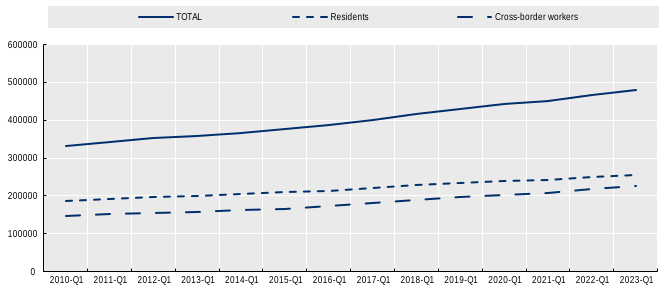
Note: The workforce is defined as domestic payroll employment, excluding self-employed. Cross-border workers include workers from Belgium, Germany and France.
Source: LUSTAT Data Explorer (Domestic payroll employment by citizenship and country of residence)

Source: LUSTAT Data Explorer (Domestic payroll employment by citizenship and country of residence)
A small share of the cross-border commuters to Luxembourg are TCNs. In 2023, TCNs accounted for around 5% of all cross-border workers. Of the TCNs commuting to Luxembourg, 710 (1.37%) were from Germany, 590 (1.16%) from Belgium and 1 910 (1.73%) from France (Figure 4.6). The nationalities representing the largest shares of cross-border commuters vary across the three neighbouring countries. In 2023, the most common nationalities among TCNs commuting from France were Algeria, Morocco, and Turkey, which made up 36.1% of the total influx of commuters from France. For Belgium, the three nationalities were Brazil, Morocco, and Cameroun, accounting for 30.5%. Among TCNs commuting from Germany, the largest nationalities were American, Russian, and Ukrainian.
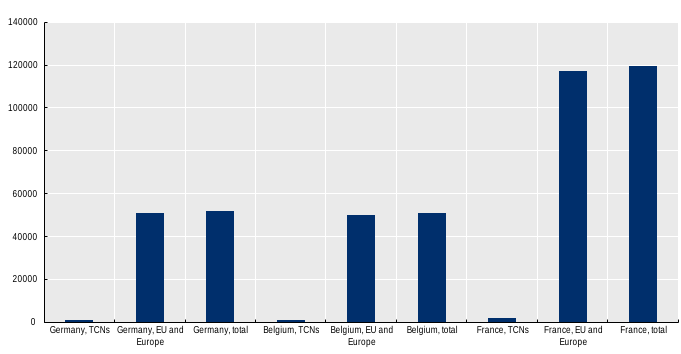
Note: The category “TCNs” includes cross-border that is not a national from a European/EU country.
Source Data provided by ADEM.
The labour market in Luxembourg remains an attractive destination for cross-border commuting due to higher salary levels in Luxembourg and relatively lower living costs in neighbouring countries. Luxembourg has the highest minimum wage in the EU, and its salary levels are significantly higher compared to its bordering countries, Belgium, France and Germany, which are also among the highest in the EU. In January 2024, Luxembourg’s minimum wage was just over EUR 2 500 monthly, compared to EUR 1 750 in France. Luxembourg also has the second-highest average wage level in the EU (eurostat, 2024[49]). However, when comparing costs of living, including food prices, Luxembourg ranks highest in the EU (European Commission, 2023[50]). Cross-border workers in Luxembourg are employed across various sectors, with the highest numbers in commerce, construction, financial and insurance activities, and specialised scientific and technical activities.
Legislative, regulatory and administrative barriers to cross-border labour mobility of TCNs in the cross-border region
Despite the growing demand for foreign labour to meet Luxembourg’s employer needs, TCNs from neighbouring countries face several barriers to commuting for work. As noted in previous case studies, the main barriers involve the rules governing work permits in Luxembourg, which tends to favour highly skilled workers over medium and low-skilled workers, and how these intersect with residence permit rules in bordering countries. Other barriers include issues related to taxation, social security, skills recognition and language barriers. This section outlines the legislative and administrative procedures for work permits in Luxembourg and their interaction with residence permit rules in the neighbouring countries. It also examines the available information to support TCN cross-border commuting to Luxembourg and highlights more general barriers to cross-border commuting, such as taxation.
Legislation, regulation and administrative procedures for work permits
The responsibility for granting work and residence permits to TCNs coming to Luxembourg is shared among various government agencies and ministries. The Ministry of Labour (Ministère du Travail) is in charge of designing and implementing labour market policies, including those for foreign workers, while the Ministry of Home Affairs (Ministère des Affaires intérieures, MAI) manages immigration and international protection applications. The Ministry of Foreign and European Affairs, Defence, Development Co-operation and Foreign Trade (Ministère des Affaires étrangères et européennes, de la Défense, de la Coopération et du Commerce extérieur, MAEE) oversees visa application procedures Additionally, the Public Employment Service (Agence pour le développement de l'emploi, ADEM) supports international job matching, and the National Reception Office is responsible for organising the reception of applicants. The General Directorate of immigration (Direction générale de l’immigration, DGIM) handles applications related to immigration, entry and residence for TCNs, while the Inspectorate of Labour and Mines (Inspection du travail et des mines, ITM) oversees the implementation and application of labour law, including the posting of workers (Table 4.14).
Source: Compilation by the OECD based on publicly available information and information shared by Luxembourg.
TCNs can access work in Luxembourg through several routes, including the EU Blue Card Scheme and the salaried worker permit. As described in previous case studies, the EU Blue Card Scheme is for highly skilled workers wishing to work in an EU country. In 2023, 1 280 TCNs took up work in Luxembourg via this scheme (Guichet.lu, 2024[51]). TCNs who do not qualify for the EU Blue Card scheme may apply for a work and residence permit as salaried workers. These permits are granted by the General Immigration Directorate based on two conditions: 1) a valid work contract with a Luxembourg employer and 2) a foreign workforce certificate, issued by the Public Employment Service. To obtain the certificate, the employer must first declare the position to the Public Employment Service. The certificate is issued within five days if the position is on the list of professions in labour shortage (complied yearly). If the position is not on the shortage list, a labour market test is conducted to assess whether registered jobseekers in Luxembourg math the job profile. If no suitable candidates are found, the certificate is issued within 21 days. Employers hiring under the EU Blue Card Directive are exempt from this process (Ministère des Affaires intérieures, 2024[52]).
In addition to the EU Blue Card Directive and the salaried worker permit, TCNs can access Luxembourg’s labour market through other specialised labour mobility schemes, such as for self-employed, researchers and students. As summarised in Table 4.15, several schemes give access to the labour market in Luxembourg. TCNs can enter Luxembourg if they wish to carry out an activity as self-employed, as researchers, and as students if they are enrolled in a higher education establishment in Luxembourg. In addition, TCNs may temporarily come to Luxembourg as intra-corporate transferred or posted workers (see further discussion below).
Recent legislative changes highlight Luxembourg’s ambition to attract foreign talent and address the labour market challenges. Since 2023, the Public Employment Service has published a list of professions in significant shortage to help address skills shortages. This list, published annually in the first quarter, is based on data from the previous year, including vacant positions, declared jobseekers and positions for which qualified candidates could not be found. The 2024 list included 24 professions, which are exempt from the labour market test, with the employer certificate issued within five days. For positions not on the list, the labour market test still applies, but the process has been expedited. The Public Employment Service now has seven working days to check for jobseekers, and if no suitable candidates are found, the certificate is issued within five working days. If candidates are proposed, the Public Employment Service has an additional 15 working days to finalise the process (ADEM, 2023[53]).
A key challenge with the shortage list and the labour market test is the limited use of these systems by employers in Luxembourg. While employers in Luxembourg are legally required to declare open positions to the Public Employment Service, consulted stakeholders have reported that only 35% of employers declare open positions to the agency. Consequently, the agency lacks a comprehensive overview of unfilled positions, limiting the effectiveness of the shortage list. Furthermore, employers face difficulties hiring foreign workers if they cannot secure a foreign workforce certificate for a suitable candidate not residing in Luxembourg. If fully utilised, the shortage list could help attract more talent, including from neighbouring countries.
Source: Compilation by the OECD based on publicly available information and information shared by Luxembourg.
TCNs legally residing in another EU Member State who wish to work in Luxembourg as a cross-border worker can obtain a work permit without a residence permit. These TCNs can access the Luxembourg labour market by applying for a work permit from the General Immigration Directorate while residing in another EU country. In this case, they will not receive a residence permit in Luxembourg. Like those seeking to reside in Luxembourg, cross-border TCN workers must have a valid work contract with a Luxembourg employer before applying for a work permit. If applying under the general salaried worker scheme, the employer must have obtained a foreign workforce certificate from the Public Employment Service, unless the position is on the shortage list.
An exception to the general rule on TCN cross-border commuters applies to family members of EU citizens working in Luxembourg. TCNs who are spouses, partners, or children of EU citizens working as cross-border workers are exempt from the general work permit requirements. These TCNs can access the labour market in Luxembourg without a work or residence permit if they share a residence with an EU citizen, who works in Luxembourg. If the situation changes (e.g. in the event of divorce), the TCN must apply for a work permit. Asylum seekers and individuals with temporary residence permits cannot commute to Luxembourg for work.
Cross-border commuters in Luxembourg have good opportunities for telework and part-time work. Luxembourg follows the EU definition of a cross-border commuter, which defines such workers as someone “who pursues his occupation in the territory of a Member State and resides in the territory of another Member State to which he returns as a rule daily or at least once a week” (European Commission, 2024[54]). Therefore, cross-border workers in Luxembourg are not required to return daily to their country of residence. Depending on their legal status, TCNs may also have the option to work part-time, as there are no specific rules on the hours or salary levels for cross-border workers (Ministère des Affaires Étrangères et Europeennes, 2024[55]).
Employers based abroad may temporarily post employees to Luxembourg under the EU Directive on the posting of workers. For businesses established in the EU or a country treated as such, it is necessary to notify the General Directorate for Small and Medium-Sized Enterprises (Direction générale des Classes moyennes) at the Ministry of the Economy about occasional and temporary service provisions.
The Labour Market Inspectorate is the main authority for regulating posted workers in Luxembourg. The agency is responsible for verifying contracts between companies and posted workers and conducting checks at companies registered as posting companies. According to the agency, there are significant cross-border postings from Belgium, France and Germany to Luxembourg. While some posted workers return home every evening, others stay overnight in Luxembourg. To ensure daily inspections of facilities for cross-border posted workers returning to their home countries, the agency engages in cross-border inspections with the labour market inspectorates in neighbouring countries. While the agency’s role is typically limited to visitor status in these inspections, it provides valuable information on the situation of cross-border posted workers.
Interactions with legislation on residence permits in bordering countries
As with other EU-border regions, obtaining a work permit in Luxembourg may, depending on the TCN's situation, conflict with their residence permit. For TCNs wishing to work in Luxembourg as cross-border workers, obtaining a work permit could affect their residence permit in their country of residence. As cross-border workers to Luxembourg come from three countries (Belgium, France and Germany), the situation for TCNs may vary somewhat between these countries. The potential consequences for TCNs residing in Belgium and Germany and commuting to another country for work have already been analysed in previous case studies on the Meuse-Rhine Region and the cross-border region Austria/Germany. The conclusions drawn regarding the potential consequences for their residence permits in these countries also apply to TCNs commuting to Luxembourg. Therefore, this section focuses more specifically on France.
A TCN coming to France for work must obtain a valid work permit from the French authorities There are several types of work permits in France, but the main requirement across all schemes is that TCNs must have secured an employer in France willing to hire them. Table 4.16 provides an overview of selected labour mobility schemes in France and the potential consequence for residence permits in France when a TCN travels to Luxembourg (or elsewhere) for work. As with other case studies, it is important to note that this area of legislation is characterised by significant legal uncertainty, and information from key stakeholders can be difficult to obtain. Nevertheless, the main conclusion drawn from the table is that only a few categories of TCNs residing in France have good options for becoming cross-border workers in Luxembourg. These include family members of EU citizens who are themselves cross-border workers and long-term residence permit holders. In addition, family members of TCNs or EU citizens who are not cross-border commuters may be able to commute without losing their temporary residence permit. However, most other categories of TCNs face the risk of negative consequences for their temporary or permanent residence permits if they choose to work across the border to Luxembourg.
Source: OECD assessment based on publicly available information and consultations with stakeholders.
Information provision and other support services for cross-border commuters
Several institutions and agencies provide information for cross-border workers in the region. One such example is Frontaliers Grand-Est, which offers guidance and information about options for cross-border work and studies. Their website features informative brochures addressing various issues related to employment, life and mobility in the region, with a specific focus on Luxembourg (Frontaliers Grand Est, 2024[56]). In addition to their website, Frontaliers Grand-Est and the Public Employment Service in Luxembourg organise employment forums to offer in person information and guidance to jobseekers and employers in the region.
Despite the extensive information provided to cross-border workers, there is limited guidance available for TCNs wishing to commute across the border. As with other cross-border regions, targeted information on commuting options for TCNs is lacking, and regional institutions and agencies are generally reluctant to offer advice due to the connection to migration policies, an area outside their expertise. As a result, TCNs are often advised to consult national regulations or seek guidance from national agencies that specialise in work and residence rules. According to consulted stakeholders, employers also have limited knowledge of the legal situation for TCNs wishing to commute for work. This lack of information and legal clarity leads many TCNs who may have opportunities through Luxembourg’s labour mobility schemes, to hesitate in seeking work across the border.
References
[34] ABA (2024), ABA: The Red-White-Red – Card, https://www.workinaustria.com/en/residence-employment/red-white-red-card/ (accessed on 8 October 2024).
[35] ABA (2024), Red-White-Red-Card Plus, https://www.workinaustria.com/en/residence-employment/red-white-red-card-plus/ (accessed on 8 October 2024).
[48] ADEM (2024), ADEM Stats, https://adem.public.lu/en/marche-emploi-luxembourg/statistiques/chiffres-cles-adem.html#:~:text=In%20April%202024%2C%20employers%20reported,7%2C996%20as%20of%20April%2030. (accessed on 2 July 2024).
[53] ADEM (2023), New law facilitates the recruitment of third-country nationals, https://adem.public.lu/en/actualites/adem/2023/09/metiers-penurie.html (accessed on 2 July 2024).
[33] Bayerisches Landesamt für Statistik (2024), Bevölkerung: Kreise, Geschlecht, Nationalität, Quartale, Jahr.
[29] Bayerisches Landesamt für Statistik (2024), Bevölkerungsstand, https://www.statistik.bayern.de/statistik/gebiet_bevoelkerung/bevoelkerungsstand (accessed on 8 October 2024).
[32] Bayerisches Landesamt für Statistik (2023), Ausländische Bevölkerung in Bayern am 31. Dezember 2022, Bayerisches Landesamt für Statistik, Fürth, https://www.statistik.bayern.de/mam/produkte/veroffentlichungen/statistische_berichte/a1500c_202200.pdf (accessed on 8 October 2024).
[38] Bundesagentur für Arbeit (2024), Technical directives Residence Act and Employment Ordinance (Fachliche Weisungen Aufenthaltsgesetz und Beschäftigungsverordnung), https://www.arbeitsagentur.de/datei/dok_ba033210.pdf (accessed on 8 October 2024).
[11] CBS (2024), Internationaliseringsmonitor – België, CBS, DenHaag, https://www.cbs.nl/nl-nl/publicatie/2024/13/internationaliseringsmonitor-2024-eerste-editie-belgie (accessed on 8 October 2024).
[12] CBS (2024), Ruim 86 duizend mensen werken in Nederland en wonen in Duitsland of België, https://www.cbs.nl/nl-nl/nieuws/2024/13/ruim-86-duizend-mensen-werken-in-nederland-en-wonen-in-duitsland-of-belgie (accessed on 8 October 2024).
[13] CBS (2020), 8 duizend zorgwerknemers in grenspendel met Duitsland en België, https://www.cbs.nl/nl-nl/nieuws/2020/13/8-duizend-zorgwerknemers-in-grenspendel-met-duitsland-en-belgie (accessed on 8 October 2024).
[10] CBS (2020), Grenspendelaars naar Nederland wonen vaak vlak over de grens, https://www.cbs.nl/nl-nl/nieuws/2020/46/grenspendelaars-naar-nederland-wonen-vaak-vlak-over-de-grens (accessed on 8 October 2024).
[6] Chilla, T. (2020), Innerstaatliche Vernetzung von Grenzregionen, Bundesministerium des Innern, für Bau und Heimat.
[25] De Interregionale Vakbondsraad Schelde-Kempen (2023), Fair Mobility Tool, https://fairmobilitytool.eu/about (accessed on 8 October 2024).
[4] De Wispelaere, F., L. De Smedt and J. Pacolet (2022), Poster workers in the European Union. Facts and figures, POSTING.STAT project VS/2020/0499, Leuven, https://hiva.kuleuven.be/en/news/docs/posted-workers-in-the-european-union-facts-and.pdf (accessed on 8 October 2024).
[16] Donner, J. (2010), Letter from the Minister of Social Affairs and Employment. Tweede Kamer der Staten-Generaal 29861 nr. 32, https://zoek.officielebekendmakingen.nl/kst-29861-32.html (accessed on 10 October 2024).
[57] Durà A., C. (2018), Euroregions, Excellence and Innovation across EU borders. A Catalogue of Good Practices..
[5] Durà, A. et al. (2018), Euroregions, Excellence and Innovation across EU borders. A Catalogue of Good Practices.
[54] European Commission (2024), frontier worker, https://home-affairs.ec.europa.eu/networks/european-migration-network-emn/emn-asylum-and-migration-glossary/glossary/frontier-worker_en (accessed on 2 July 2024).
[45] European Commission (2024), “Governance of migrant integration in Luxembourg”, https://migrant-integration.ec.europa.eu/country-governance/governance-migrant-integration-luxembourg_en (accessed on 2 July 2024).
[50] European Commission (2023), “2023 Country Report - Luxembourg”, COMMISSION STAFF WORKING DOCUMENT, https://economy-finance.ec.europa.eu/document/download/3bc05f70-1d9d-4b4f-a93a-282128013c78_en?filename=LU_SWD_2023_616_en.pdf (accessed on 2 July 2024).
[40] European Migration Network (2023), Annual report on migration and asylum 2022: Austria, EMN, https://home-affairs.ec.europa.eu/system/files/2023-07/00_eu_arm2022_report.pdf (accessed on 8 October 2024).
[49] eurostat (2024), “Minimum wage statistics”, eurostat, https://ec.europa.eu/eurostat/statistics-explained/index.php?title=Minimum_wage_statistics (accessed on 2 July 2024).
[58] Evrard, E. (2020), Euroregion (Concept), Peter Lang.
[27] Expat Centre Maastricht Region (2024), Expat Centre Maastricht Region, https://expatcentremaastrichtregion.nl/ (accessed on 8 October 2024).
[39] Federal Government of Germany (2024), Make it in Germany, https://www.make-it-in-germany.com/en/ (accessed on 8 October 2024).
[37] Federal Government of Germany (2023), The new Skilled Immigration Act at a glance, https://www.make-it-in-germany.com/en/visa-residence/skilled-immigration-act (accessed on 8 October 2024).
[36] Federal Ministry for Economic Affairs and Climate (2024), Skilled professionals for Germany, https://www.bmwk.de/Redaktion/EN/Dossier/skilled-professionals.html (accessed on 8 October 2024).
[56] Frontaliers Grand Est (2024), Brochures - Frontaliers Grand Est, https://frontaliers-grandest.eu/brochures/ (accessed on 2 July 2024).
[3] Gasperini, M. and M. Geraci (2024), Cross-border work in the EU and EFTA countries, Publications Office of the European Union, Luxembourg, https://op.europa.eu/en/publication-detail/-/publication/cda87a92-f619-11ee-8e14-01aa75ed71a1/language-en (accessed on 8 October 2024).
[17] Government of the Netherlands (2024), Posting employees to the Netherlands: a checklist, https://business.gov.nl/running-your-business/staff/posting-and-outsourcing/posting-employees-to-the-netherlands/#art:3-apply-for-work-permits (accessed on 8 October 2024).
[15] Government of the Netherlands (2000), Aliens Act the Netherlands 2000 (Vreemdelingenwet 2000), https://www.asylumlawdatabase.eu/en/content/en-aliens-act-netherlands-2000-vreemdelingenwet-2000 (accessed on 8 October 2024).
[44] Grande Region (2024), The Greater Region at a Glance, https://www.granderegion.net/en/The-Greater-Region-at-a-Glance (accessed on 2 July 2024).
[43] Greater Region (2024), Sommet, https://www.granderegion.net/Institutions/Le-Sommet-en-detail/Sommet2 (accessed on 7 October 2024).
[26] Grensinfopunt (2024), Grensinfopunt, http://www.grensinfo.nl (accessed on 8 October 2024).
[24] Grensoverschrijdende Arbeidsbemiddeling (2024), Grensoverschrijdende dienstverlening en arbeidsbemiddeling, https://grenzarbeit.eu/nl/start/ (accessed on 8 October 2024).
[51] Guichet.lu (2024), Salaried work for third-country highly qualified workers (EU Blue Card), https://guichet.public.lu/en/citoyens/immigration/plus-3-mois/ressortissant-tiers/hautement-qualifie/salarie-hautement-qualifie.html (accessed on 2 July 2024).
[1] Hassan, E. et al. (2024), Annual report on intra-EU labour mobility 2023, Publications Office of the European Union, Brussels, https://data.europa.eu/doi/10.2767/59413 (accessed on 10 October 2024).
[2] Hassan, E. et al. (2023), Annual report on intra-EU labour mobility 2022, Publications Office of the European Union, Brussels, https://data.europa.eu/doi/10.2767/560178 (accessed on 10 October 2024).
[21] IND (2024), Cross-border workers, https://ind.nl/en/residence-permits/work/cross-border-worker#no-residence-permit-but-a-cross-border-worker-residence-endorsement-sticker (accessed on 8 October 2024).
[18] IND (2024), Residence permit cross-border service provider, https://ind.nl/en/residence-permits/work/residence-permit-cross-border-service-provider (accessed on 8 October 2024).
[28] Interreg (2025), Interreg Germany/Bavaria - Austria, https://interreg.eu/programme/interreg-austria-germany/ (accessed on 17 January 2025).
[42] Interreg (2025), Interreg Grande Région, https://interreg.eu/programme/interreg-grande-region-grosregion/ (accessed on 17 January 2025).
[7] Interreg (2025), Interreg Meuse-Rhine, https://interreg.eu/programme/interreg-netherlands-belgium-germany/ (accessed on 17 January 2025).
[55] Ministère des Affaires Étrangères et Europeennes (2024), “Work permit for third country nationals, holder of a residence permit as a « family member » wishing to engage in part-time salaried activity”, https://guichet.public.lu/dam-assets/catalogue-formulaires/immigration/document/tiers/regroupement-familial/autorisation-travail-note-regroupement-familial/regroupement-familial-travail-note-en.pdf (accessed on 2 July 2024).
[52] Ministère des Affaires intérieures (2024), “Work permit for a third-country national residing legally in another member State of the EU, who wishes to work in Luxembourg”, https://guichet.public.lu/dam-assets/catalogue-formulaires/immigration/document/tiers/frontalier/autorisation-travail-note/autorisation-travail-frontalier-tiers-note-en.pdf (accessed on 2 July 2024).
[47] OECD (2023), OECD Skills Strategy Luxembourg: Assessment and Recommendations, OECD Skills Studies, OECD Publishing, Paris, https://doi.org/10.1787/92d891a4-en.
[22] Raad van State (2015), Uitspraak 201407465/1/V6., Raad van State, https://www.raadvanstate.nl/uitspraken/@100982/201407465-1-v6/ (accessed on 8 October 2024).
[14] Rasnaca, B. (2021), Interaction between labour law and immigration regimes The case of short-term third-country national workers in the EU and the EEA, ETUI, Brussels, https://www.etui.org/sites/default/files/2023-06/Interaction%20between%20labour%20law%20and%20immigration%20regimes-2023.pdf (accessed on 8 October 2024).
[46] STATEC (2024), Indicateurs du marché de l’emploi, https://app.powerbi.com/view?r=eyJrIjoiZWRjOTM0OGItYzk2Yi00OTA0LWJiMDUtNmU4ZjZkMmIzOTE2IiwidCI6ImNmZjViYTQyLWNlZDktNDA2NS04MjI2LTBjODI4YjM4M2RjNSIsImMiOjl9 (accessed on 2 July 2024).
[30] Statistics Austria (2024), Census Austria 2021: results of the registered-based Census, Statistics Austria, Vienna, https://www.statistik.at/fileadmin/user_upload/CensusAustria2021.pdf (accessed on 8 October 2024).
[31] Statistics Austria (2024), Register-based labour market statistics – Commuters – time series since 2009, https://statcube.at/statistik.at/ext/statcube/jsf/tableView/tableView.xhtml (accessed on 8 October 2024).
[9] Steunpunt, W. (2017), De arbeidsmarkt in de grensregio van Nederland en Vlaanderen, CBS, DenHaag, https://www.vlaanderen.be/publicaties/de-arbeidsmarkt-in-de-grensregio-van-nederland-en-vlaanderen (accessed on 8 October 2024).
[41] The Government of the Grand Duchy of Luxembourg (2024), AN OPEN AND COSMOPOLITAN SOCIETY, https://luxembourg.public.lu/en/society-and-culture/population/demographics.html (accessed on 2 July 2024).
[23] UWV (2024), Hulp bij werkvergunning voor personeel uit het buitenland, https://inspiratie.uwv.nl/werkgeverschap/LSA-geeft-advies-over-werkvergunning#:~:text=Het%20Landelijk%20Steunpunt%20Arbeidsmigratie%20(LSA)%20helpt%20bij%20vragen%20en%20informatie,van%20het%20LSA%20voor%20werkgevers. (accessed on 8 October 2024).
[19] UWV (2024), Speciale voorwaarden per categorie, https://www.uwv.nl/werkgevers/werkvergunning/speciale-voorwaarden-per-categorie/detail/gewone-arbeidsplaats-en-overig (accessed on 8 October 2024).
[20] UWV (2024), UWV Kwantitatieve informatie 2023, https://www.uwv.nl/imagesdxa/uwv-kwantitatieve-informatie-2023_tcm94-456766.pdf (accessed on 8 October 2024).
[8] Wassenberg, B. and B. Reitel (2020), Critical Dictionary on Borders, Cross-Border Cooperation and European Integration, Peter Lang, Brussels.
← 1. There are approximately 152 Euroregions across the European Union, serving as laboratories for European co-operation (Durà A., 2018[57]). There is no universal concept of a Euroregion nor a universal set-up, but the Euroregions are generally formed by local partner regions across borders in an institutionalised (legal) form promoting cross-border dialogue and co-operation in border regions (Evrard, 2020[58]).
← 2. As recommended by Statistics Austria and used in their publications.
← 3. In 2023, 52% of the cross-border workers in Bavaria came from Czech Republic, 14% from Austria and 14% from Poland.