Fragility is a systemic feature that is essential to our understanding of the impact of policy. Shocks linked to conflict, debt, climate, energy and geopolitical competition transcend borders to increase risk and stress resilience, making fragility a global concern with shared consequences across geographies and sectors. Food insecurity, displacement, climate impacts, conflict and macroeconomic pressures increasingly reinforce one another, demanding systemic rather than sector-specific responses.
Fragility analysis shows that resilience itself is a target. From organised crime to hybrid warfare, some actors are targeting state and societal resilience for strategic advantage. Insufficient resilience is a source of fragility when institutional weaknesses, public trust, inadequate fiscal capacity and fragmented governance are targeted so that shocks transform into crises. Effective resilience depends on the ability of institutions, economies and societies to anticipate risks, manage uncertainty and maintain essential functions during prolonged disruption – security instruments alone will not address these gaps. Resilience should therefore be understood as a systemic capability, not only as recovery after shocks.
Development and peace are the foundations for the resilience upon which national security depends. Development, peace and security policies are complementary agendas. Policy approaches that isolate development trajectories from security risk overlook the drivers of instability, thereby limiting the effectiveness of prevention efforts. As such, development actors are central to stability and security outcomes. Investments in governance, social cohesion, economic opportunity and institutional effectiveness often determine whether societies can withstand and adapt to shocks.
Enhancing data coverage is a priority. Global data coverage is deteriorating precisely where risks are greatest. Conflict, political instability, shrinking statistical capacity, misinformation and AI-generated content are creating a growing "data fog" that obscures emerging threats and weakens decision-making. As conflict, instability and technological disruption reduce the availability and reliability of information, strengthening data systems, fragility monitoring, foresight and analytical capabilities is essential to anticipate risks, inform policy and shape outcomes before crises escalate.
Fragility analysis should move from assessing conditions and realised risks, to understanding faultlines and how shocks travel through systems. A system-based approach can identify how risks develop, intensify and propagate across economic, political, social and environmental systems and where vulnerabilities may escalate into crises. This new approach to multidimensional fragility analysis can drive better foresight and scenario planning to help policymakers identify emerging risks before they develop into crises or violence. Focusing on risk dynamics rather than static vulnerability assessments will therefore allow the next generation of fragility analytics to show how shocks interact with sources of resilience, where faultlines are emerging and which investments can deliver the greatest preventive impact.
States of Fragility, 2026 update
As the sequence of global shocks continues through conflicts in the Middle East and Africa, and through major ecological shifts in Europe, Asia and Latin America, the universality of fragility and the systemic interdependencies that drive exposure to fragility emerge as the overarching narrative from the latest analysis. In 2026, 42 of the 177 contexts1 analysed are identified as exposed to high fragility and 20 to extreme fragility. The 2 billion people living in these 62 contexts represent 24.6% of the world’s population and 72.4% of the world’s extreme poor.
Positive and negative trends are apparent in various parts of the world. Since the States of Fragility 2025 report was published, decreasing exposure to fragility is most closely associated with contexts showing modest improvements in the security dimension, such as Timor-Leste, Nigeria, Indonesia, Fiji, Argentina, Iraq, Benin, South Africa and the Solomon Islands. In most of these contexts this reflected human security, initiatives associated with rule of law, measures to counter organised crime or insurgent militias. Exposure to fragility increased the most in Lebanon and in Bolivia – driven by security, environmental and economic factors. In the low to medium fragility spectrum, increasing fragility in Cuba is also noteworthy – driven by striking deterioration in environmental and economic dimensions as exposure to global shocks compounds longstanding internal structural weaknesses. Unsurprisingly, a notable increase is also recorded across all dimensions in the West Bank and Gaza2, where subnational analysis is essential to building a deeper appreciation of the full impact of conflict and what it means for recovery in Gaza. This is also one of the locations, similar to Syria, where the deterioration of data coverage has been a pronounced feature of conflict, reflecting a notable trend of declining data coverage in conflict-affected contexts that must be addressed as a priority to ensure governments can plan for comprehensive reconstruction and recovery (OECD, forthcoming[1]).
Progress previously identified with fragility in the human dimension (OECD, 2025[2]) has reversed in 43 contexts, marked by deteriorating resilience across a number of indicators: including access to water, inequality and social protection. Though security fragility has decreased in Libya and Syria,3 it intersects with other dimensions of fragility, especially political and societal, pointing to situations with significant underlying instability or the mere absence of armed conflict (negative peace) that could easily unravel (Institute for Economics & Peace, 2026[3]). In Afghanistan, the transition from armed conflict to peace led to lower security fragility but the trend of greater societal fragility identified in 2025 has consolidated and deepened alongside a notable increase in economic fragility, both with devastating impact for women and girls. This contrasts with Iraq, where more elements of positive peace (i.e. the presence of conditions that promote justice, equality and social harmony) and therefore resilience are identifiable; though progress achieved remains vulnerable to shocks.
The OECD multidimensional fragility framework, depicted in Infographic 1 helps reconcile the complexity of fragility with the simplicity needed to guide tailored action in every context. For the 62 contexts experiencing high and extreme fragility, the framework offers a strategic compass that can guide national, sectoral and subnational fragility analysis more effectively for policy design and implementation. Four contexts have moved into the extreme exposure category: Angola, Papua New Guinea, Mozambique and Myanmar. Two contexts have moved from extreme to the high exposure category: Iraq and Libya. These movements reflect modest overall changes, though Iraq is indicative of steadily reducing fragility over the past 5 years. One context has moved from medium to the high exposure category: Honduras. Instances of localised fragility are the standout feature of contexts exposed to medium fragility, once again highlighting the need for greater focus on subnational pockets of fragility. The fragility of OECD members has decreased in most cases, in 21 out of 38 contexts, reflecting their comparatively greater resilience.
New conflicts and ecological shocks offer stark illustrations of how sudden impacts initiate reactions across systems, exposing faultiness and transmission channels that aggravate risks and stress sources of resilience.4 Though causality is often difficult to establish, fragility framework analysis highlights how shocks expose political, economic and societal faultlines. The most visible consequence of these combinations of fragility in 2025 can be seen in the 117.8 million forcibly displaced persons, (UNHCR, 2026[4]) mostly driven by conflict, and the sustained high demand for humanitarian assistance (UN, 2026[5]). It is also reflected in the economic dimension though rising debt and inflation, as states and communities struggle to respond and adapt.

Note: The different shadings of the colours used for dimensions represent various degrees of severity of fragility experienced in each context in a particular dimension. In this way, the framework helps reconcile the complexity of fragility with the simplicity needed to guide effective and differentiated action in every context. However, the framework should be understood as a strategic compass that can guide national, sectoral and subnational fragility analysis to better effect for policy design and implementation.
Source: OECD 2026, Multidimensional fragility dashboard
The rapidly evolving character of organised violence and conflict
It is well established that state and non-state actors employ multiple instruments of power simultaneously to instrumentalise and exploit fragility to achieve political objectives (OECD, 2025[2]); however, the acceleration of multipolar competition is reshaping the character of organised violence and generating new forms of strategic coercion. Contemporary conflict increasingly combines conventional military capabilities with actions across multiple systems through cyber operations, information manipulation, economic systems, criminal networks and other non-state actors: creating what has become increasingly understood as hybrid warfare (Hoffman, 2007[6]). This evolution challenges long-standing assumptions in foreign and defence policy regarding deterrence, escalation and strategic response (Weissmann, 2021[7]). It equally challenges thinking on how development policy is designed and applied in a contested landscape.
Among the most significant drivers of this transformation has been the rapid diffusion of drone and autonomous technologies, increasingly driven by AI models, creating fundamentally altered operational realities across land, air and maritime domains. These technological innovations disrupt military and civilian mobility and accelerate invasive surveillance of civilian populations and infrastructure, with acute implications for humanitarians who are struggling to adapt to new operating environments (OCHA, 2026[8]). Growing drone accessibility has also expanded opportunities for organised crime, coercive border activities and transnational security threats, illustrating how technological innovations shape both military and non-military forms of coercion (Davis, 2025[9]), in many cases overwhelming existing governance capacities.
The manipulation of population movements through disinformation is one example of how state and non-state actors use new technology to manufacture crises to produce cascading effects that extend far beyond their initial point of origin. In the Americas, smugglers and social media accounts promise short, uncomplicated passage through the Darién Gap, to the extent that around 70 per cent of people arriving there relied on social media information that downplayed or misrepresented the risks (UNHCR, 2024[10]). In Sudan, the Rapid Support Forces (RSF) used disinformation about attacks on humanitarian organisations, safe routes that turned out to be traps, and chemical contamination in Khartoum, to manipulate the movement of vulnerable populations trying to escape conflict (Obeid, 2026[11]). The reactions observed were consistent with research showing that unverified rumours spread readily in areas affected by political instability and conflict (Greenhill and Oppenheim, 2017[12]). These campaigns are not incidental. Whether orchestrated by criminal networks, states or unidentified actors, they are deliberately designed to find and aggravate existing fragilities, such as overstretched reception systems, polarised politics, weak border governance and desperate, poorly informed displaced populations, so that a modest initial provocation produces disproportionate political and humanitarian strain. The result is a security environment in which fragility itself becomes both a target and an instrument of competition, producing consequences that move through interconnected systems and often remain difficult to attribute or predict (Greenhill, 2010[13]).
Embedded faultlines and transmission channels of economic fragility
Countries facing high levels of fragility are more likely to see the build-up of economic risks than other countries, as well as negative impacts of their transmission through other systems and across countries and regions. Conflict and organised criminal violence exacerbate these weaknesses through the destruction of productive assets, displacement, disrupted trade flows and declining state revenues, reinforcing cycles of economic and political fragility (OECD, 2025[2]).
Macroeconomic instability, high volatility in growth, exchange rates and inflation and low fiscal capacities, can in turn exacerbate fragility and erode the ability to respond to shocks in contexts such as Sudan, Syria and IRG Yemen (OECD, forthcoming[14]). Inflationary pressures, unsustainable debt burdens and fiscal deterioration remain acute.
High dependence on narrow economic and revenue bases, high informality, weak business environments and regulatory vacuums can increase risks and reduce the ability of countries and households to build economic resilience to manage those risks. A narrow economic base is common, whether through hydrocarbons in Iraq, Libya and South Sudan, single-commodity exports in Chad and the Democratic Republic of Congo, or aid dependence in Afghanistan and Somalia. High levels of informality are common, as are persistent youth unemployment and constraints on the potential of women in the workforce, with on average more than 40% of GDP and 65% of employment being informal (OECD, 2026[15]). These issues hamper the private sector in fulfilling its role as a provider of goods, services, livelihoods and government income.
Research on systemic resilience emphasises that interconnected shocks can rapidly cascade across economic, governance and social systems, with some economies particularly exposed where diversification, institutional capacity and adaptive mechanisms remain limited (Ranger, Mahul and Monasterolo, 2021[16]). For example, 51 of the 62 contexts with the largest shadow economies are also exposed to high or extreme fragility (Rozkrut, 2025[17]). The prominence of illicit economies and illicit financial flows illustrates how failures of governance and resilience are closely intertwined with an inability to sustain growth over time. This dynamic is evident across intersections between political, security and economic dimensions affected by illicit mining, trafficking, smuggling and organised criminal activity, which generate economic rents while simultaneously eroding state legitimacy and fiscal capacity.
Low levels of economic diversification, heavy dependence on natural resources, environmental degradation and persistent food and livelihood insecurity further compound these risks, amplifying the impact of supply shocks such as the conflict in Iran and effective closure of the Strait of Hormuz. (Box 2). Such concentrations heighten vulnerability to disruptions in global markets and strategic trade corridors. The result is a pattern of systemic fragility in which economic shocks, environmental stress, governance weaknesses and illicit activity reinforce one another, reducing household resilience and increasing the likelihood that local crises evolve into broader regional and international challenges (Herrera, Watson and Mia, 2026[18]). At the global level, this is exacerbated by rising geoeconomic fragmentation, protectionism and competition over critical resources, particularly as states seek to secure strategic supply chains associated with technology and energy transitions (Klint, 2025[19]).
The Strait of Hormuz carries almost one-fifth of global oil supply and a substantial share of global liquefied natural gas exports. The 2026 conflict centred on the Strait is the latest example of how a regional security crisis can quickly become a global economic shock as disruptions to one of the world's most important maritime chokepoints affected energy markets, shipping routes, financial stability, fertiliser and food systems and critical supply chains. The crisis illustrates how:
Fragility resides within networks and systems rather than solely within states. Exposure to fragility is dynamic and universal, transmitted across interconnected systems, where shocks generate cascading effects when coping capacities are limited. As seen with fragility analysis of the impact of the COVID-19 pandemic, critical infrastructure, shipping corridors and global supply chains function as transmission mechanisms through which risks propagate across borders. The disruption of a single maritime chokepoint affected manufacturing sectors dependent on energy-intensive inputs, constrained the supply of critical minerals and industrial gases used in advanced manufacturing, increased freight and insurance costs, and generated uncertainty in financial markets. Countries were affected not only according to their geographic proximity to the conflict, but also through their dependence on energy imports, fertiliser supplies, trade routes, remittances and external financing. Net energy importers across North Africa, Sub-Saharan Africa, South Asia and Southeast Asia faced rising fuel costs, inflationary pressures and deteriorating external balances. At the same time, disruptions to fertiliser supply chains raised agricultural production costs and threatened food security in countries already facing high levels of fragility with average fertiliser prices rising by 44% and urea prices up nearly 115%. In several regions, particularly Sub-Saharan Africa and parts of South Asia, higher fertiliser costs are expected to reduce agricultural productivity, deepen food insecurity and place additional strain on already fragile public finances and social protection systems.
Conflict acts as a force multiplier for existing fragility. Countries such as Sudan, Somalia, Ethiopia, Lebanon and others that were already experiencing conflict, displacement, food insecurity or fiscal stress became more exposed to additional shocks through higher import costs, disrupted trade, reduced remittance flows and increasing humanitarian needs. Haiti illustrates how little room exposure to extreme fragility leaves for choice: it raised gasoline prices 29% and diesel 37% in April despite protests, against a food system where 5.8 million people face crisis-level food insecurity. This reflects a central insight of the OECD multidimensional fragility framework: fragility increases where exposure, vulnerability and insufficient coping capacity intersect. External shocks rarely create fragility in isolation; rather, they interact with pre-existing structural conditions, increasing the likelihood that economic stress translates into social tensions, political instability or humanitarian need.
Understanding fragility faultlines and transmission channels will become increasingly important for identifying vulnerabilities, strengthening resilience and preventing localised shocks from escalating into broader regional and global crises. Pacific SIDS illustrate the stakes: with imported fuel accounting for 5-15% of GDP and around 80% of electricity generation reliant on diesel, the Asian Development Bank projects a cumulative GDP growth loss of 2.2 percentage points and inflation increases of 1.8 percentage points over 2026–27 under a long-term conflict scenario. As geopolitical tensions increase and global systems become more tightly interconnected, the policy challenge is not only to strengthen resilience within individual countries, but also to address vulnerabilities embedded in cross-border energy systems, food markets, transport corridors, critical mineral value chains and financial networks: moving towards a systems-based understanding of risk and resilience.
Source: (Tooze, 2022[20]) (OECD, 2025[2]) (Lawrence et al., 2024[21]) (Folke et al., 2010[22]) (IRENA, 2026[23]) (OECD, 2022[24]) (FAO, OCHA, WFP, WMO, 2026[25]), (Famine Early Warning System Network, 2026[26]), (ADB, 2026[27])
Ecological shocks are critical risk multipliers in most contexts where droughts, floods, ecosystem degradation, biodiversity loss and extreme weather interact with pre-existing risks and vulnerable coping capacity to create pressures across human, economic, societal and, ultimately, political systems (IPCC, 2023[28]). The 2026/27 El Niño event is anticipated to illustrate again how ecological shocks compound existing environmental fragility to act as catalysts of systemic fragility. According to the World Meteorological Organization (WMO), El Niño is firmly established and is expected to intensify through late 20265, with an exceptionally high likelihood of persisting into early 2027. The organisation warns that a very strong event could significantly alter rainfall and temperature patterns worldwide, increasing the risks of floods, droughts, extreme heat and associated disruptions across climate-sensitive sectors, including agriculture, health, energy and water resources.
The resulting human and economic impacts frequently extend far beyond the initial shock. Ecological disruptions more significantly contribute to food insecurity, livelihood losses, migration, public health challenges, inflationary pressures, social tensions, market volatility and increased competition over scarce resources. Previous shocks and the anticipated impacts of El Niño illustrate this dynamic (WMO, 2026[29]). Shifts in rainfall and temperature patterns can simultaneously affect agricultural production, hydropower generation, water availability and public health outcomes across multiple regions, creating compound and reinforcing vulnerabilities. These secondary shocks can reinforce existing fragility and create feedback loops that deepen fragility over time, propagating across sectors, geographies and timescales, often producing consequences that exceed the scale of the original event. Resilience therefore cannot be understood solely as a capacity to recover from shocks; it must also incorporate the ability to anticipate, absorb and adapt to the systemic transmission of risks (Duvat, 2026[30]).
Rather than treating environmental pressures as external constraints on development, evidence suggests that ecological stability is a foundational condition upon which all other dimensions of resilience depend. This resonates strongly with narratives on energy and planetary security that note the convergence of ecological degradation, resource competition, conflict systems and governance challenges (Lazard and Shahid, 2026[31]). The trends associated with environmental fragility are reshaping patterns of insecurity in ways that existing political and economic institutions are struggling to address, requiring more systemic and regenerative approaches to resilience and development. While the transmission effects of ecological shocks are most immediately visible in the human, societal and economic dimensions, their influence ultimately reaches political systems as well, reinforcing the need to view the environmental dimension not as one component among many, but as the foundation from which risks and resilience are transmitted across the entire fragility spectrum (IPCC, 2023[28]). Ecological pressure points such as major river basins, biodiversity hotspots, agricultural breadbaskets and climate-vulnerable urban regions are becoming as strategically significant as the Suez Canal or Strait of Hormuz in shaping global stability and human well-being.
Beyond the traditional maritime chokepoints that dominate geopolitical analysis, a new set of geostrategic pressure points are emerging across ecological systems, critical resource networks, digital infrastructures and fragmenting systems of governance. Intertwined with the environmental fragility described above, the twin energy and digital transitions are reshaping the geography of power. The International Energy Agency notes that demand for minerals essential to clean energy technologies has elevated concerns regarding supply concentration, bottlenecks and geopolitical risk, while the International Renewable Energy Agency argues that control over critical material extraction and processing is becoming a central feature of the geopolitics of the energy transition (IEA, 2024[32]) (IRENA, 2026[23]). These shifts create new opportunities for states and non-state actors to instrumentalise fragility, whether through resource coercion, cyber disruption, disinformation campaigns or the exploitation of governance weaknesses along strategic value chains. The result is a global power transition in which resilience, rather than territory alone, becomes a key source of geopolitical advantage.
The central question is no longer simply where fragility exists, but how fragility spreads: where risk and resilience reside and which intervention points offer the most potential for development and peace. In this context, the potential of the OECD’s multidimensional fragility framework to provide analysis on how risks propagate across interconnected ecological, economic, technological, political and societal systems points to the next frontier for multidimensional analysis. (Box 3). Fragility analysis is evolving from a measurement of conditions to an analysis of systems that can drive new thinking on strategic approaches to recovery and reconstruction: helping partners move beyond managing symptoms toward strengthening the capacities that enable societies to absorb shocks, adapt and sustain recovery. Applying this approach also offers new policy options to unlock issues such as youth engagement and gender equality, deepening the understanding of their importance as drivers of systemic resilience.
Syria continues to be exposed to extreme levels of fragility but the nature of its fragility is changing. The political transition initiated in December 2024 has created opportunities for re-engagement, sanctions relief, institutional recovery, returns and renewed development finance. At the same time, fourteen years of conflict have left deep structural vulnerabilities: fragmented authority, damaged infrastructure, mass displacement, weak purchasing power, contested justice, environmental degradation and pervasive mistrust. While Syria's opportunities for recovery have expanded, its capacity to absorb and manage shocks remains severely constrained: 16.5 million people still require humanitarian assistance, 6.7 million remain displaced, and reconstruction needs are estimated at USD 216 billion.
Systemic risks are apparent across all dimensions of fragility. Economic shocks affect legitimacy; security failures undermine return and recovery; political exclusion fuels communal tensions; and environmental pressures translate into food insecurity, displacement and social instability. These risks coexist with points of resilience that offer opportunities for recovery: national technical institutions, local councils, civil society organisations and diaspora networks have helped sustain service delivery and social coping despite years of conflict. Improved international engagement, sanctions relief, renewed diplomatic activity and restored access to multilateral financing, including World Bank support, provide significant opportunities for recovery. Returnees may contribute skills, capital and social connections that support reconstruction, provided reintegration conditions remain viable.
Applying a fragility analytical approach to these combinations of risk and resilience identifies four systemic priorities to guide reconstruction and recovery in Syria:
Consolidate security sector governance as the starting point for economic recovery. Fragmented security arrangements and widespread land contamination continue to constrain mobility, service restoration and investment. Explosive ordnance and weak rule of law can rapidly undermine return, economic activity and trust in state institutions.
Prioritise core economic functions for critical infrastructure, debt management and fiscal capacity to build resilience to risks, including conflict risk. Half of peace agreements fail within five years and economic instability is often a significant drive of a return to violence. The nexus between electricity shortages, weak public finances and limited payment systems creates risks that cascade across water, health, education, markets and state legitimacy.
Establish the sub-national governance priorities for reintegration. Post-conflict transitions must be attuned to local political economies. Large-scale return movements risk overwhelming local absorption capacity where housing, services, documentation and property-resolution mechanisms remain weak.
Integrate ecological recovery as part of economic recovery. Drought, water scarcity and damaged water infrastructure increasingly function as systemic risks rather than environmental concerns alone, transmitting pressure into agriculture, food security, health, migration and local conflict.
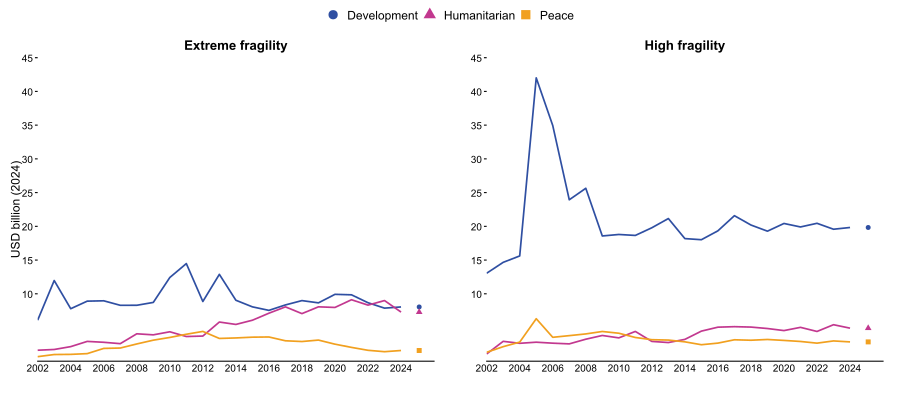
Development assistance is one of several levers that can drive development outcomes, but for contexts exposed to high and extreme fragility, Official Development Assistance (ODA) is critically important – if not for the sustainable development then at least for mitigating the worst impacts of chronic fragility and violence. In this way, ODA through development assistance and humanitarian assistance, is often a baseline for survival. Alongside ODA, levels of Other official flows (OOF), remittances and Foreign direct investment (FDI) to contexts exposed to high and extreme fragility remained broadly stable in the period 2023-24. However, ODA remains an essential lifeline for contexts exposed to extreme fragility, accounting for 65% of external development finance in 2024.
The volume of ODA is falling rapidly, with short- and long-term geopolitical implications. Total ODA from Development Assistance Committee (DAC) members and associates amounted to USD 174.3 billion in 2025 on a grant equivalent basis, a 23.1% decrease over 2024. This is the largest annual contraction on record and a second consecutive year of decline, bringing ODA to where it stood at the start of the 2015. The volume of aid from all donors to contexts facing high and extreme fragility in 2024 was USD 106.2 billion. Within this total, aid from OECD-DAC countries to contexts with high and extreme fragility amounted to USD 44.5 billion, a 3.8% decrease over 2023 and representing 45.5% of DAC members’ country allocable aid. However, the share of their total ODA allocated to these contexts dropped to its third-lowest level in 20 years. Of DAC members’ ODA to contexts with high and extreme fragility in 2024, 27.4% was humanitarian aid, 62.6% was for development and 10% for peace. For the contexts with ongoing humanitarian appeals, the decline in humanitarian funding year on year is the most notable feature of this data. Twelve official providers that are not members of the DAC reported a total of USD 18.3 billion in ODA, reflecting sustained engagement in development co-operation, of which 74% went to contexts experiencing high and extreme fragility.6
Source: OECD 2026
Amidst the global trend of declining ODA, Ukraine, a context with medium exposure to fragility despite over four years of conflict, stands as an outlier.7 Total ODA to Ukraine reached USD 44.9 billion in 2025, an increase of 18.7% compared to 2024. This is the largest volume of ODA to a single recipient in any year on record. Ukraine received more ODA than all least developed countries and countries in sub-Saharan Africa. Sustained cooperation, especially since 2014, has assisted Ukraine not only to maintain essential public services during wartime but also to adapt, innovate and continue pursuing recovery and reform – resilience that has been reflected in the OECD’s multidimensional fragility framework since 2022 (OECD, 2026[37]) (OECD, 2025[38]) (OECD, 2022[24]) (Zykova, 2026[39]).
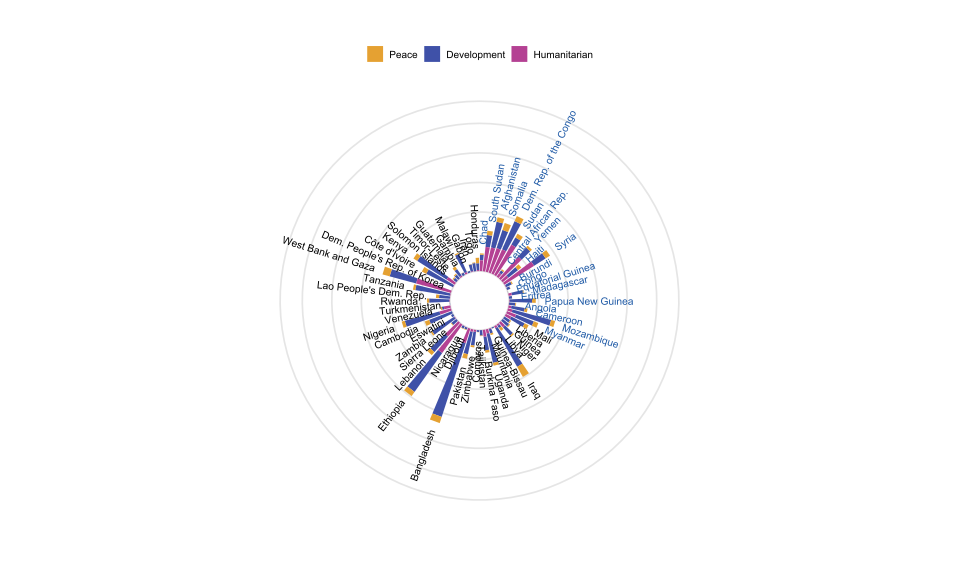
The OECD has consistently highlighted ODA as a crucial and reliable resource for contexts facing fragility, especially extreme fragility, and an indispensable component of their pathway towards sustainable development and peace. Current declines in ODA threaten not only a key source of investment in resilience, adaptation and risk management, but also, in the most extreme cases, an essential buffer against catastrophic outcomes with associated security costs. In countries such as Somalia, South Sudan, Yemen and Afghanistan, development and humanitarian assistance has frequently functioned as a critical lifeline, sustaining basic services, preserving institutional capacity for future opportunities for development and helping avert outright societal and state collapse, even where broader ambitions for peacebuilding, state-building or development were only partially realised. This risk extends well beyond individual countries – the 62 contexts exposed in 2026 to high and extreme fragility – where fragility and conflict often generate regional and international spillovers through insecurity, humanitarian needs and migration pressures. Consequently, growing resilience deficits represent a challenge that security instruments alone cannot address but which some actors are targeting for security purposes through disruption, disinformation, distortion and degradation. ODA has historically not been allocated in proportion to levels of fragility and, in many contexts exposed to high and extreme fragility, has been insufficient in scale and duration to meet the often-unrealistic expectations placed upon it by donors and partners. Yet judging ODA solely by whether it achieves transformational or sectoral change risks overlooking one of its most important contributions in the contexts most exposed to fragility: preventing further deterioration and in some cases collapse. Figure 1 shows that aid allocation and fragility are not correlated.
Note: The order of contexts is the same as for Infographic 1.
Source: (OECD, 2026[40])
Combine security and development concepts of resilience for strategic impact
Facing multipolar competition, Western governments have entered an era of accelerated defence spending. While relevant, an exclusive focus on military capabilities risks treating symptoms while neglecting causes. Fragility analysis consistently demonstrates that instability emerges from interactions between governance failures, economic exclusion, environmental stress, weakened institutions, corruption, injustice and violence. In confronting such instability, military deterrence is vital but conflict prevention should be equally indispensable. The strategic opportunity is to recognise development as a force multiplier for security and shared economic prosperity. Countries with stronger institutions, more effective justice systems, greater economic opportunity and higher social trust are more resistant to conflict, extremism and foreign interference. Development therefore operates as a geopolitical capability rather than being a discretionary expenditure.
This reality presents challenges for a peace and development sector used to operating according to a post-Cold War landscape that allowed for values-led approaches to flourish. Those values must now drive development competitiveness. The policy impulses that push security-exclusive responses to complex challenges unnecessarily constrain the advantages of peace and development approaches: from harnessing the potential of agro-ecological transformation to capital markets transformation for more broadly shared economic security and prosperity (Lazard, 2026[41]). Development and security actors should strive to agree on a shared understanding of resilience that harness their respective strengths.
Prioritise ecological resilience
The global severity of environmental fragility is established as a feature of OECD fragility analysis. Geopolitical competition is increasingly influenced by access to energy, food, water, minerals and critical ecosystems. Climate stress is functioning as a fragility multiplier. Environmental degradation contributes to migration pressures, social tension, economic instability and political unrest. At the same time, competition over resources is becoming a central feature of international relations. Countries that successfully combine environmental regeneration, energy transformation and economic growth will enjoy significant strategic advantages. Ecological resilience is no longer an environmental objective. It is a national security objective. Embedding environmental resilience, energy reform and agro-ecological transformation within national security and foreign policy strategies helps harness the potential of development cooperation.
Establish the geopolitical advantage of development information: Enhance data coverage and open-source analytics as a priority
Fragility cannot be managed if it cannot be understood. Yet global data coverage is deteriorating precisely where risks are greatest. Conflict, political instability, misinformation and AI-generated content are creating a growing "data fog" that obscures emerging threats and weakens decision-making. Shrinking statistical capacity is also emerging as an issue of concern, for example, the financing and institutional base for gender statistics is deteriorating with early evidence pointing to reversals or gaps on survey-based data on violence or household decision-making in contexts experiencing high or extreme fragility. (Cesca, Hedman and Williams, 2026[42]) (UN Women and UNDESA, 2026[43]) Aligned with the tendency for more analysis to be classified or exist behind paywalls, the strategic consequence is dangerous. Governments risk making high-cost decisions using increasingly incomplete information. Data is a political-economic asset. Countries that understand fragility first will respond first. Countries that respond first will shape outcomes. The first step is to strengthen data systems, fragility monitoring, foresight capabilities and shared analysis across governments and partner countries. A new generation of multidimensional fragility analysis has the potential to move beyond snapshots identifying where fragility exists at a particular moment in time, towards understanding how fragility is produced, transmitted and exploited across interconnected systems. The next generation of fragility analysis will need monitor and track systemic pressure points and strengthen understanding of how shocks interact with underlying structural imbalances to travel along faultlines and through transmission channels connecting energy systems, food markets, critical mineral supply chains, migration corridors, financial networks and digital infrastructure.
Building resilience will require the integration of fragility analysis, strategic foresight, systems thinking, scenario planning, political economy analysis and intelligence assessment to better understand transmission pathways, tipping points and cascading effects across interconnected systems. The advantages of such an analytical shift would be considerable. Beyond responding primarily to the consequences of fragility after crises emerge, development, peace and security actors would be better positioned to anticipate risks, identify transmission pathways and target investments that strengthen resilience across multiple sectors simultaneously, including those elements of risk extending to the donor countries themselves.
The central geopolitical challenge of the coming decade is not simply rivalry between states. It is competition between systems that can absorb shocks and those that cannot. If geostrategy determines how power is exercised, resilience determines whether that power can endure. Alternative development models, private capital and security-led approaches all compete to shape influence and partnership choices. Successful geostrategy for donors and partners alike means combining security, economic dynamism, institutional strength, innovation, legitimacy and partnership. The next generation of strategic leadership will be defined by those governments who succeed with that alignment and a securitised approach to international engagement will not be sufficient under these conditions. Rapid rearmament may strengthen deterrence; but deterrence without development will not produce stability. Fragility analysis reveals where system strengths matter most for co-operation. The most effective, credible and legitimate strategy for like-minded donors and partners is one that integrates defence, development, governance and economic statecraft within a common resilience framework.
Prioritise the data coverage and invest in future analytics for better decision making across development peace and security.
Reframe collective understanding of resilience based on systemic interconnectedness beyond exclusively security-based interpretations.
Challenge entrenched development and security cultures to recognise their complementarity and shared interests to respond to the challenges of multidimensional fragility across all dimensions: political, security, economic, societal, human and environmental.
OECD multidimensional fragility dashboard, Multidimensional fragility | OECD
OECD (2025) States of fragility, States of Fragility 2025 | OECD
Contact
DAC INCAF Secretariat - incaf.secretariat@oecd.org
References
[27] ADB (2026), Middle East Conflict: Updated Analysis, https://www.adb.org/sites/default/files/publication/1142926/adb-brief-388-middle-east-conflict-updated-analysis.pdf.
[45] Centeno, M. et al. (2015), The Emergence of Global Systemic Risk, SociologyJulis-Rabinowitz Center for Public Policy & FinancePrinceton School of Public and International Affairs, https://collaborate.princeton.edu/en/publications/the-emergence-of-global-systemic-risk/.
[42] Cesca, C., J. Hedman and L. Williams (2026), ODA for gender equality is plummeting: How can we protect it?, OECD, Paris, https://www.oecd.org/en/blogs/2026/03/oda-for-gender-equality-is-plummeting--How-can-we-protect-it.html.
[9] Davis, E. (2025), Drones and the Changing Character of War, Parameters 55, no. 4 (2025), https://doi.org/10.55540/0031-1723.3369.
[44] Dekker, R. et al. (2018), Smart Refugees: How Syrian Asylum Migrants use Social Media Information in Migration Decision-making, Erasmus University Rotterdam, https://research-portal.uu.nl/en/publications/smart-refugees-how-syrian-asylum-migrants-use-social-media-inform/.
[30] Duvat, V. (2026), Compound Climate Events and Cascading Impacts in the IPCC AR6: Analysis of Gaps and Avenues for the AR7, Wiley Interdisciplinary Reviews: Climate Change, 2026, https://wires.onlinelibrary.wiley.com/doi/pdf/10.1002/wcc.70046.
[26] Famine Early Warning System Network (2026), Gas prices and insecurity worsen food access in Haiti, https://fews.net/latin-america-and-caribbean/haiti/food-security-outlook-update/april-2026.
[25] FAO, OCHA, WFP, WMO (2026), , https://www.unocha.org/publications/report/indonesia/asia-and-pacific-snapshot-el-nino-middle-east-crisis-12-june-2026.
[22] Folke, C. et al. (2010), Resilience thinking: Integrating Resilience, Adaptability and Transformability, Ecology & Society, https://www.jstor.org/stable/26268226.
[13] Greenhill, K. (2010), Weapons of Mass Migration: Forced Displacement, Coercion, and Foreign Policy, Cornell University Press, London.
[12] Greenhill, K. and B. Oppenheim (2017), Rumour has it: The adoption of unverified information in conflict zones, Oxford University Press, U.K., https://www.jstor.org/stable/48539042.
[18] Herrera, F., D. Watson and D. Mia (2026), Mapping Risk and Resilience in the Global Illicit Gold Economy, the International Institute for Strategic Studies, https://www.iiss.org/globalassets/media-library---content--migration/files/research-papers/2026/06/illict-gold/iiss_mapping-risk-and-resilience-in-the-global-illicit-gold-economy_17062026.pdf.
[6] Hoffman, F. (2007), Conflict in the 21st Century: The rise of hybrid wars, Potomac Institute for Policy Studies, Arlington, Virginia, https://potomacinstitute.org/images/stories/publications/potomac_hybridwar_0108.pdf.
[32] IEA (2024), Global Critical Minerals Outlook 2024, International Energy Agency, https://www.iea.org/reports/global-critical-minerals-outlook-2026.
[3] Institute for Economics & Peace (2026), Global Peace Index 2026, Institute for Economics & Peace, Sydney, https://www.economicsandpeace.org/wp-content/uploads/2026/06/Global-Peace-Index-2026-Report.pdf.
[35] IOM (2026), IOM in Syria, https://syria.iom.int/iom-syria.
[28] IPCC (2023), “Section 3”, in Climate Change 2023: Synthesis Report. Contribution of Working Groups I, II and III to the Sixth Assessment Report of the Intergovernmental Panel on Climate Change, IPCC, Geneva, Switzerland, 184 pp., https://doi.org/10.59327/IPCC/AR6-9789291691647.
[23] IRENA (2026), Geopolitics of the Energy Transition, International Renewable Energy Agency, https://www.irena.org/Digital-Report/Geopolitics-of-the-Energy-Transition-Critical-Materials.
[19] Klint, C. (2025), 5 ways businesses can navigate global trade in today’s fragmented geoeconomic landscape, World Economic Forum, https://www.weforum.org/stories/trade-and-investment/5-key-actions-business-fragmented-geoeconomic-landscape/.
[21] Lawrence, M. et al. (2024), Global polycrisis: the causal mechanisms of crisis entanglement, Cambridge University Press, https://www.cambridge.org/core/journals/global-sustainability/article/global-polycrisis-the-causal-mechanisms-of-crisis-entanglement/06F0F8F3B993A221971151E3CB054B5E.
[41] Lazard, O. (2026), 12 Steps to the Electro Union, Norrsken, https://www.norrsken.org/goodnews/twelve-steps-to-the-electro-union.
[31] Lazard, O. and A. Shahid (2026), Ecological Statecraft in the Midst of War: Water, Regeneration, and the Future of Gulf Security, Carnegie, https://carnegieendowment.org/europe/research/2026/05/ecological-statecraft-in-the-midst-of-war-water-regeneration-and-the-future-of-gulf-security.
[11] Obeid, S. (2026), Sudan Wartime Online Propaganda, Ifri Studies, https://www.ifri.org/sites/default/files/2026-04/ifri_el_obeid_sudan_wartime_online_propaganda_2026.pdf.
[8] OCHA (2026), Take fighting and armed drones out of populated areas: appeal to global leaders, United Nations OCHA, https://www.unocha.org/news/take-fighting-and-armed-drones-out-populated-areas-appeal-global-leaders.
[40] OECD (2026), ODA allocations by exposure to fragility.
[37] OECD (2026), Public Governance Review of Ukraine, OECD Publishing, Paris, https://doi.org/10.1787/7810f059-en.
[15] OECD (2026), Resilience, peace and private sector development, OECD, Paris, https://www.oecd.org/content/dam/oecd/en/publications/reports/2026/06/resilience-peace-and-private-sector-development_f508facf/56456759-en.pdf.
[38] OECD (2025), OECD Integrity and Anti-Corruption Review of Ukraine, OECD Publishing, Paris,, https://doi.org/10.1787/7dbe965b-en.
[2] OECD (2025), States of Fragility 2025, OECD, Paris, https://www.oecd.org/en/publications/states-of-fragility-2025_81982370-en.html.
[24] OECD (2022), States of Fragility 2022, OECD, Paris, https://www.oecd.org/en/publications/states-of-fragility-2022_c7fedf5e-en.html.
[14] OECD (forthcoming), Building resilience through support to core economic systems and functions.
[1] OECD (forthcoming), Rethinking transitions: International support to post-conflict and transition contexts.
[16] Ranger, N., O. Mahul and I. Monasterolo (2021), Managing the financial risks of climate change and pandemics: What we know (and don’t know), https://www.sciencedirect.com/science/article/pii/S259033222100539X.
[17] Rozkrut, M. (2025), Why the shadow economy persists and how governments are responding, EY, https://www.ey.com/en_gl/insights/tax/why-the-shadow-economy-persists-and-how-governments-are-responding.
[20] Tooze, A. (2022), Welcome to the World of the Polycrisis, Financial Times, https://www.ft.com/content/498398e7-11b1-494b-9cd3-6d669dc3de33.
[5] UN (2026), Crisis and emergency response, United Nations, https://www.un.org/en/global-issues/crisis-and-emergency-response.
[34] UN (2025), Syrian Arab Republic Humanitarian Overview, UN OCHA, http://large-scale return movements risk overwhelming local absorption capacity where housing, services, documentation and property-resolution mechanisms remain weak.
[33] UN (2025), Syrian Arab Republic: Humanitarian Overview, UN OCHA, https://www.unocha.org/publications/report/syrian-arab-republic/syrian-arab-republic-humanitarian-overview-issue-no-2-november-2025.
[43] UN Women and UNDESA (2026), Progress on the Sustainable Development Goals: The Gender Snapshot 2026, UN Women and UNDESA, New York, https://unstats.un.org/sdgs/gender-snapshot/2026/.
[4] UNHCR (2026), Figures at a glance, United Nations High Commissioner for Refugees, https://www.unhcr.org/about-unhcr/overview/figures-glance.
[10] UNHCR (2024), Press Release - Trust the Toucan Anniversary, UNHCR, Panama, https://data.unhcr.org/fr/documents/details/108396.
[7] Weissmann, M. (2021), Hybrid threats and hybrid warfare : time for a comprehensive approach?, https://www.academia.edu/115051864/Hybrid_threats_and_hybrid_warfare_time_for_a_comprehensive_approach.
[29] WMO (2026), El Niño set to become very strong, raising risks of extreme weather into 2027, World Meterological Organisation, https://wmo.int/news/media-centre/el-nino-set-become-very-strong-raising-risks-of-extreme-weather-2027.
[36] World Bank (2025), Syrias post-conflict reconstruction costs estimated at $216 billion, World Bank Press Release, https://www.worldbank.org/en/news/press-release/2025/10/21/syria-s-post-conflict-reconstruction-costs-estimated-at-216-billion.
[39] Zykova, O. (2026), Olga Zykova at the OECD conference: For Ukraine, security and development are inseparable elements of national resilience, Ministry of Finance of Ukraine, https://mof.gov.ua/en/news/olga_zykova_at_the_oecd_conference_for_ukraine_security_and_development_are_inseparable_elements_of_national_resilience-5723.
← 1. The OECD applies the term “context” to allow for analysis of territories not officially recognised as states as well as for more adaptable analysis of fragility in all its presentations from subnational to global levels.
← 2. The data currently available for the West Bank and Gaza Strip do not yet fully capture the impact of the conflict in Gaza. This impact is expected to be better reflected in the next data cycle, which will inform the States of Fragility 2028 report. In addition, data meeting the requirements of the States of Fragility analytical framework are available only at the aggregate level, covering the West Bank and Gaza Strip together, rather than as separate geographical areas.
← 3. The initial impact of the overthrow of the Baathist regime in Syria at the end of 2024 has yet to be captured by the available data.
← 4. Systemic faultlines and transmission channels are distinct concepts. A faultline is a latent vulnerability within a system: a hidden pressure point, such as an overstretched reception system, weak border governance, polarised politics or a population lacking reliable information, that may hold under normal conditions but is liable to fail when stressed. A transmission channel is the pathway along which a shock travels and is propagated, whether a smuggling network, a social media rumour, a drone-enabled coercive operation or a contested border crossing (Dekker et al., 2018[44]). The distinction matters analytically because the two answer different questions: faultlines show where a system is likely to fail, while channels show how, how fast and how far a failure will spread. It also matters for policy. Reducing a faultline, for example by strengthening reception capacity or improving the quality of information available to displaced people, lowers a system's underlying exposure, whereas disrupting or monitoring a channel limits the reach of a shock that has already been triggered. This is especially important where actors deliberately engineer crises, since a modest provocation delivered through a well-chosen channel can produce disproportionate effects wherever it meets an unaddressed faultline, a dynamic that remains difficult to attribute or predict without better data coverage and open-source analytics. It also informs understanding of structural, systemic and dynamic presentations of fragility (Centeno et al., 2015[45]).
← 5. The WMO has characterized the scientific consensus regarding the persistence and intensification of the event as unusually strong, reflecting a rare degree of agreement across global forecasting systems (WMO, 2026[29]).
← 6. All data cited in this section is from 2024 except for one application of preliminary data from 2025. Preliminary ODA data are released by the OECD each April and cover only aggregate level data reported by providers. The detailed data will be released in December 2026.
← 7. Ukraine’s continued categorisation as being exposed to medium levels of fragility reflects the strength of its performance on resilience indicators across all dimensions of the fragility framework, that contextualise its exposure to severe levels of security fragility. This resilience correlates strongly with the levels and distribution of ODA to Ukraine since the start of Russia’s armed aggression, but it should also be noted that the levels of resilience are steadily declining across many indicators as the extended toll of conflict takes effect.