This chapter examines how the HR function is organised in France and how responsibilities are distributed across stakeholders. It focuses on key areas most affected by ongoing transitions, including leadership management, recruitment, learning and development, and strategic workforce planning.
Developing a Resilient HR Function in the French Public Service
Addressing Digital, Ecological and Managerial Change

Abstract
In the public service context, human resource management (HRM) extends far beyond dedicated HR departments. A wide range of actors are involved in HRM to varying degrees, including public servants, managers at all levels (executive, middle and local managers (DGAFP, 2023[1])), public employers, trade unions and central administrations. This underscores the shared nature of responsibility for management of public servants, requiring clear co-ordination to ensure consistent and coherent practices.
Within this ecosystem, the “HR function” plays a central role in organising a shared approach to workforce management. For methodological purposes, the OECD defines the HR function as encompassing the actors responsible for the activities, policies and processes related to the management, development and optimisation of an administration’s human capital (Box 1.1).
In this project, the human resources (HR) function is defined as encompassing public servants within the State public service (excluding public institutions [établissements publics]) whose primary responsibilities relate to HRM. This includes staff within the DGAFP, HR departments in central and decentralised administrations, and supporting services, such as the plates-formes régionales d’appui interministériel à la GRH (Regional inter-ministerial support platforms for HRM, PFRH). The HR function also includes managers, insofar as they perform HR missions.
The HR function can be considered from different perspectives, ranging from a holistic view to a more narrowly defined approach. A broader definition extends to all stakeholders involved in HRM, including public servants themselves, as actors in their own careers and, thus, indirectly, in HRM.
A more restrictive approach limits the HR function to institutional actors with direct responsibilities for the management, development and optimisation of human capital in public administrations. Under this definition, the HR function comprises central administrations responsible for the public service, HR departments within central and decentralised administrations, and, to a certain extent, managers, notwithstanding the fact that they do not report directly to HRM services. For the purposes of analysis, comparability and the formulation of recommendations, this report adopts this more restrictive definition.
The HR function therefore encompasses a wide range of actors with varying degrees of HRM-related responsibilities. The multiplicity of actors reflects the complexity of modern public service organisations and makes strengthened co-ordination and effective collaboration all the more essential to ensure the coherence of HR policies. Without such dialogue, the risk of siloed management and fragmented initiatives can undermine the overall effectiveness of HR actions and the experience of public servants.
Within the public service, HRM relies on governance structures that balance centralisation, to ensure standardisation, with delegation to individual ministries, departments or operators, to promote flexibility. This evolution underscores the growing role of HR as a driver of organisational success, extending far beyond its traditional operational support function. Among EU and OECD Member countries, various public service HRM models coexist (Figure 1.1) (OECD, 2025[2]). For example, Nordic public service systems, particularly in Denmark and Norway, are characterised by a high degree of delegation of HRM practices. In other countries with more centralised governance, HRM practices tend to be more centralised. The French public service is in line with the OECD average and seeks to achieve a balance between these two extremes.
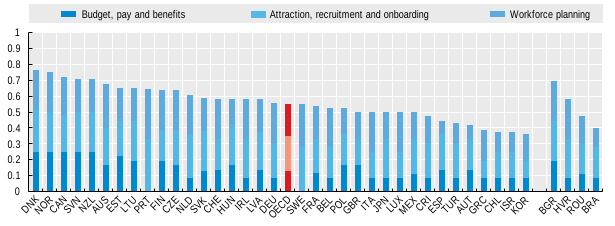
Note: Preliminary data. The index of delegation ranges from 0 (no delegation) to 1 (high level of delegation) and is composed of the following variables: the existence of a central HRM body; the extent of delegation in relation to financial and budgetary decisions; attraction, recruitment and onboarding; and workforce planning decisions. Data for Colombia, the United States, Iceland, and Japan are not available.
Source: OECD (2025), Government at a Glance.
However, differences in the degree of delegation of HRM practices across inter-ministerial, ministerial and administration levels should be interpreted with caution. For example, even some countries with relatively decentralised HRM models may choose to centralise certain HR tasks. Furthermore, responsibility for HR tasks is often shared among several actors within the HR function, operating at different levels. In most EU and OECD Member countries with a career-based public service, the inter-ministerial level is generally responsible for steering most HRM policies, while ministries are responsible for their implementation on the ground. In theory, this makes it possible to develop a comprehensive overview of HRM, while implementing policies at the operational level tailored to the specificities of each context.
A comprehensive mapping of the HR function in the public service therefore requires a more detailed analysis of the roles and responsibilities of the various HR actors in relation to each HR task. This mapping exercise is particularly complex given the broad scope of public service HRM missions. These can be grouped into four key dimensions:
Strategic direction, including the definition of policy guidance across all areas of the HR function, social dialogue with trade unions, leadership missions and management (senior public service leaders [cadres dirigeants] and local management), strategic workforce planning (gestion prévisionnelle des effectifs, des emplois et des compétences, GPEEC), and foresight. This dimension aims to anticipate, steer and respond to organisational changes, and to structure HR in line with the needs of the State;
Attractiveness and recruitment, through policies on attractiveness, recruitment processes and retention efforts. This dimension aims to ensure that the public service can attract the profiles it needs to fulfil its missions and adapt to transitions;
Career development, through mobility, learning and development, performance management and promotion. This dimension aims to ensure that public servants have opportunities to develop and progress in their careers, while remaining up to date with the skills required for their work;
Working environment, through working conditions, social welfare, occupational health and safety, strengthening employee engagement, and administrative management. This dimension aims to ensure that public servants have the means to perform effectively and engage, in favourable working conditions.
1.3.1. Priority roles of the HR function in supporting transitions
Public administrations today are facing major transitions, sometimes described as megatrends. These megatrends are characterised by their profound, global and long-lasting nature, affecting most organisations (Naisbitt, 1982[3]). The digital transition is transforming ways of working, user service delivery and expectations regarding the responsiveness of administrations, as well as the simplification and monitoring of procedures. The green transition is forcing administrations to rethink their policies, practices and missions in light of sustainability objectives and adaptation to climate change. The managerial transition is redefining governance and steering practices, as well as workplace relations. Other transitions such as the demographic transition, while outside the scope of this report, are also changing the public service as a whole. Together, these transitions are profoundly reconfiguring the operation and priorities of public policy.
These major transitions also affect the HR function. As a strategic steering function, it is not only affected by these transitions but is also a key lever in responding to them. These transitions are transforming the very nature of HR missions, while strengthening their role in policy adaptation (Figure 1.2).
The various HR roles are affected differently by the major transitions underway. For example, the digital transition is redefining required skills and accelerating the pace of organisational change, while prompting a review of processes. The green transition is forcing administrations to integrate new expertise and strengthen their adaptive capacity. Lastly, the managerial transition is intensifying leadership challenges in the public service, requiring management of an increasingly diverse workforce in a more complex environment, while steering change.
Together, these evolutions place certain HR roles at the centre of adaptation strategies, making their modernisation a priority to ensure that public administrations are able to meet citizens’ expectations. In this context, leadership management, attractiveness and recruitment, strategic workforce planning, and learning and development emerge as the dimensions most directly affected by the three major transitions. Other HR tasks and activities are also affected, but their exposure to these transitions may be less immediate or less pronounced.

Source: Authors’ elaboration.
In France, the structure of these missions draws on a rich and diverse ecosystem, which is both a strength and a challenge (Table 1.1). Inter-ministerial steering of the HR function, mainly led by the DGAFP, provides a common framework and shared tools, such as job and competency frameworks, the master plan for lifelong professional training for State employees, and multi-year strategic guidance. Ministries retain a high degree of autonomy in the practical implementation of this guidance and its adaptation to the specific characteristics of their professions, notably through ministerial management guidelines. This interplay between the comprehensive overview and ministerial ownership is essential in such a vast and diverse public service, but it requires close collaboration between the various levels of responsibility.
In this context, the proliferation of tools and mechanisms at the inter-ministerial level raises questions about their effective ownership and their actual impact on administrations’ HR practices. The use of cross-government tools remains difficult to track and their contribution to the transformation of HR processes and cultures appears uneven. Strengthening the monitoring, evaluation and support of HR function actors is key to enhancing the effectiveness of approaches aimed at supporting major transitions.
Summary overview analysed in the following section
Source: Authors’ elaboration.
1.3.2. Leadership management
Management, as a key actor within the HR function and a primary channel for policy implementation, is on the front line of the major transitions. Three evolving levels of management can be distinguished:
Top management, or executive management, is responsible for defining and steering overall strategy. Its remit is expanding to include complex issues such as sustainability, innovation and digital transformation. It increasingly embodies the values and objectives of the administration, requiring inspirational leadership skills. For international comparison purposes, this corresponds to D1 positions (OECD, 2021[4]).1
Middle management, the interface between strategy and implementation, is responsible for cross-functional co-ordination, breaking down organisational silos and promoting inter-departmental collaboration to support change. For international comparison purposes, this corresponds to D2 positions.2
Local management, in direct contact with teams, is evolving from a primarily organisational role to that of team leader, focused on inclusive and motivating work environments, quality of working life, and individual support for public servants. For international comparison purposes, these are D3 and D4 positions.3
Use of the related term “senior public service” (haute fonction publique) varies across EU and OECD Member countries. In 51% of Member countries, the senior public service is understood to include only D1 and D2 public servants. However, nearly 20% of Member countries also include D3 and D4 managers in their definition of the senior public service. These differing definitions have significant implications for workforce management, given the varying operational realities and the size of the cohort concerned.
More generally, management of D1 and D2 managers tends to be differentiated from that of D3 and D4 managers. For example, 51% of OECD Member countries have a central administration or unit responsible for managing the recruitment and careers of senior public service leaders (OECD, 2021[4]). Such units enable overall management of senior public servants, better organisation of inter-ministerial mobility, development of a managerial culture based on common principles, and more strategic management of the senior public service leader talent pool. These units often closely liaise with public administrations and their HR departments to ensure alignment between the profiles of senior public service leaders drawn from the talent pool and the needs of the administration. Thus, while 46% of OECD Member countries have at least one central unit that manages the recruitment of senior public service leaders, 43% of these countries involve the relevant ministries or agencies (OECD, 2024[5]).
However, many EU and OECD Member countries continue to adopt a ministerial approach to the management of local managers, with mechanisms that vary in their degree of structuring across administrations. While this ministerial approach reflects the diversity of administrative cultures and organisational priorities, it also leads to marked disparities in recruitment, training and support practices. In some cases, it may limit the dissemination of a common skills baseline, thereby weakening overall system coherence.
In France, leadership management is based on an HR framework structured around several actors with distinct but complementary responsibilities. This framework was revised for top management (encadrement supérieur) following the State public service top management reform initiated in 2021 (Table 1.2).
Source: Authors’ elaboration.
Thus, leadership management in the French government, particularly for top management, is underpinned by a clearly structured framework. For top managers (cadres supérieurs), this framework aims to promote coherence in career paths and complementarity across interventions at each stage of their careers. The reform of the senior public service strengthened this co-ordination by establishing common foundations, including the inter-ministerial corps of State administrators, inter-ministerial management guidelines and shared competency frameworks. These elements form a unified baseline that can reconcile whole-of-government requirements with the specific characteristics of each ministry. In addition, the creation of the DIESE is intended to ensure smoother management of top managers’ career paths.
Despite these advances, co-ordination among the multiple actors responsible for leadership management remains challenging, notably due to the diversity of practices, levels of HR maturity, and ministerial cultures. At present, there is no fully integrated, system-wide approach to management. Existing mechanisms tend to focus on senior public service leaders, neglecting a systematic approach to middle and local managers. This lack of structured support raises questions about their effective development, beyond the mere provision of tools. Indeed, the effective implementation of shared tools depends heavily on ministries’ capacity to appropriate their objectives and adapt them in a coherent manner. Furthermore, harmonisation between ministerial and inter-ministerial levels requires sustained co-ordination efforts by ministries, the DGAFP and, in the case of senior public service leaders, the DIESE. It calls for professionalisation of the HR function, particularly within ministries, which are required to ensure both strategic steering and operational support for leadership at all levels. Finally, the dissemination of a whole-of-government management culture and tools to the managers concerned may be uneven, particularly in administrations with a strong ministerial administrative culture. These challenges underscore the importance of sustained dialogue between the various HR actors and continued investment in support capacities, particularly for local and middle managers, whose role is decisive in driving transformations.
1.3.3. Recruitment
Responsibility for the recruitment of public servants varies across OECD Member countries. In more than half of Member countries, recruitment is carried out solely by the administrations concerned (51%) (OECD, 2024[5]). However, nearly 23% of countries have adopted a process that involves both a central body and the relevant administration. Countries following this approach, such as France, often have career-based public service systems, in which recruitment processes are relatively standardised across the public service as a whole. In a large majority of OECD Member countries (71%) the recruitment of contractual staff or temporary public servants is entirely the responsibility of the relevant administrations. Importantly these recruitment processes generally involve close co-ordination between finance ministries, which are responsible for defining the budgetary envelopes for each administration; inter-ministerial bodies, which identify and structure responses to major cross-cutting policy priorities; and the administrations responsible for implementing these policies on the ground. It is also essential to develop a clear policy for the management of contractual staff, an area of public HRM that often remains overlooked across EU and OECD Member countries.
In France, the organisation of the recruitment function in the State public service is based on a structure shared between inter-ministerial and ministerial actors (Table 1.3).
Source: Authors’ elaboration.
Co-ordination of the various actors involved at each stage of the recruitment process is therefore key to ensuring the effectiveness and clarity of recruitment procedures in the French public service. The recruitment chain is currently based on formalised procedures and shared tools (methodological guides, practical information sheets, inter-ministerial frameworks). This structuring is intended to ensure a clear allocation of roles between inter-ministerial bodies, HR departments, selection panels and managers, within a public service that remains career-based but is increasingly open to contractual workers. When responsibilities are clearly defined and tools are well understood, processes can be more responsive, while ensuring fair treatment of applications.
However, co-ordination among actors, both across and within structures, can be complex to implement in practice. For example, interactions between different HR actors can lead to poorly synchronised validation steps or duplication, potentially leading to longer recruitment timelines. In particular, the calculation of remuneration of a future contractual employee involves HR departments, financial departments, and the budget and accounting controller attached to the Ministry of Finance. This process is further complicated by the variety of entry routes into the public service, which require HR professionals to regularly update their knowledge in order to use them strategically in a context of attractiveness challenges. Finally, these difficulties can be exacerbated by disparities in practices among ministries. For example, the level of remuneration depends in part on a compensation scheme, the amount of which varies from one administration to another. While some of these variations have been reduced by the introduction in 2014 of a compensation scheme linked to duties, constraints, expertise and professional commitment of public servants (régime indemnitaire tenant compte des fonctions, des sujétions, de l’expertise et de l’engagement professionnel des fonctionnaires de l’État, RIFSEEP), differences remain. These factors point to the need for gradual convergence towards shared standards, without disregarding the specific characteristics of each ministry, by strengthening support for HR professionals and alignment between the different levels of actors.
1.3.4. Learning and development
Responsibility for learning and development is highly fragmented across most EU and OECD Member countries. In 78% of OECD Member countries, each ministry is responsible for structuring and organising its own training programmes (OECD, 2023[7]). In addition, 51% of OECD Member countries have a government training school that provides additional training, and 49% have a ministry or agency dedicated solely to training, particularly for public servants.
These different actors are often complementary, performing distinct but interconnected functions. Ministries, which are closest to operational needs, ensure the practical implementation of training priorities in line with the specificities of their missions and operating contexts. This makes it possible, in particular, to adapt training content to technical and strategic developments in their missions and to meet the expectations of employees and their managers. At the same time, inter-ministerial training schools and agencies perform a cross-functional role. They contribute to promoting a shared culture within the public service by offering training on cross-cutting issues such as management. This dual approach, both sectoral and cross-functional, helps to reconcile professional realities with a shared public service culture. However, it must be accompanied by co-ordination, generally provided by central bodies that oversee the alignment of mechanisms with whole-of-government priorities, while promoting educational innovation and the pooling of resources.
In France, Article L. 421-1 of the General Public Service Code (code général de la fonction publique) recognises the right of public servants to lifelong professional training. This is structured around several HR function actors (Table 1.4).
Source: Authors’ elaboration.
The French ecosystem for learning and development, while highly diverse, shows a certain degree of structuring. Inter-ministerial co-ordination by the DGAFP through the master plan for lifelong professional training for State employees makes it possible to identify cross-cutting priorities, setting out the main areas for skills development aligned with the career paths described and the emerging needs of the public service. The green, digital and managerial transitions are now clearly identified as priorities and guide the adaptation of training plans at ministerial level. Ministries can draw on this shared framework to structure their training offer, while adapting their mechanisms to the specific requirements of their professions.
However, such a diverse system can be difficult for public servants to navigate. Effectively recognising and leveraging training within career management remains a significant challenge. From an administrative perspective, the outcomes of participation to learning and development are not always clearly integrated into evaluation or promotion processes. Furthermore, freeing up time to allow public servants to undertake training requires managers to make organisational trade-offs. In addition, the proliferation of digital platforms (Mentor, Safire, ministerial platforms, etc.) may dilute the information available to public servants, potentially hindering their participation in relevant training courses. This also limits the capacity of information systems to monitor training provision, participation and results. The coexistence of multiple tools, sometimes lacking interoperability, can therefore limit administrations’ capacity to effectively steer learning pathways.
1.3.5. Strategic workforce planning
Strategic workforce planning is essential for anticipating changes in the public service. It enables better forecasting and responses to evolving missions and the major transitions that are transforming the public service. It relies on forward-looking analysis tools, reliable data and specific skills. When integrated across the HR function, it makes it possible to link an overall strategic vision to personnel management, by identifying needs in recruitment, mobility, retraining for redeployment and learning and development.
However, strategic workforce planning remains difficult to implement in OECD Member countries. Only 20% involve both a central HR administration and ministries in the development of strategic workforce management plans. In 40% of cases, this responsibility lies solely with ministries, and in 17% solely with central HR administrations (OECD, 2024[5]). This reflects a limited capacity to develop a comprehensive vision and strategy to effectively address future HR challenges.
In France, as with most other HR processes, strategic workforce planning involves shared responsibilities at inter-ministerial, ministerial and local levels (Table 1.5).
Source: Authors’ elaboration.
In theory, this structuring allows for better anticipation of changes in the public service, while taking account of sectoral and local realities. This approach is intended to support a multi-year assessment of HR needs, incorporating both qualitative data (missions, professions, skills, etc.) and quantitative data (headcounts, budgets, employment ceilings). The diversity of actors and levels of intervention requires close institutional collaboration, based on clearly defined processes and shared tools. This is the objective of tools such as the Public Service Job Profiles Directory (Répertoire des métiers de la fonction publique, RMFP) and the Inter-ministerial Dictionary of State Skills (Dictionnaire interministériel des compétences de l’État, DiCo), which aim to foster strategic workforce planning based on professions and skills rather than statutory provisions.4
In practice, implementation of these tools and this vision remains uneven. Strategic workforce planning is often perceived as an additional HR task, with limited resources allocated to it. This constrains the public service’s capacity to anticipate changes and needs, forcing it to be constantly reactive. Furthermore, the inter-ministerial HR information system (HRIS) RenoiRH, developed by the Inter-ministerial Centre for Human Resources IT Services (Centre interministériel de services informatiques relatifs aux ressources humaines, CISIRH), is not yet used across all public administrations, making it more difficult to conduct strategic workforce planning based on easily accessible shared data. Finally, at the regional level, PFRHs remain dependent on the relevant central administrations for data, and implementation of ambitious strategic workforce planning would require the public servants involved in the collection, processing and analysis of such data to upgrade their skills, in a context of budgetary constraints (OECD, 2023[8]).
References
[1] DGAFP (2023), “La transition managériale au regard de l’évolution des attentes des agents publics”, Conseil d’orientation des politiques de ressources humaines.
[6] DGAFP (2021), Structurer la fonction Recrutement, https://www.fonction-publique.gouv.fr/files/files/publications/publications-dgafp/guide_structurer_la_fonction_recrutement.pdf.
[3] Naisbitt, J. (1982), Megatrends: Ten New Directions Transforming Our Lives.
[2] OECD (2025), Government at a Glance 2025, OECD Publishing, Paris, https://doi.org/10.1787/0efd0bcd-en.
[5] OECD (2024), Survey on Public Service Leadership and Capability.
[7] OECD (2023), Public Employment and Management 2023: Towards a More Flexible Public Service, OECD Publishing, Paris, https://doi.org/10.1787/5b378e11-en.
[8] OECD (2023), “Strengthening the attractiveness of the public service in France: Towards a territorial approach”, OECD Public Governance Policy Papers, No. 28, OECD Publishing, Paris, https://doi.org/10.1787/ab9ebe85-en.
[4] OECD (2021), Public Employment and Management 2021: The Future of the Public Service, OECD Publishing, Paris, https://doi.org/10.1787/938f0d65-en.
← 1. D1 managers are senior public servants just below the minister, secretary of State or minister delegate. They advise government on policy matters, oversee the interpretation and implementation of government policies and, in some countries, have executive powers.
← 2. D2 managers are just below D1 managers. They formulate and review policies, and plan, direct, co-ordinate and evaluate the overall activities of the ministry or special directorate/unit, with the support of other managers.
← 3. D3 managers plan, direct and co-ordinate the general functioning of a specific directorate/administrative unit within the ministry with the support of other managers usually within the guidelines established by a board of directors or a governing body. They provide leadership and management to teams of professionals within their particular area. D4 managers formulate and administer policy advice, and strategic and financial planning. They establish and direct operational and administrative procedures, and provide advice to top managers. They provide leadership to specific professional teams within a unit.
← 4. In France, the statutory framework (“statut de la fonction publique”) applies specifically to civil servants (fonctionnaires) and defines their rights and obligations, career structures, recruitment modalities (notably through competitive examinations), and employment conditions. While this statutory system underpins workforce management for civil servants through centrally defined rules, a significant share of the broader public workforce is composed of contractual staff (contractuels), who are employed under labour-law-based arrangements rather than the civil service statute.